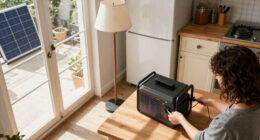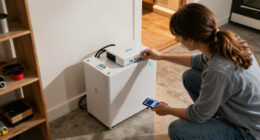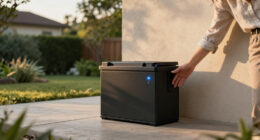
For a flexible home backup setup, I’d start with the BLUETTI Elite 100 V2 bundle: its 1,024Wh power station and included 200W panel balance useful storage with a manageable solar input. The EF ECOFLOW DELTA 3 Max pairs a larger 2,048Wh battery with a 400W panel, while the Jackery Explorer 300 is a simpler fit for smaller loads and shorter outages. The main tradeoff is between portability and the capacity needed to run more demanding devices or last through longer cloudy stretches. Bundles also vary in panel size, so the station’s battery capacity alone does not tell you how quickly you can recharge it. Read on for the full breakdown and picks by backup need.

Get backup power and energy gear delivered free with Prime
- Fast, free delivery on millions of items
- Prime Video, Amazon Music and more included
- Member-only deals all year
Complete the kit


Key Takeaways
- The BLUETTI Elite 100 V2 bundle is the balanced pick: it combines 1,024Wh of storage with a 200W panel, giving buyers a more substantial backup setup than the compact 111Wh and 292Wh options.
- Solar input changes the backup equation: the DELTA 3 Max includes a 400W panel for its 2,048Wh station, while the 2,000Wh Jackery Explorer 2000 v2 bundle has two 200W panels.
- Small stations suit small loads: the MARBERO M82MAX and Jackery Explorer 300 are easier to carry, but their 111Wh and 292Wh capacities call for selective device use.
- Large capacity brings a portability tradeoff: the Jackery HomePower 3600 Plus and EcoFlow Delta Pro are aimed at more demanding backup needs, but their size and setup demands matter more than they do with compact kits.
- A panel kit is not a complete backup system: the DOKIO 300W foldable panel kit includes a charge controller, but buyers still need a compatible power station or battery to store energy for later.
| BLUETTI Elite 100 V2 Solar Generator with 200W Panel, 1024Wh |  | Best for Home Backup | Battery capacity: 1024Wh | Battery type: LiFePO₄ | Continuous AC output: 1800W | VIEW LATEST PRICE | See Our Full Breakdown |
| Jackery Explorer 300 Portable Power Station with 40W Solar Panel, 292Wh |  | Best Compact Kit | Battery capacity: 292Wh | Peak output: 600W | Battery chemistry: LiFePO₄ | VIEW LATEST PRICE | See Our Full Breakdown |
| MARBERO M82MAX 111Wh Portable Power Station with 30W Solar Panel |  | Best for Ultralight Loads | Battery capacity: 111Wh | Battery type: Lithium-ion | AC output: 80W continuous, 120W peak | VIEW LATEST PRICE | See Our Full Breakdown |
| DaranEner 300W Portable Power Station with 30W Solar Panel |  | Best Small LiFePO₄ Backup | Battery capacity: 192Wh | Battery type: LiFePO₄ | Continuous output: 300W | VIEW LATEST PRICE | See Our Full Breakdown |
| ZeroKor 300W Portable Solar Generator with 60W Solar Panel | 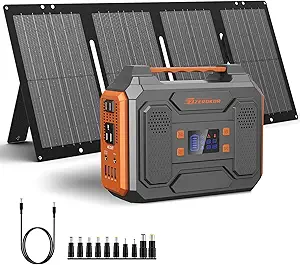 | Best Included Panel for Small Loads | Power output: 300W | Solar panel power: 60W | Solar panel type: Monocrystalline | VIEW LATEST PRICE | See Our Full Breakdown |
| Jackery HomePower 3600 Plus Portable Power Station with Two 200W Solar Panels |  | Best for Whole-Home Backup | Battery capacity: 3,584Wh | Output: 3,600W | Battery type and cycle life: LFP; rated for 6,000 cycles | VIEW LATEST PRICE | See Our Full Breakdown |
| EF ECOFLOW DELTA 3 Max Portable Power Station with 400W Solar Panel, 2048Wh |  | Best for Fast-Recharging Backup | Battery capacity: 2,048Wh | Battery type: LiFePO4 | Included solar panel: 400W | VIEW LATEST PRICE | See Our Full Breakdown |
| Jackery Explorer 2000 v2 Portable Power Station with Two 200W Solar Panels |  | Best for a Balanced Solar Kit | Battery capacity: 2,042Wh | AC output: 2,200W | Battery type: LiFePO4 | VIEW LATEST PRICE | See Our Full Breakdown |
| Jackery Solar Generator 1000 v2 with 200W Solar Panel |  | Best Compact Backup Kit | Battery capacity: 1,070Wh | Battery type: LiFePO4 | AC output and surge: 1,500W; 3,000W surge | VIEW LATEST PRICE | See Our Full Breakdown |
| DOKIO 300W Portable Foldable Solar Panel Kit with Charge Controller |  | Best Panel for Existing 12V Setups | Maximum power: 300W | Maximum voltage: 18V | Amperage capacity: 16.67A | VIEW LATEST PRICE | See Our Full Breakdown |
| EcoFlow Delta Pro Solar Generator 3.6 kWh with 400W Foldable Solar Panel |  | Best for High-Demand Backup | Battery capacity: 3,600 Wh | Continuous output: 3,600 W | Surge power: 4,500 W | VIEW LATEST PRICE | See Our Full Breakdown |
| portable solar panels for backup power | Battery capacity | Weight | Battery type |
|---|---|---|---|
| BLUETTI Elite 100 V2 Solar Gen | 1024Wh | — | LiFePO₄ |
| Jackery Explorer 300 Portable | 292Wh | 12.9lb | — |
| MARBERO M82MAX 111Wh Portable | 111Wh | — | Lithium-ion |
| DaranEner 300W Portable Power | 192Wh | 5.8lb | LiFePO₄ |
| ZeroKor 300W Portable Solar Ge | — | — | — |
| Jackery HomePower 3600 Plus Po | 3,584Wh | 77.2 lb | — |
| EF ECOFLOW DELTA 3 Max Portabl | 2,048Wh | — | LiFePO4 |
| Jackery Explorer 2000 v2 Porta | 2,042Wh | 39.5 lb for power station; 66.8 lb listed item weight | LiFePO4 |
| Jackery Solar Generator 1000 v | 1,070Wh | 23.8 lb | LiFePO4 |
| DOKIO 300W Portable Foldable S | — | 15.2 lb | — |
| EcoFlow Delta Pro Solar Genera | 3,600 Wh | 35.3 lb (16 kg) | — |
More Details on Our Top Picks
BLUETTI Elite 100 V2 Solar Generator with 200W Panel, 1024Wh
The BLUETTI Elite 100 V2 is the strongest fit here when backup power needs to cover more than phones and lights. Its 1024Wh LiFePO₄ battery and 1800W continuous output can support many everyday appliances, while the included 200W panel gives it a more substantial solar starting point than the smaller kits from Jackery and DaranEner. The 10ms UPS switchover also suits sensitive electronics during an outage. Its tradeoff is portability: at this capacity, it is less of a grab-and-go option than the 12.9-pound Jackery Explorer 300. Solar setup also takes coordination because the panel ships separately, and the 200W panel is only one part of a system that accepts up to 1000W solar input.
Pros:- 1024Wh LiFePO₄ battery and 1800W continuous output support more than small electronics
- Included 200W solar panel provides more collection capacity than the 30W and 40W kits in this batch
- 10ms UPS switchover helps keep sensitive electronics powered through an interruption
- Quiet 30dB operation is better suited to indoor backup and nighttime use
Cons:- The solar panel ships separately, which can delay a complete setup
- Larger capacity makes it less convenient to carry than compact options such as the Jackery Explorer 300
- The included 200W panel is below the station’s stated 1000W maximum solar input
Best for: Households seeking a quiet, mid-capacity backup station for electronics and everyday appliances, with room to add stronger solar input
Not ideal for: Travelers who prioritize low weight and compact packing, or buyers who need the included panel to ship and arrive with the power station
- Battery capacity:1024Wh
- Battery type:LiFePO₄
- Continuous AC output:1800W
- Peak output:2700W
- Included solar panel:200W
- Maximum solar input:Up to 1000W
- UPS switchover:10ms
- Noise level:30dB
- Battery cycle life:More than 4000 cycles to 80% capacity
Our verdict“Choose the BLUETTI if household backup capacity and UPS support matter more than keeping the kit lightweight.”
Jackery Explorer 300 Portable Power Station with 40W Solar Panel, 292Wh
For buyers who need a portable kit for modest loads, the Jackery Explorer 300 balances 292Wh capacity with a 12.9-pound station and an included 40W panel. That makes it easier to move and pack than the BLUETTI Elite 100 V2, though the difference in capacity and output means it is aimed at a narrower set of backup jobs. Its 300W rated output can handle small electronics and selected low-wattage devices, not typical high-draw appliances. The panel is a useful way to recharge off-grid, but its stated charge time—about 7.5 hours to reach 80%—makes it a slow recovery option when power use is frequent. I’d pick it for portability and useful capacity, not fast solar replenishment.
Pros:- 292Wh capacity offers more reserve than the 111Wh MARBERO M82MAX
- 12.9-pound weight is manageable for a portable station
- 40W solar panel is included for off-grid recharging
- LiFePO₄ battery is rated for more than 4000 cycles to 70% capacity
Cons:- 300W rated output excludes many household appliances
- The 40W panel is slow, with an estimated 7.5 hours to reach 80% charge
- Station and panel may ship separately
Best for: Campers and car travelers who want a carryable station for phones, laptops, lights, and other modest loads
Not ideal for: Households expecting to run larger appliances or restore a depleted battery quickly from the included panel
- Battery capacity:292Wh
- Peak output:600W
- Battery chemistry:LiFePO₄
- Solar panel:40W
- Weight:12.9lb
- Ports:2 AC, 1 USB-C PD, 2 USB-A, 1 car port
- Battery cycle life:More than 4000 cycles to 70% capacity
Our verdict“Pick the Explorer 300 for a portable, modest-capacity kit when slow solar charging is acceptable.”
MARBERO M82MAX 111Wh Portable Power Station with 30W Solar Panel
The MARBERO M82MAX is the lightest station in this group: the unit weighs 2.3 pounds, and its foldable 30W panel adds 1.8 pounds. That makes it a practical option for travelers who mainly need to top up phones, run lights, or support a compatible laptop, with AC, USB, and DC outputs covering a mix of small devices. Its limits show up quickly for backup use: 111Wh capacity and 80W continuous AC output leave little room for sustained or higher-power loads. Compared with the DaranEner, it is easier to carry but has less capacity and lower AC output. I’d choose it when minimal weight matters more than keeping several devices running through a long outage.
Pros:- Power station weighs just 2.3 pounds, with a 1.8-pound folding panel
- 30W panel provides an off-grid charging option
- USB, USB-C, AC, and DC outputs cover several small-device types
- Built-in protections cover overcharging, overloads, and short circuits
Cons:- 111Wh capacity is limited for extended backup use
- 80W continuous AC output rules out many appliances
- Lithium-ion battery chemistry differs from the LiFePO₄ batteries in the Jackery Explorer 300 and DaranEner
Best for: Backpackers and light-packing travelers who need a small solar kit for phones, lights, and occasional low-power device charging
Not ideal for: Households needing to run appliances or keep several devices powered for an extended outage
- Battery capacity:111Wh
- Battery type:Lithium-ion
- AC output:80W continuous, 120W peak
- DC output:Up to 120W
- Solar panel output:30W
- Power station weight:2.3lb
- Solar panel weight:1.8lb
- Ports:4 USB-A, 1 USB-C, 2 AC, 1 DC
Our verdict“Choose the MARBERO when low carry weight is the priority and your backup needs are limited to small electronics.”
DaranEner 300W Portable Power Station with 30W Solar Panel
The DaranEner NEOX offers a middle ground for buyers who want a small station with LiFePO₄ chemistry and more AC output than the MARBERO M82MAX. At 192Wh and 300W continuous output, it can cover a modest backup kit of lights, phones, and selected low-wattage electronics, while its 5.8-pound weight remains manageable for a car trip or home storage shelf. The 30W panel is the weak link for recovery: it is smaller than the Jackery Explorer 300’s 40W panel, and neither compact kit matches the BLUETTI’s 200W panel for solar collection. Multiple ports and AC, car, or solar charging add flexibility, but eight outlets do not increase the battery’s limited energy reserve.
Pros:- LiFePO₄ battery is rated for 3500+ cycles to 80% capacity
- 300W continuous output exceeds the MARBERO M82MAX’s 80W AC output
- At 5.8 pounds, it is still manageable for travel and storage
- Can recharge from AC, car, or solar sources
Cons:- Included 30W panel offers limited solar collection
- 192Wh capacity is modest for sustained backup
- 300W output cannot support higher-power appliances
Best for: Car campers and outage planners who want a light LiFePO₄ station for a few small devices and flexible charging options
Not ideal for: Buyers who need substantial solar replenishment, long runtimes, or power for high-draw appliances
- Battery capacity:192Wh
- Battery type:LiFePO₄
- Continuous output:300W
- Surge output:600W
- Included solar panel:30W
- Battery cycle life:3500+ cycles to 80% capacity
- Weight:5.8lb
- Recharging methods:AC, car, or solar
- Ports:2 AC, 2 USB-C, 1 USB-A, 1 car socket, 2 DC5521
Our verdict“Choose the DaranEner for a compact LiFePO₄ backup kit when modest capacity and several charging options are enough.”
ZeroKor 300W Portable Solar Generator with 60W Solar Panel
The ZeroKor pairs a 300W output with the largest included panel among these compact kits: its 60W monocrystalline panel has a stated 20.5% conversion efficiency. That gives it a solar-collection advantage over the 30W MARBERO and DaranEner kits, while MPPT input supports charging from solar, AC, or a car outlet. The panel’s junction box is not waterproof, so outdoor placement needs care around moisture. Its 300W ceiling also keeps it in the small-load category; it cannot replace the BLUETTI Elite 100 V2 for broader household backup. Battery capacity and chemistry are not specified in the provided product data, making runtime and long-term cycle-life comparisons harder. I’d favor it for panel output, with that information gap in mind.
Pros:- 60W monocrystalline panel is larger than the 30W MARBERO and DaranEner panels
- Stated panel conversion efficiency is 20.5%
- MPPT charging supports solar, AC, and car input
- AC, DC, USB, and flashlight functions support varied small-device needs
Cons:- Panel junction box is not waterproof and must be kept dry
- 300W output limits use to small loads
- Provided product data does not specify battery capacity or chemistry
Best for: Campers who prioritize a stronger included panel for small electronics and can keep the panel connection dry
Not ideal for: Buyers needing documented battery capacity and chemistry, weather-ready panel connections, or power above 300W
- Power output:300W
- Solar panel power:60W
- Solar panel type:Monocrystalline
- Panel conversion efficiency:20.5%
- AC outlets:2, up to 300W max
- DC port:9V–12.6V, 10A max
- Charging options:AC wall outlet, 12V car charger, 13–23V solar input
- USB ports:3 USB-A, 1 Quick Charge USB-A
Our verdict“Choose the ZeroKor for its 60W included panel if you can work within a 300W output limit and protect the panel connection from moisture.”
Jackery HomePower 3600 Plus Portable Power Station with Two 200W Solar Panels
For backup that needs to cover more than a few essentials, the 3,584Wh battery and 3,600W output give this Jackery a broader starting point than the 2,048Wh EF ECOFLOW DELTA 3 Max. Its two 200W panels provide a substantial solar setup, while AC, solar, gas generator, and hybrid charging give me more ways to replenish power when conditions change. The LFP battery is rated for 6,000 cycles, and parallel operation can support 240V and higher output for compatible setups. That capacity comes with a real handling cost: at 77.2 lb, the wheels and telescopic handle help with rolling, but not lifting over steps. I’d also plan for the station and panels to arrive separately. This pick makes the most sense when backup capacity matters more than easy portability.
Pros:- 3,584Wh capacity and 3,600W output suit broader home backup needs than smaller 2,048Wh systems
- Two 200W solar panels are included
- AC, solar, gas generator, and hybrid charging offer several replenishment options
- Expandable capacity, parallel operation, wheels, and a telescopic handle support larger or more flexible setups
Cons:- The 77.2 lb unit is difficult to lift, even with wheels for rolling
- The power station and solar panels may arrive in separate packages
- 240V output requires compatible units connected in parallel
Best for: Households that want substantial backup capacity for several appliances and have space to roll the unit into position
Not ideal for: People who need to carry their backup system up stairs or move it frequently without help
- Battery capacity:3,584Wh
- Output:3,600W
- Battery type and cycle life:LFP; rated for 6,000 cycles
- Included solar panels:Two 200W panels
- Parallel output:Up to 7,200W
- Expandable capacity:Up to 21kWh per unit or 43kWh with multiple units
- Weight:77.2 lb
- Charging time:Hybrid AC+DC: 2 hours; AC: 2.5 hours; solar: 4 hours; gas generator: 2.5 hours
- Warranty:5 years
Our verdict“Choose this Jackery when you want high-capacity home backup with included solar and can accommodate its weight.”
EF ECOFLOW DELTA 3 Max Portable Power Station with 400W Solar Panel, 2048Wh
The 400W solar panel and 2,048Wh LiFePO4 battery make this a practical middle ground between the larger Jackery HomePower 3600 Plus and the smaller Jackery Solar Generator 1000 v2. Its strongest distinction is how quickly it can regain charge from an outlet: the listed time to 80% is about 1.13 hours, which helps when a short grid window is all that’s available. At 2,400W output, it can handle many household devices; X-Boost is listed up to 3,400W, though buyers should check appliance requirements rather than assume every heavy load will work. App control and a 10ms transfer time add useful backup features. The tradeoff is a short outlet list: just three outlets are specified, so powering several AC devices may call for a power strip and careful load planning.
Pros:- Includes a 400W solar panel with the 2,048Wh station
- Listed 0–80% AC charging time is about 1.13 hours
- 2,400W output with X-Boost listed up to 3,400W
- App control and 10ms transfer time support convenient backup use
Cons:- Only three power outlets are listed
- X-Boost may be needed for some heavy appliances, so load compatibility needs checking
- Its capacity is lower than the Jackery HomePower 3600 Plus
Best for: Households that need a mid-capacity solar backup system and value quick AC recharging between outages
Not ideal for: People who need several AC outlets built into the station or want the largest capacity in this group
- Battery capacity:2,048Wh
- Battery type:LiFePO4
- Included solar panel:400W
- Output:2,400W; X-Boost up to 3,400W
- AC charging:0–80% in about 1.13 hours
- Transfer time:10ms
- Power outlets:3 listed
- Dimensions:9.4 × 19.44 × 12 inches
- Warranty:5 years
Our verdict“Pick the DELTA 3 Max if fast AC recharging and a 400W included panel matter more than extra outlets or maximum capacity.”
Jackery Explorer 2000 v2 Portable Power Station with Two 200W Solar Panels
This package pairs a 2,042Wh station with two 200W panels, giving it a useful solar setup without the bulkier capacity of the Jackery HomePower 3600 Plus. Its 2,200W AC output and three AC ports can cover several moderate household loads, while the 100W USB-C PD port suits compatible laptops and other devices. For backup, the 20ms UPS switching time offers a quick handoff, though buyers should confirm that their sensitive equipment tolerates that interval. The listed solar recharge time is six hours with the included 400W of panels, making panel placement and daylight availability part of the plan. At 39.5 lb for the station, it is easier to move than the HomePower 3600 Plus, but it is still a substantial unit; the listed item weight is higher at 66.8 lb.
Pros:- Includes two 200W solar panels with a 2,042Wh station
- 2,200W AC output and three AC ports support multiple moderate loads
- 100W USB-C PD port can power compatible higher-draw devices
- Listed 80% AC charging time is 66 minutes
Cons:- Solar charging is listed at six hours with the included panels, subject to sunlight and setup
- 20ms UPS switching may not suit every sensitive device
- The 39.5 lb station is still heavy to carry, and panels may ship separately
Best for: Buyers who want a near-2kWh power station, two included 200W panels, and a manageable size for home or business backup
Not ideal for: Households that need 240V support, very high capacity, or a guaranteed seamless UPS experience for sensitive equipment
- Battery capacity:2,042Wh
- AC output:2,200W
- Battery type:LiFePO4
- Included solar panels:Two 200W panels
- AC ports:3
- USB-C PD output:100W
- Weight:39.5 lb for power station; 66.8 lb listed item weight
- UPS switching time:20ms
- Charging time:Solar: 6 hours with 400W panels; AC: 80% in 66 minutes
Our verdict“Choose the Explorer 2000 v2 for a capable, panel-included backup kit that is easier to move than the HomePower 3600 Plus.”
Jackery Solar Generator 1000 v2 with 200W Solar Panel
At 23.8 lb, this is the more portable choice beside the Explorer 2000 v2, while its 1,070Wh battery and 1,500W AC output still cover a meaningful set of essentials. The included 200W panel gives buyers a solar charging path without assembling a larger kit, and the port mix—three AC, two USB-C, one USB-A, and a car port—helps spread power across household devices. App-controlled charging includes an emergency mode that can reach a full charge in one hour when enabled, a useful option when time is short. That speed comes with a setup dependency, and the smaller battery means less stored energy than the 2,048Wh EF ECOFLOW DELTA 3 Max. I’d favor it for targeted backup, such as communications and a few appliances, over running a broad household load.
Pros:- 23.8 lb weight and foldable handle make it easier to carry than larger 2kWh stations
- Includes a 200W solar panel
- 1,500W AC output with 3,000W surge capacity
- Multiple AC, USB-C, USB-A, and car outputs support varied devices
Cons:- 1,070Wh capacity stores considerably less energy than the Explorer 2000 v2
- One-hour full charging requires emergency mode to be enabled in the app
- The generator and solar panel may ship separately
Best for: Apartment dwellers and road-trip households who want a lighter station for essential devices and modest appliance loads
Not ideal for: People who need to run several high-draw appliances for extended periods or want a 400W panel setup included
- Battery capacity:1,070Wh
- Battery type:LiFePO4
- AC output and surge:1,500W; 3,000W surge
- Included solar panel:200W
- Ports:3 AC, 2 USB-C, 1 USB-A, 1 DC car port
- USB-C output:100W
- Weight:23.8 lb
- Battery lifespan:Over 70% capacity after 4,000 charge cycles
- Warranty:5 years
Our verdict“Choose the Solar Generator 1000 v2 when portability and essential-load backup matter more than extended runtime.”
DOKIO 300W Portable Foldable Solar Panel Kit with Charge Controller
Unlike the Jackery and EcoFlow bundles above, the DOKIO is a foldable panel kit, not a power station; it needs a compatible 12V battery or power station to store the energy it collects. That makes it a useful add-on for RV owners and backup setups that already have storage, especially where the 9.85-foot cable helps place the panel in better sunlight while the battery stays sheltered. The separate PWM controller includes protections against reverse polarity, overcharging, overload, and short circuits, and the kit supplies several connector types. Its 300W rating is useful on paper, but actual input depends on sunlight and whether the connected station can accept it. I’d skip this as a standalone outage solution: it cannot power devices or store energy by itself, and its one-year warranty is shorter than the Jackery stations’ five years.
Pros:- 300W monocrystalline panel folds for storage and transport
- Separate PWM controller includes several electrical protections
- 9.85-foot cable and multiple connectors allow flexible setup
- Storage bag and dual USB ports are included
Cons:- Does not include a battery or power station for storing energy
- Some power stations may limit its usable solar input
- Fabric case is not suited to extended heavy rain or strong sun, and the warranty is one year
Best for: RV owners and backup-system users who already have a compatible 12V battery or power station and need a portable panel
Not ideal for: Buyers seeking a complete solar generator with built-in battery storage and AC outlets
- Maximum power:300W
- Maximum voltage:18V
- Amperage capacity:16.67A
- Output voltage:12V DC
- Controller:Separate PWM controller
- Connectors:SAE, XT60, DC, alligator clips
- Cable length:9.85 ft (3 m)
- Weight:15.2 lb
- Warranty:1 year
Our verdict“Choose the DOKIO when you already own compatible 12V storage and want a foldable panel to recharge it.”
EcoFlow Delta Pro Solar Generator 3.6 kWh with 400W Foldable Solar Panel
For backup that needs to run several substantial loads, the 3,600 Wh capacity and 3,600 W continuous output set the Delta Pro apart from smaller options such as the BLUETTI Elite 100 V2 and Jackery Explorer 300. Its included 400 W foldable panel converts at 22.4% efficiency, though one panel takes about 11 hours to recharge the station under stated conditions. Three compatible panels cut that estimate to 3.5 hours, making additional panels valuable for recovery between outages. Fifteen output connections give households room to power and charge different devices at once. The tradeoff is its 35.3 lb station: portable in the broad sense, but less convenient to carry than compact kits. This is a high-capacity choice, not a lightweight grab-and-go setup.
Pros:- 3,600 Wh battery capacity suits longer backup needs than compact stations.
- 3,600 W continuous output and 4,500 W surge support higher-demand loads.
- Fifteen outputs accommodate a range of devices and charging needs.
- Three-panel recharge estimate is 3.5 hours.
Cons:- At 35.3 lb, the power station is cumbersome to carry frequently.
- One 400 W panel takes about 11 hours for a stated full recharge.
- The station and panel ship in separate packages.
Best for: Households seeking substantial portable backup capacity for multiple devices and willing to manage a heavy power station.
Not ideal for: Campers or apartment dwellers who need a light kit they can carry easily, or buyers relying on one panel for a quick recharge.
- Battery capacity:3,600 Wh
- Continuous output:3,600 W
- Surge power:4,500 W
- Solar panel:400 W foldable
- Solar conversion efficiency:22.4%
- Recharge time:About 11 hours with one panel; 3.5 hours with three panels
- Weight:35.3 lb (16 kg)
- Outputs:15 total: 5 AC, 4 USB-A, 2 USB-C, 2 DC, 1 car power, 1 Anderson
- Warranty:5 years
Our verdict“Choose the Delta Pro if backup capacity and output matter more to you than a light, easy-to-carry kit.”

How We Picked
I ranked these 11 options by how well their included solar equipment and power station work together for backup power. I weighed battery capacity against panel wattage, then considered portability, setup demands, and whether the bundle offers a practical path to recharge during an outage. A large battery can run more devices for longer, but a modest panel may take a long time to replenish it; panel output also depends on sunlight and conditions.
The order favors bundles that balance useful storage, included solar input, and manageable use for common backup scenarios. Smaller kits rank lower for whole-home or extended backup, though they can make better sense for phones, lights, and other modest loads. High-capacity systems have a place for buyers with heavier needs, while the standalone DOKIO panel kit serves a different role because it needs compatible storage. I treated each product’s stated capacity and panel wattage as comparison points, not guarantees of real-world runtime or charging speed.
| portable solar panels for backup power | Battery type |
|---|---|
| BLUETTI Elite 100 V2 Solar Gen | LiFePO₄ |
| Jackery Explorer 300 Portable | — |
| MARBERO M82MAX 111Wh Portable | Lithium-ion |
| DaranEner 300W Portable Power | LiFePO₄ |
| ZeroKor 300W Portable Solar Ge | — |
| Jackery HomePower 3600 Plus Po | — |
| EF ECOFLOW DELTA 3 Max Portabl | LiFePO4 |
| Jackery Explorer 2000 v2 Porta | LiFePO4 |
| Jackery Solar Generator 1000 v | LiFePO4 |
| DOKIO 300W Portable Foldable S | — |
| EcoFlow Delta Pro Solar Genera | — |
Factors to Consider When Choosing Portable Solar Panels For Backup Power
Before choosing a bundle, decide what you need to keep running and how you will recharge it. A backup purchase can disappoint when buyers focus on the headline battery capacity but overlook device draw, panel output, weather, or connector compatibility.
Start With the Loads You Need to Keep Running
Write down the devices you would actually use during an outage, such as a phone, router, lamp, or medical equipment. Check each device’s wattage and estimate how many hours it needs to run; this gives a more useful starting point than choosing by battery capacity alone. High-wattage appliances can drain a portable station quickly or exceed its output limits. For essentials, decide which loads can take turns instead of assuming everything will run at once. Leave a margin for conversion losses and changing usage. If an item is safety-critical, confirm the station’s output and operating requirements against its manufacturer’s guidance.
Match Panel Wattage to the Recharge You Need
A solar panel’s rated wattage describes its output under specified conditions, not what it will deliver all day. Sun angle, shade, clouds, temperature, and placement can all reduce incoming power. A larger panel can help restore a station faster, but it still needs suitable sun and a compatible input. Buyers often pair a very large battery with a small panel and then expect a quick recharge during a short daylight window. Think about how much energy you need to replace between uses, not only how long a full battery might last. For outage planning, allow for multiple charging sessions when sunlight is limited.
Check Output Limits and Connections Before You Buy
Confirm that the panel’s connector and voltage range match the power station’s solar input. A panel’s wattage can be appropriate on paper while its electrical characteristics still fall outside the station’s accepted range. If you plan to add panels later, check the station’s maximum solar input and whether it supports parallel or series connections. Misreading these limits can cap charging or prevent a connection from working. Also check what cables and adapters come in the bundle. A standalone panel kit, such as the DOKIO, needs compatible storage and a suitable controller setup before it can provide stored backup energy.
Plan for the Gap Between Outages and Sunlight
Solar backup works best when you can recharge before the next period of use. If an outage begins after dark or cloudy weather continues, a panel cannot replace energy until conditions improve. Consider whether you can keep the station charged from a wall outlet before an expected storm, and whether you need enough capacity to cover a stretch without solar input. Avoid counting a panel’s rated output as guaranteed daily energy. A larger station can offer more stored reserve but takes up more space and may be heavier to move. Choose a setup that fits both your storage space and the way you expect to deploy it.
Decide How Much Portability Matters
“Portable” can mean carrying a small station to a campsite or rolling a much larger unit between rooms. Consider the combined weight of the station, panels, and cables, along with how quickly you can set them up outdoors. Foldable panels save storage space, but they need room to unfold and stable positioning in the sun. A larger backup system may be a good fit if it will mostly stay in one place, while a compact unit is easier to grab for a short trip or localized outage. Think through the full route from storage to charging location, including stairs and doorways. If one person must move it, portability should be part of the capacity decision.
Pay More for Capacity Only When Your Loads Justify It
More storage is useful when your planned loads require longer runtime or higher output, but extra capacity does not automatically mean a better backup choice. A high-capacity station paired with modest solar input may be slow to refill, and its size may make setup less convenient. Compare the appliance wattage limits as well as watt-hours, since those measure different things: available energy and the power the unit can supply at a moment. For phones, lights, and brief use, a smaller bundle may be easier to store and deploy. If you need to support heavier loads, check the station’s continuous and surge output against the appliance requirements. Spend for the capabilities you can name, rather than capacity you may not use.
Frequently Asked Questions
Can a portable solar panel run my appliances directly during an outage?
A panel produces power only while it receives sunlight, and its output varies with conditions. Most backup bundles use a power station to regulate incoming solar energy and store it for later, including after sunset. A standalone panel kit needs compatible equipment before it can supply stored energy. Check the station’s AC output and wattage limits for each appliance you plan to use. For critical equipment, confirm compatibility and runtime with the device maker and power station specifications.
How do I tell whether a 200W panel is enough for a 1,000Wh power station?
Compare the energy you expect to use each day with the panel’s likely production in your conditions. A 200W rating is a peak figure, and the panel will usually produce less as sun angle, shade, clouds, and heat affect it. The station’s solar input limits also determine whether it can accept that panel’s output. If you expect to replace a large share of the battery each day, a larger compatible panel or more sun hours may be needed. Plan around a range of charging conditions rather than assuming full rated output throughout daylight.
Should I choose a bigger battery or a stronger solar panel for backup?
Choose more battery capacity if you need to store enough energy for longer use or for hours without sunlight. Choose more panel capacity if your priority is restoring energy during the daylight you have. Many buyers need a balance, since a large battery with slow charging can be inconvenient across repeated outage days. Estimate the energy your essential devices use, then check whether your available sun and panel setup can replace it. The station’s solar input limit and your storage space may set practical limits on adding panels.
Can I expand a solar bundle later by adding another panel?
Sometimes, but expansion depends on the station’s maximum solar input, accepted voltage range, connectors, and supported wiring arrangement. Two panels do not always double charging speed because the station may cap the input or the panels may be connected in a way that exceeds its limits. Check the station manual before buying a second panel and confirm whether the required cables are included. Using mismatched panels can also make a combined setup less effective. If expansion matters, treat those specifications as part of the original purchase decision.
Is a portable solar station a dependable backup for a refrigerator?
It depends on the refrigerator’s startup surge, running wattage, duty cycle, and how long you need it to operate. Check both the station’s continuous output and surge rating, then estimate energy use over the full backup period. Solar input may replenish some of that energy during daylight, but changing weather makes daily production uncertain. A compact station intended for phones and lights may not suit this load. For food safety, have a backup plan for extended outages and check the refrigerator and station documentation for compatibility.
Conclusion
For most buyers seeking a portable solar backup bundle, I’d choose the BLUETTI Elite 100 V2 as the best overall balance of 1,024Wh storage and a 200W panel. The Jackery Explorer 300 is the best value for lighter loads and buyers who prioritize a smaller setup, while the Jackery HomePower 3600 Plus is the premium direction for those who need substantially more stored energy and can accommodate a larger system. Beginners who mainly want to keep phones, lights, and small devices running should look at the compact Jackery or MARBERO bundles and keep expectations tied to their limited capacity. For faster solar input with a mid-to-large station, the EF ECOFLOW DELTA 3 Max bundle pairs 2,048Wh with a 400W panel; for buyers who already have compatible storage, the DOKIO 300W kit is the panel-focused choice. Match the pick to your actual loads, recharge window, and willingness to move the equipment.
Fall Picks

Arlo Essential Wireless Security Camera 2K (3rd Gen) – 3-Cam Kit with Yard Sign
As an affiliate, we earn on qualifying purchases.