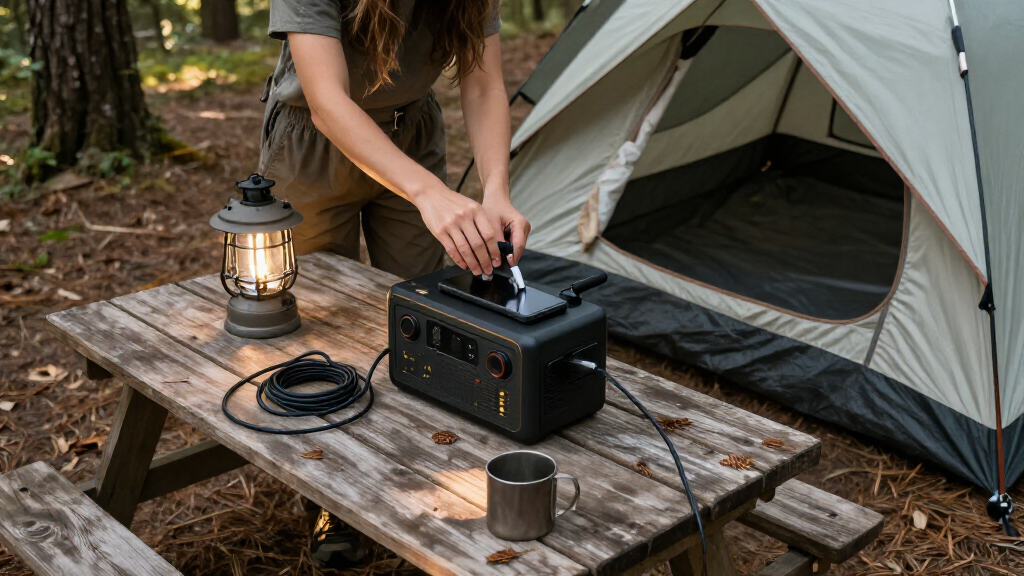

For most camping trips, I’d start with the Jackery Explorer 300: its 292Wh capacity offers a useful balance of everyday device runtime and manageable size. The Anker SOLIX C300 is another strong fit for campers who want a compact 288Wh unit, while the Jackery Explorer 1000 v2 suits longer trips and more demanding gear with its 1070Wh capacity and 1500W output. The main tradeoff is straightforward: smaller stations are easier to carry but run out sooner, while larger models add runtime at the cost of greater bulk. Output type and battery chemistry also matter, especially if you need to run an appliance or want a LiFePO4 battery. Read on for the full breakdown and guidance on matching capacity to your camping plans.

Get backup power and energy gear delivered free with Prime
- Fast, free delivery on millions of items
- Prime Video, Amazon Music and more included
- Member-only deals all year
Complete the kit


Key Takeaways
- The Jackery Explorer 300 is the most balanced starting point. At 292Wh, it sits between the very small 88–89.6Wh stations and the much larger 1070Wh Explorer 1000 v2.
- The Explorer 1000 v2 is the clear capacity outlier. Its 1070Wh battery and 1500W output suit longer trips and heavier loads, but it is more station than many weekend campers need.
- Several compact options cluster around 230–300Wh. The GRECELL EB300, CUBUS 350M, VTOMAN FlashSpeed 300, and other similarly sized units call for comparison of ports, battery chemistry, and charging options rather than capacity alone.
- Small capacity can be the right choice for electronics-only trips. The HOWEASY, Daran 89.6Wh, and MARBERO models are much lighter-duty choices than the 288–300Wh group, so they make more sense for topping up small devices than supporting a campsite full of gear.
- LiFePO4 appears across more than one size class. The VTOMAN FlashSpeed 300, Daran 89.6Wh, and DYNESS 300W bring that battery chemistry to different camping loads, but capacity and output still determine whether each one fits a trip.
| GRECELL EB300 Portable Power Station, 330W, 230.88Wh |  | Best for Flexible Recharging | Battery capacity: 230.88Wh | Surge output: 600W | USB-C outputs: 1 × 60W PD; 1 × 18W PD | VIEW LATEST PRICE | See Our Full Breakdown |
| HOWEASY 88Wh Portable Power Station, 120W (240W Peak) |  | Best Ultra-Light Pick | Battery capacity: 88Wh | Running output: 120W | Peak output: 240W | VIEW LATEST PRICE | See Our Full Breakdown |
| Anker SOLIX C300 Portable Power Station, 288Wh |  | Best Overall for Compact Camping | Battery capacity: 288Wh | Battery type and cycle life: LiFePO4; rated for 3,000 cycles | Running and surge output: 300W; 600W surge | VIEW LATEST PRICE | See Our Full Breakdown |
| CUBUS 350M Portable Power Station, 350W (700W Surge), 230.4Wh |  | Best for a Long-Life Battery | Battery capacity: 230.4Wh | Battery chemistry and cycle life: LiFePO4; rated for 3,000+ cycles | AC outlets: 2 pure sine wave outlets | VIEW LATEST PRICE | See Our Full Breakdown |
| Jackery Explorer 300 Portable Power Station, 292Wh |  | Best for Jackery Solar Setups | Battery capacity: 292Wh | Battery chemistry: LiFePO4 | AC outlets: 2 | VIEW LATEST PRICE | See Our Full Breakdown |
| Anker SOLIX C300 DC Portable Power Station (288Wh, 300W) |  | Best for USB-C Camping Setups | Battery capacity: 288Wh (90,000mAh) | Battery type: LiFePO4 | Output: 300W | VIEW LATEST PRICE | See Our Full Breakdown |
| VTOMAN FlashSpeed 300 Portable Power Station, 300W, 230Wh LiFePO4 Battery |  | Best Value for Multi-Method Recharging | Battery capacity: 230Wh | Battery type: LiFePO4 | Running output: 300W | VIEW LATEST PRICE | See Our Full Breakdown |
| Daran 89.6Wh LiFePO4 Portable Power Station, 100W Output |  | Best Compact Pick for Lightweight Camps | Battery capacity: 89.6Wh | Battery type: LiFePO4 | Weight: 2.54 lb | VIEW LATEST PRICE | See Our Full Breakdown |
| Jackery Explorer 1000 v2 Portable Power Station, 1070Wh, 1500W |  | Best for Extended Off-Grid Camping | Battery capacity: 1,070Wh | Battery type: LFP (LiFePO4) | AC output: 1,500W at 120V | VIEW LATEST PRICE | See Our Full Breakdown |
| Westinghouse iGen400s Portable Power Station, 400W Peak, 183Wh |  | Best for a Simple Campground Backup | Battery capacity: 183Wh | Running output: 200W | Peak output: 400W | VIEW LATEST PRICE | See Our Full Breakdown |
| MARBERO Portable Power Station, 88Wh, 120W Surge, 24,000mAh |  | Best Compact Pick | Capacity: 88Wh | Battery capacity: 24,000mAh | Output / surge: 80W / 120W | VIEW LATEST PRICE | See Our Full Breakdown |
| 500W Portable Power Station, 519.48Wh |  | Best for Longer Camps | Battery capacity: 519.48Wh (140,400mAh) | AC output: 500W pure sine wave; two 110V outlets | USB-A: 3 QC 3.0 ports, up to 18W each | VIEW LATEST PRICE | See Our Full Breakdown |
| DARAN 350W Portable Power Station, 288Wh, 600W Surge |  | Best for Long-Term Battery Use | Capacity: 288Wh | AC output: 350W | Peak surge output: 600W | VIEW LATEST PRICE | See Our Full Breakdown |
| DYNESS 300W Portable Power Station, 256Wh LiFePO4 Battery |  | Best for a Compact, Durable Setup | Battery capacity: 256Wh | Battery type: LiFePO4 | Continuous / starting output: 300W / 600W | VIEW LATEST PRICE | See Our Full Breakdown |
| EnginStar 300W Portable Power Station, 296Wh |  | Best for Multiple AC Connections | Battery capacity: 296Wh | Battery type / cycle life: Lithium-ion; more than 1,000 charge cycles | AC output: 300W | VIEW LATEST PRICE | See Our Full Breakdown |
| portable power stations for camping | Battery capacity | Weight | Dimensions |
|---|---|---|---|
| GRECELL EB300 Portable Power S | 230.88Wh | 7.3 lb | 9.61 × 6.72 × 6.97 in |
| HOWEASY 88Wh Portable Power St | 88Wh | 2.3 lb | 6.6 × 3 × 4 in |
| Anker SOLIX C300 Portable Powe | 288Wh | 4.13kg | — |
| CUBUS 350M Portable Power Stat | 230.4Wh | 6.9 lb | 9 × 5.4 × 6.2 in |
| Jackery Explorer 300 Portable | 292Wh | 7.1 lb | 9.1 × 5.2 × 7.8 in |
| Anker SOLIX C300 DC Portable P | 288Wh (90,000mAh) | — | — |
| VTOMAN FlashSpeed 300 Portable | 230Wh | — | — |
| Daran 89.6Wh LiFePO4 Portable | 89.6Wh | 2.54 lb | 6.5 × 3.3 × 4 in |
| Jackery Explorer 1000 v2 Porta | 1,070Wh | 23.8 lb | — |
| Westinghouse iGen400s Portable | 183Wh | 5 lb | 9.4 × 4.5 × 5.9 in |
| MARBERO Portable Power Station | 24,000mAh | 3.2 lb (1.04 kg, as listed) | 6.5 × 4.6 × 3.1 inches |
| 500W Portable Power Station | 519.48Wh (140,400mAh) | 18 lb | 11.57 × 7.95 × 7.95 inches |
| DARAN 350W Portable Power Stat | — | — | — |
| DYNESS 300W Portable Power Sta | 256Wh | — | 9.3 × 5 × 6.8 inches |
| EnginStar 300W Portable Power | 296Wh | — | — |
More Details on Our Top Picks
GRECELL EB300 Portable Power Station, 330W, 230.88Wh
The GRECELL EB300 is a sensible camping pick for travelers who want more ways to recharge than a basic wall-powered unit offers. Its built-in MPPT controller supports solar input, and it can also recharge from a car outlet—useful when moving between campsites. At 7.3 pounds, it is still manageable to carry, though the 230.88Wh capacity is better suited to topping up phones, cameras, and small electronics than powering them for a long trip. Compared with the Anker SOLIX C300, it has slightly higher rated AC output but less capacity and fewer USB-C ports. The 330W limit rules out many heat-producing appliances, and you’ll need to supply a compatible solar panel separately. Choose it for charging flexibility, not extended high-draw use.
Pros:- Built-in MPPT controller supports solar recharging.
- Can also recharge from a car outlet or AC outlet.
- USB-C PD and USB-A QC ports support compatible fast-charging devices.
- Compact 7.3-pound design with built-in battery protections.
Cons:- 230.88Wh capacity limits runtime for devices used throughout a longer trip.
- 330W rated output excludes many higher-power appliances.
- A solar panel is not listed among the included components.
Best for: Campers who want solar, car, and wall recharging options for phones, cameras, and other modest-power gear.
Not ideal for: Campers planning multi-day use of laptops or higher-draw appliances, since its capacity is modest and AC output is capped at 330W.
- Battery capacity:230.88Wh
- Surge output:600W
- USB-C outputs:1 × 60W PD; 1 × 18W PD
- USB-A outputs:2 × 18W QC
- Recharge methods:AC outlet, solar panel, or car outlet
- Weight:7.3 lb
- Dimensions:9.61 × 6.72 × 6.97 in
Our verdict“Pick the GRECELL EB300 if flexible solar and vehicle recharging matter more than a larger battery or higher appliance output.”
HOWEASY 88Wh Portable Power Station, 120W (240W Peak)
At just 2.3 pounds, the HOWEASY 88Wh is the easiest option here to tuck into a daypack or carry to a remote campsite. Its eight ports and built-in steady, flash, and SOS light make it useful as a small electronics hub, but the 120W running limit keeps the job narrow: phones, lights, and similarly low-draw gear, not most appliances. Compared with the GRECELL EB300, it weighs far less and offers more total ports, but it has well under half the capacity and much less AC output. Wall, car, and compatible solar charging give it useful flexibility; the solar panel is not included. This is a minimalist backup for short trips, rather than a substitute for the larger stations in this roundup.
Pros:- Very light at 2.3 pounds, with a hidden handle.
- Eight output ports accommodate several small devices.
- Built-in light has steady, flash, and SOS modes.
- Can recharge from an AC outlet, car socket, or compatible solar panel.
Cons:- 88Wh capacity provides limited runtime compared with the other stations here.
- 120W running output restricts which devices it can power.
- Compatible solar panel is sold separately.
Best for: Solo campers and day hikers who need a very light backup for phones, small lights, and other low-power electronics.
Not ideal for: Campers who need laptop charging across multiple days or want to run appliances, since capacity is only 88Wh and output is limited to 120W.
- Battery capacity:88Wh
- Running output:120W
- Peak output:240W
- Output ports:8 total: 2 AC, 1 USB-C, 3 USB-A, 2 DC
- USB-C output:18W
- Recharge methods:AC outlet, compatible 15–24V solar panel, or 12V/24V car socket
- Weight:2.3 lb
- Dimensions:6.6 × 3 × 4 in
- Lighting modes:Steady, flash, SOS
Our verdict“Choose the HOWEASY when minimizing carried weight matters more than capacity or appliance compatibility.”
Anker SOLIX C300 Portable Power Station, 288Wh
The Anker SOLIX C300 earns the all-around spot by pairing a useful 288Wh capacity with a compact footprint and several ways to recharge. Its three AC outlets and three USB-C ports make it easier to share power among a laptop, camera batteries, and phones than the simpler port layouts on the Jackery Explorer 300 or GRECELL EB300. Fast wall charging—80% in 50 minutes—can help between trips, while car, solar, and USB-C charging add flexibility at camp. The tradeoff is that 300W of rated output still rules out many appliances, and the solar panel and shoulder strap are not included. At 4.13kg, it is also heavier than the 2.3-pound HOWEASY, though that lighter unit has far less stored energy. This is the strongest balance for campers with mixed electronics and modest power needs.
Pros:- 288Wh LiFePO4 battery is rated for 3,000 cycles.
- Eight ports include three AC outlets and three USB-C ports.
- Recharge options include wall, solar, car, and USB-C input.
- Wall charging reaches 80% in 50 minutes; stated operating noise is 25dB.
Cons:- 300W rated output limits use with higher-power appliances.
- Solar panel and shoulder strap are not included.
- At 4.13kg, it is heavier than the ultra-light HOWEASY.
Best for: Campers who want one compact station for phones, camera gear, and a laptop, with multiple ports and several recharge routes.
Not ideal for: Campers who prioritize the lightest possible carry or need to power appliances above 300W; a solar panel and shoulder strap must also be sourced separately.
- Battery capacity:288Wh
- Battery type and cycle life:LiFePO4; rated for 3,000 cycles
- Running and surge output:300W; 600W surge
- AC outlets:3, 300W total
- USB-C ports:3: 2 × 140W, 1 × 15W
- Other ports:1 × 12W USB-A; 1 × 120W car socket
- Recharge methods:Wall outlet, solar, car, or USB-C
- Wall recharge:80% in 50 minutes
- Weight:4.13kg
Our verdict“Choose the SOLIX C300 for a balanced camping station with broad port selection and fast wall recharging, provided 300W is enough for your gear.”
CUBUS 350M Portable Power Station, 350W (700W Surge), 230.4Wh
The CUBUS 350M makes a strong case for campers who expect to keep a compact station in service over many charge cycles: its LiFePO4 battery is rated for 3,000+ cycles. Two pure sine wave AC outlets and a 350W rated output give it a little more headroom than the GRECELL EB300, while the 700W peak rating can accommodate brief surges within the unit’s limits. Its 6.9-pound weight and foldable handle suit car camping, and the four-mode light adds a practical campsite feature. Capacity remains modest at 230.4Wh, however, so the extra output does not mean long runtime. USB-C tops out at 45W, below the Anker SOLIX C300’s higher-power USB-C ports, and solar panels are sold separately. Pick it for cycle-life emphasis and straightforward AC access, not maximum capacity or laptop-speed USB-C charging.
Pros:- LiFePO4 battery is rated for 3,000+ charge cycles.
- Two pure sine wave AC outlets and 350W rated output.
- Foldable handle and 6.9-pound weight support campsite carrying.
- Four-mode LED light includes SOS.
Cons:- 230.4Wh capacity limits runtime for sustained device use.
- 45W USB-C output is lower than the Anker SOLIX C300’s two 140W USB-C ports.
- Solar panel is sold separately.
Best for: Car campers who want a compact LiFePO4 station for modest loads and value a battery rated for frequent cycling.
Not ideal for: Campers needing extended runtime, higher-power USB-C charging, or an included solar panel.
- Battery capacity:230.4Wh
- Battery chemistry and cycle life:LiFePO4; rated for 3,000+ cycles
- AC outlets:2 pure sine wave outlets
- USB-C output:45W PD
- Other outputs:2 × 18W QC3.0 USB-A; 12V DC5521, 60W
- Recharge methods:AC adapter, car socket, or solar panel
- Weight:6.9 lb
- Dimensions:9 × 5.4 × 6.2 in
Our verdict“Pick the CUBUS 350M if you want a cycle-life-focused compact station with two AC outlets and can work within its modest capacity.”
Jackery Explorer 300 Portable Power Station, 292Wh
The Jackery Explorer 300 is a straightforward choice for campers building around compatible Jackery solar panels. Its 292Wh LiFePO4 battery provides slightly more stored energy than the GRECELL EB300, and the listed solar setup can reach 80% in approximately 2.8 hours with a 100W panel. The 100W USB-C port is useful for compatible laptops and other devices, while two AC outlets and a car port cover common camping gear. Compared with the Anker SOLIX C300, the Jackery has a higher stated USB-C output but fewer listed USB-C ports and a slower stated wall charge time. Its 300W AC limit still excludes many appliances, and the solar panel is not included. Choose it if you value the Jackery solar ecosystem and a simple mix of outputs; look elsewhere if you need more USB-C connections or the Anker’s faster wall recharge.
Pros:- 292Wh LiFePO4 battery is rated for over 4,000 charge cycles before reaching 70% capacity.
- 100W USB-C port supports compatible higher-power devices.
- Two AC outlets, two USB-A ports, and a 120W car port offer several connection types.
- With a compatible 100W solar panel, it can reach about 80% charge in approximately 2.8 hours.
Cons:- 300W rated output limits the appliances it can run.
- Compatible solar panel is sold separately.
- Has fewer USB-C ports than the Anker SOLIX C300.
Best for: Campers who already own, or plan to buy, compatible Jackery solar panels and need a compact station for electronics and modest loads.
Not ideal for: Campers who need more than 300W of AC output, want multiple USB-C ports, or expect a solar panel to come with the station.
- Battery capacity:292Wh
- Battery chemistry:LiFePO4
- AC outlets:2
- USB-C output:100W
- Other outputs:2 USB-A ports; 120W car port
- Weight:7.1 lb
- Dimensions:9.1 × 5.2 × 7.8 in
- Solar charging:Up to 80% in approximately 2.8 hours with a compatible 100W panel
Our verdict“Choose the Explorer 300 if compatible Jackery solar charging and a 100W USB-C port fit your camping setup better than a broader port selection.”
Anker SOLIX C300 DC Portable Power Station (288Wh, 300W)
The Anker SOLIX C300 DC is a strong match for campers whose main loads are phones, tablets, cameras, and other USB-powered gear. Its two 140W two-way USB-C ports can charge compatible devices quickly and also accept power for recharging the station, while seven total ports make it easier to share power around camp. Compared with the smaller Daran 89.6Wh, it has far more capacity for a weekend of device charging; its 288Wh battery still falls short of the Jackery Explorer 1000 v2 for running larger appliances or supporting several days off-grid. The compact design and LiFePO4 chemistry suit frequent trips, but the wall charger is not included, and a shoulder strap costs extra. Solar compatibility is also limited: several Anker panels are unsupported, so check your panel before buying.
Pros:- 288Wh LiFePO4 battery offers more capacity than the Daran 89.6Wh for multi-device camping setups.
- Two 140W two-way USB-C ports support fast charging and station recharging.
- Seven ports, including a 120W car socket, allow several devices to connect at once.
- Compact design and temperature and impact protections suit portable outdoor use.
Cons:- 300W output rules out many high-wattage appliances.
- Wall charger and shoulder strap are not included.
- Not compatible with some Anker SOLIX solar panels, including the PS30, PS200, and PS400.
Best for: Campers carrying USB-C laptops, tablets, phones, and camera gear who want a compact station for charging electronics at camp.
Not ideal for: Campers who need to run high-wattage appliances, want an included wall charger or strap, or plan to use an unsupported Anker solar panel.
- Battery capacity:288Wh (90,000mAh)
- Battery type:LiFePO4
- Output:300W
- Ports:7; USB-C, USB-A, and car socket
- USB-C:Two 140W two-way ports
- Recharge time:80% in 1 hour; 1.5 hours to full
- Model:A1726
- Warranty:3-year limited
Our verdict“Choose the C300 DC for a compact, USB-C-focused camp setup, but pick a higher-capacity station for appliances or extended off-grid stays.”
VTOMAN FlashSpeed 300 Portable Power Station, 300W, 230Wh LiFePO4 Battery
The VTOMAN FlashSpeed 300 makes sense for campers who want several ways to refill a modest-capacity station. It supports AC, solar, vehicle, and 100W USB-C charging, so a car can serve as a useful backup when there is no wall outlet at camp. Its 230Wh battery and 300W running output are suited to phones, lights, and smaller electronics, while the built-in light adds practical utility after dark. Compared with the Anker SOLIX C300 DC, the VTOMAN offers more varied recharge routes and includes charging accessories, but its battery is smaller and its USB-C input and output are capped at 100W rather than Anker’s higher-speed USB-C ports. The listed weight is inconsistent across the supplied product details, so I would verify it before relying on it for a long carry. It is not a fit for high-draw appliances.
Pros:- Supports AC, solar, vehicle, and USB-C recharging.
- LiFePO4 battery is rated for over 3,000 cycles.
- Seven outlets provide connections for multiple small devices.
- Built-in LED offers steady, strobe, and SOS modes.
Cons:- 230Wh capacity is lower than the Anker SOLIX C300 DC’s 288Wh.
- 300W running output cannot support many higher-wattage appliances.
- Product details give conflicting weight information.
Best for: Car campers who want multiple ways to recharge a small station and need power for phones, lights, and other low-wattage gear.
Not ideal for: Backpackers sensitive to carry weight or campers who need more than 300W of running output or extended appliance runtime.
- Battery capacity:230Wh
- Battery type:LiFePO4
- Running output:300W
- Peak output:600W
- Outlets:7: 2 AC, 1 USB-C, 3 USB-A, and 1 DC
- USB-C input/output:100W
- AC recharge time:About 2.5 hours
- Recharging methods:AC, solar, 12V/24V vehicle, and USB-C PD
Our verdict“Pick the FlashSpeed 300 if flexible recharging and included cables matter more than maximum capacity or high output.”
Daran 89.6Wh LiFePO4 Portable Power Station, 100W Output
At 2.54 pounds, the Daran is the easiest option here to justify when every pound matters. Its 89.6Wh capacity is aimed at topping up phones, headlamps, and other small electronics rather than powering a full camp kitchen. The fanless operation is useful in a quiet tent or shared campsite, and its flashlight adds a backup light without another item in the pack. Against the Westinghouse iGen400s, the Daran is lighter and has a LiFePO4 battery rated for more than 3,500 cycles, but the Westinghouse offers 183Wh of capacity and a higher 200W running output. Daran’s 100W ceiling limits what it can run, and its solar panel and cable are optional extras. I’d choose it for a short, electronics-focused trip, not as the main power source for multiple days off-grid.
Pros:- 2.54-pound weight and compact dimensions make it easy to carry.
- LiFePO4 battery is rated for more than 3,500 cycles.
- Seven output ports and several charging methods support a range of small devices.
- Fanless operation and SOS flashlight suit quiet campsites and emergency use.
Cons:- 89.6Wh capacity and 100W output limit runtime and device choice compared with the Westinghouse iGen400s.
- Solar panel and cable are not included.
- Small capacity is a poor match for extended trips or appliance use.
Best for: Lightweight campers and day-trip users who need a small backup for phones, lights, and other devices drawing 100W or less.
Not ideal for: Campers who need to run appliances above 100W, recharge several devices over a long trip, or expect solar gear to be included.
- Battery capacity:89.6Wh
- Battery type:LiFePO4
- Weight:2.54 lb
- Dimensions:6.5 × 3.3 × 4 in
- Maximum output:100W
- Peak output:200W
- Ports:7: 2 AC, 2 USB-C, 2 USB-A, and DC5521
- Charging methods:AC, USB-C PD, car, and optional solar
Our verdict“Choose the Daran for lightweight trips centered on small electronics, not as a substitute for a higher-capacity camping station.”
Jackery Explorer 1000 v2 Portable Power Station, 1070Wh, 1500W
For campers who need to power more than phones and lights, the Jackery Explorer 1000 v2 is the clear capacity step-up in this group. Its 1,070Wh battery and 1,500W AC output can support a wider range of campsite appliances and give several devices more runtime than the 288Wh Anker SOLIX C300 DC or the 230Wh VTOMAN FlashSpeed 300. Despite its capacity, it weighs 23.8 pounds and has a foldable handle, making it more suited to car camping than a long walk from the parking area. The LFP battery is rated to retain over 70% capacity after 4,000 cycles, and app control adds charging options. The fastest one-hour recharge requires enabling emergency charging; default charging takes 1.7 hours. Solar panels are sold separately, and compatibility is limited to Jackery panels.
Pros:- 1,070Wh capacity and 1,500W AC output exceed the smaller stations in this group.
- 3,000W surge peak supports compatible devices with higher startup demands.
- LFP battery is rated to retain over 70% capacity after 4,000 charge cycles.
- Foldable handle, app control, and quiet overnight charging mode support car-camping use.
Cons:- At 23.8 lb, it is much less suitable for carrying far than the Daran or smaller stations.
- One-hour charging requires emergency charging to be enabled in the app; default charging takes 1.7 hours.
- Solar panel is not included, and solar charging is limited to Jackery panels.
Best for: Car campers staying off-grid for multiple days who need more runtime and enough AC output for compatible campsite appliances.
Not ideal for: Backpackers, minimalist campers, and buyers who want broad third-party solar-panel compatibility or an included solar panel.
- Battery capacity:1,070Wh
- Battery type:LFP (LiFePO4)
- AC output:1,500W at 120V
- Surge peak:3,000W
- Ports:3 AC, 2 USB-C, 1 USB-A, and 1 DC car port
- USB-C output:Up to 100W
- Weight:23.8 lb
- Charging time:1 hour with emergency charging enabled; 1.7 hours by default
- Solar compatibility:Jackery solar panels only; panel not included
Our verdict“Choose the Explorer 1000 v2 for multi-day car camping and higher-power gear, but skip it if low weight or flexible solar compatibility matters most.”
Westinghouse iGen400s Portable Power Station, 400W Peak, 183Wh
The Westinghouse iGen400s sits between pocket-sized backup units and the more capable Jackery Explorer 1000 v2: its 183Wh capacity and 200W running output can cover small electronics and selected low-draw devices, without the size of a multi-day station. At 5 pounds, it is practical to carry around a campground, while two AC outlets and a mix of USB-C, USB-A, and 12V connections give campers room for different devices. Compared with the Daran 89.6Wh, it offers about twice the capacity and twice the running output, though it is heavier and lacks the listed LiFePO4 battery details and cycle rating provided for the Daran. The flashlight and emergency flasher are useful additions, but the AC adapter and solar panel are not included. Its 200W running limit still excludes many appliances.
Pros:- Five-pound design with a carrying handle is manageable around camp.
- Two AC outlets plus USB-C, USB-A, and 12V connections support varied small devices.
- LED display shows battery level, charge time, and output watts.
- Tri-mode flashlight and emergency flasher add campsite utility.
Cons:- 183Wh capacity and 200W running output are limited beside the Jackery Explorer 1000 v2.
- AC power adapter and solar panel are not included.
- Charging to 80% in two hours depends on a 120V outlet and 100W AC adapter.
Best for: Car campers who want a straightforward, five-pound backup for phones, lights, and a few low-wattage devices at a campground.
Not ideal for: Campers who need multi-day appliance power, want an included AC adapter or solar panel, or need more than 200W of continuous output.
- Battery capacity:183Wh
- Running output:200W
- Peak output:400W
- AC outlets:2 × 120V
- USB ports:3 × USB-C 30W, 1 × USB-C 100W, and 2 × USB-A
- DC outlet:12V
- Weight:5 lb
- Dimensions:9.4 × 4.5 × 5.9 in
- Warranty:2-year limited
Our verdict“Pick the iGen400s for a portable campground backup with varied ports, but choose a larger station for extended stays or appliance use.”
MARBERO Portable Power Station, 88Wh, 120W Surge, 24,000mAh
At 3.2 pounds and just 6.5 inches long, the MARBERO suits campers who want backup power for phones, lights, and other small electronics without carrying a larger station. Its eight output ports let several people charge devices at once, while the built-in LED light adds useful campsite illumination and an SOS mode. Compared with the 500W Portable Power Station, this is far easier to pack, but its 88Wh capacity and 80W output are in a different league: it cannot run many small appliances and has less energy for multi-day trips. Charging from solar also requires a compatible MARBERO panel, which is not included. I’d choose it for a light overnight setup, not as the camp’s main power source.
Pros:- Compact 3.2-pound design is easy to carry and pack.
- Eight output ports allow multiple small devices to connect.
- Built-in light offers three brightness levels and an SOS mode.
- Battery management and automatic shutdown protection address overheating, short circuits, and overloads.
Cons:- 80W output rules out most appliances and many higher-draw devices.
- 88Wh capacity is limited for extended trips or frequent recharging.
- Compatible MARBERO solar panel is not included.
Best for: Minimalist campers and solo overnight hikers who mainly need to recharge phones and small USB devices.
Not ideal for: Campers who need to run appliances, recharge several devices over multiple days, or rely on solar without buying a compatible MARBERO panel.
- Capacity:88Wh
- Battery capacity:24,000mAh
- Output / surge:80W / 120W
- Output ports:8
- Dimensions:6.5 × 4.6 × 3.1 inches
- Weight:3.2 lb (1.04 kg, as listed)
- Charging:AC adapter or compatible 30W/60W MARBERO solar panel
- Light:Three brightness levels and SOS mode
Our verdict“Choose the MARBERO for lightweight trips centered on phones and small electronics, but skip it if you need meaningful appliance power or multi-day capacity.”
500W Portable Power Station, 519.48Wh
This is the capacity-first option in this group: its 519.48Wh battery gives campers more room to recharge devices or run compatible small appliances than the 256Wh DYNESS PPS300-4. The 500W pure sine wave inverter also makes it the strongest AC choice among these five, though it still cannot power equipment rated above 500W. Ten output options, including USB-C PD and wireless charging, make it practical for a shared campsite with varied devices. That extra capacity comes with a clear packing cost: at 18 pounds, it is much less appealing for a walk-in site than the 3.2-pound MARBERO. Wall, car, and compatible solar charging offer flexibility, but solar panels are separate, and leaving AC enabled can drain the battery.
Pros:- 519.48Wh capacity provides more stored energy than the other reviewed models here.
- 500W pure sine wave AC output supports compatible small appliances and sensitive electronics.
- Ten output options include USB-C PD, wireless charging, and two AC outlets.
- Can recharge from a wall outlet, car charger, or compatible solar panel.
Cons:- 18-pound weight makes it a poor fit for carrying far from a vehicle.
- Devices rated above 500W are outside its output limit.
- Solar panel is not included, and leaving AC output on can waste stored power.
Best for: Car campers sharing power across several phones and small appliances, especially on trips where carrying an 18-pound station is manageable.
Not ideal for: Backpackers, weight-conscious campers, or anyone whose equipment draws more than 500W.
- Battery capacity:519.48Wh (140,400mAh)
- AC output:500W pure sine wave; two 110V outlets
- USB-A:3 QC 3.0 ports, up to 18W each
- USB-C:PD, up to 60W
- Total output ports:10
- Weight:18 lb
- Dimensions:11.57 × 7.95 × 7.95 inches
- Charging time:6–7 hours by wall outlet; 7–8 hours by car; 6–9 hours with a 100W solar panel in full sun
- Charging methods:Wall outlet, car charger, or compatible 100W/200W solar panel
Our verdict“Pick this model for a car-based campsite that benefits from extra capacity and stronger AC output, rather than a setup where low carry weight matters most.”
DARAN 350W Portable Power Station, 288Wh, 600W Surge
The DARAN pairs a useful middle-ground capacity with a LiFePO4 battery rated for 3,000+ cycles, making it the standout here for campers who expect to use their station frequently over many seasons. Its 350W AC output and 600W peak surge give it more headroom than the EnginStar 300W for compatible devices with a brief startup demand, while the 288Wh capacity remains far below the 519.48Wh option in this group. It can charge up to six devices at once, and its display and three-mode light help at a campsite after dark. The tradeoff is appliance range: 350W still limits what it can run. Solar charging is supported, but the panel is sold separately.
Pros:- LiFePO4 battery is specified for more than 3,000 cycles.
- 350W AC output and 600W peak surge offer more headroom than the EnginStar 300W.
- Can power or charge up to six devices at once.
- Smart display and solid, strobe, and SOS light modes suit campsite use.
Cons:- 350W continuous output excludes many higher-power appliances.
- 288Wh capacity offers less stored energy than the 519.48Wh model.
- Solar panel is sold separately.
Best for: Frequent car campers who want a cycle-life-focused battery, multiple device connections, and modest AC power for compatible gear.
Not ideal for: Campers who need to run higher-wattage appliances or want the longest runtime available among these five options.
- Capacity:288Wh
- AC output:350W
- Peak surge output:600W
- Battery type / cycle life:LiFePO4; 3,000+ cycles
- AC outlets:2
- USB-C:1 × 60W PD
- Other USB ports:2 USB-A ports, up to 18W each
- Simultaneous devices:Up to 6
- Recharge methods:AC, car charger, or solar panel
Our verdict“Choose the DARAN if repeated seasonal use and a long stated battery cycle life matter more than maximum capacity or high-wattage appliance support.”
DYNESS 300W Portable Power Station, 256Wh LiFePO4 Battery
The DYNESS is a tidy middle option for campers who want a LiFePO4 battery and several recharge routes without moving up to a heavier, higher-capacity station. Its 256Wh capacity is less than the DARAN 350W’s 288Wh, and its 300W continuous output is lower, so the DARAN makes more sense for devices near that power ceiling. The DYNESS answers with a compact 9.3 × 5 × 6.8-inch body, six ports, and pure sine wave AC output for compatible small electronics and appliances. A 600W starting rating provides brief surge headroom, not permission to run a 600W appliance continuously. Wall, car, solar, and dual-input charging give it flexibility, but the solar panel is optional and its output remains modest.
Pros:- LiFePO4 battery offers a chemistry suited to repeated charging.
- Pure sine wave AC output supports compatible sensitive electronics.
- Six output ports accommodate several small devices.
- Supports wall, car, solar, and dual-input recharging.
Cons:- 300W continuous output limits appliance choices and trails the DARAN 350W.
- 256Wh capacity is below the DARAN’s 288Wh and the larger 519.48Wh option.
- Compatible solar panel is not included.
Best for: Car campers who want a compact LiFePO4 station for phones, lights, and small compatible AC devices, with more than one way to recharge.
Not ideal for: Campers whose gear needs over 300W continuously or who want more capacity than the 256Wh battery provides.
- Battery capacity:256Wh
- Battery type:LiFePO4
- Continuous / starting output:300W / 600W
- AC output:110V pure sine wave, 60Hz
- Output ports:6: 1 AC, 1 USB-C, 1 USB-A, 2 DC, 1 car outlet
- Dimensions:9.3 × 5 × 6.8 inches
- Recharge methods:AC wall outlet, compatible solar panel, car charger, or dual input
- Included components:Power station, car cigarette cable, AC charging cable, user manual
- Warranty:2 years
Our verdict“Choose the DYNESS for a compact LiFePO4 station and flexible charging, but pick the DARAN if you need a little more capacity and continuous output.”
EnginStar 300W Portable Power Station, 296Wh
For campers who want to plug in two compatible AC devices at once, the EnginStar stands apart from the DYNESS PPS300-4, which has one AC outlet. It offers two pure sine wave AC outlets, 296Wh of capacity, and a broad set of ports for sharing power across campsite electronics. Its 300W maximum AC output still puts it in the small-device category; two outlets do not raise the total wattage available. The lithium-ion battery is specified for more than 1,000 charge cycles, short of the DARAN’s 3,000+ cycle claim, but its stated recharge speed reaches 80% in two hours. It can recharge by wall, car, or compatible solar panel. At 3.6kg, it is portable for car camping, though not the lightest choice here.
Pros:- Two pure sine wave AC outlets allow two compatible devices to connect at once.
- 296Wh capacity exceeds the DYNESS’s 256Wh.
- Wall, 12V car, and compatible solar charging provide several refill options.
- Digital display, built-in flashlight, and overload protection add practical campsite features.
Cons:- 300W AC output limits use with higher-draw appliances.
- Lithium-ion battery is specified for more than 1,000 cycles, below the DARAN’s 3,000+ cycle rating.
- Solar panel is not included.
Best for: Car campers who need two separate AC connections for compatible low-draw electronics and value fast stated wall recharging.
Not ideal for: Campers with appliances above 300W or those prioritizing LiFePO4 chemistry and a higher stated cycle life.
- Battery capacity:296Wh
- Battery type / cycle life:Lithium-ion; more than 1,000 charge cycles
- AC output:300W
- AC outlets:2 × 110V pure sine wave
- USB-C:18W
- Other outputs:2 regulated DC outputs, 12V/24V; USB-A, 5V/3.1A max
- Charging methods:Wall outlet, 12V car socket, or compatible 12–25V solar panel
- Recharge time:Up to 80% in 2 hours
- Dimensions / weight:9.1 × 5 × 7 inches; 3.6 kg
Our verdict“Pick the EnginStar if two AC outlets and a 296Wh battery suit your campsite kit, but choose a higher-output station for power-hungry appliances.”
How We Picked
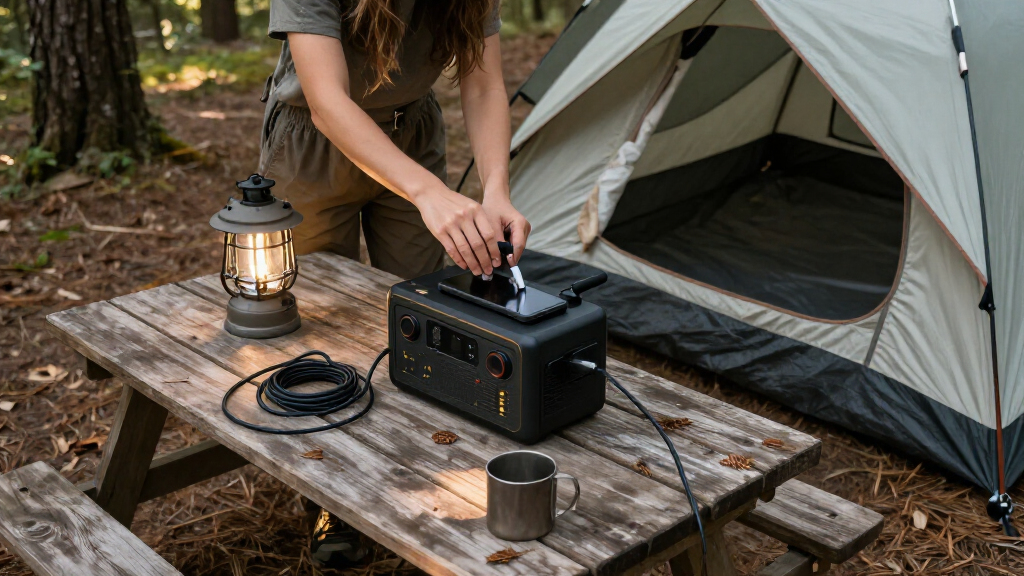
I compared these portable power stations for camping around the needs that change a trip: usable capacity for overnight or weekend use, output for the devices a camper plans to run, portability, and the flexibility of the available charging and connection options. Battery chemistry and stated surge output also matter, but neither replaces checking whether a station can support a specific device and for how long. A compact unit can be the better camp choice when it handles the planned load without adding unnecessary weight.
The ranking gives preference to balanced camping usefulness over a single standout specification. That puts the Jackery Explorer 300 near the top as a middle-ground option, with the Anker SOLIX C300 close behind for a similar capacity class. The Explorer 1000 v2 earns a distinct role for high-capacity needs rather than taking the lead for every camper. Lower-capacity models rank as niche picks for lighter loads, while the 500W, 519.48Wh station earns attention for its larger battery without matching the Explorer 1000 v2’s stated output. Where the supplied specifications do not identify port details, weight, or charging speed, I avoid treating those as established advantages.
Factors to Consider When Choosing Portable Power Stations For Camping
Choosing a station for camping starts with your actual load, not the biggest number on a product page. I’d work out which devices need power, how often they’ll run, and whether the station will travel by car, cart, or backpack before comparing models.
Estimate Energy Use, Not Just Device Wattage
Wattage tells you whether a station can run a device; watt-hours help estimate how long it can run. Add up the energy needs of the devices you plan to use over a day, then allow a buffer because conversion losses and changing conditions reduce real-world runtime. A phone and headlamp routine may fit a compact 88Wh class, while multiple devices overnight can call for a 230–300Wh station or more. Appliances that cycle on and off can make estimates less obvious, so check both their running draw and startup demand. Avoid buying solely by battery capacity if the output cannot support your intended device.
Match Output to Your Camping Gear
Check the station’s continuous AC output against the device’s running wattage, then check surge capacity for equipment with a motor or compressor. A peak or surge rating is not a promise that the station can run at that level continuously. USB-powered electronics may not need an AC outlet at all, so the right port mix can matter more than a larger inverter. If you plan to use a cooler, pump, or cooking appliance, confirm its draw and plug type before choosing a station. This can prevent paying for capacity you cannot use—or arriving with a station that trips under load.
Treat Capacity and Portability as a Pair
More watt-hours generally mean more runtime, but a larger station can be awkward to carry from a vehicle to a campsite. For car camping, the extra capacity may be worthwhile if it supports several nights or multiple users; for a walk-in site, weight and carrying shape may matter more than reserve energy. Compare actual weight and dimensions where available, not just the capacity printed on the product. Also account for the space a station takes in a packed vehicle and whether it can stay protected from rain and dust. The best capacity is the one you can transport comfortably and put to use.
Understand Battery Chemistry and Long-Term Use
Some models in this roundup specify LiFePO4 batteries, while others do not state their chemistry in the supplied product names. Battery chemistry can affect service life and operating characteristics, but it should be weighed alongside capacity, output, warranty, and care instructions. Do not assume two stations with similar watt-hours will have the same cycle life or maintenance needs. If you camp often, check the manufacturer’s guidance for storage charge, temperature limits, and charging intervals between trips. Occasional campers may get more practical value from a better-sized unit than from paying extra for a chemistry feature they will not use much.
Plan How You’ll Recharge at Camp
A station’s battery only helps if you can restore it on your schedule. Check its supported wall, vehicle, and solar charging methods, plus the charging time for each; availability and speed vary by model and setup. Solar charging depends on panel compatibility, sunlight, placement, and weather, so it is not a guaranteed replacement for a full charge before departure. For a short weekend, charging at home may be enough, while a longer stay makes recharge access part of the capacity decision. Confirm whether a panel is included or sold separately rather than assuming a solar-ready station comes with one.
Choose a Safety Margin for Cold and Shared Loads
Camping conditions can change how much power you need: cold nights may increase the demand from some devices, and shared trips can add unplanned phone or lighting loads. Leave extra capacity instead of planning to drain a station to its limit every day. Keep the unit dry, shaded from direct heat, and within the manufacturer’s operating range. If several people will use it, agree on which devices take priority and whether high-draw gear is allowed. That simple plan can matter more than moving up one capacity tier.
Frequently Asked Questions
Is a 230–300Wh power station enough for a weekend camping trip?
It can be enough when the main loads are phones, lights, cameras, and other modest electronics, especially if you can recharge during the trip. It may fall short if you expect to run a cooler continuously, use AC appliances, or support several people without recharging. List each device, its wattage, and its expected hours of use before deciding. The Jackery Explorer 300 and Anker SOLIX C300 sit in this general capacity range, but actual suitability depends on your load and the ports you need. A larger battery is most useful when it prevents frequent charging or supports a specific higher-demand device.
Can any of these stations run a small refrigerator or electric cooking appliance?
Not automatically: check both the appliance’s continuous draw and its startup surge against the station’s output ratings. The Explorer 1000 v2, at 1500W and 1070Wh, is the strongest stated option in this list for heavier loads, but runtime still depends on the appliance. The compact 300W-class models are better suited to lower-draw gear and may not support an appliance that exceeds their output. Electric cooking can use a battery quickly even when the station can handle the wattage. Verify the appliance label and the station’s continuous AC rating before packing either one.
Should I choose a LiFePO4 camping power station over a similar-sized model?
LiFePO4 is a useful differentiator, particularly for frequent use, but it should not be the only selection criterion. This roundup includes LiFePO4 models at very different capacities, including the 89.6Wh Daran and the 230Wh VTOMAN, so chemistry does not tell you whether a unit will run your gear long enough. Compare the battery’s capacity, output, ports, charging support, and the manufacturer’s cycle and storage guidance. For occasional, electronics-only trips, a better capacity match may matter more than chemistry. For regular camping, checking the stated battery life and warranty can help clarify the value of paying for that feature.
Is the 1070Wh Explorer 1000 v2 too large for ordinary car camping?
It may be more capacity and output than a short trip with phones and lights requires, but it can make sense for longer stays, multiple campers, or compatible higher-draw gear. Its 1500W output separates it from the compact stations, while the larger battery means more stored energy for use between charges. The tradeoff is carrying and packing a larger unit, so check its physical dimensions and weight before choosing it. If your planned loads fit within a 230–300Wh station, the smaller class may be easier to handle. Buy the larger model for a defined runtime or appliance need, not just because its capacity is highest.
Do I need solar panels to use a portable power station while camping?
No. You can charge a station before leaving and use the stored energy without solar, which is often simplest for a short trip. Solar becomes more useful when you will be away from outlets for longer, but panel compatibility, charge input limits, sunlight, and weather all affect how much energy you can restore. Confirm the required panel and whether it is included before planning around solar recharging. A panel also needs placement in good sun, which may be difficult at shaded campsites. For a weekend, a fully charged station and a realistic load estimate may be more dependable than assuming daily solar input.
Conclusion
For the widest range of ordinary car-camping needs, I’d choose the Jackery Explorer 300 as the best overall, with the Anker SOLIX C300 close behind for campers who prefer that compact 288Wh class. The 500W, 519.48Wh station is my value-oriented capacity pick for buyers who want more stored energy than the compact group; verify its output and port details against your gear before choosing it. For premium capacity and heavier compatible loads, the Jackery Explorer 1000 v2 is the standout. Beginners who mainly charge phones and lights should start with a compact, straightforward option such as the Jackery Explorer 300, rather than paying for capacity they will not use. For a very light electronics kit, look at the HOWEASY 88Wh or Daran 89.6Wh LiFePO4; for a LiFePO4 unit in a more versatile capacity range, compare the VTOMAN FlashSpeed 300 and DYNESS 300W. Match your choice to the devices, trip length, and carrying distance, then confirm the specific output and charging details before packing.