TL;DR
A solar-powered backup generator is usually a battery power station that stores electricity and can recharge from solar panels, a wall outlet, or other sources. Choose it by checking both battery capacity in watt-hours and output in watts, then compare those figures with your appliances’ running and startup demands. Solar recharge depends on sunlight, panel compatibility, and the station’s input limit.
A refrigerator can go quiet in seconds when the power fails, but a battery that looks large on a product page may still be unable to start it. That gap between stored energy and available power is the first thing to understand about solar-powered backup generators.

Get backup power and energy gear delivered free with Prime
- Fast, free delivery on millions of items
- Prime Video, Amazon Music and more included
- Member-only deals all year
Most are portable battery systems that store electricity and recharge from solar panels, a wall outlet, a vehicle, or sometimes a conventional generator. The panels collect energy; the battery supplies it when you need it. In this a blog article, you’ll learn what they are, how to match one to your essentials, what solar charging can realistically do, and where electrical safety calls for a professional.
The useful question isn’t whether one can “power your home.” It’s which devices you need during an outage, for how long, and how you’ll recharge the battery. A few clear measurements can help you answer that before you spend money.
A solar-powered backup generator is usually a battery that stores electricity; its panels recharge the battery rather than guarantee on-demand power.
Compare watt-hours for stored energy with watts and surge output for appliance compatibility.
Use usable capacity divided by average load for a rough runtime estimate, then allow for inverter losses and variable appliance use.
Solar charging slows with shade, clouds, short winter days, panel angle, and the station’s input limit.
Plug devices into a portable station directly; household wiring needs compatible transfer equipment and proper installation.
Know what a solar-powered backup generator can actually do
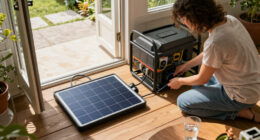
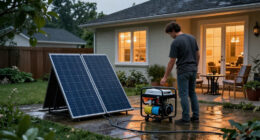
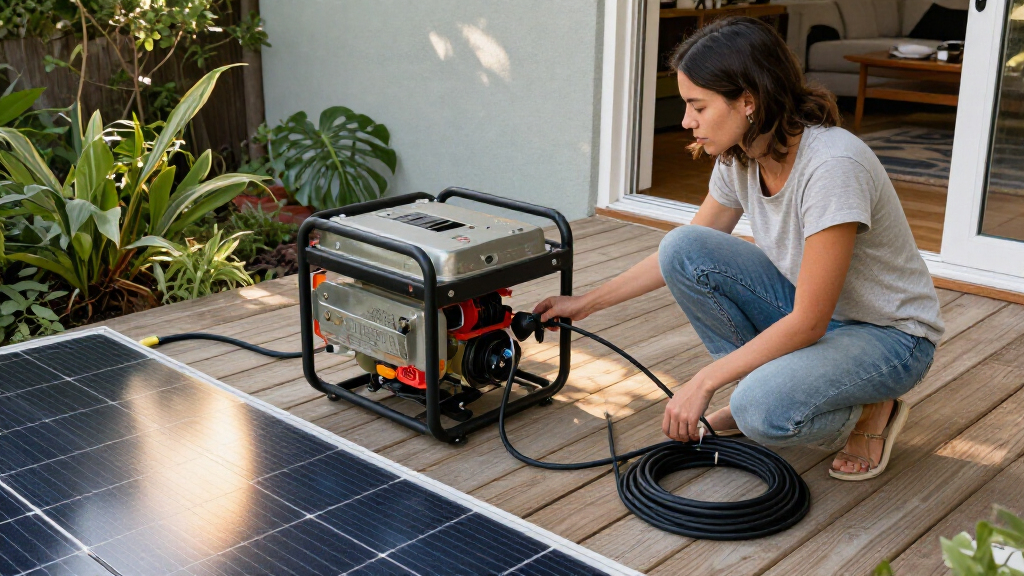
A solar-powered backup generator is typically a portable battery system that stores electricity and can recharge from solar panels. The panels produce the electricity, while the battery holds it for later use; many units can also charge from a wall outlet or vehicle. The name sounds like a machine that makes power on demand, but the battery does the immediate work when the grid goes down.
That distinction matters on a cloudy afternoon. A panel may be producing too little energy to run a hungry appliance directly, yet a charged battery can still supply power through the station’s outlets. Think of the panels as a slow refill and the battery as a water tank: sunlight changes the refill rate, while your devices determine how quickly the tank empties.
A portable station also differs from rooftop solar with a home battery. A compact unit might keep phones, a lamp, a router, and perhaps a refrigerator going for a limited time. A fixed home system is designed around household circuits and may require installation, permits, and grid-interconnection equipment.
For example, a camper might carry a modest station to recharge a phone and run an LED lantern at night. A family hoping to run air conditioning through a long outage needs a different system altogether. They are both seeking backup power, but their loads and equipment needs are worlds apart.
Products Worth Considering

Philips Hue Amarant Outdoor Smart Light Bar, Black

Dyson V15 Detect Cordless Stick Vacuum

Philips Hue Play Floor Lamp, RGBWWIC LED, 53 Inch, Black
As an affiliate, we earn on qualifying purchases.
Match watt-hours and watts to the appliances you need
Choose a power station by checking both its battery capacity in watt-hours (Wh) and its output in watts (W). Capacity estimates how much energy it stores; output shows how much power it can provide at one time. One number measures the size of the tank, the other the width of the pipe.
For a rough runtime estimate, divide usable battery capacity by the appliance’s average power draw. A station with 1,000 Wh of usable energy supplying a steady 100 W load has a simple estimate of about 10 hours, before losses. Real runtime is usually shorter because the inverter uses energy and many appliances draw varying amounts.
Motors add another wrinkle. A refrigerator may use modest power once running but draw a brief startup surge when its compressor kicks in. If the station’s surge capability falls short, the fridge may fail to start even when the battery has plenty of energy left.
Write down the devices you truly need: perhaps a refrigerator, two phones, a router, and a few lights. Check each device’s running draw and any startup demand, then see whether they can run at the same time. Heating, air conditioning, electric cooking, and water heating can consume far more power than a small portable station can supply.
- Wh helps estimate how long a battery can supply a load.
- W tells you whether the unit can run that load at all.
- Surge output matters for compressors, pumps, and some tools.
Estimate solar charging time without trusting the best-case number
Solar charging time depends on the battery size, available sunlight, panel setup, and the station’s maximum solar input. A rough ideal calculation divides battery capacity by effective solar input: a 1,000 Wh battery receiving a steady 200 W would take about five hours under those simplified conditions. In real use, expect the refill to take longer.
A panel’s rated wattage is a laboratory maximum, not a promise for every hour outdoors. Shade from a chimney, low winter sun, clouds, panel angle, temperature, and location all reduce production. Even a narrow strip of shade across a panel can cut the output you were counting on.
Imagine you set up panels beside a cabin on a bright summer morning. If a tree’s shadow creeps over them by noon, your charging pace drops right when you may be running a fridge and communications gear. Short winter days make solar-only recharging slower still, so another charging option can matter during a multi-day outage.
Check the station’s maximum solar input, supported voltage and current, and connector type before buying panels. A 400 W panel array cannot feed a station beyond its input limit, and incompatible electrical specifications may prevent charging or damage equipment. Manufacturer charging claims often assume favorable sun and compatible gear; treat them as best-case guidance.
Choose a portable station or a home battery for your backup plan
A portable station suits selected devices and flexible use; a fixed home battery suits broader household backup when designed and installed for that purpose. The right choice depends on how many loads you need, whether you want to move the battery, and how much installation work your home requires. A portable box is convenient, but it does not automatically become a whole-home system.
Consider a renter who wants to keep a phone, laptop, modem, and a small lamp working through an evening outage. A portable unit can be carried to the right room and recharged later from a wall outlet or panels. A homeowner who wants to support household circuits during repeated outages may prefer rooftop solar paired with a properly configured battery and transfer equipment.
Solar panels alone generally do not keep a grid-tied home powered when the grid fails. Many grid-tied systems shut down during outages unless they have suitable islanding and storage equipment. That protects utility workers and requires system components designed to disconnect safely from the grid.
| Feature | Portable power station | Home battery system |
|---|---|---|
| Typical use | Selected devices, camping, short backup | Selected circuits or broader household backup |
| Setup | Plug devices into unit outlets | Installed with compatible electrical equipment |
| Portability | Movable, though larger units can be heavy | Fixed installation |
| Planning needs | Capacity, output, panels, and cables | Load design, permits, transfer equipment, and grid rules |
When someone advertises that a portable power station “runs your home,” ask which appliances, for how long, and through what connection. Those details turn a broad claim into a useful comparison.
Use these buying checks to avoid a costly mismatch
The best buying checklist starts with your actual outage loads and ends with the accessories and warranty. Compare the usable capacity, continuous and surge output, solar input limit, supported panel specifications, recharge options, battery chemistry, outlets, expansion capability, weight, and safety certifications. A low headline price can rise once you add compatible panels, cables, and transfer equipment.
For instance, a family may find a station with enough Wh for an evening of fridge use, then discover it is too heavy to move easily or cannot accept the panels they already own. Another buyer may value a lighter unit for phones and camping, where portability matters more than long refrigerator runtime. Bigger capacity and output often mean higher cost, more weight, and longer charging time.
Lithium iron phosphate (LFP) batteries are increasingly common in portable stations. They typically support more charge cycles and have strong thermal stability compared with many other lithium-ion chemistries, though actual lifespan depends on use, temperature, and the battery-management system. Check the manufacturer’s warranty and cycle-life terms instead of assuming chemistry alone predicts service life.
- List the devices you need during an outage and how long you expect to use them.
- Check their running draw and startup surge against the station’s output ratings.
- Estimate battery capacity with a runtime calculation, allowing for inverter losses.
- Confirm panel voltage, current, connectors, and the station’s solar input limit.
- Add the cost and weight of panels, cables, expansion batteries, and any transfer gear.
Recent models may add faster AC or solar charging, app monitoring, modular expansion, or UPS-style backup for selected electronics. These features can help, but compare specifications and warranty details rather than relying on the feature list alone.
Connect backup power safely when household wiring is involved
A portable power station can safely power devices through its own outlets when you follow the manufacturer’s instructions and use compatible equipment. Connecting a station to household wiring is a different job: it needs suitable transfer equipment and must follow local electrical codes. Never feed power into a home circuit through an ordinary wall outlet.
That unsafe practice, called backfeeding, can send electricity out through utility lines and put workers or neighbors at risk. It can also create fire and equipment hazards. If your plan involves a panel, fixed circuits, or a transfer switch, ask a licensed electrician to specify and install compatible equipment.
Portable battery stations do not produce exhaust during operation, unlike fuel-powered generators. Still, indoor use does not make every setup safe: follow the maker’s placement, temperature, charging, and ventilation guidance, and keep cables and accessories within their ratings. A station charging in a cramped, hot closet is not the same as one set up in the clear, open location its manual recommends.
Keep the connection simple: plug individual devices into the station’s outlets. For household wiring, use properly installed transfer equipment and follow local electrical requirements.
For example, you can run a lamp and router from the station directly while the grid is out. If you want selected kitchen circuits powered through the home panel, bring in a licensed professional; do not improvise an outlet-to-outlet connection.
Frequently Asked Questions
Can a solar-powered backup generator run a refrigerator?
Often, if its continuous output, surge capability, and battery capacity are sufficient. Check the refrigerator’s running draw and compressor startup requirement, then allow for inverter losses and any other devices you plan to run. A refrigerator that cycles on and off may use less energy on average than its running draw suggests.
How long will a solar power station run?
A rough estimate is usable battery capacity in Wh divided by average load in W. For example, 800 Wh divided by a steady 80 W load gives an ideal estimate of 10 hours. Real runtime is usually shorter because of conversion losses and changing appliance demand.
How long does it take to recharge with solar panels?
A simplified ideal estimate is battery capacity divided by effective solar input. A 1,000 Wh battery receiving 200 W would take about five hours under steady conditions, but real sunlight varies and the station may cap incoming power. Clouds, shade, panel angle, and winter daylight can extend the charging time.
Can a portable solar generator power a whole house?
A portable unit can run selected devices or circuits if its capacity and output match those loads. Whole-home backup usually calls for equipment designed for household loads, compatible transfer equipment, and often professional installation. Solar panels alone generally do not keep a grid-tied home running during an outage.
Can I connect regular solar panels to a power station?
Only when the panels’ voltage, current, connectors, and total input fit the station’s specifications. Check both the panel and power station manuals before connecting them. A mismatch may prevent charging or damage equipment.
Are battery power stations safe to use indoors?
They do not produce exhaust during operation like fuel-powered generators, but follow the manufacturer’s placement, temperature, charging, and ventilation guidance. Keep the station and cables away from conditions the manual warns against, and use compatible accessories. Indoor operation does not make every battery setup suitable for every space.
Conclusion
Choose backup power around the devices you need, the hours you need them, and the conditions in which you’ll recharge. Check capacity, continuous and surge output, panel compatibility, and total cost before trusting a headline claim.
A well-sized battery can keep the refrigerator humming and the router lights blinking through an outage. Start with your essential loads, then build the system around that list.