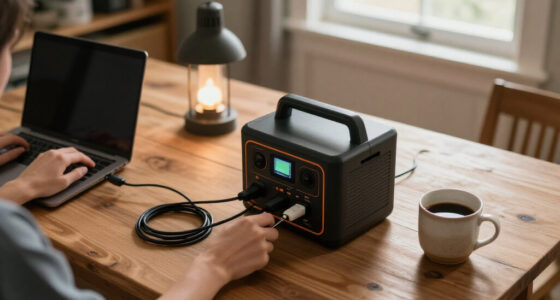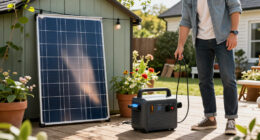
Solar-powered laptop chargers split into two camps: high-capacity power stations with AC outlets that can run a laptop for hours, and compact solar power banks that trade runtime for portability. The Portable Solar Generator 300W with 60W Solar Panel earns the best overall spot because it pairs a genuinely useful battery with a panel big enough to recharge it in a single sunny day. The Takki Solar Generator 120W is the standout budget-friendly bundle, while the Daran 89.6Wh LiFePO4 wins on long-term battery durability. The main tradeoff to understand before buying: most “solar” power banks under $60 have tiny panels that charge slowly, so matching the panel size to your actual off-grid time matters more than raw battery capacity. Read on for the full breakdown of what each option does well and who should skip it.

Get backup power and energy gear delivered free with Prime
- Fast, free delivery on millions of items
- Prime Video, Amazon Music and more included
- Member-only deals all year
Complete the kit


Key Takeaways
- Bundled panel size was the single biggest differentiator — the 60W panel in the top pick can realistically recharge its battery in a day of sun, while the 5–10W panels on power banks like the BLASOUL and SOARAISE take days to refill their own capacity.
- Raw mAh ratings on power banks are misleading: the SOARAISE’s claimed 48000mAh delivers far less usable laptop charging than the Daran‘s 89.6Wh LiFePO4 pack once conversion losses are factored in.
- Only the power stations with true AC outlets (300W models, Takki, Daran, and the 146Wh unit) can charge laptops that lack USB-C PD charging or that pull more than 65W.
- LiFePO4 chemistry in the Daran gives it roughly 5x the cycle life of the standard lithium-ion packs in every other entry — a real advantage for buyers who will cycle it weekly.
- Two entries (the 280Wh station and the 220Wh backup pack) ship without any solar panel, so they only fit buyers who already own panels or plan to buy them separately.


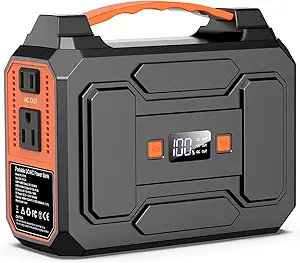
| solar-powered laptop charger | Weight | Extras | Capacity | Output |
|---|---|---|---|---|
| Portable Power Station 300W | 5 lbs | Built-in LED light, safety protections | — | — |
| YELLOMIN Solar Power Bank 1000 | — | 3-mode SOS flashlight, weather-resistant build | — | — |
| Portable Solar Power Bank with | — | — | — | — |
| BLASOUL Solar Power Bank 49800 | — | — | 49800mAh | — |
| SOARAISE Solar Power Bank 4800 | — | — | — | 5V / 3A max |
| Takki Solar Generator 120W Pea | 2.29 lbs | LED flashlight with SOS mode | 88.8Wh | — |
| Daran Portable Power Station 8 | 2.54 lbs | — | 89.6Wh | 100W (200W peak) |
| Portable Solar Generator 300W | — | — | — | 300W (2 AC outlets) |
| Portable Power Station 300W | 5 lbs | LED flashlight | 280Wh | 300W, 110V AC |
| Portable Power Station | 3.3 lbs | Dual LED flashlight with SOS mode | 146Wh / 39,600mAh | 100W AC max |
More Details on Our Top Picks
Portable Power Station 300W, 220Wh Solar Generator Backup Battery Pack
Among the power stations in this roundup, this 220Wh unit hits the best balance of capacity, output variety, and portability. Compared with the Portable Power Station 300W, 110V Solar Generator 280Wh, it gives up a little battery capacity but compensates with a lighter 5-pound frame and seven simultaneous output ports, including two 110V AC outlets. It outclasses the smaller Daran 89.6Wh power station for laptop users because 300W of continuous output handles most ultrabooks and 13-inch laptops without strain. The triple recharge options (AC, car, solar) make it practical at home and off-grid. The tradeoff is real, though: anything drawing over 300W — gaming laptops under load, for example — will trip it, and frequent heavy use drains the 220Wh reserve quickly. No solar panel is included, so budget for one.
Pros:- 220Wh capacity runs a typical laptop for multiple full charges
- Seven outputs let you charge a laptop, phone, camera, and lights at once
- Recharges via AC, car, or solar panel for flexible top-ups
- Genuinely portable at 5 pounds with a built-in LED light
Cons:- 300W output cap excludes high-draw laptops and appliances
- Solar panel sold separately, adding to the real cost
Best for: Remote workers and campers who need to run a laptop plus phone, camera, and lights off-grid for a weekend
Not ideal for: Anyone running power-hungry gear like gaming laptops, mini fridges, or microwaves — the 300W ceiling rules those out
- Power Output:300W (600W peak)
- Battery Capacity:220Wh / 60000mAh
- Outputs:2x 110V AC, 4x USB, 1x DC vehicle port
- Recharge Options:AC outlet, car port, solar panel
- Weight:5 lbs
- Dimensions:8.5 x 6.7 x 4.1 inches
- Extras:Built-in LED light, safety protections
Our verdict“The most versatile all-rounder here for laptop-centric off-grid work, provided your machine stays under 300W.”
YELLOMIN Solar Power Bank 10000mAh with Foldable Solar Panels, Wireless Charging, and Emergency Flashlight
Where the Portable Power Station 300W is a basecamp workhorse, the YELLOMIN takes the opposite approach: a self-contained emergency block that needs nothing else in the bag. Its four foldable panels mean it can trickle-charge itself in sunlight indefinitely, which no power station here can do without buying a separate panel. The built-in USB-C, Lightning, and USB-A cables eliminate the forgotten-cable problem entirely, and the 15W wireless pad handles MagSafe iPhones with no cord at all. The catch is capacity: 10000mAh (50Wh) is phone-and-tablet territory — a laptop will barely get a partial charge, and only if it negotiates USB power delivery. Compared with the SOARAISE 48000mAh bank, it survives blackouts for phones far longer on self-generated power, but it is not the tool for keeping a MacBook alive. Slow solar intake in weak light tests patience.
Pros:- Four foldable solar panels recharge the bank without any accessories
- Built-in cables cover USB-C, Lightning, and USB-A devices
- 15W wireless charging works with MagSafe and Qi phones
- Rugged, weather-resistant housing with an SOS flashlight
Cons:- 10000mAh capacity only partially charges most laptops
- Solar recharge is slow in cloudy or low-light conditions
Best for: Households building a blackout or car emergency kit who want phone charging with zero dependency on the grid
Not ideal for: Laptop-first users — 50Wh is simply too small to meaningfully charge a notebook computer
- Battery Capacity:10000mAh (50Wh)
- Solar Panels:4 foldable panels
- Wireless Charging:15W (MagSafe/Qi compatible)
- Built-in Cables:USB-C, Lightning, USB-A
- Ports:3
- Extras:3-mode SOS flashlight, weather-resistant build
Our verdict“A grab-and-go emergency block for keeping phones alive in outages, not a laptop power solution.”
Portable Solar Power Bank with AC Outlet 65W 110V
This is the cheapest credible path in this lineup to an AC outlet you can carry in a sling bag. The 24000mAh (roughly 88Wh) battery plus a bundled 30W folding panel gives you a complete solar laptop-charging loop at a price below most bare power stations here — the Takki 120W generator costs more and still limits you to 88.8Wh. A 65W inverter is enough for most 13- and 14-inch laptops, which draw well under that ceiling. The compromises are honest ones: the AC outlet needs a manual toggle and shuts off without a detected load, so unattended charging stops, and the panel’s junction box is not waterproof — a genuine problem if rain surprises you mid-camp. It also cannot touch high-draw machines; a 16-inch workstation laptop will overload it. For budget travelers with modest laptops, though, it nails the essentials.
Pros:- Complete package: battery bank plus 30W folding solar panel included
- 65W AC outlet charges most compact laptops from a bag-friendly frame
- Compact at 6.89 x 3.98 x 1.89 inches for the battery unit
- Built-in BMS protects against overcharge and short circuits
Cons:- AC outlet requires manual toggling and auto-shuts off without a load
- Solar panel junction box is not waterproof
- Capped at 65W, ruling out power-hungry laptops
Best for: Budget-conscious travelers with small or mid-size laptops who want a complete solar kit without power-station pricing
Not ideal for: Owners of gaming or workstation laptops — 65W AC output won’t cover their draw under load
- Battery Capacity:24000mAh (~88Wh)
- AC Output:65W max, 110V
- Solar Panel:30W folding panel included
- USB Output:5V/2.4A max; QC 5V/3A, 9V/2A
- DC Output:9V–12.6V / 10A max
- Bank Size:6.89 x 3.98 x 1.89 inches
- Folded Panel Size:12.7 x 8.4 x 0.3 inches
Our verdict“The most affordable self-sufficient solar laptop kit here, if your laptop sips 65W or less.”
BLASOUL Solar Power Bank 49800mAh Wireless Portable Phone Charger with Fast Charging and Built-in Cables
The BLASOUL stakes its claim on sheer endurance and durability. Its IP65 rating against water, shock, and dust is the strongest environmental protection in this batch — the YELLOMIN is weather-resistant but not formally rated, and none of the power stations advertise anything comparable. With 49800mAh on tap and built-in iOS, Type-C, Micro, and USB-A cables, it can keep a whole group’s phones alive across a multi-day trip, plus deliver 22.5W fast wired charging and a 15W wireless pad. Against the SOARAISE 48000mAh, it wins on hardening and charging speed; SOARAISE counters with four solar panels versus BLASOUL’s more modest solar input. Be skeptical of the headline capacity figure — real-world capacity will be lower — and the missing dimensions and weight mean you’re buying blind on pocketability. Solar recharge remains a trickle, not a primary input.
Pros:- IP65 water, shock, and dust resistance leads this roundup
- Massive 49800mAh rated capacity spans multiple days of charging
- Built-in iOS, Type-C, Micro, and USB-A cables
- 22.5W fast wired plus 15W wireless charging
Cons:- Small solar input means sunlight recharging is very slow
- No published dimensions or weight — size is a gamble before ordering
Best for: Hikers and campers in wet or dusty environments who need a bombproof bank that outlasts a long weekend of phone charging
Not ideal for: Anyone prioritizing fast solar regeneration — its panel area is small, so wall charging does most of the real work
- Capacity:49800mAh
- Fast Charging:22.5W wired
- Wireless Charging:15W max
- Built-in Cables:iOS, Type-C, Micro USB, USB-A
- Durability Rating:IP65 water/shock/dust resistant
- Power Source:Solar + USB recharge
Our verdict“The toughest high-capacity bank here for harsh-weather trips, so long as you treat solar as a backup input.”
SOARAISE Solar Power Bank 48000mAh Wireless Portable Charger with 4 Cables
If the BLASOUL’s weakness is slow solar intake, the SOARAISE makes that its whole identity: four solar panels spread across the bank’s face mean meaningfully faster sun-driven recovery than any single-panel rival in this roundup. With 48000mAh of storage, you can deplete phones all day and still claw capacity back by evening in good light — something the YELLOMIN, with similar panel count but a quarter of the storage, cannot sustain over a long trip. Four built-in cables plus wireless charging cover nearly any device a group carries. The drawbacks deserve attention: the listed 50-gram weight is almost certainly a data error, so expect a heavy brick in practice, and with only 5V/3A output it charges laptops slowly or not at all over USB. Few detailed reviews exist, so reliability is less proven than YELLOMIN’s.
Pros:- Four solar panels recharge faster than single-panel rivals
- 48000mAh capacity supports a whole group across several days
- Four built-in cables plus wireless charging cover mixed devices
- Compact footprint at 6.38 x 3.43 x 1.57 inches for its class
Cons:- 5V/3A output makes laptop charging impractical
- Sparse detailed user reviews make reliability unproven
- Likely heavier than the erroneous 50 g listing suggests
Best for: Extended off-grid campers who need large storage that actually recovers from sunlight between uses
Not ideal for: Laptop users — 5V/3A USB output cannot meaningfully charge a notebook the way the 65W AC power bank can
- Battery Capacity:48000mAh
- Solar Panels:4
- Output:5V / 3A max
- Ports:3 plus wireless charging
- Built-in Cables:4 cables for mixed devices
- Dimensions:6.38 x 3.43 x 1.57 inches
- Power Source:Corded electric & solar
Our verdict“The pick when solar recovery speed matters more than laptop support — big storage that refills itself under strong sun.”
Takki Solar Generator 120W Peak Portable Power Station with 21W Solar Panel and 88.8Wh Battery
Most options in this roundup force a choice: buy a bundled solar panel and carry extra weight, or buy a bare power station and shop for a panel later. The Takki 88.8Wh generator splits the difference better than anything else here — it ships with a foldable 21W panel yet weighs just 2.29 lbs, making it the lightest complete solar kit of the batch. Compared with the Daran 89.6Wh, capacity is nearly identical, but Takki includes the panel while Daran leaves you buying one separately. The tradeoff is headroom: an 80W continuous ceiling covers most laptops, but a gaming machine drawing 100W+ will trip it. The bundled panel is also slow — a 21W panel can’t refill 88.8Wh in a single afternoon of sun, so this works best as a trickle-recharge setup rather than a full off-grid loop.
Pros:- Complete kit: battery plus foldable solar panel included at just 2.29 lbs
- AC, USB, and 12V DC outputs cover every common charging cable
- LED flashlight with SOS mode adds emergency utility
- Genuinely backpackable weight for a full solar generator
Cons:- 80W output ceiling excludes power-hungry laptops and appliances
- 21W panel recharges slowly — expect multiple days of good sun for a full refill
- Charging devices while recharging the unit can shorten battery lifespan
Best for: Backpackers and minimalist campers who want a complete panel-plus-battery solar kit under 2.5 lbs for charging a laptop and phone
Not ideal for: Owners of high-wattage gaming or workstation laptops — the 80W limit will shut down charging under heavy load
- Capacity:88.8Wh
- Continuous Output:80W (120W peak)
- Solar Panel:21W foldable (included)
- Outlets:2 AC, USB ports, 12V DC
- Weight:2.29 lbs
- Extras:LED flashlight with SOS mode
Our verdict“The right pick if you want everything in one lightweight box for laptop-scale charging, provided your machine stays under 80W.”
Daran Portable Power Station 89.6Wh LiFePO4 Battery 100W Solar Power Bank with AC Outlets & Fast Charging
Nearly every budget power station in this category uses lithium-ion cells that degrade noticeably after a few hundred cycles. The Daran stands out for its LiFePO4 chemistry rated at 3,500+ cycles — roughly triple the lifespan of standard cells, which matters if this lives in a go-bag or gets drained weekly. Compared with the Takki at essentially the same capacity, you gain 100W of output and four fast-charging ports, but you lose the included panel, so the true cost of a solar setup lands higher than the sticker price. At 6.5×3.3×4 inches it fits in a laptop bag, and silent operation makes it usable beside a bed or in a library — something larger fan-cooled units can’t claim. Twelve built-in safety protections round out a package that prioritizes durability over bundled accessories.
Pros:- LiFePO4 battery rated 3,500+ cycles — far longer lifespan than typical lithium-ion rivals
- 100W continuous output handles most standard laptop chargers
- Six output ports including two USB-C for modern charging
- Silent, fanless operation suitable for bedrooms and offices
Cons:- Solar panel not included, adding cost if off-grid recharging is the goal
- 89.6Wh capacity means roughly one full laptop recharge before depletion
Best for: Frequent users and emergency-preparedness buyers who want a battery that survives years of charge cycles, not just a season
Not ideal for: Buyers wanting a complete out-of-the-box solar solution — no panel is included, so you’ll need a separate purchase and adapter
- Capacity:89.6Wh
- Battery Type:LiFePO4, 3,500+ cycles
- Output:100W (200W peak)
- Ports:2 AC, 2 USB-C, 2 USB-A, DC5521
- Recharging:AC, USB-C PD, car, solar (panel sold separately)
- Weight:2.54 lbs
- Safety:12 protection systems
Our verdict“The smart buy if you plan to use a power station for years — just budget extra for a panel.”
Portable Solar Generator 300W with 60W Solar Panel
This is the entry point for buyers who want real solar independence rather than an emergency trickle. The bundled 60W monocrystalline panel with 20.5% conversion efficiency generates roughly three times the charging power of the Takki’s 21W panel, meaning a sunny afternoon can meaningfully refill the station instead of nudging it. The 300W output covers any laptop in this roundup’s buyer profile plus lights, a fan, or a small drone battery — a clear step up from the Daran’s 100W ceiling. MPPT solar charging squeezes more from the panel than basic controllers do. Tradeoffs exist: the junction box is not waterproof, so rain demands attention, and the overall package is bulkier than the sub-3-lb kits. Compared with the 280Wh station without a panel, this bundle delivers a working off-grid system on day one.
Pros:- 60W MPPT solar panel included with strong 20.5% conversion efficiency
- 300W output powers laptops plus small appliances simultaneously
- Three recharge methods: AC, car, and solar
- Battery management system and SOS flashlight built in
Cons:- Non-waterproof junction box requires protection from rain and moisture
- 300W ceiling still excludes power tools, kettles, and similar appliances
- Requires periodic recharging to maintain battery health in storage
Best for: Off-grid campers and van lifers who need a self-sustaining charging loop capable of running a laptop plus accessories all weekend
Not ideal for: Day hikers and ultralight backpackers — the panel-plus-station combo is heavier and bulkier than pocketable options like the YELLOMIN power bank
- Output:300W (2 AC outlets)
- Solar Panel:60W foldable monocrystalline (included)
- Solar Efficiency:20.5%
- USB:3× 5V/3A plus 1× quick-charge port
- Recharging:AC, solar (MPPT), 12V car
- Safety:Built-in battery management system
Our verdict“The best turnkey solar setup here for anyone whose laptop work happens far from an outlet for days at a time.”
Portable Power Station 300W, 110V Solar Generator 280Wh (Without Solar Panel)
If you strip away the bundled panel, this 280Wh station delivers more stored energy per dollar than anything else in this lineup — more than triple the Takki’s 88.8Wh and double the 146Wh unit later in this list. For laptop charging specifically, that translates to several full recharges rather than one, which is the difference between a weekend trip and a week off-grid. Seven outlets let you charge a laptop, phone, camera, and headlamp simultaneously, matching the 300W generator’s output ceiling at a lower price. The obvious catch: no solar panel is included, so pairing it with the 60W panel from the bundle above — or any compatible third-party panel — is essential for this to function as a true solar charger. At 5 lbs with a carry handle, it’s portable but noticeably heavier than the Daran, so it suits car camping rather than backpacking.
Pros:- 280Wh capacity offers multiple laptop recharges — the most energy per dollar here
- 300W output with 7 outlets charges a full kit of devices at once
- Short circuit, over-current, over-voltage, and overload protection built in
- Carrying handle and 5 lb weight make it easy to move between camp and car
Cons:- Solar panel sold separately — an added cost before it functions as a solar charger
- Cannot run anything above 300W
- Needs periodic recharging during long storage to preserve battery health
Best for: Budget-conscious car campers and home-backup planners who already own or will buy a solar panel separately and want maximum stored capacity per dollar
Not ideal for: Anyone wanting a plug-and-play solar kit out of the box, or backpackers — it’s panel-less and 5 lbs
- Capacity:280Wh
- Output:300W, 110V AC
- Outlets:7 total (AC, DC, USB)
- Recharging:AC, 12V car, solar (panel not included)
- Weight:5 lbs
- Safety:Short circuit, over-current, over-voltage, overload protection
- Extras:LED flashlight
Our verdict“The strongest capacity-for-price play in this roundup, as long as you’re willing to source a solar panel yourself.”
Portable Power Station, 146Wh 100W Solar Powered Power Bank with AC Outlet
This 146Wh station occupies a useful middle ground the other entries skip past: noticeably more capacity than the Takki or Daran (roughly 60% more), yet at 3.3 lbs still light enough for a laptop bag. That’s typically one to two full laptop recharges, enough for a long travel day or an overnight outage. Compared with the 280Wh unit, you give up half the runtime but shed 1.7 lbs and get a slimmer footprint. The output selection is well considered for a laptop-first buyer — two AC outlets, QC3.0 fast USB, and a 12V DC port cover nearly every charging scenario, and the dual LED flashlight with SOS is a genuine emergency feature rather than a checkbox. The recurring caveat applies: no solar panel ships in the box, and the 100W AC ceiling mirrors the Daran’s, ruling out power-hungry hardware.
Pros:- 146Wh capacity provides one to two full laptop recharges in a 3.3 lb package
- Two AC outlets plus QC3.0 USB and 12V DC cover mixed device loads
- Dual LED flashlight with SOS mode for genuine emergency use
- Advanced battery management system for safe unattended charging
Cons:- Solar panel not included despite solar-ready design
- 100W AC output excludes high-draw laptops and appliances
- Capacity falls short for multi-day trips without a way to recharge
Best for: Remote workers and travelers who want a bag-friendly battery with enough capacity for a full workday away from outlets
Not ideal for: Multi-day off-grid users — 146Wh runs dry after a couple of laptop charges and there’s no bundled panel to refill it
- Capacity:146Wh / 39,600mAh
- Output:100W AC max
- Ports:2× 110V AC, 2× USB 5V/3.1A, 1× USB QC3.0, 1× DC 12V
- Recharging:AC adapter, car charger, solar panel (not included)
- Weight:3.3 lbs
- Extras:Dual LED flashlight with SOS mode
Our verdict“The best everyday-carry option here for laptop users who need more than one recharge but don’t want a 5 lb station.”

How We Picked
My ranking logic starts with one question: can this product actually keep a laptop running off-grid? That meant verifying sustained AC or USB-C PD output against typical laptop draws of 45–100W, then checking whether the included (or compatible) solar panel could refill the battery in a reasonable timeframe. A 300Wh station paired with a 5W panel is really just a power bank with a gimmick, so watt-hours of battery matched against panel wattage carried more weight than headline capacity claims.
From there I weighed build quality and chemistry (LiFePO4 over standard lithium-ion where available), port selection, weight, and price per usable watt-hour. Products that bundle a serious panel ranked higher than panel-less stations at similar prices, and I penalized inflated mAh marketing that falls apart under conversion math. Finally, each pick was assigned a distinct role — best overall, best value, best compact, best for beginners — so the order reflects which product serves its buyer best, not which spec sheet looks longest.
Factors to Consider When Choosing Solar-powered Laptop Chargers
Before clicking buy on any of these ten options, it helps to understand the physics and marketing quirks that shape this category. A few patterns surfaced repeatedly in this comparison, and knowing them will save you money and frustration.
Match Panel Wattage to Battery Size
The most common mistake in this category is buying a huge battery with a token solar panel. A 10W panel in full, direct sun produces roughly 40–60Wh per day — enough to refill a small power bank, but nowhere near enough for a 200Wh+ power station. Divide battery watt-hours by panel watts to estimate minimum recharge hours in perfect conditions, then double it for real-world clouds and panel angle. This is why the 60W bundle ranked first while high-capacity power banks with 5W fold-out panels ranked lower despite their marketing. If you genuinely need solar to be your refill method rather than an emergency trickle, anything under 20W of panel is decorative. Panel-less stations are fine — but only if you already own a panel or intend to buy one that matches the station’s input limit.
Watt-Hours Beat Milliamp-Hours
Power banks advertise mAh at the cell’s 3.7V internal voltage, but laptops charge at 110V AC or 20V USB-C, which means conversion losses of 30% or more. A “49800mAh” bank is really about 184Wh at the cell level and closer to 120Wh usable — less than the honest 220Wh rating on a mid-size power station. Compare watt-hours, never milliamp-hours, when shopping across product types. This single conversion explains most of the price differences in this roundup: a power station at $0.50–$0.80 per usable watt-hour is often better value than a flashy high-mAh power bank at $1.20+. Vendors know mAh numbers look bigger, which is exactly why they lead with them.
Check Your Laptop’s Actual Power Draw
A MacBook Air sips 30–35W, a 14-inch Windows ultrabook pulls 45–65W, and a gaming laptop or 16-inch workstation can spike past 150W — enough to trip the surge limits on several 100W-rated units here. Check your charger brick’s wattage before choosing; that number is the ceiling your laptop may demand under load. Also confirm whether your laptop charges over USB-C PD, because a 65W+ PD port is more efficient than converting to AC and back. Buyers with barrel-charger-only laptops must stick to the true AC outlet models regardless of other features. Undersizing here is the top cause of “it charged my phone fine but shuts off my laptop” reviews.
Battery Chemistry and Cycle Life
Standard lithium-ion (what most of these use) delivers roughly 500 charge cycles before capacity drops meaningfully; LiFePO4, like the Daran’s pack, typically lasts 2,500–3,500 cycles. If you’ll drain and recharge the unit weekly for van life or frequent camping, LiFePO4’s longer lifespan justifies a higher upfront cost — you’re effectively buying two or three lithium-ion batteries in one. For occasional emergency backup or a few trips a year, standard lithium-ion is perfectly rational and lighter per watt-hour. LiFePO4 also tolerates being stored at partial charge better, which matters for something that sits in a closet most of the year. Chemistry is invisible on the spec sheet’s front page, so check it before assuming all watt-hours are equal.
Weight and Portability Tradeoffs
Every entry here sits somewhere on the spectrum from pocketable power bank to 7+ pound power station, and the right choice depends on how you carry it. Hikers and backpackers should stay under 2 pounds, which realistically means USB-C PD charging and modest capacity — fine for topping up a laptop, not running it all day. Car campers and van-lifers can carry the 300W stations without noticing, and the extra capacity pays off in real work sessions. A useful rule: if you’ll move the unit on foot more than once per trip, capacity above 150Wh starts costing you more in effort than it returns in runtime. Don’t buy a 280Wh brick “just in case” if your actual use case is a lunch-hour park work session.
Pass-Through Charging and Solar Etiquette
Many buyers assume they can charge the battery from solar while simultaneously charging the laptop from the battery — and several budget units throttle or refuse pass-through charging, which quietly ruins off-grid workflows. Check whether the unit supports pass-through or priority charging, and how it behaves when solar input fluctuates with cloud cover. Another overlooked factor: panel placement. Even a great 60W panel produces a fraction of its rating if laid flat on a table or partially shaded; a kickstand or hanging loop and the ability to reposition every couple of hours can double your daily harvest. These behavioral details often matter more than another 50Wh of battery.
Frequently Asked Questions
Can a solar power bank actually charge a laptop, or only phones?
Only if it has an AC outlet or a USB-C PD port rated at least 45W — and many budget power banks cap out at 20–30W, which is phone territory. Even with the right port, a small bank may only add 30–60 minutes of laptop runtime because of conversion losses at AC voltage. The realistic laptop-capable options in this roundup are the power stations and the two PD-capable power banks with AC outlets (the 65W 110V unit and the 146Wh model). If your laptop charges over USB-C, a 65W PD port is more efficient than an AC inverter and wastes less of your stored capacity. Check your laptop’s charger wattage first — that tells you the minimum output you need.
How long does it take to recharge these with solar panels?
Divide the battery’s watt-hours by the panel’s real-world output, which is typically 60–75% of its rated wattage in good sun. That means the 60W bundled panel refills a 296Wh battery in roughly 7–9 hours of direct sunlight — about one good day — while a 10W fold-out panel would need several days for the same battery. Panel angle, shading, and heat all matter more than buyers expect, so repositioning the panel every couple of hours meaningfully increases harvest. Cloudy days can cut output by 80% or more, which is why off-grid workers should treat solar as the refill method and the AC wall charger as the pre-trip method. If your trip is short, charge fully at home and think of solar as a top-up, not the primary source.
Is it better to buy a bundled solar generator or separate panels and a station?
Bundles win on convenience, guaranteed compatibility, and usually price — the 300W/60W bundle in this lineup costs less than buying comparable components separately. Buying separately makes sense when you already own a panel, when you want higher-wattage panels than any bundle includes, or when you want to upgrade the battery later without replacing the panel. Check the station’s maximum solar input wattage before pairing: feeding 200W of panel into a station that caps at 100W input wastes money and panel. Also verify the connector type (usually MC4 or 8mm barrel), because adapters between brands are cheap but not always included. For first-time buyers, a matched bundle removes the most common compatibility headaches.
Are the giant mAh ratings like 48000mAh and 49800mAh real?
The cell capacity may technically exist, but it doesn’t translate to what buyers expect. Those ratings are quoted at 3.7V, so a 48000mAh bank holds about 178Wh — and after inverter and voltage-conversion losses, you’ll see maybe 110–130Wh usable at the outlet. That’s still respectable, but it’s less than a 220Wh power station that costs similarly, and the marketing makes direct comparison nearly impossible. Independent teardown reviews of ultra-high-mAh banks also frequently find the true cell capacity overstates reality. Convert everything to watt-hours (mAh × 3.7 ÷ 1000) and assume 70–75% efficiency when comparing to rated power stations. That single piece of math will make these listings far easier to read.
Can I carry one of these on a plane?
Airline rules cap lithium batteries at 100Wh for carry-on without airline approval and 160Wh with approval, and none are allowed in checked baggage. That rules out every power station in this roundup over 100Wh, including the 220Wh, 280Wh, and 296Wh models. The smaller power banks generally fall under the limit, but verify the watt-hour rating printed on the label — if a bank only shows mAh, convert it (mAh × 3.7 ÷ 1000) and expect TSA to do the same. For travel-focused buyers, this is a genuine argument for a compact sub-100Wh bank like the Daran rather than a big station. Solar panels themselves have no battery and fly without restriction, so a panel plus a compliant bank is a common travel combo.
Conclusion
The right pick depends less on specs and more on how you actually work off-grid. For the best overall choice, the Portable Solar Generator 300W with 60W Solar Panel stands out for pairing serious runtime with a panel that can genuinely refill it — the combination every other entry compromises on somewhere. The Takki 120W bundle is the best value for budget buyers who still want real solar input, while the Daran LiFePO4 is the best premium-adjacent pick for frequent users who will benefit from its cycle life for years. Beginners should start with the YELLOMIN or the 65W AC power bank — cheap, simple, and a low-risk way to learn whether solar charging fits your routine before spending more. For specific needs: backpackers get the SOARAISE or BLASOUL banks with built-in cables, van-lifers who already own panels get the 280Wh or 220Wh panel-less stations at a better price per watt-hour, and the 146Wh unit suits anyone wanting AC outlet capability in a carry-on-friendly size. Whatever you choose, size the panel to the battery and the output to your laptop — those two checks prevent nearly every disappointment in this category.
Halloween Picks
halloween
As an affiliate, we earn on qualifying purchases.