
Solar-powered laptop chargers split into two camps: compact power banks with small attached panels and larger portable power stations paired with separate folding solar panels. The tradeoff is straightforward — the small units fit in a backpack but trickle-charge slowly, while the bigger stations can run a laptop all day but demand space, weight, and budget. My top pick overall is the Portable Solar Generator 300W with 60W Solar Panel because its 60W panel is the only bundled option here large enough to meaningfully recharge while you work. For tight budgets and light use, the SinKeu 24000mAh Portable Power Bank with AC Outlet delivers reliable laptop output at a fraction of the price, and the Daran 89.6Wh LiFePO4 power station stands out for its battery chemistry, which should last years longer than standard lithium-ion rivals. Read on for the full breakdown of all eleven options.
Open a free Amazon Business account
Business pricing, bulk buying and tax-exempt orders.
Create a free accountAs an affiliate, we earn on qualifying purchases.
Complete the kit


Key Takeaways
- Panel size separates real chargers from trickle chargers: only the 60W panel bundled with the Portable Solar Generator 300W and the 21W Takki panel can replenish laptop-level battery drain in a single sunny day; everything else’s built-in panels are emergency backup only.
- AC outlet wattage ratings are peak numbers, not sustained numbers — the 300W-class stations can run most laptops comfortably, but the 65W and 100W power banks will throttle or shut down with gaming laptops or high-wattage chargers.
- Battery chemistry is a hidden differentiator: the Daran‘s LiFePO4 battery is rated for roughly four times the charge cycles of the standard lithium-ion packs in the other ten products, which changes the long-term value math.
- Two of the eleven options ship without any solar panel at all (the 280Wh and 220Wh 300W stations), making them backup batteries rather than true solar chargers unless you add a panel separately.
- High mAh ratings on solar power banks (like the 48000mAh SOARAISE) are inflated relative to actual AC outlet capacity — watt-hours are the only honest metric when comparing laptop charging capability.


| solar-powered laptop charger | Battery Capacity | Weight |
|---|---|---|
| Portable Solar Generator 300W | — | — |
| Portable Solar Power Bank with | 24000mAh | — |
| Takki Solar Generator 120W Pea | 88.8Wh | 2.29 lbs |
| Portable Power Station 300W | 220Wh lithium-ion | 5 lbs |
| Solar Charger Power Bank Pack: | 20000mAh | 1.2 kg |
| SOARAISE Solar Power Bank 4800 | 48000mAh | — |
| Daran Portable Power Station 8 | 89.6Wh | 2.54 lbs |
| SinKeu 24000mAh Portable Power | 24000mAh / 88.8Wh | — |
| YELOMIN 10000mAh Solar Power B | — | — |
| Portable Power Station | 146Wh / 39600mAh | 3.3 lbs |
| Portable Power Station 300W | 280Wh | About 5 lbs |
More Details on Our Top Picks
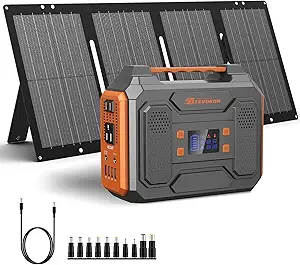
Portable Solar Generator 300W with 60W Solar Panel
This pairing of a 300W power station with a genuinely useful 60W monocrystalline solar panel is what makes this kit stand out — most competitors either sell the panel separately or include one too weak to matter. Compared with the Takki 120W generator’s 21W panel, this one can realistically recharge the battery in a single sunny day, which is the whole point of a solar laptop charger. The 20.5% conversion efficiency is above average for foldable panels at this price, and with 2 AC outlets plus 7 total ports, it handles a laptop, phone, and camera battery without triage. The tradeoff is weight and size: this is a basecamp setup, not something that disappears into a daypack the way the 24000mAh AC power bank does.
Pros:- 60W solar panel actually recharges the station in reasonable sunlight
- 20.5% conversion efficiency is above average for foldable panels
- 2 AC outlets and 7 ports let you run a laptop plus peripherals simultaneously
- Full protection suite with BMS and cooling system
Cons:- Cannot run appliances over 300W like coffee makers or hair dryers
- Solar panel junction box is not waterproof, limiting wet-weather deployment
Best for: Campers and remote workers who want a true solar-recharge basecamp kit that powers a laptop all weekend
Not ideal for: Hikers counting grams — the station-plus-panel combo is far heavier than a pocketable solar power bank
- Power Capacity:300W
- Solar Panel:60W monocrystalline, foldable
- Outlets:2 AC, 1 DC, 3 USB-A, 1 Quick Charge USB
- Recharging Methods:AC outlet, 60W solar panel, 12V carport
- Conversion Efficiency:20.5%
- Battery Management System:Yes
- Included Accessories:AC adapter, car adapters, solar panel kit, manual
Our verdict“Buy this if you want a complete solar laptop charging system out of the box rather than assembling one piecemeal.”
Portable Solar Power Bank with AC Outlet 65W 110V
For buyers whose real priority is keeping a laptop alive on the trail, this 24,000mAh power bank with a 65W AC outlet nails the size-to-capacity ratio. It slides into a backpack compartment where the 5 lb 300W station simply can’t go, yet still delivers enough wattage for most ultrabooks and tablets. The 30W foldable panel is twice as capable as the 10W panels on cheaper solar power banks like the 20,000mAh wireless model, so solar topping-up is plausible rather than theoretical. The compromises are real though: 65W rules out gaming laptops and fast chargers that spike higher, the AC outlet needs manual switching on and off, and the panel’s junction box won’t survive rain.
Pros:- 65W AC outlet covers most ultrabooks and small electronics
- 30W foldable solar panel doubles the input of budget solar banks
- Wall, solar, and car recharging options add flexibility
- Built-in BMS protects against overcharge and short circuits
Cons:- AC outlet requires manual on/off switching — easy to forget and drain the bank
- Solar panel junction box is not waterproof
Best for: Backpackers and digital nomads who need laptop power in a package under 2 lbs
Not ideal for: Owners of power-hungry gaming or workstation laptops that draw more than 65W
- Battery Capacity:24000mAh
- AC Output:65W, 110V
- DC Output:9V–12.6V / 10A max
- USB Ports:5V/2.4A; 5V/3A, 9V/2A
- Solar Panel:30W foldable
- Size:6.89 x 3.98 x 1.89 inches
- Folded Solar Panel:12.7 x 8.4 x 0.3 inches
Our verdict“This is the pick when a full power station is overkill but USB-only banks aren’t enough for your laptop.”
Takki Solar Generator 120W Peak Portable Power Station with 21W Solar Panel and Battery Power Bank
At 2.29 lbs total, the Takki undercuts nearly everything in this lineup on carry weight while still shipping as a complete solar kit — panel included, unlike the 220Wh station that leaves you to buy one separately. The 88.8Wh battery comfortably tops up a laptop once or twice, and the 2-hour AC recharge to 80% makes pre-trip prep painless. Where it falls short against the 65W AC power bank is sustained output: the 80W continuous ceiling means it handles a modest laptop but nothing demanding, and unlike some rivals it can’t charge devices while the station itself recharges, which forces you to choose between topping the battery and using it. Solar recharge times of 5–7 hours also demand patience.
Pros:- Complete kit at just 2.29 lbs, panel included
- Fast 2-hour AC recharge to 80% before trips
- LED flashlight with SOS mode adds emergency utility
- AC, USB, and USB-C output covers small devices and laptops
Cons:- Cannot charge devices while the station itself is recharging
- 80W continuous limit excludes power-hungry laptops and appliances
Best for: Ultralight campers and bikepackers who want an all-in-one solar kit under 2.5 lbs
Not ideal for: Anyone expecting multi-day outage coverage — 88.8Wh runs dry quickly with a laptop in the mix
- Battery Capacity:88.8Wh
- Weight:2.29 lbs
- Solar Panel Power:21W foldable
- AC Charging Time:2 hours to 80%
- Solar Charging Time:5–7 hours to 80%
- Max Power Output:120W peak
- Dimensions (Station):5.7 x 4.13 x 3 inches
Our verdict“The lightest complete solar laptop option here — just accept small-battery tradeoffs in exchange.”
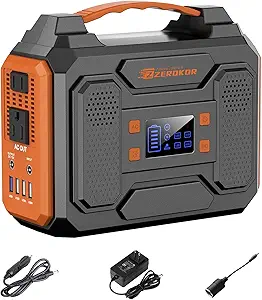
Portable Power Station 300W, 220Wh Solar Generator Backup Battery Pack
The argument for this 220Wh station is capacity per dollar and flexibility: 7 devices at once, a pure sine wave inverter that’s gentler on laptop chargers than modified sine alternatives, and three recharge paths including a carport for road-trip top-ups. That 220Wh battery is roughly 2.5 times the Takki’s capacity, enough for several laptop charges over a weekend. The catch is baked into the price — no solar panel is included, so the ‘solar’ in the description is a capability, not a kit. Buyers who already own a panel (or plan to pair it with a quality 60W unit like the one bundled with the 300W solar generator kit) get a bargain; buyers expecting out-of-the-box off-grid charging should look elsewhere.
Pros:- 220Wh capacity covers multiple laptop charges per fill
- Pure sine wave inverter is safer for sensitive laptop chargers
- Solar, AC, and car recharging covers every scenario
- Powers up to 7 devices simultaneously
Cons:- Solar panel not included — added cost and research required
- 300W ceiling rules out most kitchen or heating appliances
Best for: Buyers who already own a solar panel or want to choose their own, and prioritize battery capacity
Not ideal for: Anyone wanting a complete solar kit in one purchase — the panel is sold separately
- Wattage:300W (600W peak)
- Battery Capacity:220Wh lithium-ion
- Weight:5 lbs
- Output Ports:2x 110V AC, 4 USB, 1 DC vehicle port
- Charge Cycles:1000+
- Inverter Type:Pure sine wave
- Safety Features:BMS, short-circuit and overload protection
- Dimensions:8.5 x 6.7 x 4.1 inches
Our verdict“A smart buy only if you already have or plan to buy a panel separately; otherwise buy a bundled kit.”
Solar Charger Power Bank Pack: 20000mAh Wireless Portable Charger with 10W Foldable Solar Panels and 20W PD Fast Charging
What separates this unit from every other product in this roundup is the hand crank generator — a genuinely rare fallback when sun, wall power, and car power are all gone. For an emergency kit stashed in a car or go-bag, that redundancy matters more than raw specs, and the wireless charging pad plus 7 ports let it serve a whole household’s phones during an outage. As a laptop charger specifically, it’s the weakest performer here: the 10W solar panel is a trickle compared to the 60W panel on the 300W solar generator kit, and 20W PD output will charge most laptops slowly or merely hold them level. The 1.2 kg weight also sits awkwardly between power bank and power station — heavier than the Takki, less capable than the 220Wh station.
Pros:- Hand crank generator provides power with no sunlight or grid at all
- Wireless charging plus 7 ports serve multiple devices in an outage
- Pass-through solar charging keeps the bank topped up in a window or campsite
- 36-month warranty is unusually long for the category
Cons:- 10W solar panel is far too slow to be a primary recharge method
- 1.2 kg is heavy for a power bank while offering less capacity than a station
Best for: Emergency preppers who want multiple redundant power sources including a hand crank
Not ideal for: Laptop-first buyers — 20W output and a 10W panel make this a phone charger with laptop aspirations
- Battery Capacity:20000mAh
- Power Output:20W PD
- Wireless Charging:Yes
- Solar Panel:10W foldable monocrystalline
- Ports:7 total
- Emergency Features:Hand crank generator, LED flashlight
- Weight:1.2 kg
- Warranty:36 months
Our verdict“Buy it for the crank and redundancy in a disaster kit, not as your main solar laptop charger.”
SOARAISE Solar Power Bank 48000mAh Wireless Portable Charger with 4 Cables
For buyers who want a power bank with solar built in rather than a separate panel and station, this SOARAISE unit stands out for its sheer capacity. The 48000mAh battery can recharge a laptop several times over, which is something the YELOMIN 10000mAh simply cannot do, and the four integrated solar panels mean the sun is always a backup input rather than an afterthought.
The tradeoff is bulk and honesty about solar math. Panel charging is slow compared to wall recharging, so the solar feature works best as an emergency trickle rather than a primary input. Compared with the Daran 89.6Wh station, you lose AC outlets but gain true pocket-and-go portability for multi-day trips away from any outlet.
Pros:- Massive 48000mAh capacity recharges a laptop multiple times
- Four integrated solar panels for genuine off-grid trickle charging
- Built-in cables eliminate the need to pack extras
- Waterproof, shockproof, and dustproof housing survives rough handling
Cons:- Solar recharging is slow and weather-dependent
- No AC outlet limits laptop charging to USB-C models
- Bulkier than standard single-panel power banks
Best for: Backpackers and emergency preppers who need multiple laptop recharges without carrying a separate power station
Not ideal for: Buyers who need to run AC-powered devices — there is no wall outlet, only USB and wireless
- Battery Capacity:48000mAh
- Solar Panels:4 integrated panels
- Ports:3 (2 USB-A, 1 USB-C)
- Wireless Charging:Yes
- Protection:Waterproof, shockproof, dustproof
- Dimensions:6.38 x 3.43 x 1.57 inches
Our verdict“This is the pick for multi-day off-grid trips where capacity matters more than AC outlets.”
Daran Portable Power Station 89.6Wh LiFePO4 Battery 100W Solar Power Bank
What separates the Daran from cheaper lithium-ion rivals like the SinKeu 88.8Wh is its LiFePO4 chemistry, rated for over 3500 cycles. That translates to years of near-daily use before meaningful degradation — a real advantage if this lives in a car or go-bag rather than coming out once a season.
The 1.2-hour recharge time is genuinely fast for this class, and fanless operation makes it quiet enough for a tent or office corner overnight. The catch: two AC outlets capped at 100W total means gaming laptops and power tools are off the table, and unlike the SOARAISE power bank, there is no solar panel included — you will need to buy one separately to make this a true solar charger.
Pros:- LiFePO4 battery rated for 3500+ charge cycles
- Recharges fully in about 1.2 hours
- Silent fanless operation suits tents and bedrooms
- Seven output ports including two AC outlets
Cons:- 100W ceiling excludes high-wattage laptops and appliances
- Solar panel sold separately
- 89.6Wh capacity runs out quickly with multiple devices
Best for: Frequent users and emergency preppers who want a battery that survives thousands of recharge cycles
Not ideal for: Anyone expecting solar out of the box — the panel is a separate purchase
- Battery Capacity:89.6Wh
- Battery Type:LiFePO4 (3500+ cycles)
- Output Power:100W
- Outlets:7 (2 AC, 2 USB-C, 2 USB-A, DC5521)
- Recharge Time:~1.2 hours
- Weight:2.54 lbs
- Inputs:AC, USB-C, DC, solar (panel not included)
Our verdict“This model makes the most sense for buyers prioritizing long-term battery health over raw capacity.”
SinKeu 24000mAh Portable Power Bank with AC Outlet, 88.8Wh Portable Laptop Charger
Where the Daran is a boxy station, the SinKeu takes nearly identical stored energy — 88.8Wh versus 89.6Wh — and packs it into a slab-shaped body that slides into a laptop bag. For commuters and remote workers, that form factor is the whole point: it is a power bank first and a generator second.
The 110V/65W AC outlet covers most USB-C laptops and thin ultrabooks, and the OLED display shows remaining runtime at a glance, which the SOARAISE lacks. Be realistic about limits, though: 65W will not run gaming laptops or projectors, and recharging is slower than the Daran’s rapid 1.2-hour turnaround. As with most entries here, solar input requires providing your own panel.
Pros:- Slim form factor fits laptop bags better than boxy stations
- AC outlet covers most USB-C and thin laptops
- OLED display shows charge status and runtime
- Five ports allow simultaneous multi-device charging
Cons:- 65W AC ceiling excludes power-hungry laptops
- Recharges slower than the Daran station
- Solar charging requires a separate panel
Best for: Remote workers and students who want AC laptop charging in a bag-friendly shape
Not ideal for: Owners of gaming laptops or 90W+ machines — the 65W AC cap will not support them
- Battery Capacity:24000mAh / 88.8Wh
- AC Output:110V, 65W
- Ports:5
- Display:OLED status screen
- Dimensions:6.8 x 3.8 x 1.78 inches
- Power Sources:AC, solar, USB
Our verdict“This option suits mobile professionals who value a bag-friendly shape over maximum output.”
YELOMIN 10000mAh Solar Power Bank with Foldable Solar Panels, Wireless Charging, and Emergency Flashlight
At 10000mAh, the YELOMIN is honest about what it is: an emergency lifeline, not a laptop generator. One full charge covers roughly half to two-thirds of a typical laptop battery, placing it closer to a phone-first charger with laptop top-up ability. Compared with the SOARAISE 48000mAh, capacity is a fraction — but so is the price and the weight.
Its strength is self-sufficiency. Four foldable panels plus MagSafe-compatible 15W wireless charging and built-in USB-C and Lightning cables mean you can leave every accessory at home. The military-grade housing with sealed ports handles rain and drops better than bare power banks. Just expect slow solar recovery in anything but direct midday sun, and plan around the modest capacity.
Pros:- Foldable solar panels recharge the bank without any outlet
- MagSafe and Qi-compatible 15W wireless charging
- Built-in USB-C and Lightning cables cut packing weight
- Rugged military-grade housing with sealed ports
Cons:- 10000mAh provides only partial laptop charges
- Solar recharging is slow in overcast or low-light conditions
- Folded panels add noticeable bulk for pocket carry
Best for: Day hikers and budget-minded buyers who want cable-free emergency power for phones plus occasional laptop top-ups
Not ideal for: Anyone needing full laptop recharges — 10000mAh is top-up territory only
- Capacity:10000mAh
- Solar Panel:4 foldable panels
- Wireless Charging:15W (MagSafe/Qi compatible)
- Built-in Cables:USB-C, Lightning
- Flashlight:Constant, Strobe, SOS modes
- Battery Type:Li-ion
Our verdict“A sensible low-cost choice for short outdoor trips where emergency phone power matters more than laptop runtime.”
Portable Power Station, 146Wh 100W Solar Powered Power Bank with AC Outlet
Sitting between the Daran 89.6Wh and full-size generators like the 220Wh–280Wh units elsewhere in this roundup, this 146Wh station hits a sweet spot: roughly 60% more stored energy than the Daran for only about half a pound of extra weight. For campers who want a weekend of laptop and phone charging without lugging a big box, the math favors this one.
You get seven outputs, dual AC outlets, quick-charge USB ports, and a 12V DC output for accessories like portable fridges. The familiar tradeoffs apply: the 100W ceiling blocks high-draw appliances, and the solar panel is not bundled, so pair it with a 60W panel to make the solar promise real. If the Daran is the longevity pick, this is the capacity-per-pound pick.
Pros:- 146Wh capacity offers strong energy-to-weight ratio at 3.3 lbs
- Seven outputs including dual AC and quick-charge USB
- 12V DC output supports car accessories and portable fridges
- Advanced BMS safety management with LED flashlight and SOS modes
Cons:- 100W output cap excludes power-hungry appliances
- Solar panel not included
- Lithium-ion cells degrade faster than LiFePO4 rivals like the Daran
Best for: Campers and van-lifers who want maximum stored energy per pound of carry weight
Not ideal for: Buyers wanting a complete solar kit — the panel must be purchased separately
- Battery Capacity:146Wh / 39600mAh
- Output Wattage:100W
- Outlets:7 (2 AC, 4 USB, 12V DC)
- Weight:3.3 lbs
- Battery Type:Lithium Ion
- Recharge Options:AC, DC, USB-C, solar (panel not included)
Our verdict“This model is the smart middle ground for campers who need more runtime than compact stations offer without full generator weight.”
Portable Power Station 300W, 110V Solar Generator 280Wh (Without Solar Panel)
Capacity is the story here. At 280Wh, this unit outpaces most of the power banks in this roundup — it holds roughly three times the energy of the SinKeu 24000mAh Portable Power Bank and doubles the Portable Power Station 300W, 220Wh model. For a laptop user spending a full weekend off-grid, that difference translates into several extra days of charges rather than a single overnight boost. Two AC outlets mean a laptop and a lamp can run simultaneously, something the single-outlet Daran 89.6Wh can’t manage.
The catch: this is a solar generator, not a solar charger. The panel is sold separately, so buyers who want true out-of-the-box solar charging should compare it against the Portable Solar Generator 300W with 60W Solar Panel, which bundles one for likely less total spend. The 300W ceiling also rules out power-hungry appliances like kettles or hair dryers.
Pros:- 280Wh capacity is the largest in this lineup, supporting multiple laptop recharges
- Three recharge methods (AC, solar, car 12V) add flexibility for trips and emergencies
- Dual AC outlets let you run a laptop plus a second device at once
- Full protection suite guards against overloads and short circuits
- Around 5 lbs makes it genuinely portable for a station this size
Cons:- Solar panel is not included, adding cost before off-grid use is possible
- 300W limit excludes high-draw appliances like coffee makers or microwaves
- Not designed for long-term storage or continuous daily use as a home backup
Best for: Weekend campers and remote workers who already own a solar panel and need maximum stored capacity in a carry-friendly package
Not ideal for: Buyers wanting an all-in-one solar kit — the missing panel means a second purchase before it works off-grid
- Power Output:300W MAX
- Battery Capacity:280Wh
- AC Outlets:2 x 110V
- DC Output:1 (9V~12.6V/10A MAX)
- USB Ports:3 (5V/3A), 1 QC USB (5V/3A, 9V/2A)
- Weight:About 5 lbs
- Charging Methods:AC outlet, solar panel (sold separately), car 12V
- Protection Features:Short circuit, over-current, over-voltage, overload protection
Our verdict“If you already own a compatible solar panel and prioritize stored energy over bundled convenience, this is the capacity leader of the group.”

How We Picked
I ranked these products on five factors, weighted by how people actually use solar laptop chargers off-grid. First, usable laptop capacity in watt-hours, because mAh ratings are marketing artifacts and only Wh tells you how many laptop charges you really get. Second, solar input realism — a 5W built-in panel is an emergency trickle, while a 60W folding panel can genuinely sustain a workday, and I ranked accordingly. Third, inverter and output quality: whether the AC outlet delivers its rated wattage continuously and whether USB-C PD is fast enough to skip the inverter entirely.
Fourth, I weighed portability against capability, since a 6-pound power station and a 1.5-pound power bank serve completely different trips. Fifth, value and durability, where battery chemistry, cycle life, and included accessories separated similar-looking products. Products were penalized for missing panels, inflated capacity claims, and inverters too weak for real laptop chargers. The ranking favors products that close the solar loop — panel plus battery working together — over battery packs that merely have the word solar on the box.
Factors to Consider When Choosing Solar-powered Laptop Chargers
Before picking from the lineup above, it helps to understand the physics and the marketing traps that shape this category. These are the factors that most often make or break an off-grid laptop setup.Watt-Hours, Not Milliamp-Hours
Almost every mistake in this category starts with mAh confusion. A 48000mAh rating sounds enormous until you realize mAh is measured at the cell’s 3.7V, while your laptop charges at 11.1V or more — divide by three and the number deflates fast. Watt-hours account for voltage directly: a 13-inch laptop holds roughly 50–70Wh, so an 88.8Wh bank gives you one full charge, while a 280Wh station gives three or four. When a listing only quotes mAh with no Wh figure, treat that as a warning sign about the manufacturer’s honesty. Also expect 10–15% of rated capacity to vanish as inverter and conversion losses. Buy for the number of real charges you need, not the biggest number on the box.
Panel Size Determines Whether Solar Actually Matters
A laptop drawing 30–60W through its charger cannot be sustained by a small attached panel producing 5W in ideal sun. Small built-in panels on power banks are best understood as emergency float chargers that offset standby drain — useful, but never a real recharging strategy. Folding panels of 20W and up start to close the gap, and a 60W panel can genuinely recharge a mid-size station over a sunny afternoon. Real-world output typically lands at 50–70% of the rated number depending on angle, cloud cover, and temperature, so budget conservatively. If solar charging is the whole point of your purchase, panel wattage should drive your decision more than battery size.
Sustained Inverter Wattage and Laptop Compatibility
AC outlet ratings are usually peak figures, and many budget inverters can only sustain 60–70% of that continuously. A modern USB-C laptop charging at 65W is fine on nearly everything here, but a 16-inch workstation or gaming laptop pulling 100–150W will trip the low-wattage units. Where possible, skip the inverter entirely and charge via USB-C PD — it’s quieter, cooler, and 10–20% more efficient. Check the PD wattage too: 20W PD maintains a battery but charges slowly, while 60W and up matches a wall charger. Match the output to your specific laptop’s power brick before buying, not after.
Battery Chemistry and Lifespan
Standard lithium-ion power banks typically survive 300–500 full charge cycles before capacity drops noticeably, which matters if you use the charger weekly. LiFePO4 chemistry — used in the Daran and increasingly in power stations — is rated for 2000+ cycles and handles heat better, which is exactly the environment solar charging creates. The catch is lower energy density: LiFePO4 packs are heavier per watt-hour. Also check the recharging input wattage, because a large battery with a weak input can take eight hours to refill from a wall outlet. A cheaper battery you replace in two years may cost more than a durable one kept for six.
Weight, Size, and Honest Portability
There’s a hard physical limit here: watt-hours weigh roughly a pound per 100Wh with current battery technology, and the panels add more. The pocketable solar power banks work for day hikes and emergency kits, while the multi-pound stations belong in car camping, van life, or balcony setups. Be honest about whether you’ll actually carry 6+ pounds before choosing the big capacity — an unused power station at home charges nothing. Also consider whether the panel and battery are separate pieces, since separate panels let you charge while the battery stays in the shade, which protects both efficiency and lifespan.
Common Mistakes That Ruin Off-Grid Work Sessions
The most frequent error is expecting to charge a laptop directly from a small solar panel without a battery in between — panel output fluctuates with every passing cloud, and laptops reject unstable power. Always charge the battery from the sun, then the laptop from the battery. The second mistake is ignoring panel orientation; a panel lying flat on a backpack captures half the energy of one angled at the sun and repositioned every couple of hours. Third, heat silently kills both output and battery life, so keep the battery pack shaded even while the panel bakes. Finally, first-time buyers often forget cables — verify the station includes a wall charger and the right USB-C cable, because fast-charging over a cheap cable caps output dramatically.
Frequently Asked Questions
Can a small solar power bank actually charge a laptop, or is the solar panel just for show?
The battery portion charges a laptop fine — anything with a 65W AC outlet or strong USB-C PD handles a modern ultrabook. The solar panel is the honest problem: a 5–10W built-in panel needs roughly 15–25 hours of direct sunlight to refill a 20000mAh battery, so it can’t keep pace with laptop drain. These panels work as emergency top-ups if you’re stranded with no outlet for days, or as trickle maintainers while the battery sits idle. If genuine solar recharging matters to your plans, you want a separate folding panel of 20W or more paired with a station, like the 300W generator with its 60W panel in this lineup.
Is a 100W AC outlet enough for my laptop?
For most laptops, yes — any machine that charges over USB-C at 65W or less will run comfortably. The risk zone is gaming laptops, mobile workstations, and 16-inch performance machines, which can pull 100–180W under load and will trip or throttle a 100W inverter. Even when a laptop only draws 60W, remember the inverter also has to handle the surge when the laptop wakes under load. A safer rule: match the inverter’s sustained rating to your laptop’s power brick wattage with at least 30% headroom. If your charger says 140W or higher, look at the 300W-class stations instead of the compact banks.
Why do some products in this list come without a solar panel?
Some manufacturers sell the battery station and panel separately to hit lower price points, and a few listings in this category are battery-only despite the solar branding. That’s not necessarily bad — buying the panel separately often gets you better wattage per dollar than a bundled kit. But it means the total cost of a real solar setup is higher than the headline price, and you should verify connector compatibility between third-party panels and the station’s input port. If you want a complete out-of-the-box solar charging system, the kits with bundled panels (the 300W/60W generator and the Takki 120W) remove that guesswork entirely.
How many laptop charges will I actually get from these capacities?
Working in watt-hours: an average 13–14 inch laptop holds 50–70Wh, so an 88.8Wh bank delivers one full charge plus a bit of spare, a 146Wh station manages two, and a 280Wh station reaches three to four charges. Subtract roughly 15% for inverter losses if you’re using the AC outlet rather than USB-C PD. A 16-inch or gaming laptop at 90–100Wh cuts those numbers by a third. Also remember you don’t have to charge from zero — topping up from 40% stretches capacity much further than full cycles. Plan capacity for your worst expected day, not your average one.
Is LiFePO4 worth choosing over standard lithium-ion for a solar charger?
For frequent use, usually yes. LiFePO4 cells handle 2000+ charge cycles versus roughly 500 for standard lithium-ion, which means the battery still holds most of its capacity after five years of weekly use. They’re also more stable in hot conditions — relevant since solar charging means equipment sitting in the sun. The tradeoffs are weight and price: LiFePO4 stores less energy per pound, so you carry more for the same capacity. If you’ll use the charger a few times a year for emergencies, standard lithium-ion is the smarter buy; if it’s part of a weekly off-grid or van-life routine, the Daran’s LiFePO4 chemistry pays for itself in lifespan.
Conclusion
Mapping these eleven options to buyer types makes the decision simple. Best overall goes to the Portable Solar Generator 300W with 60W Solar Panel — it’s the only kit here where the solar input genuinely matches laptop consumption, closing the loop for real off-grid work. Best value is the SinKeu 24000mAh with AC Outlet, which delivers honest laptop charging per dollar for occasional off-grid days. Best premium pick is the Daran 89.6Wh LiFePO4 station, where the long-life battery chemistry justifies the spend for frequent users. Best for beginners is the YELOMIN 10000mAh — cheap, simple, and a low-risk way to learn how solar charging behaves before committing to a bigger system. For specific needs: the SOARAISE 48000mAh fits travelers who want built-in cables and wireless charging, the Takki 120W kit suits car campers wanting a lightweight all-in-one, and the 280Wh 300W station makes sense for buyers who already own a panel or plan to buy a better one separately. Whatever you choose, size the battery to your worst day, the panel to your patience, and the inverter to your laptop’s power brick — in that order.
Flea & tick season Picks
flea and tick prevention
As an affiliate, we earn on qualifying purchases.