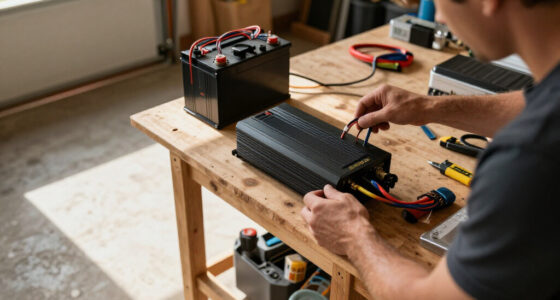
Solar-powered attic fans use sunlight to move hot air out of an attic, but the right choice depends on roof layout, ventilation, and whether you need airflow after dark. My best overall pick is the iLIVING 14-Inch Hybrid-Ready Solar Roof Attic Exhaust Fan for its smart thermostat and hybrid-ready design; the OmniPV Smart Hybrid stands out for higher stated airflow, while the PEAKROCK 25W suits smaller spaces. Higher CFM figures can move more air, yet they do not guarantee better cooling if intake vents are limited or the fan is poorly matched to the attic. Solar-only models also depend on available sun, while hybrid options can offer another power path. Continue reading for my full comparison and advice on matching a fan to your home.

Get backup power and energy gear delivered free with Prime
- Fast, free delivery on millions of items
- Prime Video, Amazon Music and more included
- Member-only deals all year
Key Takeaways
- Hybrid-ready control is a meaningful differentiator: iLIVING and OmniPV pair solar operation with a path to grid power, which can help buyers who want more consistent operation than a solar-only setup.
- Stated airflow spans very different jobs: the PEAKROCK is rated at 430 CFM, while several 40W to 50W options claim substantially higher output; choose by attic size and vent capacity rather than wattage alone.
- Remote controls and thermostats add convenience, not ventilation capacity: compare the VEVOR remote-control models and thermostat-equipped options by their airflow and power setup too.
- Mounting style can narrow the field quickly: most listed fans are roof-mount models, while the VEVOR 14-Inch Gable Mount is designed for a gable opening and may suit homes where roof penetration is undesirable.
- Battery and adapter details matter for less sunny conditions: the Windfox lists a battery, while several models include an adapter or dual-power feature; check what backup power actually supports before choosing.
| Windfox 10-Inch Solar Exhaust Fan with Battery and Dual Solar Panels |  | Best for After-Sunset Ventilation | Fan diameter: 10 inches | Maximum airflow: 1,020 CFM | Solar panels: Two 20W monocrystalline panels | VIEW LATEST PRICE | See Our Full Breakdown |
| 40W Solar Attic Fan with Thermostat, 12-Inch Roof Vent, 2000 CFM, Dual Power Auto-Switch |  | Best for High-Airflow, Dual-Power Operation | Wattage: 40 watts | Fan diameter: 12 inches | Maximum airflow: 2,000 CFM | VIEW LATEST PRICE | See Our Full Breakdown |
| Remington Solar 30-Watt Roof-Mount Solar Attic Fan |  | Best for Automatic Temperature and Humidity Control | Wattage: 30 watts | Airflow capacity: 1,550 CFM | Mounting type: Roof mount | VIEW LATEST PRICE | See Our Full Breakdown |
| PEAKROCK 25W Solar-Powered Exhaust Fan, 430 CFM, with 12V Monocrystalline Solar Panel |  | Best Compact Battery-Free Pick | Maximum power: 25 watts | Output voltage: 12V DC | Airflow: Up to 430 CFM | VIEW LATEST PRICE | See Our Full Breakdown |
| 40W Solar-Powered Attic Exhaust Fan, 12-Inch, 2000 CFM |  | Best for Simple Roof-Mount Installation | Solar panel wattage: 40 watts | Blade size: 12 inches | Airflow capacity: Up to 2,000 CFM | VIEW LATEST PRICE | See Our Full Breakdown |
| 32W Solar Attic Fan, 1600 CFM, Weatherproof Roof Vent |  | Best for Harsh Weather | Power: 32W | Airflow: 1600 CFM | Solar panel: Integrated monocrystalline | VIEW LATEST PRICE | See Our Full Breakdown |
| VEVOR 35W Solar Attic Fan with Thermostat, 2400 CFM |  | Best Thermostat-Controlled Value | Power: 35W | Airflow: Up to 2400 CFM | Controller: MPPT | VIEW LATEST PRICE | See Our Full Breakdown |
| 25W Solar-Powered 8-Inch Exhaust Fan Kit with Adapter and Mounting Bracket |  | Best for Sheds and Small Outbuildings | Fan size: 8 inches | Solar panel: 25W monocrystalline; 21.5% stated conversion efficiency | Airflow: Up to 430 CFM | VIEW LATEST PRICE | See Our Full Breakdown |
| iLIVING 14-Inch Hybrid-Ready Solar Roof Attic Exhaust Fan with Smart Thermostat, 40W, 1150 CFM, Black |  | Best for Adjustable Temperature Control | Fan diameter: 14 inches | Power: 40W | Airflow: 1150 CFM | VIEW LATEST PRICE | See Our Full Breakdown |
| VEVOR 42W Solar Attic Fan with Remote Control, 2800 CFM |  | Best Feature-Rich Hybrid Pick | Power: 42W | Airflow: Up to 2800 CFM | Power source: Solar; 110V adapter included | VIEW LATEST PRICE | See Our Full Breakdown |
| 35W Solar Attic Fan with 110V Adapter, Remote Control, and 1600 CFM Airflow |  | Best for Flexible Day and Night Operation | Solar power: 35 watts | Power source: Solar and 110V AC | Airflow capacity: Up to 1600 CFM | VIEW LATEST PRICE | See Our Full Breakdown |
| DC HOUSE 32W Solar-Powered Attic Exhaust Fan |  | Best Daytime Airflow Value | Solar power: 32 watts | Power source: Solar powered | Airflow capacity: 2400–2500 CFM stated | VIEW LATEST PRICE | See Our Full Breakdown |
| VEVOR 50W Solar Attic Fan with Remote Control |  | Best for High-Capacity Smart Controls | Solar power: 50 watts | Airflow capacity: Up to 3000 CFM | Motor: Brushless DC | VIEW LATEST PRICE | See Our Full Breakdown |
| OmniPV Smart Hybrid Solar Attic Exhaust Fan, 2850 CFM, 50W Solar Panel |  | Best for Adjustable Panel Positioning | Solar panel: 50 watts | Power source: Solar; includes 12V 2A AC adapter | Airflow capacity: Up to 2850 CFM | VIEW LATEST PRICE | See Our Full Breakdown |
| VEVOR 14-Inch Solar-Powered Gable Mount Attic Exhaust Fan, 1300 CFM, Black |  | Best Gable-Mount Pick | Fan diameter: 14 inches | Airflow capacity: 1300 CFM | Recommended coverage: Up to 1850 square feet | VIEW LATEST PRICE | See Our Full Breakdown |
| solar powered attic fan | Motor |
|---|---|
| Windfox 10-Inch Solar Exhaust | — |
| 40W Solar Attic Fan with Therm | — |
| Remington Solar 30-Watt Roof-M | Brushless |
| PEAKROCK 25W Solar-Powered Exh | — |
| 40W Solar-Powered Attic Exhaus | Pure copper |
| 32W Solar Attic Fan | 100% copper brushless; IP68-rated |
| VEVOR 35W Solar Attic Fan with | Brushless DC |
| 25W Solar-Powered 8-Inch Exhau | — |
| iLIVING 14-Inch Hybrid-Ready S | — |
| VEVOR 42W Solar Attic Fan with | — |
| 35W Solar Attic Fan with 110V | Brushless DC |
| DC HOUSE 32W Solar-Powered Att | Brushless |
| VEVOR 50W Solar Attic Fan with | Brushless DC |
| OmniPV Smart Hybrid Solar Atti | Brushless DC |
| VEVOR 14-Inch Solar-Powered Ga | Brushless |
More Details on Our Top Picks
Windfox 10-Inch Solar Exhaust Fan with Battery and Dual Solar Panels
I’d choose the Windfox when ventilation needs to continue after direct sunlight fades. Its 60Wh battery is listed for more than 10 hours at the default setting, a meaningful advantage over the battery-free PEAKROCK 25W fan, which runs only when sunlight is available. Two adjustable 20W panels and a remote with 12 speeds and timer controls also give buyers more control over placement and airflow than the simpler PEAKROCK setup. The tradeoff is that Windfox’s 1,020 CFM maximum is below the 2,000 CFM listed for the DuskSnug 40W roof fan, so it is less suited to buyers prioritizing maximum airflow for a large attic. Its stated runtime applies to the default speed, not necessarily higher settings, and ongoing use still depends on solar charging.
Pros:- 60Wh battery is listed to run for 10+ hours at the default setting.
- Two adjustable 20W solar panels offer flexibility when positioning the fan and panels.
- Remote provides 12 speed settings and timer controls.
- Metal housing, aluminum blades, and a brushless copper motor are designed for outdoor use.
Cons:- The 1,020 CFM maximum is lower than the listed airflow of the DuskSnug 40W roof fan.
- Battery runtime is specified at the default speed, so higher-speed runtime may be shorter.
- Solar charging remains necessary for ongoing operation.
Best for: Owners of sheds, garages, greenhouses, or smaller attic spaces who want battery-backed airflow and remote speed control after daylight.
Not ideal for: Buyers ventilating a large attic who prioritize the highest listed airflow, or anyone who needs predictable operation without relying on solar charging.
- Fan diameter:10 inches
- Maximum airflow:1,020 CFM
- Solar panels:Two 20W monocrystalline panels
- Battery capacity:60Wh
- Listed battery runtime:10+ hours at default speed
- Speed settings:12
- Mounting type:Wall mount
- Housing and blades:Metal housing; aluminum blades
Our verdict“Choose Windfox for adjustable, battery-backed ventilation in a smaller space, but choose a higher-airflow model for a large attic.”
40W Solar Attic Fan with Thermostat, 12-Inch Roof Vent, 2000 CFM, Dual Power Auto-Switch
This 12-inch fan stands out for combining up to 2,000 CFM with a thermostat and an included AC/DC adapter. When the adapter is connected, the unit can switch between solar and household power, unlike the battery-free DuskSnug 40W fan, which is described as running automatically in sunlight. That makes this a stronger fit for buyers who want a backup power route rather than battery storage. The adjustable panel and four speeds let owners adapt panel placement and airflow, while the thermostat range spans 68–113°F. The compromises are clear: there is no battery backup, and Mode 2 requires the adapter. Compared with the Remington Solar 30-watt roof fan, this model lists higher airflow, but its wall-mount design may not suit a roof-only installation plan.
Pros:- Lists up to 2,000 CFM and coverage for spaces up to 2,500 square feet.
- Included AC/DC adapter enables household-power operation and automatic source switching when connected.
- Adjustable thermostat and four speeds offer more operating control than the DuskSnug fan’s automatic sunlight operation.
- Solar panel adjusts horizontally and vertically for flexible positioning.
Cons:- No battery backup is included for operation when solar power is unavailable.
- Mode 2 requires the AC/DC adapter.
- Wall mounting may not fit buyers planning a roof-mounted attic installation.
Best for: Owners of larger garages, workshops, or attic spaces who want thermostat control, substantial listed airflow, and the option to use household power.
Not ideal for: Buyers who need stored energy for operation after sunlight fades, or those specifically seeking a roof-mounted fan.
- Wattage:40 watts
- Fan diameter:12 inches
- Maximum airflow:2,000 CFM
- Listed coverage:Up to 2,500 sq. ft.
- Speeds:4
- Thermostat range:68–113°F
- Solar panel adjustment:0–70° horizontally and vertically
- Mounting type:Wall mount
- Power backup:AC/DC adapter included; no battery backup
Our verdict“Pick this model if you want high listed airflow and an included household-power option, but not if battery-backed nighttime operation is a requirement.”
Remington Solar 30-Watt Roof-Mount Solar Attic Fan
I’d put the Remington Solar on the shortlist for buyers who prefer a roof-mounted attic fan that adjusts itself to temperature and humidity. Its built-in thermostat and humidistat provide automatic control, while the brushless motor is listed at 0.08 sones, making quiet operation a central part of its appeal. Compared with the DuskSnug 40W fan, Remington supplies more automatic sensing, while DuskSnug lists higher airflow at 2,000 CFM and uses a simpler plug-and-play setup. Remington’s listed 1,550 CFM sits between that model and the Windfox wall fan’s 1,020 CFM. The main limitation is nighttime operation: the hybrid adapter is sold separately, so this isn’t a battery-backed choice out of the box. Its 30-pound roof-mounted form also calls for suitable roof access and installation planning.
Pros:- Built-in thermostat and humidistat adjust ventilation automatically.
- Brushless motor is listed at 0.08 sones.
- Steel flashing and weather-resistant construction are suited to roof installation.
- DIY installation and a limited lifetime warranty are listed.
Cons:- Nighttime operation requires a separately sold hybrid adapter.
- Roof mounting and 30-pound weight may complicate installation for some homeowners.
- Its listed 1,550 CFM is below the 2,000 CFM specified for the DuskSnug 40W fan.
Best for: Homeowners seeking a roof-mounted attic fan that can respond automatically to heat and humidity, with quiet operation as a priority.
Not ideal for: Buyers who want battery-backed or included nighttime operation, or who need a wall-mounted fan for a shed or garage.
- Wattage:30 watts
- Airflow capacity:1,550 CFM
- Mounting type:Roof mount
- Controls:Built-in thermostat and humidistat
- Motor:Brushless
- Noise level:0.08 sones
- Flashing dimensions:22.5 × 22.5 inches
- Weight:30 pounds
- Certification:Texas Windstorm certified
Our verdict“Choose Remington for quiet, automatic roof ventilation keyed to temperature and humidity, provided solar-only daytime operation meets your needs.”
PEAKROCK 25W Solar-Powered Exhaust Fan, 430 CFM, with 12V Monocrystalline Solar Panel
The PEAKROCK is the straightforward choice when a small outbuilding needs ventilation only while the sun is shining. Its 25W panel powers up to 430 CFM without batteries or household wiring, avoiding the added power setup of the Windfox and the AC adapter included with the 40W dual-power fan. A 13 × 13-inch footprint, UV-stabilized ABS housing, and dual-layer safety mesh suit applications such as a shed, chicken coop, or RV where a compact outdoor fan may be more useful than a high-capacity attic unit. That compactness brings a real airflow limit: its stated output is far below the 1,020 CFM Windfox and the 2,000 CFM DuskSnug. With no battery, operation follows available sunlight, so it won’t provide ventilation after dark.
Pros:- Operates on solar power without a battery or household-electric connection.
- Compact 13 × 13-inch footprint suits smaller outbuildings and utility spaces.
- UV-stabilized ABS housing and a corrosion-resistant grill are designed for outdoor use.
- Dual-layer safety mesh helps protect birds and small animals from the blades.
Cons:- Maximum listed airflow of 430 CFM is well below the Windfox and DuskSnug models.
- Fan operation depends on direct sunlight.
- No battery backup is available for night or low-sun operation.
Best for: Owners of small sheds, chicken coops, greenhouses, or RVs who want simple, battery-free ventilation during sunny conditions.
Not ideal for: People ventilating a large attic or needing airflow to continue through cloudy periods or after sunset.
- Maximum power:25 watts
- Output voltage:12V DC
- Airflow:Up to 430 CFM
- Motor speed:2,500 RPM
- Solar panel:12V monocrystalline
- Dimensions:13 × 13 inches
- Ingress protection:IP65, as stated in the product description
- Housing:UV-stabilized ABS
- Safety feature:Dual-layer safety mesh
Our verdict“Choose PEAKROCK for compact, sun-dependent ventilation in a small space, not for a large attic or round-the-clock airflow.”
40W Solar-Powered Attic Exhaust Fan, 12-Inch, 2000 CFM
The DuskSnug is the simplest fit here for buyers who want a roof-mounted fan that runs automatically in sunlight. Its panel and fan arrive pre-connected, and the product is described as plug-and-play, avoiding the thermostat, remote, and adapter decisions attached to the 40W dual-power wall fan. It also lists 2,000 CFM, matching that model’s stated maximum airflow and exceeding the Remington Solar’s 1,550 CFM. The tradeoff is less control: DuskSnug has no separate controller listed and depends on sunlight, while the dual-power model offers four speeds, thermostat control, and an AC/DC adapter. Its 25.4-pound weight and roof-mount design also mean DIY setup still requires safe roof access and appropriate preparation. I’d favor it for a straightforward roof installation, not for buyers seeking battery-backed or adjustable operation.
Pros:- Lists up to 2,000 CFM of airflow from a 40W solar panel.
- Pre-connected panel and fan simplify the setup compared with a system requiring separate wiring.
- Automatic sunlight operation avoids the need for a separate controller.
- Metal housing and a copper motor are designed for outdoor use.
Cons:- Operation depends on sunlight, with no battery backup listed.
- No thermostat, speed control, or remote is specified, unlike the 40W dual-power model.
- Roof mounting, 25.4-pound weight, and DIY installation require suitable access and preparation.
Best for: Homeowners with a suitable roof installation point who want high listed airflow and a pre-connected solar panel for a simpler setup.
Not ideal for: Buyers who need battery backup, thermostat or remote control, or a wall-mounted fan for a shed or garage.
- Solar panel wattage:40 watts
- Blade size:12 inches
- Airflow capacity:Up to 2,000 CFM
- Mounting type:Roof mount
- Installation:DIY, plug-and-play
- Material:Metal
- Motor:Pure copper
- Weather resistance:IP65
- Dimensions:19.29 × 19.29 × 8.07 inches
Our verdict“Pick DuskSnug for a high-airflow roof fan with a simple solar setup, but choose a controlled or battery-backed model for more flexible operation.”
32W Solar Attic Fan, 1600 CFM, Weatherproof Roof Vent
I’d shortlist this model for buyers who put weather resistance ahead of controls or backup power. Its 1600 CFM airflow is higher than the iLIVING 14-Inch fan’s 1150 CFM, while the 130 mph wind-resistance rating and IP68-rated motor speak to demanding roof exposure. The factory-connected solar panel and fan make the setup straightforward, with no household wiring connection described. That simplicity also limits flexibility: the roof location needs strong, direct sunlight, and there’s no separate panel placement or alternate-power arrangement listed. Compared with the VEVOR 42W model, this fan gives up remote controls, humidity settings, and an included 110V adapter. I’d choose it for a sun-exposed roof where rugged construction matters more than adjustable operation or cloudy-day backup.
Pros:- 1600 CFM airflow offers more capacity than the iLIVING 14-Inch model’s 1150 CFM.
- Rated for wind up to 130 mph and an operating range of -40°F to 150°F.
- IP68-rated motor and corrosion-proof mounting system are suited to outdoor exposure.
- Integrated panel and fan avoid a separate household power connection.
Cons:- Solar operation depends on strong, direct sunlight at the roof location.
- The factory-connected panel and fan offer no separate panel placement setup.
- No thermostat, remote, or alternate-power adapter is listed.
Best for: Homeowners with a sunny roof in a high-wind or wide-temperature area who want a weather-resistant fan without household electrical wiring.
Not ideal for: Buyers who need operation during low-sun periods or want to position the solar panel separately from the roof fan.
- Power:32W
- Airflow:1600 CFM
- Solar panel:Integrated monocrystalline
- Motor:100% copper brushless; IP68-rated
- Noise level:43 dB
- Wind resistance:Up to 130 mph
- Operating temperature:-40°F to 150°F
- Housing and blades:Impact-resistant steel housing; reinforced aluminum alloy blades
Our verdict“Choose this fan for a sunny, weather-exposed roof where rugged construction and 1600 CFM matter more than controls or backup power.”
VEVOR 35W Solar Attic Fan with Thermostat, 2400 CFM
The VEVOR 35W makes a strong case for buyers who want substantial airflow with automatic temperature-based operation, but don’t need a remote or backup adapter. Its 2400 CFM capacity exceeds the 32W Solar Attic Fan’s 1600 CFM, and the built-in thermostat starts the fan above 79°F, so it can respond to attic heat without manual switching. The 35W MPPT controller and brushless DC motor support its solar setup, while the adjustable, weather-resistant panel helps with sun positioning. Compared with the VEVOR 42W model, this one is simpler: it lacks that model’s remote, humidity controls, smoke detection, and included 110V adapter. I’d favor it for a suitable metal or masonry roof when automatic heat response matters more than all-weather control.
Pros:- 2400 CFM capacity is higher than the 32W Solar Attic Fan’s 1600 CFM.
- Thermostat activates the fan above 79°F without requiring manual switching.
- MPPT controller and brushless DC motor are paired with solar operation.
- Adjustable, weather-resistant panel can be positioned for outdoor sun exposure.
Cons:- No remote control is included.
- Operation depends on sunlight; no backup adapter is listed.
- Listed roof compatibility is limited to metal and masonry.
Best for: Homeowners with a metal or masonry roof who want high airflow and automatic attic-temperature activation without adding household power.
Not ideal for: Buyers who want remote operation, humidity or smoke controls, or fan operation when sunlight is unavailable.
- Power:35W
- Airflow:Up to 2400 CFM
- Controller:MPPT
- Motor:Brushless DC
- Thermostat activation:79°F (26°C)
- Mounting:Roof mount
- Compatible roof types:Metal and masonry
- Dimensions and weight:22.2 x 22.2 x 9.6 inches; 22.5 pounds
Our verdict“Pick this model for automatic, high-airflow solar ventilation on a compatible roof if you can do without remote and backup-power features.”
25W Solar-Powered 8-Inch Exhaust Fan Kit with Adapter and Mounting Bracket
This kit is the small-space pick in a lineup otherwise focused on roof-mounted attic fans. Its 430 CFM output and recommended 100–250 sq. ft. area suit a shed, greenhouse, or coop better than a large attic; the 32W Solar Attic Fan’s 1600 CFM is a more appropriate starting point for buyers prioritizing higher-volume roof ventilation. The kit adds useful flexibility with a 25W monocrystalline panel, an AC adapter, and a 16.4-foot panel cable, so the panel need not sit directly beside the fan. An anti-backflow valve helps limit insects and debris entering when it’s off. The tradeoff is installation: this is a wall-mount fan, not a roof-ready attic unit, and fitting it requires drilling a 7-inch hole. I’d skip it for large attic spaces.
Pros:- 430 CFM output and stated 100–250 sq. ft. range suit smaller enclosed spaces.
- Includes both a solar panel and AC adapter for two power options.
- 16.4-foot panel cable allows more flexibility in panel placement.
- Anti-backflow valve helps block insects and debris when the fan is off.
Cons:- Wall-mount design and 430 CFM output are less suited to large attic ventilation than the 32W Solar Attic Fan.
- Installation requires drilling a 7-inch hole.
- Actual airflow and coverage can vary with sunlight and enclosure resistance.
Best for: Owners of sheds, greenhouses, coops, or other small outbuildings who want a wall-mounted solar fan with an AC power option.
Not ideal for: Homeowners seeking a roof-mounted fan for a large attic or anyone who cannot cut a 7-inch wall opening.
- Fan size:8 inches
- Solar panel:25W monocrystalline; 21.5% stated conversion efficiency
- Airflow:Up to 430 CFM
- Motor and speed:Brushless; 2300 RPM
- Noise level:≤36 dB
- Power options:Solar; AC adapter included
- Recommended space:Approximately 100–250 sq. ft.
- Mounting and included parts:Wall mount; adjustable bracket, screws, AC adapter, anti-backflow valve
Our verdict“Choose this kit for a small outbuilding needing flexible solar or AC ventilation, not as a substitute for a high-capacity roof attic fan.”
iLIVING 14-Inch Hybrid-Ready Solar Roof Attic Exhaust Fan with Smart Thermostat, 40W, 1150 CFM, Black
I’d pick the iLIVING for buyers who want more control over thermostat settings than the simpler VEVOR 35W model provides. Its 50°F–122°F thermostat range includes an enable/disable feature, and the solar panel tilts to four positions to suit roof exposure. The tradeoff is airflow: at 1150 CFM, it falls below the 1600 CFM 32W Solar Attic Fan and well below the VEVOR 35W’s 2400 CFM. The stated coverage reaches up to 2,900 sq. ft., but that figure shouldn’t be read as a direct comparison of ventilation capacity alone. This fan runs at one speed, and its optional AC/DC adapter for continuous operation is sold separately. I’d favor its thermostat flexibility and long stated warranty over raw airflow or included backup power.
Pros:- Thermostat range from 50°F to 122°F includes an enable/disable feature.
- Solar panel adjusts to 0°, 15°, 30°, or 45° tilt.
- IP68 waterproof brushless motor is designed for roof exposure.
- Includes a 15-year limited manufacturer warranty.
Cons:- 1150 CFM is below the 32W Solar Attic Fan’s 1600 CFM and VEVOR 35W’s 2400 CFM.
- Continuous AC/DC operation requires a separately sold adapter.
- Only one speed and one power level are listed; noise level is 65 dB.
Best for: Homeowners who want a roof-mounted solar fan with a broad adjustable thermostat range and a panel that can be tilted to suit roof exposure.
Not ideal for: Buyers prioritizing higher listed CFM, multiple fan speeds, or continuous AC operation without buying a separate adapter.
- Fan diameter:14 inches
- Power:40W
- Airflow:1150 CFM
- Stated coverage:Up to 2,900 sq. ft.
- Solar panel:Adjustable polycrystalline; 0°, 15°, 30°, or 45° tilt
- Thermostat range:50°F–122°F
- Motor and noise:Brushless; 65 dB
- Warranty and adapter:15-year limited manufacturer warranty; AC/DC adapter sold separately
Our verdict“Choose the iLIVING for adjustable thermostat control and panel positioning, but pick a higher-CFM model if airflow capacity is your priority.”
VEVOR 42W Solar Attic Fan with Remote Control, 2800 CFM
Among these five, the VEVOR 42W is the most flexible choice when sunlight alone may not suit the operating schedule. It pairs up to 2800 CFM with three speeds, remote operation, temperature and humidity controls, smoke detection, and an included 110V adapter. That gives it a broader control and backup-power package than the VEVOR 35W, which reaches 2400 CFM but has no remote or adapter listed. The extra features come with compromises: the listed 60 dB noise level may matter near living areas, and its temperature control switches on above and off below 26°C. It is also more involved than the simple, directly connected 32W Solar Attic Fan. I’d choose this one when controls and alternate power justify the added complexity.
Pros:- Up to 2800 CFM exceeds the VEVOR 35W model’s 2400 CFM.
- Remote control and three speeds provide more operating flexibility than the VEVOR 35W.
- Temperature and humidity controls plus smoke detection add monitoring features.
- Included 110V adapter allows operation when solar power is unavailable.
Cons:- Listed 60 dB noise level may be a drawback near occupied rooms.
- Temperature control is specified to switch on above and off below 26°C.
- The added controls and alternate-power setup are less simple than the directly connected 32W fan.
Best for: Homeowners who want strong roof ventilation with remote, temperature and humidity controls, smoke detection, and an included AC power option.
Not ideal for: Buyers seeking the quietest or simplest solar-only setup, or those without a suitable metal or masonry roof.
- Power:42W
- Airflow:Up to 2800 CFM
- Power source:Solar; 110V adapter included
- Motor and speeds:Brushless DC; 3 speeds
- Controls:Remote; temperature and humidity controller
- Temperature control:Turns on above 26°C and off below 26°C
- Additional features:Smoke detection; adjustable weather-resistant solar panel
- Noise and dimensions:60 dB; 22.2 x 22.2 x 9.7 inches
Our verdict“Pick this VEVOR when you want high airflow, remote controls, and an included AC backup option, and can accept its listed noise level.”
35W Solar Attic Fan with 110V Adapter, Remote Control, and 1600 CFM Airflow
The included 110V AC adapter gives this 35W fan an advantage over the DC HOUSE 32W Solar-Powered Attic Exhaust Fan, which runs only in daylight. That backup can keep ventilation going when sunlight fades, while the 1600 CFM airflow is aimed at spaces up to 2,500 square feet. A brushless motor, remote, and automatic temperature control add useful operating options without requiring manual switching for every temperature change. Its aluminum alloy housing is specified for several roof materials, which broadens installation fit. The tradeoff is that this remains a roof-mounted installation, and its thermostat uses fixed thresholds: it turns on above 26°C and off below 24°C. Buyers who want adjustable temperature settings or more airflow should compare it with higher-capacity hybrid models.
Pros:- Solar and 110V AC operation support ventilation when sunlight is unavailable.
- Rated for up to 1600 CFM and spaces up to 2500 square feet.
- Remote control and automatic temperature control provide two ways to manage operation.
- Aluminum alloy housing is listed for metal, masonry, asphalt shingle, and wood roofs.
Cons:- Roof mounting requires installation work and roof compatibility checks.
- The automatic thermostat uses preset 26°C and 24°C thresholds.
- Its airflow rating is lower than the DC HOUSE and VEVOR 50W models.
Best for: Homeowners with a roof-mounted attic who want solar ventilation by day and included AC operation when sunlight is weak or unavailable.
Not ideal for: Buyers seeking a wall or gable installation, a larger airflow rating, or user-adjustable thermostat thresholds.
- Solar power:35 watts
- Power source:Solar and 110V AC
- Airflow capacity:Up to 1600 CFM
- Recommended coverage:Up to 2500 square feet
- Fan size:12 inches
- Motor:Brushless DC
- Mounting:Roof mount
- Temperature control:On above 26°C; off below 24°C
Our verdict“Choose this fan if you want moderate airflow with included AC backup for times when solar power is insufficient.”
DC HOUSE 32W Solar-Powered Attic Exhaust Fan
The DC HOUSE pairs 32W solar power with a stated airflow range of 2,400–2,500 CFM, giving it a higher listed capacity than the 35W RYLENE fan despite using less wattage. Its coverage claim reaches up to 3,000 square feet, so it may suit larger spaces that need daytime exhaust without drawing household electricity. The brushless motor, five aluminum blades, and metal housing are specified for outdoor use; the listed 43 dB noise level also gives buyers a reference when comparing fan sound. Its main limitation is the power source: it switches off at night and has no listed AC backup. The airflow figure is also inconsistent across the product data, so I would treat the 2,400–2,500 CFM rating as an approximate range rather than a single confirmed output.
Pros:- 32W solar panel is paired with a listed 2400–2500 CFM airflow range.
- Coverage is specified up to 3000 square feet.
- Brushless motor and five aluminum blades are designed for outdoor ventilation.
- Includes mounting brackets and installation hardware.
Cons:- Solar operation stops at night, with no AC backup listed.
- Airflow is stated inconsistently as 2400 or 2500 CFM.
- Roof mounting requires installation and suitable roof placement.
Best for: Owners of larger attics, sheds, or workshops who mainly need solar-powered ventilation during daylight hours.
Not ideal for: Buyers who need night or cloudy-weather operation, or who require a clearly specified airflow rating and backup power.
- Solar power:32 watts
- Power source:Solar powered
- Airflow capacity:2400–2500 CFM stated
- Coverage:Up to 3000 square feet
- Motor:Brushless
- Blades:5 aluminum blades
- Noise level:43 dB
- Mounting:Fixed roof mount
Our verdict“Pick the DC HOUSE for substantial daytime airflow across a larger space if you can accept that it stops when sunlight is gone.”
VEVOR 50W Solar Attic Fan with Remote Control
With up to 3000 CFM, the VEVOR is the highest-capacity option in this group, edging out the DC HOUSE’s stated 2,400–2,500 CFM range. Its 50W MPPT controller is paired with temperature and humidity controls, so the fan can respond to more than heat alone. A smoke sensor that shuts the fan off adds a distinct safety response, while solar-to-electrical switching is intended to extend operation after sunset. The adjustable-angle panel and remote make it more configurable than the simpler RYLENE 35W model. The key catch is incomplete information about the electrical backup: the listed data does not say what supply is required. It is also a roof-only installation, and its metal or masonry roof compatibility is narrower than the RYLENE’s listed options.
Pros:- Rated for up to 3000 CFM with a 50W MPPT solar controller.
- Temperature and humidity controls can respond to multiple indoor conditions.
- Smoke detection triggers automatic fan shutoff.
- Solar-to-electrical switching and an adjustable-angle panel support varied operating conditions.
Cons:- Electrical backup power requirements are not specified in the product data.
- Installation is roof-mounted and listed for metal or masonry roofs.
- Its 19-pound weight and roof installation may require more planning than a smaller fan.
Best for: Owners of larger attics or workspaces who want high airflow, humidity response, and remote access to fan controls.
Not ideal for: Buyers who need clearly documented backup wiring requirements or a fan for shingle or wood roofs.
- Solar power:50 watts
- Airflow capacity:Up to 3000 CFM
- Motor:Brushless DC
- Blades:5; 12-inch blade length
- Mounting:Roof mount
- Controls:Remote control; temperature and humidity control
- Smoke feature:Smoke detection with automatic shutoff
- Weight:19 pounds
Our verdict“Choose this VEVOR when airflow and sensor-based controls matter more than having fully documented backup power details.”
OmniPV Smart Hybrid Solar Attic Exhaust Fan, 2850 CFM, 50W Solar Panel
The OmniPV combines 2850 CFM airflow with a 50W panel and an included 12V 2A AC adapter, making it a straightforward hybrid alternative to the VEVOR 50W fan. Its capacity is slightly lower than VEVOR’s 3000 CFM claim, but the OmniPV specifies a broad thermostat range of 50–104°F and offers either automatic temperature control or continuous operation through a wall switch. The panel’s horizontal and vertical adjustment ranges can help installers orient it around roof conditions, while rust-resistant aluminum construction and included stainless steel cables address outdoor exposure and wind securing. This model is listed for coverage up to 4,000 square feet, though buyers should match that claim to their space and ventilation needs. It still requires roof work, and solar operation depends on available light unless the AC adapter is used.
Pros:- 50W solar panel and included 12V 2A AC adapter support hybrid operation.
- Rated for 2850 CFM and coverage up to 4000 square feet.
- Panel adjusts horizontally and vertically to suit installation angles.
- Wall switch offers automatic temperature control or continuous operation.
Cons:- Roof mounting requires installation work and compatible placement.
- Solar operation depends on sunlight unless the AC adapter is used.
- Airflow is slightly below the VEVOR 50W model’s stated 3000 CFM.
Best for: Homeowners or facility operators who want a hybrid roof fan with adjustable panel positioning and a choice between thermostat or continuous operation.
Not ideal for: Buyers who need a wall-mounted option, sensor features such as humidity or smoke detection, or solar operation independent of sunlight.
- Solar panel:50 watts
- Power source:Solar; includes 12V 2A AC adapter
- Airflow capacity:Up to 2850 CFM
- Coverage:Up to 4000 square feet
- Motor:Brushless DC
- Thermostat range:50–104°F
- Panel adjustment:45° horizontally; 0–60° vertically
- Mounting:Roof mounted
Our verdict“The OmniPV suits buyers who value adjustable panel placement and specified AC backup over the VEVOR’s higher airflow and extra sensors.”
VEVOR 14-Inch Solar-Powered Gable Mount Attic Exhaust Fan, 1300 CFM, Black
Unlike the four roof-mounted fans here, this VEVOR is designed for gable wall mounting, which can make it a better fit when a roof installation is impractical or unwanted. Its 1300 CFM rating and coverage claim of up to 1,850 square feet place it below the RYLENE 35W fan’s 1600 CFM and 2,500-square-foot rating, so it is better suited to smaller spaces. The adjustable thermostat can manage operation by ambient temperature, and a protective mesh helps keep birds, leaves, and debris away from the fan. Steel housing with aluminum alloy blades gives it a different material mix from the aluminum roof models. The tradeoff is a single speed and a solar-only power source, with no listed AC backup for night operation.
Pros:- Gable wall mounting offers an alternative to roof-mounted installation.
- 1300 CFM rating is specified for spaces up to 1850 square feet.
- Adjustable thermostat responds to ambient temperature.
- Protective mesh helps block birds, leaves, and debris.
Cons:- One fan speed limits airflow adjustment.
- Solar-only power means operation depends on available sunlight.
- Lower airflow and coverage than the RYLENE 35W roof-mounted model.
Best for: Owners of smaller attics, garages, or workshops with a suitable gable wall who want solar ventilation without roof mounting.
Not ideal for: Buyers needing higher airflow, multiple fan speeds, or continued operation after sunset and during low-sun conditions.
- Fan diameter:14 inches
- Airflow capacity:1300 CFM
- Recommended coverage:Up to 1850 square feet
- Solar power:45 watts
- Motor:Brushless
- Speed:1 speed; 1600 RPM
- Noise level:45 dB
- Mounting:Wall mount
Our verdict“Choose this VEVOR if your attic has a suitable gable opening and you prefer wall mounting over a roof installation.”

How We Picked
I compared the 15 listed fans on the factors that change the buying decision: stated airflow, solar panel wattage, power flexibility, controls, mounting format, and the information available about each model. I gave more weight to options whose listed features address common attic needs, such as thermostat control, hybrid power, or a distinct gable-mount format. CFM and wattage are useful comparison points, but they do not establish real-world cooling on their own; attic size, sun exposure, intake ventilation, and installation all affect results.
The order reflects fit and versatility, not a claim that one fan suits every home. The iLIVING ranks first for its combination of hybrid-ready operation and smart thermostat, while OmniPV and the higher-output VEVOR models make stronger cases for buyers prioritizing stated airflow or remote control. Compact kits and lower-CFM fans rank better for focused or smaller applications than for whole-attic ventilation. Product details can vary by seller or model revision, so I would confirm included wiring, adapters, controls, and mounting hardware before purchase.
Factors to Consider When Choosing Solar Powered Attic Fans
I would start with the attic and its ventilation needs, then narrow the options by power and installation. A fan can only exhaust air that can enter through intake vents, and a large advertised airflow figure cannot make up for an undersized or poorly balanced vent system.
Match airflow to attic size and venting
Use the fan’s stated CFM as a comparison point, then check the manufacturer’s guidance for the attic area and ventilation conditions it supports. A higher CFM rating may be useful for a larger space, but the fan needs enough intake vent area to replace the air it exhausts. Without that path, airflow can be restricted or drawn from the living space through leaks. Buyers often focus on fan output and overlook soffit or other intake vents. If the attic has limited intake, address that constraint before choosing the largest unit. A ventilation professional can help assess unusual roof layouts or existing moisture issues.
Check sun exposure across the day
Solar panel wattage alone does not tell you how many hours a fan will run. Roof direction, shade from trees or neighboring structures, seasonal daylight, and panel placement all affect available power. A panel that receives strong midday sun may still provide little help during cloudy periods or late afternoon. Look for installation guidance on panel angle, cable length, and whether the panel can be positioned apart from the fan. Avoid assuming that a larger wattage rating guarantees steady operation in every climate. If the roof has persistent shade, compare hybrid or adapter-supported options.
Decide whether backup power is worth the added complexity
A solar-only fan keeps wiring simple, but its operation follows sunlight. Battery, adapter, or hybrid features may extend operation or provide another power source, though the exact behavior differs by product. Check whether backup power is included, sold separately, or only supported with an additional connection. Ask when the fan switches between power sources and whether the thermostat controls both modes. A feature described as hybrid-ready may still require extra equipment or electrical work. Choose this added flexibility when evening operation or variable sun is a real need.
Choose roof-mount or gable-mount around the house
Roof-mount fans require a suitable roof opening and careful flashing to keep water out. Gable-mount units use an existing or prepared gable opening, which can be a better fit when roof penetrations are difficult or unwanted. Neither format is automatically simpler: access, framing, clearances, wiring, and weather sealing determine the work involved. Check that the mounting dimensions match the opening and that the fan’s location will move air through the intended attic area. A fan mounted at one end may leave distant sections poorly ventilated. If you are unsure about cutting roofing or siding, plan for professional installation.
Treat controls as a usability feature
A thermostat can help the fan run in response to attic temperature rather than sunlight alone, while a remote can make adjustments easier after installation. These controls do not replace a correctly sized fan or adequate intake vents. Confirm whether the thermostat is built in, adjustable, and compatible with any backup power mode. For remote controls, check their operating range and whether basic fan operation remains possible if the remote is misplaced. Buyers who prefer a simple setup may value fewer components over extra controls. Those managing a hot attic with changing conditions may welcome the added adjustment options.
Compare installation and ongoing upkeep
Before buying, check what the kit includes: panel, brackets, roof flashing, wiring, thermostat, adapter, and fasteners may not all be supplied. Installation time and cost depend on roof access, existing openings, cable routing, and whether electrical backup is involved. Panels and fan openings also need periodic checks for leaves, dust, loose connections, or weather damage. A more complex setup can offer greater flexibility but adds parts that may need inspection. Review the warranty terms and replacement-part availability for the fan and panel separately. Clarifying these details before ordering helps avoid a kit that does not fit the planned installation.
Frequently Asked Questions
Will a solar attic fan work on a shaded roof?
It may run with limited sun, but output and operating time can fall when the panel is shaded. Check whether the panel can be placed in a sunnier location using the included cable or an approved extension. Compare hybrid or adapter-supported models if shade is unavoidable and you need more predictable operation. Confirm the wiring limits and power-switching behavior in the product instructions. Also assess whether trimming shade or relocating the panel is practical before choosing a higher-wattage unit.
Does a higher CFM rating mean an attic will stay cooler?
Not by itself. A fan’s stated CFM is only useful when the attic has enough intake ventilation and the fan is sized for the space. Poor intake can limit the air the fan moves, while an undersized fan may not exchange enough attic air. Roof design, insulation, air leaks, and climate also affect attic temperature. Compare ratings alongside the manufacturer’s sizing guidance and check the existing vent balance before selecting a high-output model.
Can I install a solar attic fan without cutting a new roof opening?
Possibly, if a compatible gable opening is available and the fan is designed for that mounting style. The listed VEVOR 14-Inch Gable Mount is one option to investigate for that setup. Verify opening dimensions, framing, clearance, and airflow direction before ordering. A roof-mount model generally needs an appropriate roof opening and weatherproof flashing. If no suitable opening exists, compare the installation work and sealing requirements for each location with a qualified installer.
Do I need a battery for a solar-powered attic fan?
No, a battery is not required for every solar fan, but solar-only operation typically follows available sunlight. A battery may allow operation beyond direct sun, depending on how the system is designed and whether storage is included. The Windfox listing identifies a battery, but buyers should verify its capacity and what runtime it supports. Adapter or hybrid features may offer a separate route to power without battery storage. Check the complete power setup rather than inferring nighttime operation from a product title.
Should I choose a fan with a thermostat or remote control?
A thermostat is useful when you want fan operation tied to attic temperature, while a remote can make manual adjustments easier. Neither feature guarantees better ventilation if the fan is poorly matched to the attic or lacks intake air. Check whether settings are adjustable and whether controls work in solar and backup modes. A simpler fan may be easier to install and maintain if you rarely need to change settings. Choose controls based on how you plan to operate the system, then compare airflow and mounting fit separately.
Conclusion
For a versatile roof-mount choice, I would start with the iLIVING 14-Inch Hybrid-Ready Solar Roof Attic Exhaust Fan, whose thermostat and hybrid-ready design set it apart from the solar-only entries. Buyers prioritizing a smart hybrid setup and high stated airflow should compare the OmniPV Smart Hybrid; those seeking a simpler, focused option can look at the PEAKROCK 25W or the 8-inch fan kit, while recognizing their more limited stated airflow. For remote operation, compare the VEVOR 42W and 50W models against their installation details and controls. Beginners should choose the format that matches an existing roof or gable opening and verify what the kit includes before purchasing. If your specific need is a gable installation, the VEVOR 14-Inch Gable Mount is the direct fit to investigate; for every option, confirm sun exposure, intake ventilation, and attic sizing first.