
Among these whole house surge protectors, I’d name the Square D HEPD80 my best overall pick for its 80kA capacity and broad panel compatibility, while the Eaton CHSPT2SURGE stands out for its NEMA 4 enclosure and the Leviton R2120-B for Type 1 installation. The right choice depends on more than a surge rating: your panel brand, installation location, enclosure, and electrician’s recommendation all matter. Some models are designed to fit specific breaker families, while others offer more flexible mounting. I also compare higher-capacity options with simpler, panel-matched devices so you can weigh protection against fit and installation needs. Read on for the full breakdown, buying advice, and answers to common selection questions.

Get backup power and energy gear delivered free with Prime
- Fast, free delivery on millions of items
- Prime Video, Amazon Music and more included
- Member-only deals all year
Key Takeaways
The Square D HEPD80 leads on listed surge capacity at 80kA, but its universal label does not replace checking the panel instructions and wiring requirements.
Installation type changes the shortlist: the Leviton R2120-B and ABB Thomasurge are Type 1 devices, while several other picks are Type 2 or panel-mounted devices.
Enclosure ratings affect placement: Eaton’s CHSPT2SURGE has a NEMA 4 enclosure, and several models list indoor and outdoor use; confirm the rating for the exact installation spot.
Breaker compatibility narrows the field: the Type BR and Homeline SurgeBreaker options are tied to particular panel families, so matching the device to your panel comes before comparing ratings.
Duplicate Type BR listings do not represent clear performance tiers: the roundup includes single-device and multi-pack listings, so buyers should verify the exact model and quantity before choosing.




| whole house surge protector | Voltage |
|---|---|
| Type BR Whole-Panel Circuit Br | 120/240V |
| Type BR Whole-Panel Circuit Br | — |
| Leviton Type 1 Surge Protectiv | — |
| ABB Thomesurge Whole Home Surg | 120/240V and 120/208V AC |
| Square D HEPD80 Universal Whol | 120/240V |
| Type BR Whole-Panel Circuit Br | — |
| Square D by Schneider Electric | 120/240V |
| Square D by Schneider Electric | 120/240V |
| Type BR Circuit Breaker Surge | Not specified |
| Eaton CHSPT2SURGE Type 2 Whole | 120/240 VAC |
| Siemens QSPD2A035B 35kA BoltSh | — |
| HSPD Square Whole Home Surge P | 120/240VAC |
| FHSPD108S Whole House Surge Pr | 120/240V |
| Eaton Surge Protection Device | 120/240V |
| Furniqro FHSPD36S Whole House | 120/240V |
More Details on Our Top Picks
Type BR Whole-Panel Circuit Breaker Surge Protective Device (3-Pack)
This three-device set suits homeowners with multiple compatible panels or a project that calls for more than one protected location. Each unit is rated for 18 kA and uses a pigtail connection, giving it a direct panel-based approach compared with the standalone Leviton R2120-B surge panel. The set’s advantage is coverage across several locations; its tradeoff is that the listing specifies Type BR compatibility, so it is not a universal fit for other panel families. The supplied details identify residential 120/240V use but provide little about warranty coverage or status monitoring. I’d choose this pack when the panel match is confirmed and multiple devices are useful; for a single installation, the one-pack Type BR model is the simpler choice.
Pros:- Three devices support protection at multiple compatible panels
- 18 kA surge current capacity per the supplied product description
- Pigtail installation connects directly within a compatible panel
- Designed for residential 120/240V systems
Cons:- Limited to Type BR panel compatibility
- No detailed warranty information is supplied
- Three units may be unnecessary for a one-panel home
Best for: Homeowners or electricians protecting several Type BR panels in one property or across multiple residential projects
Not ideal for: Owners with non-BR panels or a single panel who do not need three devices
- Number of units:3
- Surge current:18 kA
- Voltage:120/240V
- Installation:Pigtail
- Application:Residential whole-panel surge protection
- Panel compatibility:Type BR
Our verdict“Choose this set when you have several compatible Type BR panels to protect; for one panel, the single-unit Type BR device is a more targeted pick.”
Type BR Whole-Panel Circuit Breaker Surge Protective Device (1 Pack)
For a home with one compatible panel, this single Type BR device avoids buying the three-pack when only one installation is needed. Its 18 kA surge current rating matches the three-pack’s per-device rating, while the listing also specifies that it uses two branch circuit spaces. That space requirement is useful to check before choosing it, especially if the panel is crowded. Compared with the Leviton R2120-B, this is a panel-mounted breaker-style option rather than a separate Type 1 surge panel with stated LED monitoring and a NEMA 4X enclosure. The tradeoff is less detail about compatibility beyond Type BR, device lifespan, and status indication. It makes sense when you want one panel device and have the required spaces available.
Pros:- Single unit fits a one-panel installation
- 18 kA surge current rating
- Uses two branch circuit spaces, a clearly stated panel requirement
- Designed for whole-panel surge protection
Cons:- Requires two branch circuit spaces
- Compatibility details beyond the Type BR designation are limited
- No lifespan or status monitoring details are provided
Best for: Owners with one Type BR panel, two available branch circuit spaces, and a preference for a single-device purchase
Not ideal for: Owners with a non-BR panel, limited panel space, or a need for documented status monitoring and lifespan information
- Pack size:1
- Branch circuit spaces:2
- Surge current:18 kA
- Panel compatibility:Type BR
- Application:Whole-panel surge protection
- Installation format:Circuit breaker surge protective device
Our verdict“Pick this for one compatible Type BR panel with two spaces available, and choose the three-pack only when you need multiple installations.”
Leviton Type 1 Surge Protective Panel, Residential Home Surge Protection, 120/240 VAC, Split Phase, 36kA per Phase, R2120-B, Gray
The Leviton R2120-B is the clearest fit for homeowners who want a dedicated surge panel and a visible indication of device status. Its LED monitoring gives a quick cue that the unit is operating, while thermally protected MOVs add a stated safety feature. The listed 36 kA per phase capacity is higher than the 18 kA Type BR devices, though the products differ in form and the figures should not be treated as a full performance comparison on their own. Unlike ABB’s Thomesurge, which is specified for service entrance or sub-panel use with a NEMA 3R enclosure, this Leviton model has a compact NEMA 4X enclosure. Its limits are residential split-phase use and no stated remote monitoring.
Pros:- 36 kA maximum surge current per phase
- LED status indicators provide a local visual check
- Thermally protected MOVs are specified
- Compact NEMA 4X rated enclosure
Cons:- Specified for residential applications
- No remote monitoring capability is listed
- Designed for 120/240 VAC split-phase systems
Best for: Homeowners with a 120/240 VAC split-phase system who want a dedicated surge panel and an at-a-glance LED status indicator
Not ideal for: Buyers seeking remote monitoring, a device for applications beyond residential systems, or a breaker-style Type BR solution
- Brand:Leviton
- Model:R2120-B
- Type:Type 1 surge protective panel
- Application:Residential
- Voltage and phase:120/240 VAC, split phase
- Maximum surge current:36 kA per phase
- Protection components:Thermally protected MOVs
- Maximum continuous operating voltage:180V
- Enclosure:NEMA 4X
Our verdict“Choose the Leviton when local LED status and a compact NEMA 4X surge panel matter more than a breaker-style Type BR installation.”
ABB Thomesurge Whole Home Surge Protection Device Type 1 SPD NEMA 3R
ABB’s Thomesurge earns its place for buyers planning protection at a service entrance or sub-panel, rather than choosing only by a breaker-slot format. It is a Type 1 SPD with a NEMA 3R enclosure, and its listed 120/240V and 120/208V AC support gives it broader stated system coverage than the Leviton R2120-B, which is specified for 120/240 VAC split phase. The 200 kA SCCR and 10 kA nominal discharge are useful selection data, but they describe different ratings and should not be conflated into a single surge-capacity comparison. This model’s main tradeoff is installation: the product information calls for professional work, and the enclosure rating and standards compliance do not remove the need to confirm fit with the specific service equipment.
Pros:- Type 1 device suited to service entrance or sub-panel locations
- Supports listed 120/240V and 120/208V AC systems
- NEMA 3R enclosure
- NEC 2023 compliance is stated in the product description
Cons:- Professional installation is required according to the product information
- Compatibility with a specific service setup still needs confirmation
- International use may require an adapter or converter
Best for: Homeowners or electricians planning a Type 1 installation at a service entrance or sub-panel on a listed 120/240V or 120/208V system
Not ideal for: DIY buyers seeking a simple panel add-on or owners who cannot confirm compatibility with their service equipment
- Type:Type 1 SPD
- Voltage:120/240V and 120/208V AC
- Nominal discharge current:10 kA
- Operating frequency:50–60 Hz
- Enclosure:NEMA 3R
- Installation locations:Service entrance or sub-panel
- Standards:NEC 2023 compliance stated
Our verdict“Choose ABB’s Thomesurge for a professionally planned Type 1 installation with the listed system voltage and enclosure needs.”
Square D HEPD80 Universal Whole House Surge Protection Device, 1-Phase, 3-Wire for 120/240V, 80kA
The Square D HEPD80 is the pick for buyers comparing whole-home devices by their stated surge-current capacity: its product title lists 80 kA, above the 36 kA per phase listed for the Leviton R2120-B and the 18 kA Type BR devices. Those figures use different descriptions, so they are helpful context rather than a complete measure of protection quality. Square D specifies a 1-phase, 3-wire, 120/240V configuration, which helps buyers check whether it matches their home’s supply. An LED indicator provides a local status check, a practical distinction from the Type BR entries, whose supplied details do not mention monitoring. The tradeoff is a narrower stated electrical configuration and professional installation; the product information does not identify an enclosure rating or more detailed compatibility requirements.
Pros:- 80 kA surge capacity is listed in the product title
- LED indicator provides local status monitoring
- Specified for 1-phase, 3-wire 120/240V systems
- Designed for whole-house surge protection
Cons:- Limited to the stated phase, wire, and voltage configuration
- Professional installation is required according to the product information
- The supplied details do not specify an enclosure rating
Best for: Owners of 1-phase, 3-wire, 120/240V residential systems seeking a whole-house device with a stated 80 kA capacity and local LED status
Not ideal for: Buyers with a different phase or voltage setup, or those who need a specified enclosure rating or installation without professional help
- Type:Whole-house surge protector
- Phase:1-phase
- Wiring:3-wire
- Voltage:120/240V
- Listed surge capacity:80 kA
- Status indicator:LED
- Installation:Professional installation required
Our verdict“Choose the HEPD80 when its 1-phase, 3-wire 120/240V configuration matches your home and you want the highest listed capacity among these five entries.”
Type BR Whole-Panel Circuit Breaker Surge Protective Device (3 Pack)
The clearest reason to choose this Type BR three-pack is coverage across multiple panels: each device uses two branch circuit spaces and is rated for 18 kA of surge current. That makes the pack more useful for a property with several compatible panels than a single-unit option such as the Type BR Two-Pole Surge Protective Device. The tradeoff is that the available information says little about panel compatibility, installation details, or service life, so buyers will need to verify fit before planning a project. Its stated capacity is also below the Square D HEPD50 at 50 kA. I’d shortlist this pack when installing protection at multiple panels matters more than choosing a device with fuller published specifications.
Pros:- Three devices can cover multiple electrical panels
- Each unit uses two branch circuit spaces
- Whole-panel protection is intended to safeguard connected home circuits
Cons:- Panel compatibility and installation requirements are not specified
- No lifespan or durability information is provided
- 18 kA capacity is lower than the Square D HEPD50’s stated 50 kA
Best for: Homeowners or property managers with multiple compatible Type BR panels who want a device for each panel
Not ideal for: Buyers who need clearly documented panel compatibility, durability details, or a higher stated surge capacity
- Device type:Type BR whole-panel circuit breaker surge protective device
- Surge current:18 kA
- Branch circuit spaces:2
- Pack size:3
- Intended use:Electrical panel surge protection
- Panel compatibility:Not specified
Our verdict“Choose this pack when you need protection for several compatible Type BR panels and can confirm fit with the manufacturer or an electrician.”
Square D by Schneider Electric HEPD50 Universal Whole House Surge Protection Device, 1-Phase, 3-Wire + Ground for 120/240V, 50kA, Black
The Square D HEPD50 earns its place through a useful combination of a 50 kA surge rating and a green LED status indicator. The light gives homeowners a visible check on device status, while indoor and outdoor suitability offers more placement flexibility than the Square D HOM2175SB, which is designed for plug-on installation in specified panel locations. Its universal load-center connection may also suit buyers who are not choosing a device for a Homeline panel. The tradeoffs are a single-phase limit and a stated 25,000A SCCR; its available details do not spell out warranty terms or installation steps. I’d favor it when visible status and flexible placement matter more than a panel-specific plug-on format.
Pros:- 50 kA surge current capacity
- Green LED provides a visible operating status check
- Rated for indoor and outdoor use
- Designed to connect to residential load centers
Cons:- Limited to 1-phase systems
- SCCR is specified at 25,000A
- Warranty and installation details are limited in the supplied information
Best for: Homeowners with a 120/240V single-phase system who want a visible operating indicator and indoor or outdoor placement options
Not ideal for: Buyers with systems outside 1-phase 120/240V or those seeking a panel-specific plug-on device with detailed installation guidance
- Voltage:120/240V
- Phase:1-phase
- Wiring:3-wire + ground
- Surge current capacity:50,000A
- SCCR:25,000A
- Certifications:CSA; UL 1449 3rd Edition Type 1
- Installation setting:Indoor or outdoor
- Status indicator:Green LED
Our verdict“Pick the HEPD50 if your home has a compatible single-phase system and you value its higher stated capacity and visible status light.”
Square D by Schneider Electric HOM2175SB Homeline SurgeBreaker Surge Protection Device, 25kA, 120/240V, 1-Phase, 3-Wire
If your load center is in the Homeline family, this device’s plug-on installation is its main advantage: it fits specified service entrance, load center, and CSED locations without relying on the connection approach used by the Square D HEPD50. An LED indicator gives a quick visual status check, and the device is UL 1449 3rd Edition listed. Its 25 kA capacity is more modest than the HEPD50’s 50 kA rating, and the two-space requirement can be a problem in a crowded panel. The installation locations are also limited, so this isn’t a universal pick for every residential load center. I’d consider it first for a compatible Homeline setup where a direct plug-on format is the practical priority.
Pros:- Plug-on installation for compatible locations
- LED indicator provides a visual status check
- UL 1449 3rd Edition listed
- Specified for service entrance locations, load centers, and CSEDs
Cons:- Requires two spaces in the load center
- 25 kA capacity is lower than the HEPD50’s 50 kA
- Installation is limited to specified locations and compatible systems
Best for: Homeowners with a compatible Square D Homeline load center and two available spaces who prefer plug-on installation
Not ideal for: People with non-Homeline panels, limited breaker space, or a preference for a higher stated surge capacity
- Protection capacity:25 kA
- Voltage:120/240V
- Phase:1-phase
- Wiring:3-wire
- Installation:Plug-on
- Panel space:2 spaces
- Listed standard:UL 1449 3rd Edition
- Status indicator:LED
Our verdict“Choose the HOM2175SB when you have a compatible Homeline panel and want a plug-on device that fits its specified installation locations.”
Type BR Circuit Breaker Surge Protective Device, Two Pole
This Type BR two-pole device has a narrow use case: it is a circuit-breaker-style surge protective device for a two-pole application. That may suit a buyer replacing or adding a matching device in a compatible BR panel, while the Type BR three-pack makes more sense when several panels need coverage. Compared with the more fully specified Square D HEPD50, the listing gives no surge capacity, voltage, certification, or status-indicator details. That makes it hard to judge how its protection level compares or whether it fits a particular home installation. I’d treat it as a candidate only after confirming the exact panel fit and electrical ratings; the minimal published data leaves more homework for the buyer.
Pros:- Two-pole format is identified
- Type BR design can suit a compatible BR panel application
- Combines surge protection with a circuit-breaker form factor
Cons:- Surge capacity is not provided
- Voltage, certification, and installation details are unspecified
- No status-monitoring feature is described
Best for: A homeowner or electrician seeking a Type BR two-pole surge device for a confirmed compatible panel and application
Not ideal for: Buyers who need a published surge rating, voltage specification, certification details, or status indicator before choosing
- Device type:Type BR circuit breaker surge protective device
- Number of poles:Two
- Function:Surge protection
- Form factor:Circuit breaker
- Surge capacity:Not specified
- Voltage:Not specified
Our verdict“Consider this device only after confirming its electrical ratings and panel compatibility for your specific two-pole application.”
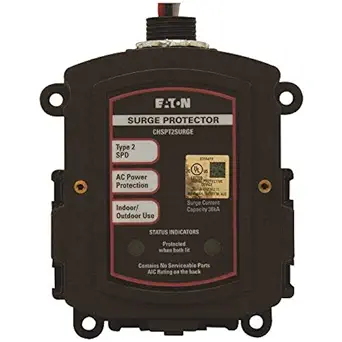
Eaton CHSPT2SURGE Type 2 Whole Home Surge Protector, NEMA 4, Single Phase, 120/240V
The Eaton CHSPT2SURGE stands out for a NEMA 4 enclosure and a quick-connect design, a practical pairing when the installation calls for an outdoor-rated housing and straightforward connection to a compatible load center. Its listed 22 kA surge capacity gives buyers a concrete comparison point, though it is lower than the Square D HEPD50’s stated 50 kA. Eaton also lists per-phase paths at 18 kA each, which helps clarify how its capacity is distributed. An LED offers a basic status check, but there is no remote monitoring, and the device is limited to single-phase 120/240V systems and load-side placement. I’d choose it for enclosure and connection needs, not for the highest stated capacity in this group.
Pros:- NEMA 4 enclosure is suited to outdoor installation
- Quick-connect design eases connection to a load center
- LED status indication
- Per-phase surge paths are specified
Cons:- Limited to single-phase systems
- Requires connection on the load side of the main service disconnect
- No remote monitoring feature is listed
Best for: Homeowners with a single-phase 120/240V system who need an outdoor-rated NEMA 4 enclosure and load-side installation
Not ideal for: Buyers seeking remote monitoring, non-single-phase compatibility, or a higher stated surge capacity than the HEPD50
- Model:CHSPT2SURGE
- Type:Type 2 whole-home surge protector
- Enclosure:NEMA 4
- Voltage:120/240 VAC
- Phase:Single-phase
- Frequency:60 Hz
- Surge current capacity:22 kA
- Surge current capacity per phase:36 kA total; 18 kA per listed path
- Maximum continuous operating voltage:150 V L–N; 300 V L–L
Our verdict“Pick the Eaton when its NEMA 4 enclosure and quick-connect format fit your installation and 22 kA capacity meets your needs.”
Siemens QSPD2A035B 35kA BoltShield Indoor Surge Protective Device
Siemens load center owners get the clearest fit here: the QSPD2A035B plugs directly into compatible panels, so it avoids the universal-breaker fit questions raised by the Eaton CHSPT2ULTRA. Its 35kA per phase rating provides a defined capacity, while mechanical status indicators offer a simple way to check whether the device still reports protection. That makes it a more specified choice than the Eaton, whose supplied product data omits a surge rating. The tradeoff is limited flexibility: this model is intended for indoor use and existing Siemens load centers, so buyers with another panel brand should look at the HSPD Square, which claims broader breaker compatibility. The status check is also manual, with no LED display for a quick glance.
Pros:- Plugs directly into compatible Siemens load centers
- Specifies 35kA of surge current protection per phase
- Mechanical indicators provide a visible protection status check
Cons:- Indoor use only
- Status indicators require a manual check and are not LEDs
- Panel compatibility is limited to Siemens load centers
Best for: Homeowners with a compatible Siemens load center who want a panel-matched device and a stated per-phase rating
Not ideal for: Homeowners with non-Siemens panels or an outdoor installation location
- Brand:Siemens
- Model:QSPD2A035B
- Part number:QSPD2A035B
- Surge current protection:35kA per phase
- Installation:Indoor; plugs into compatible Siemens load center bus
- Status indication:Mechanical visual indicators
- Warranty:3-year/$10,000
- Item weight:6.4 ounces
Our verdict“Choose this if you have a compatible Siemens panel and want a direct-fit indoor protector with a stated per-phase rating.”
HSPD Square Whole Home Surge Protective Device, Type 1 SPD, 120/240VAC
The HSPD Square stands out for buyers who need indoor or outdoor placement and want a Type 1 device rated for 120/240VAC. Its listed 25/50/80kA capacity options give buyers a range to match against their installation needs, though the supplied data does not clarify which capacity applies to this specific unit. That makes its rating harder to compare directly with the FHSPD108S, which lists a single 108,000-amp capacity. HSPD claims compatibility with breakers from any brand, giving it broader panel flexibility than the Siemens QSPD2A035B, which fits Siemens load centers. The compromises are limited detail about the capacity configuration and a need for professional installation; buyers who want a clearly stated single rating may prefer another model.
Pros:- Type 1 SPD rated for 120/240VAC
- Listed for indoor and outdoor installation
- Claims compatibility with circuit breakers from any brand
- Offers listed capacity options of 25, 50, or 80kA
Cons:- The supplied data does not identify which capacity applies to the specific device
- Professional installation is required for proper setup
- No status indicator details are provided
Best for: Homeowners seeking a Type 1 protector with indoor/outdoor placement options and broad claimed breaker compatibility
Not ideal for: Buyers who need a clearly specified capacity for the exact unit or plan to install the device themselves
- Type:Type 1 SPD
- Voltage:120/240VAC
- Surge capacity options:25/50/80kA
- Installation:Indoor and outdoor
- Breaker compatibility:Claims compatibility across circuit breaker brands
- Product type:Whole-house surge protective device
Our verdict“Consider this for flexible indoor/outdoor placement and broad claimed breaker compatibility, provided you confirm the device’s exact capacity before buying.”
FHSPD108S Whole House Surge Protector for 108,000 Amps, Indoor/Outdoor Use, 120/240V
Among these five, the FHSPD108S has the highest single listed surge capacity: 108,000 amps. That stated figure gives capacity-focused buyers a clearer comparison point than the HSPD Square’s 25/50/80kA options, whose exact configuration is unspecified. It also combines indoor/outdoor placement with LED status indicators, making protection status easier to check than the mechanical indicators on the Siemens QSPD2A035B. The commercial-grade enclosure is another fit cue for buyers prioritizing a more robust housing. Those benefits come with installation demands: the device requires professional installation and correct grounding, and the product data warns that poor grounding can cause startup issues. Its listed capacity alone does not establish how it performs in every installation, so panel fit and grounding still matter.
Pros:- Lists a surge capacity of 108,000 amps
- Suitable for indoor and outdoor installation
- LED indicators make protection status easier to check
- Commercial-grade enclosure
Cons:- Requires professional installation and proper grounding
- Improper grounding may cause startup issues
- The supplied data does not specify compatibility with particular load center brands
Best for: Capacity-focused homeowners who want an indoor/outdoor device with LED status monitoring and can arrange professional installation
Not ideal for: Buyers who need a plug-in panel-specific device or cannot confirm proper grounding at the installation site
- Model:FHSPD108S
- Surge capacity:108,000 amps
- Voltage:120/240V
- Frequency:60Hz
- Installation:Indoor and outdoor
- Enclosure:Commercial-grade
- Status indication:LED indicators
Our verdict“Pick this if its listed 108,000-amp capacity and LED monitoring suit your installation and a professional can verify grounding.”
Eaton Surge Protection Device, 1 Phase, 120/240V, 2 Poles, 2 Wires
The Eaton CHSPT2ULTRA is the panel-flexibility pick in this group: its product description says it can install in load centers from any manufacturer. That can make it a more practical match than the Siemens QSPD2A035B for a home with a non-Siemens panel. Its electrical format is clearly listed as single phase, 120/240V, two poles and two wires, which helps define the systems it suits. But the supplied data gives no surge capacity, so buyers cannot compare its stated protection level with the FHSPD36S at 36,000 amps or FHSPD108S at 108,000 amps. It also offers no status-monitoring details here. This makes the Eaton a fit-led choice for buyers prioritizing stated panel versatility over a documented capacity figure.
Pros:- Product description states compatibility with load centers from any manufacturer
- Specifies 120/240V single-phase service
- Lists its two-pole, two-wire configuration
Cons:- No surge capacity is provided in the supplied product data
- Limited to single-phase systems
- No installation location or status-monitoring details are provided
Best for: Homeowners or property managers with a compatible single-phase 120/240V load center who prioritize cross-brand panel fit
Not ideal for: Buyers who need a documented surge capacity, outdoor-use rating, or status indicator details
- Brand:Eaton
- Model number:CHSPT2ULTRA
- Voltage:120/240V
- Phase:1 phase
- Poles:2
- Wires:2
- Load center compatibility:Product description states compatibility with any manufacturer’s load center
Our verdict“Choose this when cross-brand load center compatibility is your priority and you can verify its protection details for your installation.”
Furniqro FHSPD36S Whole House Surge Protector for 36,000 Amps, Indoor/Outdoor, 120/240V
The Furniqro FHSPD36S is a compact indoor/outdoor option for homeowners who want a stated 36,000-amp capacity and LED status monitoring without choosing the much higher listed capacity of the FHSPD108S. Its 120/240V rating and claimed compatibility with all brands of load centers and circuit breakers make it more flexible by panel brand than the Siemens QSPD2A035B. The smaller capacity figure gives buyers a more specific point of comparison, but the supplied data does not explain how it relates to the higher-capacity FHSPD108S beyond the numbers themselves. Installation still requires professional grounding, and no warranty information is supplied. That absence leaves buyers with less to evaluate on long-term support than the Siemens model, which lists a warranty.
Pros:- Lists a 36,000-amp surge capacity
- Suitable for indoor and outdoor installation
- LED indicators allow status monitoring
- Claims compatibility with all brands of load centers and circuit breakers
Cons:- Requires professional installation and proper grounding
- No warranty information is provided
- Its listed capacity is lower than the FHSPD108S in this group
Best for: Homeowners seeking a compact, cross-brand indoor/outdoor protector with LED status indication and a stated 36,000-amp capacity
Not ideal for: Buyers seeking the highest listed capacity in this group or documented warranty coverage
- Brand:Furniqro
- Model:FHSPD36S
- Surge capacity:36,000 amps
- Voltage:120/240V
- Installation:Indoor and outdoor
- Load center compatibility:Claims compatibility with all brands
- Status indication:LED indicators
Our verdict“Choose this for a compact, cross-brand indoor/outdoor installation when 36,000 amps fits your needs and warranty details are not a deciding factor.”

How We Picked
I compared the listed devices by the details that affect whole-home use: surge capacity where specified, Type 1 or Type 2 classification, voltage and phase support, panel or breaker compatibility, and enclosure rating. I gave more weight to clear installation and compatibility information than to a large amperage figure alone, since a device that cannot be correctly matched to the home’s panel is not a practical choice. Enclosure details also matter because they influence where a device may be installed.
The order reflects how useful and broadly applicable each listing appears for a typical residential buyer, with higher-capacity and better-specified options generally placed ahead of narrower-fit or less-detailed listings. That does not make every higher-ranked device right for every home: a panel-matched breaker device may be the sensible choice when compatibility is confirmed, while a Type 1 unit may suit a different installation plan. Product names and listing details can vary, so I recommend confirming the exact model documentation with a licensed electrician before purchase.
Factors to Consider When Choosing Whole House Surge Protectors
Choosing a whole house surge protector starts with the electrical system already in your home. I’d use these checks to narrow the options before comparing individual ratings or pack sizes.
Match the Device to Your Panel
Start with the panel manufacturer and model, then check which surge devices its documentation supports. A breaker-integrated or panel-family device can make for a direct fit, but a similar-looking brand name does not prove compatibility. Universal devices may offer more mounting flexibility, yet they still need the specified breaker, conductor, and connection arrangement. A common mistake is buying by voltage and kA rating alone. Ask an electrician to confirm the panel’s available spaces, bus compatibility, and installation method before ordering. This check can rule out unsuitable devices before their other features matter.
Understand Type 1 and Type 2 Placement
Type 1 and Type 2 describe where a surge protective device is intended to connect within the electrical system. The right class depends on the service equipment, panel layout, and local code requirements. Do not assume Type 1 is automatically better for every home or that Type 2 is inadequate; each has an intended installation context. Some products in this roundup list Type 1, while others are marketed as Type 2 or as panel devices. Have a licensed electrician confirm which connection point is appropriate for your service. That decision can matter more than selecting the largest rating on a product page.
Read Surge Ratings in Context
Manufacturers may express capacity in kA, but that figure alone does not describe every aspect of protection or predict how a device will perform in a particular home. Compare like-for-like specifications and review the manufacturer’s technical documentation for ratings such as modes of protection, voltage protection rating, and short-circuit current rating where provided. A larger number can be a useful point of comparison, but it should not override compatibility, installation quality, or clear documentation. Avoid treating differently named amp ratings as interchangeable without checking what the manufacturer measures. If two listings leave key specifications unclear, ask for the data sheet before choosing.
Choose an Enclosure for the Location
Where the device will be mounted affects which enclosure is suitable. Indoor panels, garages, exterior service equipment, and damp locations can have different exposure to weather, dust, or moisture. Check the device’s NEMA rating and the manufacturer’s permitted placement rather than relying on a broad “indoor/outdoor” phrase. NEMA 4, as listed for the Eaton CHSPT2SURGE, signals a different enclosure specification from an indoor-only model, but installation instructions still govern its use. A frequent buying error is selecting a device first and discovering that the chosen mounting location falls outside its rating. Decide on the location with the electrician before narrowing the enclosure options.
Plan for Installation and Maintenance
Whole-panel protection is electrical work that should be handled by a qualified professional, especially when it involves service equipment or line-side connections. Before buying, ask who will install the unit, what breaker or wiring materials are required, and whether the panel has room for the connection. Check how the device signals its status and what the manufacturer says to do after an indicator changes or the unit reaches end of life. Some products may need periodic visual checks even if they require little routine care. A low-profile device can still be inconvenient if its status indicators are hard to see. Installation access and replacement plans are part of the ownership decision, not afterthoughts.
Decide Whether Whole-Home Protection Is Enough
A whole-house device can help limit surges entering through the electrical service, but it does not make every connected appliance immune to damage. Sensitive electronics or equipment with special power needs may still benefit from appropriately rated point-of-use protection, following the device manufacturers’ instructions. Also ask whether communication lines, coax, or other conductive services need separate surge protection; a panel device does not necessarily protect those paths. Buyers sometimes expect one product to cover every route a surge can take into a home. Have an electrician assess the service and consider what equipment you most want to protect. This gives you a more realistic protection plan than focusing on one device’s headline rating.
Frequently Asked Questions
Can I install a universal surge protector in any 120/240V panel?
No. “Universal” does not mean compatible with every panel, breaker, or installation arrangement. The device still has manufacturer requirements for voltage, phase, overcurrent protection, wiring, and mounting. Have an electrician check the panel model and the device’s installation sheet before purchase. If the documentation does not clearly list a suitable configuration, choose a confirmed compatible option.
Should I choose a Type 1 or Type 2 device for my home?
The choice depends on where the device will connect and how the home’s service equipment is configured. Type 1 and Type 2 units have different intended installation positions, so the label alone does not establish which one fits your panel. Local electrical code and the manufacturer’s instructions also affect the choice. Ask a licensed electrician to identify the appropriate type at the service before ordering. That avoids buying a device that cannot be installed in the planned location.
Does a higher kA rating mean a surge protector is always better?
A higher listed kA rating can indicate greater surge-current capacity under the manufacturer’s stated conditions, but it is not a complete measure of protection. Compare the same kinds of ratings and look at the rest of the technical data, including voltage protection details where available. A high-capacity device that does not fit the panel or suit the installation point is a poor match. Installation quality and a correct electrical connection also matter. Use capacity as one factor alongside compatibility and documentation.
Do I still need plug-in surge protectors after installing a whole-house unit?
Possibly. A whole-house device protects at the service or panel, while a quality point-of-use protector can add protection close to sensitive electronics. The two approaches address different parts of a home’s electrical setup, and neither guarantees that equipment cannot be damaged. Follow the instructions for both devices and avoid connecting protectors in ways their manufacturers prohibit. For computers, home theater equipment, or other sensitive gear, ask an electrician whether layered protection makes sense for your system.
How can I tell when a whole-house surge protector needs replacement?
Check the product’s status indicator and instructions for what its lights or alarms mean. Some devices signal when protection has been reduced or the unit has reached end of life, while the indicator design varies by model. Do not assume a unit is still protecting the home just because it remains installed. If its status changes, consult the manual and have an electrician inspect or replace it as directed. Keep the product documentation so you can identify the model and its replacement requirements later.
Conclusion
For a broad residential shortlist, I’d start with the Square D HEPD80 as best overall, provided its installation details suit the panel. The Type BR devices are the value-minded choices when the home has a compatible BR panel; compare the single and multi-pack listings carefully because the roundup includes repeated product names. For a more specified high-capacity alternative, the Leviton R2120-B is my premium pick for buyers whose installation calls for Type 1, while the Square D HEPD50 is a more approachable choice for someone seeking a clearly identified 50kA universal device. If your priority is outdoor enclosure suitability, look closely at the Eaton CHSPT2SURGE and confirm its permitted mounting location. The best choice for a specific home is the one an electrician can verify for its panel, placement, and service configuration.