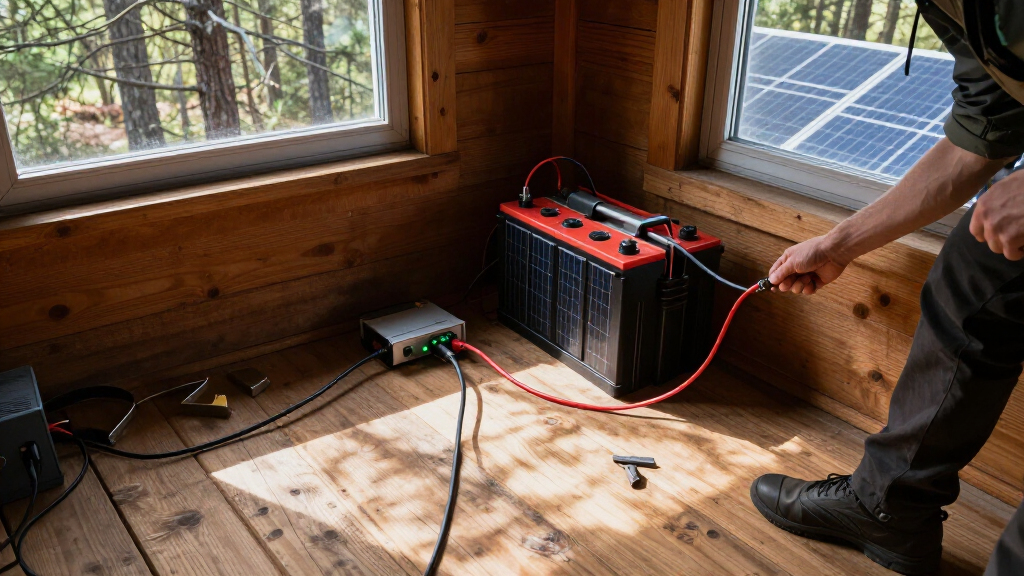
Building off-grid cabin power takes more than choosing a panel or battery. This checklist is for cabin owners planning a solar and backup setup who want to review the main components, their roles, and how they fit together. Keep your system’s voltage and expected loads in view as you compare each pick.System compatibility matters throughout.

Get backup power and energy gear delivered free with Prime
- Fast, free delivery on millions of items
- Prime Video, Amazon Music and more included
- Member-only deals all year
The sections follow the path from solar charging and mounting through power conversion, battery storage, circuit protection, and monitoring. Each slot focuses on a different job, so you can assess the components as a system rather than treating them as interchangeable products. Use the product names as starting points, then confirm the specifications that apply to your installation.Each component has a distinct role.
Before buying, write down the battery-bank voltage, the appliances you expect to run, and how the panels will be mounted. Compare those requirements with the relevant product details, including connection types and supported voltages. If a specification is missing or unclear, verify it with the manufacturer or a qualified installer before connecting equipment.Check the full system plan first.
Solar charge controllers
A charge controller manages the connection between solar panels and a battery bank, so its supported battery voltages and current capacity deserve close attention. The Renogy Rover listing names 60A operation and 12/24/36/48V support. Use those figures as a starting point, then confirm that the controller’s limits suit the panel arrangement and the battery bank you intend to use. A controller that does not match the system can constrain the installation or be unsuitable for it.Match voltage and capacity before choosing.A common buying mistake is to focus on the headline amperage while overlooking the panel configuration, wiring, and battery requirements. Check the product documentation for supported panel input limits, connection details, and any setup requirements for your battery type. Confirm how the controller will be mounted and whether its terminals accommodate the planned wire sizes. Leave room for safe access and servicing, and follow the manufacturer’s instructions for clearances and ventilation.Review the installation details alongside the ratings.
What to look for:
- Supported battery-bank voltage matches your system
- Controller current rating suits the planned array
- Panel input limits fit the panel configuration
- Terminals accept the planned wire sizes
- Documented settings support the selected battery type
Renogy Rover MPPT Solar Charge Controller 60A 12/24/36/48V
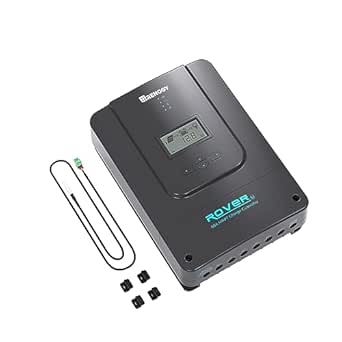
The Renogy Rover MPPT Solar Charge Controller is a versatile 60A device designed for demanding solar systems in RVs, off-grid cabins, and marine setups. It features high efficiency, multi-stage charging, lithium battery recovery, and remote monitoring capabilities, ensuring optimal energy harvest and system protection.
Pros:
- High efficiency with 99.9% multi-peak tracking
- Compatible with various battery types including lithium
- Advanced protection features against surges and temperature extremes
- Remote monitoring and data logging capabilities
Cons:
- Requires separate Bluetooth modules for app monitoring
- Complex setup may be challenging for beginners
- Limited to 60A maximum current
Best for: Cabin systems using one of its listed battery voltages
Not ideal for: Installations whose array limits or battery requirements remain unconfirmed
Bottom line: Confirm the array and battery specifications against the controller documentation before installation.
Pure sine wave inverters
An inverter converts battery power into AC power for compatible appliances, making its output and input requirements central to an off-grid cabin plan. The listed Ampinvt model is described as a 3000W inverter with 9000W peak output and a 24V DC to 120V AC conversion. Confirm what those ratings mean in the manufacturer’s documentation, including continuous output, surge duration, and the loads the unit can support. The product name alone does not establish compatibility with every appliance.Check real load requirements before selecting an inverter.One frequent mistake is adding appliance wattages without accounting for startup demand, operating duration, or the battery bank’s ability to supply current. Check the inverter’s connection requirements, protection features, installation clearances, and guidance for grounding and cable sizing. Its listed 24V input also means the planned battery system needs careful confirmation; do not assume a 12V bank will work. Ask a qualified installer to review the design if your loads or wiring are uncertain.Plan around the 24V input and documented output limits.
What to look for:
- Battery-bank voltage matches the inverter’s 24V DC input
- Continuous output rating covers the intended loads
- Surge rating and duration suit appliance startup needs
- AC output and connections fit the cabin wiring plan
- Cable, grounding, and clearance guidance is documented
Ampinvt 3000W Peak 9000W Pure Sine Wave Inverter, DC 24V to 120V AC with Battery

This pure sine wave inverter functions as an inverter, battery charger, and AC auto-transfer switch, providing high efficiency and stable power output. It supports various battery types including SLA, AGM, GEL, and Lithium, with multiple working modes and comprehensive protections for reliable operation in trucks, boats, and homes.
Pros:
- High peak and continuous power output suitable for heavy loads
- Supports multiple battery types with adjustable charging
- Multiple working modes and comprehensive protection features
Cons:
- Complex setup with many features may be overwhelming for beginners
- Relatively high power consumption during operation
- Limited detailed user instructions in the description
Best for: Cabins planned around a compatible 24V battery bank
Not ideal for: Setups needing unconfirmed voltage or startup capacity
Bottom line: Verify the appliance loads and 24V battery compatibility in the inverter documentation.
12V deep cycle batteries
A battery stores energy for times when solar production does not meet cabin demand, so capacity, chemistry, and system voltage should guide this choice. The Interstate listing identifies a 12V, 70Ah AGM marine/RV battery. Confirm the manufacturer’s capacity conditions, charging profile, and recommended depth of discharge before estimating usable energy. A single battery’s listed capacity does not establish how long it will power your cabin; that depends on the loads, system design, and operating conditions.Estimate usable capacity carefully.A common mistake is to combine batteries without checking whether the bank design and charging equipment support the arrangement. Confirm the required bank voltage, whether batteries may be connected in series or parallel, and any limits on mixing units. Check dimensions and terminal layout against the intended battery location, as well as weight, ventilation, and access requirements specified for the product. Make sure the charge controller and inverter settings are suitable for this AGM battery before connecting it.Confirm bank configuration and fit before purchase.
What to look for:
- Battery-bank voltage matches the cabin system
- Manufacturer-documented capacity conditions and charging profile
- Approved series or parallel connection guidance
- Dimensions and terminals fit the battery location
- Charging equipment settings suit the AGM chemistry
Interstate Batteries Marine/RV Battery 12V 70Ah 750CCA Group 24 AGM

This 12V AGM marine and RV battery provides reliable starting power and deep-cycle performance, suitable for boats and RVs. Built for durability and long-lasting service, it offers high cranking and deep cycle capabilities for various accessories.
Pros:
- Durable and rugged construction suitable for marine and RV use
- Longer service life compared to conventional batteries
- High cranking and deep-cycle power for extended use
Cons:
- Heavy weight may be difficult to handle
- No specific price information available
- Requires proper recycling at end of life
Best for: Plans that call for a compatible 12V AGM battery
Not ideal for: Higher-capacity banks without a confirmed configuration plan
Bottom line: Check usable capacity, bank design, and AGM charging requirements before buying.
DC circuit breaker panels
A breaker panel organizes circuit connections and provides a place for compatible overcurrent protection, making its layout and ratings important to a cabin’s electrical plan. The Blue Sea Systems listing names AC main and six positions alongside DC main and fifteen positions. Confirm the exact product configuration and what is included; the name alone does not specify every breaker or establish that every position suits your circuits. Map the planned AC and DC loads before deciding whether the layout fits.Match panel layout to circuits.Buyers can mistake the number of positions for proof that a panel is suitable for a particular installation. Verify the panel’s voltage and current ratings, breaker compatibility, wire-entry provisions, and installation requirements from the manufacturer. Check whether the planned conductors fit the terminals and whether there is room to route and label wiring neatly. Keep AC and DC circuits arranged as directed by the product instructions and applicable electrical rules, and have a qualified electrician review uncertain cabin wiring.Verify ratings and breaker fit rather than relying on position count.
What to look for:
- Exact AC and DC panel configuration
- Voltage and current ratings suit each circuit
- Compatible breakers and included components are identified
- Terminals and wire-entry provisions fit planned conductors
- Installation instructions support safe circuit separation and labeling
Blue Sea Systems 8084 AC Main + 6 Positions / DC Main + 15 Positions

This panel features pre-wired AC and DC buses with backlit labels and indicator LEDs. It includes a 100 Ampere C-Series toggle circuit breaker for main circuit protection and switching, with durable corrosion-resistant finish and heavy aluminum construction.
Pros:
- Pre-wired buses with backlit labels for easy identification
- Durable corrosion-resistant finish
- Includes main circuit breaker for protection
Cons:
- Limited to specific amperage ratings
- No detailed installation instructions provided
- Heavy weight may require sturdy mounting
Best for: Cabins needing both AC and DC positions in one panel
Not ideal for: Systems with unverified breaker or circuit requirements
Bottom line: Confirm the precise configuration, ratings, and breaker compatibility before wiring.
Solar panel mounting brackets
Mounting hardware affects panel placement, support, and access for adjustment, so the bracket dimensions and installation method need to fit the cabin and its panels. This listing describes two sets of 45-inch solar panel brackets with adjustable tilt legs. Confirm the dimensions, materials, fasteners, and compatible panel mounting points in the product details. The listed length alone does not confirm that the brackets suit your panel frame or the surface where you plan to attach them.Check panel and roof fit first.A common mistake is choosing brackets based on adjustability without checking structural attachment and exposure to local conditions. Review the manufacturer’s mounting instructions, allowed panel dimensions or weights, and any stated limits for tilt adjustment. Confirm the fasteners work with the roof, ground mount, or other support structure, and plan for weather sealing where required. Consider how you will safely reach the panels to adjust or maintain them. If the mounting surface or wind exposure raises questions, get installation guidance before drilling or fastening.Verify the support structure as well as the bracket dimensions.
What to look for:
- Bracket dimensions match panel mounting points
- Panel size and weight fall within documented limits
- Tilt adjustment range suits the installation plan
- Fasteners fit the mounting surface and structure
- Installation and weather-sealing requirements are clear
2 Sets 45 Inch Solar Panel Mount Brackets with Adjustable Tilt Legs

These durable aluminum solar panel mounting brackets are designed for secure and versatile installation of solar modules on various surfaces. The tilt angle is adjustable from 0-90°, allowing for optimal sun exposure without tools.
Pros:
- Adjustable tilt angle for optimal sunlight exposure
- Durable corrosion-resistant aluminum construction
- Versatile for various installation surfaces and orientations
- Easy to install with included hardware
Cons:
- May require additional tools for some adjustments
- Suitable for panels up to 400 watts, not larger panels
- Limited to 45-inch rails, may not fit all panel sizes
Best for: Panel layouts compatible with the listed 45-inch brackets
Not ideal for: Installations lacking confirmed structural attachment points
Bottom line: Match bracket dimensions and mounting instructions to both the panels and support surface.
Battery monitoring shunts
A shunt-based monitor measures current through a defined connection point, helping you track battery use as part of an off-grid system. The LiTime listing identifies a 500A Bluetooth monitor for 8V–120V systems. Confirm the monitor’s wiring diagram, supported battery configurations, and what information its app provides. Its stated voltage range does not by itself confirm compatibility with every battery chemistry or bank arrangement.Verify the monitoring configuration before installation.One mistake is installing the shunt where some battery current can bypass it, which can make readings incomplete. Follow the manufacturer’s diagram for connecting the shunt and monitor, and check that the rated current suits the system’s expected loads and charging current. Confirm cable and terminal requirements, app or device compatibility, and any setup steps needed to enter battery capacity or chemistry. Place the display or phone connection where it will be useful, while following the product’s installation guidance.Route all measured current as directed and configure the monitor for the bank.
What to look for:
- System voltage falls within the listed range
- 500A rating suits expected current in both directions
- Wiring diagram matches the battery-bank layout
- Setup supports the battery capacity and chemistry
- Bluetooth and app requirements fit available devices
LiTime 500A Bluetooth Battery Monitor for 8V-120V Systems

The LiTime 500A Bluetooth Battery Monitor allows real-time tracking of battery parameters via a mobile app, supporting various battery types and voltages. It offers customizable alerts, historical data analysis, and reliable protection features for RV, marine, and backup systems.
Pros:
- Real-time monitoring via mobile app
- Supports multiple battery types and voltages
- Customizable alerts for early issue detection
- Provides historical data for performance analysis
Cons:
- Requires smartphone app for full functionality
- Limited to 1-year warranty
Best for: Owners who want compatible Bluetooth battery monitoring
Not ideal for: Installations with unverified current or shunt wiring needs
Bottom line: Check the shunt rating, wiring diagram, and setup requirements against your battery system.
Build your buying order around the system requirements that affect every other choice: settle on battery-bank voltage and expected loads first, then check the charge controller, inverter, and storage plan for compatibility. Next, confirm the panel mounting arrangement and circuit protection, and choose monitoring equipment that fits the finished bank. Keep a written list of ratings and connection requirements so mismatches are easier to catch before installation.Start with voltage and loads.
An off-grid setup comes together one confirmed connection at a time. Compare each product’s documentation with the rest of your plan, and ask an electrician or solar installer to review anything you cannot verify. With the major requirements mapped out, you can make a more confident checklist and choose components that work together for your cabin.Take it one component at a time.
Fall Picks
fall essentials
As an affiliate, we earn on qualifying purchases.