Solar motion sensor flood lights combine movement-triggered lighting with a solar-powered setup, but coverage, panel placement, and controls vary widely. My best overall pick is the Tuffenough 2500-lumen, 210-LED, three-head model, which balances adjustable coverage with remote control. The Adiding two-pack stands out when a separate solar panel and 16.4-foot cable can make placement easier, while the LEPOWER 1600-lumen light suits buyers who want a simpler, single-light setup. The main tradeoff is between broader multi-head coverage and easier installation or simpler operation. Read on for the full comparison and guidance on choosing a light for your space.

Get backup power and energy gear delivered free with Prime
- Fast, free delivery on millions of items
- Prime Video, Amazon Music and more included
- Member-only deals all year
Key Takeaways
- Tuffenough’s 2500-lumen, three-head design is the clearest all-around choice in this lineup, with adjustable heads and a remote; its multiple pack sizes let buyers match quantity to the site.
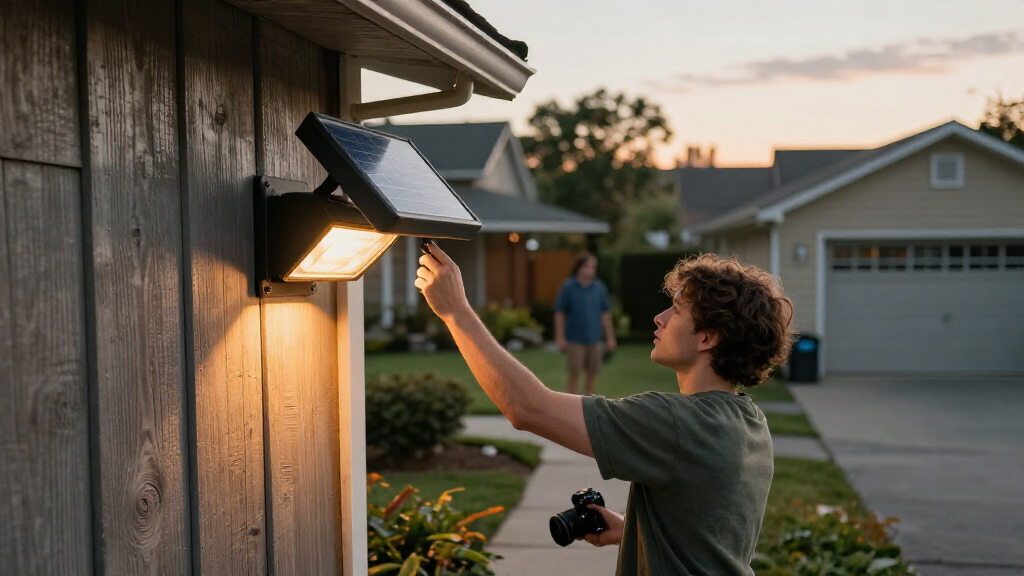
- Adiding’s 16.4-foot cable addresses a common solar-light problem: the best wall location for the light may not receive enough sun for a panel mounted directly beside it.
- Three- and four-head models emphasize coverage, while the six-head omibee and four-head LYWALT make the most sense for buyers prioritizing spread over a simpler fixture.
- Pack size changes the value calculation: several Tuffenough versions share core specifications but come in two-, three-, or four-light bundles, so compare coverage needs rather than assuming the larger bundle is a different light.
- More LEDs or a higher lumen figure alone do not settle the choice; sensor placement, adjustable angles, panel exposure, and controls can matter more for dependable lighting at a particular entrance or yard.




| solar motion sensor flood light | Water resistance | LED count | Brightness | Pack size |
|---|---|---|---|---|
| nipify Solar Outdoor Spotlight | IP65 | 56 | — | 4 lights |
| Solar Flood Lights | IP65 | 210 | — | — |
| Tuffenough Solar Outdoor Secur | IP65 | 210 | — | 4 lights |
| TECKNET 416-LED Solar Outdoor | — | 416 | — | 2 lights |
| Tuffenough Solar Outdoor Secur | IP65 | 210 | — | — |
| Intelamp Solar Outdoor Motion | — | — | 1,200 lumens | — |
| LEPOWER Solar LED Security Lig | IP65 | — | Up to 1,600 lumens | — |
| Adiding Solar Outdoor Flood Li | Water resistant | 202 per light | Up to 2,800 lumens per light | 2 lights |
| LYWALT Solar Outdoor Motion Se | IP65 waterproof, as stated in the product title | — | 3,000 lumens | — |
| Outdoor Solar Motion Sensor Fl | IP65 | — | Up to 2,500 lumens per light | 2 lights |
| Tuffenough Solar Outdoor Light | IP65 | 210 per light | Up to 2500 lumens | 3 lights |
| Daphino 2500-Lumen Solar Motio | IP65 | 156 per light | Up to 2500 lumens | 2 lights |
| Tuffenough Solar Outdoor Secur | IP65 | 210 | Up to 2500 lumens | — |
| Intelamp Solar Outdoor Motion | — | — | 1200 lumens | — |
| omibee Solar Motion Sensor Flo | IP65 | 284 | — | 2 lights |
More Details on Our Top Picks
nipify Solar Outdoor Spotlights with Motion Sensor, 4-Pack
I’d choose the nipify set when I want several smaller lights to mark a path, highlight planting beds, or add motion-triggered illumination around a yard. Its four-light pack and choice of ground insertion or wall mounting make it more flexible to place than the two-light TECKNET, while the TECKNET is the clearer fit for broad, high-output coverage. Nipify provides three lighting modes and a PIR motion sensor, but its stated maximum of 1,000 lumens is modest beside the 2,500-lumen KOOPER and Tuffenough options. That makes these spotlights better suited to localized areas than a large driveway or security perimeter. The IP65 rating supports outdoor use, though the listing gives no battery capacity or runtime, so I can’t judge how reliably they’ll stay lit after limited sun.
Pros:- Four lights can cover multiple small areas from one pack.
- Ground insertion and wall mounting allow different placement approaches.
- Three modes include motion-sensing operation.
- IP65 water resistance is specified for outdoor use.
Cons:- Maximum output is 1,000 lumens, below the 2,500-lumen KOOPER and Tuffenough models.
- Battery capacity and runtime are not specified.
- No motion detection range or sensing angle is provided.
Best for: Homeowners who want four solar spotlights to accent garden beds, paths, or smaller outdoor zones with flexible ground or wall placement.
Not ideal for: Buyers seeking strong, wide-area security lighting or a stated overnight runtime; the listed maximum output is lower than several flood-light alternatives, and battery details are absent.
- Pack size:4 lights
- Maximum brightness:1,000 lumens
- LED count:56
- Lighting modes:3
- Light color:Cool white
- Motion sensor:PIR
- Water resistance:IP65
- Installation:Ground insertion or wall mounting
Our verdict“Choose nipify for flexible, multi-point garden and path lighting, but pick a higher-output model for broad security coverage.”
Solar Flood Lights, 210 LED Motion Sensor Outdoor Lights, Waterproof, 3 Heads 300° Wide Angle Security Lights for Yard Patio Garage Entryways, 2 Pack, Black
The KOOPER’s strongest case is the combination of three adjustable heads and a stated 300° coverage angle: I’d favor it for a corner, garage approach, or patio where one fixed beam would leave gaps. Its 40-foot motion range also reaches farther on paper than the Tuffenough 4-pack’s 26 feet, although Tuffenough supplies twice as many fixtures for distributing light around separate locations. KOOPER is rated at up to 2,500 lumens and lists up to 14 hours of illumination, giving buyers more performance detail than the nipify spotlights. The tradeoff is dependence on sunlight: the manufacturer calls for direct sun for optimal charging, and shaded placement can undermine the coverage advantage. Its 5–8-hour charging estimate and three-year warranty add useful context, but do not remove that siting constraint.
Pros:- Three heads provide up to 300° stated coverage.
- Motion detection range is specified at up to 40 feet.
- Lists up to 2,500 lumens and up to 14 hours of illumination.
- Monocrystalline tempered-glass panel has a stated 5–8-hour charging time, and the product includes a three-year warranty.
Cons:- Direct sunlight is needed for optimal charging, limiting shaded placement.
- Two lights may be less suitable than the Tuffenough 4-pack for distributing fixtures across multiple areas.
- Cool-white 6500 K output may feel stark in spaces where softer light is preferred.
Best for: Owners of garages, patios, or yard entrances who need adjustable, wide-angle coverage from a two-light set and can mount the panels in direct sun.
Not ideal for: Buyers with heavily shaded mounting locations or those who want several fixtures spread across a large property; performance depends on sun exposure and this pack includes two lights.
- LED count:210
- Maximum light output:2,500 lumens
- Lighting heads:3
- Coverage angle:300°
- Motion detection range:40 ft
- Charging time:5–8 hours
- Stated illumination time:Up to 14 hours
- Water resistance:IP65
- Warranty:3 years
Our verdict“Pick KOOPER for broad, adjustable coverage and a longer stated detection range, provided the panels can receive direct sun.”
Tuffenough Solar Outdoor Security Lights, 2500 Lumens, 210 LEDs, 3 Adjustable Heads, Remote Control, 4-Pack
This Tuffenough set makes the most sense when I need matching motion lights at several doors, sheds, or paths: its four fixtures offer broader placement flexibility than the two-light version of the same Tuffenough line. Each light is listed at up to 2,500 lumens, with three adjustable heads and a 270° illumination angle, so it can cover more than a narrow doorway. The included remote and three modes give buyers control over settings without changing the basic solar-powered setup. Compared with KOOPER, the stated motion range is shorter at 26 feet rather than 40, and the coverage angle is narrower at 270° rather than 300°. Solar performance also relies on adequate sun; the supplied guidance to switch the lights off on cloudy or rainy days while charging is a practical limitation for unsettled weather.
Pros:- Four lights allow coverage across multiple mounting locations.
- Each light is rated at up to 2,500 lumens with three adjustable heads.
- Remote control and three lighting modes add operating flexibility.
- IP65 rating is specified for outdoor exposure.
Cons:- Motion detection range is up to 26 feet, shorter than KOOPER’s stated 40 feet.
- The 270° illumination angle is narrower than KOOPER’s 300° coverage.
- Charging and performance depend on sun, with instructions recommending the lights be switched off during cloudy or rainy charging.
Best for: Property owners who want four wall-mounted motion lights for separate entrances, sheds, or walkways and value remote control.
Not ideal for: Buyers who need a longer detection range or reliable charging in cloudy, shaded locations; KOOPER lists a 40-foot range, and this model’s instructions call for switching it off during cloudy or rainy charging conditions.
- Pack size:4 lights
- Maximum brightness:Up to 2,500 lumens
- LED count:210
- Illumination angle:270°
- Motion sensor range:Up to 26 feet
- Lighting modes:3
- Battery capacity:1,800 mAh
- Water resistance:IP65
- Mounting type:Wall mount
Our verdict“Choose this four-pack when you want powerful motion lights at several locations and can provide suitable sunlight for charging.”
TECKNET 416-LED Solar Outdoor Motion Sensor Lights, 2-Pack
TECKNET stands apart from the other picks here with a stated 4,200-lumen maximum and three-sided lighting across 300°. I’d place it near a garage or entry where broad, bright illumination matters more than reaching a distant motion target. Its IP66 rating is a step above the IP65 ratings on the nipify and Tuffenough options, and the listing gives a 10–12-hour runtime after a full charge. The tradeoff is a relatively short 13–20-foot detection range: KOOPER’s stated 40 feet is better for triggering light farther from the fixture. TECKNET also needs 6–8 hours of direct sunlight for a full charge, and adhesive mounting may not hold on rough or uneven surfaces. I’d favor a secure wall installation and a sun-exposed panel location.
Pros:- Highest stated maximum output in this group at 4,200 lumens.
- Three-sided design provides a 300° lighting angle.
- IP66 weather resistance and stated 10–12-hour runtime after a full charge.
- Three lighting modes include motion-activated options.
Cons:- Motion detection range is 13–20 feet, shorter than KOOPER’s stated 40 feet.
- A full charge requires 6–8 hours of direct sunlight, with reduced runtime possible in shade or cloudy weather.
- Adhesive mounting may not hold securely on rough or uneven surfaces.
Best for: Buyers who prioritize high stated brightness and broad three-sided illumination near a sun-exposed garage, entrance, or patio.
Not ideal for: People who need motion detection at longer distances or must mount on rough, uneven surfaces; KOOPER lists a 40-foot range, while TECKNET’s is 13–20 feet and adhesive mounting may be unreliable on uneven material.
- Pack size:2 lights
- LED count:416
- Maximum brightness:4,200 lumens
- Lighting angle:300°
- Motion detection range:13–20 feet
- Motion detection angle:120°
- Runtime:10–12 hours after a full charge
- Weather resistance:IP66
- Color temperature:5000 K
Our verdict“Choose TECKNET for very bright, wide-angle coverage close to the fixture, not for long-range motion detection or shaded sites.”
Tuffenough Solar Outdoor Security Lights, 2500 Lumens, 210 LEDs, 3 Heads, Remote Control, 2-Pack
This two-pack suits buyers who want Tuffenough’s remote-controlled, three-mode setup for a pair of nearby locations without buying four fixtures. Its listed output is up to 2,500 lumens per light, and the three adjustable heads spread illumination across a stated 270° angle. Compared with the four-pack Tuffenough, the main difference is straightforward: this set gives fewer mounting points, while retaining the same stated 26-foot motion range and 1,800 mAh battery capacity. It also trails KOOPER on paper for range and coverage angle, since KOOPER lists 40 feet and 300°. The IP65 rating suits outdoor wall mounting, but solar charging still depends on sunlight, and the recommended 6.5–8-foot installation height matters because placement can affect sensor performance.
Pros:- Two fixtures suit a paired setup at nearby entrances or outdoor zones.
- Three adjustable heads provide a stated 270° illumination angle.
- Remote control and three lighting modes allow changes without adjusting the fixture.
- IP65 rating and wall-mount design are specified for outdoor use.
Cons:- The 26-foot motion range is shorter than KOOPER’s stated 40-foot range.
- Two lights offer fewer mounting points than the four-pack Tuffenough.
- Charging depends on direct sunlight, and installation height can affect sensor performance.
Best for: Homeowners who need matching motion lights for two entrances or a garage and side path, with remote control and adjustable heads.
Not ideal for: Buyers covering many separate areas or needing a longer sensor reach; the four-pack Tuffenough supplies more fixtures, while KOOPER lists a longer 40-foot detection range.
- Number of lights:2
- Maximum brightness:Up to 2,500 lumens
- LED count:210
- Lighting heads:3 adjustable heads
- Lighting angle:270°
- Motion detection range:26 feet
- Battery capacity:1,800 mAh
- Water resistance:IP65
- Recommended installation height:6.5–8 feet
Our verdict“Choose this two-pack for a controlled, two-location setup, but select the four-pack Tuffenough for broader property coverage.”
Intelamp Solar Outdoor Motion Sensor Flood Lights
Three adjustable heads and a 270° lighting angle make this Intelamp a strong fit for corners, gates, and wall sections where a forward-facing beam can leave dark areas to either side. Its dual sensors cover more than 180°, giving it a broader approach zone than the LEPOWER, whose listed detection distance reaches farther but is not paired with a stated wide sensor angle. The Intelamp also lists up to three nights of motion-sensing operation after a full day of charging, a useful runtime claim for periods without sun. The tradeoff is modest output at 1,200 lumens: the LYWALT and LEPOWER specify higher brightness, so they may suit buyers prioritizing a stronger beam. Solar charging still depends on adequate sunlight, and this is an outdoor-only fixture.
Pros:- Three adjustable heads spread illumination across up to 270°.
- Dual sensors detect movement across more than 180°.
- Lists up to three nights of motion-sensing operation after a full day of charging.
- Includes three lighting modes and mounting hardware.
Cons:- Its 1,200-lumen output is lower than the LEPOWER and LYWALT ratings.
- Runtime and charging depend on receiving sufficient sunlight.
- Designed for outdoor use only.
Best for: Buyers lighting a corner, side entrance, or broad wall who value adjustable coverage and a stated multi-night motion-mode runtime.
Not ideal for: People who need the strongest listed output for a large, open yard; its 1,200-lumen rating is below the LEPOWER and LYWALT.
- Brightness:1,200 lumens
- Illumination angle:270°
- Motion detection range:Over 180°
- Lighting modes:3
- Listed runtime:Up to 3 nights in motion-sensing mode after a full day of charging
- Color temperature:6,500 K
- Power and mounting:Solar; wall mount, screws and tie straps included
Our verdict“Choose the Intelamp for broad side-to-side coverage and a stated multi-night motion runtime, not maximum brightness.”
LEPOWER Solar LED Security Light with PIR Motion Sensor, 1600 Lumens
Adjustable detection up to 72 feet is the LEPOWER’s clearest advantage: it can suit a driveway or approach where motion needs to trigger the light before someone reaches the wall. Its three adjustable heads deliver up to 1,600 lumens, more output than the Intelamp, though less than the LYWALT’s stated 3,000 lumens. A 15-foot cable lets the solar panel sit in a sunnier spot than the fixture, which can help when the mounting location is shaded. Three operating modes include auto, normally on, and test. The limits are worth weighing: normally-on operation lasts about 50 minutes after a full charge, and solar performance depends on available sun. Buyers seeking a known multi-night motion runtime may prefer the Intelamp, which explicitly lists one.
Pros:- Motion detection range is adjustable up to 72 feet.
- Three adjustable heads provide flexible beam direction.
- A 15-foot cable allows separate placement of the solar panel.
- IP65 weather resistance and three operating modes.
Cons:- Normally-on mode lasts about 50 minutes after a full charge.
- Charging performance depends on sunlight and panel placement.
- Its 1,600-lumen output is below the LYWALT’s stated 3,000 lumens.
Best for: Homeowners with a long driveway or approach who want adjustable motion detection and the flexibility to place the panel away from the light.
Not ideal for: Buyers who need extended continuous illumination or the highest stated brightness; normally-on time is limited and the LYWALT lists 3,000 lumens.
- Brightness:Up to 1,600 lumens
- Motion detection range:Adjustable up to 72 feet
- Light heads:3 adjustable heads
- Operating modes:Auto, normally on, and test
- Color temperature:5,500 K
- Solar panel cable:15 feet
- Water resistance:IP65
Our verdict“Pick the LEPOWER for a longer adjustable detection reach and flexible panel placement, while accepting limited continuous-on time.”
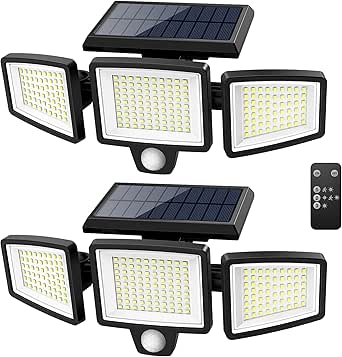
Adiding Solar Outdoor Flood Lights, 2-Pack, 202 LEDs, Remote Control, 16.4 ft Cable
The Adiding set is distinctive for pairing two lights with remote controls and a choice of attached or separately placed solar panels. The included 16.4-foot cable gives each panel more placement flexibility than the LEPOWER’s 15-foot cable, while the remote makes it easier to switch among three modes after installation. Each fixture is listed at up to 2,800 lumens, above the Intelamp and LEPOWER ratings, but its 180° lighting angle is narrower than the 270° coverage offered by those models. That makes this a better match for illuminating two separate zones than wrapping light around a corner. The description does not give a motion detection distance or battery runtime, so buyers who need predictable trigger reach or overnight performance may prefer the LEPOWER or Intelamp.
Pros:- Two-light package can cover separate outdoor locations.
- Each light is listed at up to 2,800 lumens.
- Remote control provides access to three lighting modes.
- Solar panel can be attached or installed separately with a 16.4-foot cable.
Cons:- Its 180° lighting angle is narrower than the Intelamp and LEPOWER coverage claims.
- No motion detection distance is provided in the supplied product details.
- No operating runtime is specified, and solar performance depends on sunlight.
Best for: Buyers lighting two separate outdoor areas who want remote mode changes and the option to place panels in sunnier spots.
Not ideal for: People who need a documented motion detection distance, runtime, or very wide 270° coverage.
- Pack size:2 lights
- Brightness:Up to 2,800 lumens per light
- LED count:202 per light
- Lighting angle:180°
- Lighting modes and control:3 modes; remote control
- Solar panel cable:16.4 feet
- Color temperature:6,500 K
- Water resistance:Water resistant
Our verdict“Choose the Adiding set for two bright, remotely controlled lights with flexible panel placement, not for a specified sensor reach.”
LYWALT Solar Outdoor Motion Sensor Lights, 4 Heads, 3000 Lumens
With four adjustable heads and a listed 3,000 lumens, the LYWALT is the strongest brightness-focused pick in this group. The extra head and 270° illumination angle give buyers more ways to aim light across a yard, patio, or garage approach than the three-head LEPOWER. Its two PIR sensors detect movement up to 40 feet away, a shorter stated reach than LEPOWER’s adjustable 72 feet, so the LYWALT favors broad illumination over early driveway detection. It also offers three modes, including low-level always-on options paired with motion-triggered full brightness. A 2,500 mAh battery and large tempered-glass solar panel are listed, but the supplied details do not state runtime. Choose it for a wider, brighter spread; skip it if you need a clearly specified long detection distance or guaranteed operating duration.
Pros:- Listed output of 3,000 lumens is the highest among these five products.
- Four adjustable heads and a 270° illumination angle support broad coverage.
- Two PIR sensors detect movement up to 40 feet away.
- Three modes include low-level illumination with motion-triggered full brightness.
Cons:- Its listed 40-foot detection range is shorter than the LEPOWER’s adjustable 72 feet.
- No operating runtime is specified in the supplied details.
- Solar charging performance depends on sunlight.
Best for: Buyers who want high listed brightness and flexible, broad coverage for a yard, patio, or garage exterior.
Not ideal for: People prioritizing long-range motion triggers or a clearly stated runtime; the LEPOWER lists a longer sensor reach and the Intelamp gives a multi-night runtime claim.
- Brightness:3,000 lumens
- Light heads:4 adjustable heads
- Illumination angle:Up to 270°
- Motion detection:2 PIR sensors; up to 40 feet and 180°
- Battery capacity:2,500 mAh
- Lighting modes:3
- Water resistance:IP65 waterproof, as stated in the product title
Our verdict“Choose the LYWALT when brightness and adjustable area coverage matter more than the longest detection reach or a stated runtime.”
Outdoor Solar Motion Sensor Flood Lights, 2-Pack
This two-pack makes sense when the goal is to install a light on each of two walls rather than maximize one fixture’s reach. Each unit has three adjustable heads, up to 2,500 lumens, and 270° coverage, giving it a broader spread than the Adiding set’s stated 180° angle. Motion detection is listed at up to 30 feet, which is more limited than the LEPOWER’s adjustable 72-foot reach and the LYWALT’s 40 feet. The IP65 rating and tempered-glass solar panel suit exposed outdoor mounting, and three modes offer some control over operation. The main gap is runtime: no battery capacity or operating duration is supplied, making it harder to judge performance through cloudy stretches. Its solar panel also needs suitable sun, and placement affects charging.
Pros:- Two fixtures can cover separate entrances or wall sections.
- Three adjustable heads provide up to 270° illumination per light.
- Up to 2,500 lumens and three lighting modes per fixture.
- IP65 water resistance and a tempered-glass solar panel.
Cons:- Motion detection distance is listed at up to 30 feet, shorter than the LEPOWER and LYWALT claims.
- No battery capacity or runtime is specified.
- Charging depends on direct sunlight and suitable panel placement.
Best for: Homeowners who want two adjustable, wide-angle lights for separate walls and have sunny locations for both panels.
Not ideal for: Buyers needing long-range detection or a stated battery runtime; LEPOWER lists a longer detection reach, while Intelamp provides a multi-night runtime claim.
- Pack size:2 lights
- Brightness:Up to 2,500 lumens per light
- Light heads:3 adjustable heads per light
- Illumination coverage:Up to 270°
- Motion detection distance:Up to 30 feet
- Lighting modes:3
- Water resistance:IP65
- Recommended mounting height:6.5–8 feet
Our verdict“Choose this two-pack for broad coverage on two sun-exposed walls, but look elsewhere if sensor reach or runtime is your priority.”
Tuffenough Solar Outdoor Lights 2500LM 210 LED Security Lights with Remote Control, 3 Heads Motion Sensor Lights, IP65 Waterproof, 270° Wide Angle Flood Wall Lights with 3 Modes (3 Pack)
For buyers who want to cover several entry points in one purchase, this three-light set offers a practical advantage over the Daphino two-pack. Each light combines up to 2500 lumens, three adjustable heads, and a 270° illumination angle, making it easier to aim light across a doorway and adjoining wall than with a single fixed beam. The included remote also lets you change among three modes without reaching the fixture, a convenience the button-controlled Daphino lacks. The tradeoff is motion reach: its 26-foot detection range is shorter than Daphino’s stated 40 feet, so it may be less suited to detecting movement farther down a driveway. Solar charging also makes dependable output weather-dependent, and placement height affects sensor performance. I’d choose this set for multiple nearby zones, not maximum-distance detection.
Pros:- Three fixtures make it easier to cover separate outdoor locations.
- Up to 2500 lumens per light and adjustable heads support broad, targeted illumination.
- Remote control changes between three lighting modes without accessing the fixture.
- IP65 rating and solar power support wire-free outdoor installation.
Cons:- The 26-foot motion range is shorter than the Daphino model’s stated 40 feet.
- Light output and charging depend on available sunlight.
- Sensor results can vary with installation height and positioning.
Best for: Homeowners who want solar lighting at several entrances, side paths, or garage areas and value remote mode changes.
Not ideal for: Buyers who need motion detection farther down a long driveway or who cannot place the panels where they receive useful sunlight.
- Pack size:3 lights
- LED count:210 per light
- Brightness:Up to 2500 lumens
- Color temperature:6500 K, cool white
- Motion detection range:26 ft
- Illumination angle:270°
- Battery capacity:1800 mAh
- Lighting modes:3
- Water resistance:IP65
Our verdict“Choose this three-pack to light several nearby zones with remote-controlled modes, but pick Daphino if longer stated motion reach matters more.”
Daphino 2500-Lumen Solar Motion Sensor Outdoor Lights, 3 Heads, 2-Pack
The Daphino’s clearest advantage over the Tuffenough three-pack is its stated 40-foot motion detection range, which may suit a longer approach to a garage or side entrance. Its three adjustable heads spread light across a 270° area, while the sensor’s stated detection angle is 130°—a useful distinction for buyers planning where to mount it. The set has three button-selected modes and up to 12 hours of runtime in dim mode after a 7–8 hour charge. Unlike the Tuffenough, it does not include a remote, so mode changes require reaching the light. Its two fixtures also provide fewer placement options than the three-unit Tuffenough set. I’d favor Daphino when detection distance and dim-mode runtime matter more than remote convenience or extra fixtures.
Pros:- Stated motion detection range reaches up to 40 feet.
- Three adjustable heads provide broad, aimable light coverage.
- Up to 12 hours of runtime is specified for dim mode.
- IP65-rated construction is intended for outdoor exposure.
Cons:- No remote; modes are selected using a button on the fixture.
- Only two lights are included, fewer than the Tuffenough three-pack.
- Runtime depends on receiving a full charge from sunlight.
Best for: Homeowners with a longer driveway or approach who want a two-light solar set and can access the fixtures to change modes.
Not ideal for: Buyers who want remote control, need to cover three separate areas, or expect consistent runtime without strong charging conditions.
- Pack size:2 lights
- LED count:156 per light
- Brightness:Up to 2500 lumens
- Motion detection range:Up to 40 ft
- Motion detection angle:130°
- Light coverage:270°
- Charging time:7–8 hours
- Runtime:Up to 12 hours in dim mode
- Water resistance:IP65
Our verdict“Pick Daphino for its longer stated detection reach and dim-mode runtime, provided button-only controls suit your installation.”
Tuffenough Solar Outdoor Security Lights, 2500 Lumens, 210 LEDs, 3 Adjustable Heads, Motion Sensor and Remote Control
This Tuffenough model suits buyers who want the core combination of three adjustable heads, remote control, and up to 2500 lumens without relying on a stated multi-light bundle. Its 270° illumination angle gives the heads room to cover a doorway and nearby wall, while the 26-foot sensor range is aimed at close-to-midrange approach areas rather than distant driveway detection. Compared with the Daphino, this model adds a remote but gives up Daphino’s longer stated 40-foot detection range. It shares much of its feature profile with the other Tuffenough listing in this group, so the available specifications do not establish a performance advantage between them. Solar charging is the main limitation: cloudy conditions may require two to three days of charging, which can affect readiness after poor weather.
Pros:- Up to 2500 lumens with 210 LEDs for strong close-area illumination.
- Three adjustable heads and a 270° lighting angle help spread coverage.
- Remote control provides access to three lighting modes.
- Solar power and IP65 water resistance support wire-free outdoor mounting.
Cons:- Its 26-foot detection distance is shorter than Daphino’s stated 40 feet.
- Charging can take two to three days in cloudy or rainy conditions.
- The listed specs do not distinguish its performance from the other Tuffenough model in this roundup.
Best for: Buyers mounting a single solar security light near a doorway or garage who want adjustable heads and remote mode control.
Not ideal for: People monitoring a long driveway who need more than 26 feet of stated detection range, or buyers who need dependable charging through extended cloudy weather.
- Power source:Solar
- LED count:210
- Brightness:Up to 2500 lumens
- Color temperature:6500 K
- Lighting modes:3
- Adjustable heads:3
- Illumination angle:270°
- Motion detection distance:Up to 26 ft
- Water resistance:IP65
Our verdict“Choose this Tuffenough for remote-controlled, wide-angle lighting near a home entrance, not for long-range detection.”
Intelamp Solar Outdoor Motion Sensor Flood Lights, 270° Wide Angle
Where the brighter Tuffenough and Daphino models emphasize output and coverage, Intelamp’s stated distinction is endurance: after a full day of charging, it can run for up to three nights in motion-sensing mode. That makes it a more appealing fit for a location where overnight readiness matters more than maximum brightness. Its three adjustable heads cover a 270° lighting angle, and dual motion sensors detect movement over 180°, extending sensing to the sides rather than only straight ahead. The tradeoff is a lower 1200-lumen output, well below the up-to-2500-lumen Tuffenough and Daphino options. Its specs also describe motion coverage as “over 180°” without giving a distance in feet, so buyers who need a clear detection range should look to Daphino instead. It is specified for outdoor use only.
Pros:- Up to three nights of motion-sensing operation after a full day of charging.
- Dual sensors provide stated motion detection over 180°.
- Three adjustable heads spread illumination across a 270° angle.
- Includes screws and tie straps for wall mounting.
Cons:- 1200 lumens is lower than the 2500-lumen Tuffenough and Daphino models.
- The provided specs do not state a motion detection distance in feet.
- Outdoor use only, with charging dependent on adequate sunlight.
Best for: Homeowners prioritizing multiple nights of motion-sensing operation over high lumen output, especially at side-facing outdoor approaches.
Not ideal for: Buyers who need a stated long-distance detection range, brighter illumination, or a light suitable for indoor use.
- Brightness:1200 lumens
- LED sources:108
- Color temperature:5500 K
- Lighting angle:270°
- Motion detection:Dual sensors; over 180°
- Lighting modes:3
- Runtime:Up to 3 nights in motion-sensing mode after a full day of charging
- Power source:Solar
- Mounting:Wall mount; screws and tie straps included
Our verdict“Choose Intelamp when multi-night motion-mode operation and side detection matter more than the brighter output and stated range of competing models.”
omibee Solar Motion Sensor Flood Lights, 6 Heads, 2 Pack
For buyers whose priority is lighting a broad area, the omibee stands apart with up to 6000 lumens and six adjustable heads per light. That is a much higher stated output than the 2500-lumen Tuffenough and Daphino models, while its 40-foot motion range matches Daphino’s stated reach and exceeds Tuffenough’s 26 feet. Dual sensors cover a stated 180° detection angle, and the remote offers three modes, so the extra heads do not mean giving up convenient controls. The cost in practical terms is greater dependence on solar charging for a high-output fixture: the listed two-hour charging time may vary with conditions, and the product data gives no runtime figure to compare with Intelamp’s three-night motion-mode claim. I’d choose omibee for expansive coverage, not for the clearest endurance expectations.
Pros:- Up to 6000 lumens provides the highest stated output among these five products.
- Six adjustable heads allow broad, directional coverage.
- Up to 40 feet of motion detection with a 180° detection angle.
- Remote control offers three modes, with IP65-rated weather resistance.
Cons:- The listed two-hour charging time may vary with sunlight and conditions.
- No runtime figure is provided, unlike Intelamp’s stated motion-mode endurance.
- High-output operation remains dependent on solar charging conditions.
Best for: Homeowners seeking high-output solar lighting for a large yard, garage frontage, or broad outdoor area and who can provide good sun exposure.
Not ideal for: Buyers who value documented multi-night runtime, need a lower-output fixture for a small entry, or have limited sunlight for charging.
- Pack size:2 lights
- LED count:284
- Light output:Up to 6000 lumens
- Light heads:6 adjustable heads
- Motion detection angle:180°
- Motion detection range:Up to 40 ft
- Battery capacity:2200 mAh
- Charging time:2 hours, listed
- Water resistance:IP65
Our verdict“Choose omibee for maximum stated brightness and adjustable coverage, but prefer Intelamp if documented multi-night motion runtime is the priority.”

How We Picked
I compared the 15 listed options on factors that affect real outdoor use: stated light output, head count and adjustability, sensor and lighting controls, solar-panel placement flexibility, weather protection where specified, and the number of fixtures included. I gave more weight to features that help a buyer direct light where it is needed or position the panel in sunlight than to LED counts alone, since those figures do not by themselves describe useful coverage or night-time runtime.
The ranking favors balanced, adaptable setups first, then options with a clear advantage for a particular need, such as a remote, cable-linked panel, compact single-light arrangement, or expanded head count. Similar Tuffenough models are separated mainly by pack size and stated configuration rather than treated as unrelated designs. Product details supplied here do not include comparable battery capacities, runtime figures, or detection distances, so I do not use those as ranking claims; buyers should verify them for the exact listing before purchase.
| solar motion sensor flood light | Water resistance |
|---|---|
| nipify Solar Outdoor Spotlight | IP65 |
| Solar Flood Lights | IP65 |
| Tuffenough Solar Outdoor Secur | IP65 |
| TECKNET 416-LED Solar Outdoor | — |
| Tuffenough Solar Outdoor Secur | IP65 |
| Intelamp Solar Outdoor Motion | — |
| LEPOWER Solar LED Security Lig | IP65 |
| Adiding Solar Outdoor Flood Li | Water resistant |
| LYWALT Solar Outdoor Motion Se | IP65 waterproof, as stated in the product title |
| Outdoor Solar Motion Sensor Fl | IP65 |
| Tuffenough Solar Outdoor Light | IP65 |
| Daphino 2500-Lumen Solar Motio | IP65 |
| Tuffenough Solar Outdoor Secur | IP65 |
| Intelamp Solar Outdoor Motion | — |
| omibee Solar Motion Sensor Flo | IP65 |
Factors to Consider When Choosing Solar Motion Sensor Flood Lights
Choosing a solar flood light is less about finding the biggest headline number and more about matching the light, sensor, and panel to the exact mounting spot. These broader checks can help prevent a fixture that looks suitable on paper from underperforming outdoors.
Match head layout to the area you need to cover
Start by sketching the area from the intended mounting point: note the door, path, driveway, or side wall that needs light. A multi-head fixture can aim beams in different directions, which may help cover a garage door and a walkway at once. That flexibility can be less useful on a narrow entrance where one directed beam is enough. More heads also mean more joints and angles to set, so check whether the fixture can be aimed without blocking the sensor or casting unwanted light at a neighbor. Do not treat a wide-angle claim as proof that every corner will be brightly lit; mounting height and nearby obstructions change the result. Choose the head arrangement around the shape of the space, not the largest number on the box.
Plan for sunlight before choosing the mounting point
Solar performance begins with the panel’s exposure, not the light’s advertised output. A wall under an eave or shaded by trees may be a convenient place for the fixture but a poor place for its panel. Check how direct sun reaches the proposed panel location across the day and through the seasons, and watch for shade from rooflines or branches. A cable-linked panel, such as the configuration listed for Adiding, can separate the panel from the light and give more placement options. That flexibility may involve extra cable routing and a second mounting point, so plan a neat, secure route before drilling. If the listing does not state panel dimensions or cable details clearly, confirm them rather than assuming they will suit your site.
Choose sensor behavior for the way people approach
A motion sensor should face the route people actually take, rather than merely pointing toward the brightest part of the yard. Sensor position, mounting height, and nearby movement can affect whether the light triggers at the right time or switches on too often. For a driveway, a sensor may need to detect movement across the approach; for a doorway, it should cover the path to the entrance without reacting to every passing car. Look for stated detection distance, angle, and adjustable sensitivity in the exact product details, since these are not provided consistently across this lineup. A remote or selectable mode can make adjustments easier after installation, but it cannot compensate for a poorly aimed sensor. When false triggers would be disruptive, prioritize clear sensor controls over extra LEDs.
Compare useful output, not LED counts alone
LED count describes the number of light elements, not how much usable light reaches the ground. Where a model provides a lumen figure, use it as one comparison point, then check how many heads share that output and how they can be aimed. A high-output fixture aimed too broadly may feel less effective at a specific doorway than a more focused light. Also check whether the stated output refers to a particular mode, since motion-triggered brightness and continuous or dim settings can differ. Battery capacity and runtime are especially useful specifications, but they are not supplied consistently in the product details here. If those figures are missing, ask the seller or consult the exact package listing before relying on all-night performance.
Treat weather protection and mounting as part of the choice
Outdoor lights face rain, dust, heat, and cold, but weather claims vary between listings. Check the stated ingress rating and any temperature guidance for the exact model; a general waterproof label is less informative than a published rating. The fixture’s location matters too: a sheltered porch and an exposed fence post face different conditions. Confirm that the mounting surface can support the unit and that the supplied hardware suits it, especially for masonry or siding. Avoid placing a fixture where water can collect around the panel, joints, or cable entry. A secure mount and suitable exposure can matter as much as the light’s feature list for long-term use.
Decide whether a remote and multi-pack solve a real need
A remote is useful when the fixture is mounted high or offers modes that would otherwise require reaching the unit. It adds little if you expect to set one mode and leave the light alone, so do not let it outweigh panel placement or sensor fit. Multi-packs can simplify lighting several entry points, but first check whether each location gets enough sun and whether the fixtures need the same settings. The several Tuffenough pack sizes in this roundup share a similar core design, making quantity and installation layout the main distinction. Buying more lights at once can leave you with unused fixtures if your site only has one suitable sunny mounting area. Plan each position before selecting a pack.
Frequently Asked Questions
Will a solar flood light work if the fixture is mounted in shade?
It can work only if its solar panel still receives enough sunlight to recharge, and a panel mounted beside a shaded fixture may not. Check whether the model has a separate panel and whether its cable can reach a sunnier location; the Adiding listing specifies a 16.4-foot cable. Measure the route before buying and account for corners or obstacles, not just the straight-line distance. If the panel cannot get meaningful sun, expect reduced availability or performance, regardless of the light’s stated lumen output. A cable solution helps with placement but does not remove the need for sun exposure.
Should I buy one high-output light or several smaller fixtures?
Choose based on the shape of the area and how many separate approaches need coverage. One multi-head fixture can direct light across adjacent zones, while separate fixtures can cover distant entrances or sides of a building more evenly. Multiple lights also need multiple suitable panel locations and mounts, so a larger pack is not automatically the better choice. Compare the mounting points and likely shadows before deciding, then check the stated output and sensor coverage for each exact model. For a single doorway, one well-aimed light may be simpler; a broad yard may benefit from fixtures placed around its edges.
Are more LED heads a reliable way to get brighter coverage?
Not by themselves. Head count can increase the directions you can aim light, but it does not tell you how much output each head provides or how the fixture distributes light. A six-head design may suit a wide, irregular area, while a simpler three-head model may be easier to aim at a specific entrance. Check published lumen output, beam or coverage details, and whether the heads adjust independently. Also verify whether the light uses different modes, since a listed figure may not describe every operating setting. Match the layout to your space instead of choosing by head count alone.
What specifications should I confirm if the listing does not state runtime?
Ask for battery capacity, charging conditions, runtime by mode, and whether the light dims or changes behavior after triggering. Also check detection distance, sensor angle, and any sensitivity controls, because a light that triggers constantly may use its stored charge differently from one that activates occasionally. Confirm what the lumen figure describes and whether it applies to motion mode or another setting. These details are not consistently provided across the products in this roundup, so compare the exact model listing rather than relying on a similar product name. If the seller cannot provide clear figures, avoid assuming the light will operate through a full night after limited sun.
When is a remote-control model worth choosing?
A remote is most useful when the light is mounted out of easy reach or when you expect to change modes after installation. It can save repeated ladder access, which is especially relevant for high eaves or a garage wall. If you plan to set a mode once and leave it, a remote may matter less than an adjustable sensor, flexible panel placement, or a suitable weather rating. Check which functions the remote actually controls, since the feature name alone does not say whether it adjusts sensitivity, brightness, or operating modes. Compare that convenience against the simpler setup of a model whose controls meet your needs without frequent adjustment.
Conclusion
For the strongest balance of adjustability and controls, I recommend the Tuffenough 2500-lumen, 210-LED three-head model as the best overall choice; select its pack size based on the number of sunny mounting locations you have. The Adiding two-pack is my value-minded pick when its cable-linked panel solves a real placement problem, while the LYWALT four-head, 3000-lumen model is the premium-style choice for shoppers prioritizing broad, multi-direction coverage. For beginners, the LEPOWER 1600-lumen single-light design is a straightforward place to start if one fixture covers the target area. For wide spaces or several separate zones, compare multi-head choices such as omibee’s six-head model or a Tuffenough multi-pack, but plan panel exposure and sensor aim for every position. My final rule: choose the light that fits your mounting site and coverage pattern, not the one with the biggest specification headline.
Halloween Picks
halloween
As an affiliate, we earn on qualifying purchases.