For most homeowners considering an off-grid setup, I’d start with the ECO-WORTHY 1170W kit with a 48V battery and 3500W inverter: it combines panels, storage, and power conversion without jumping straight to a large whole-home system. The Renogy 400W kit with MPPT is a simpler pick for modest 12V loads, while ECO-WORTHY’s 10 kW systems suit buyers planning substantial off-grid capacity. The main tradeoff is scale: smaller kits are easier to match to limited loads, while larger systems demand more space, planning, and careful load management. Battery capacity, inverter output, and panel wattage describe different parts of the system, so a big number in one spec does not tell the whole story. Read on for the full comparison and guidance on choosing a kit that fits your home and goals.

Get backup power and energy gear delivered free with Prime
- Fast, free delivery on millions of items
- Prime Video, Amazon Music and more included
- Member-only deals all year
Key Takeaways
- The lineup spans very different jobs: 200W and 400W kits are aimed at modest 12V setups, while the 5 kW and 10 kW systems target larger off-grid loads.
- The 1170W ECO-WORTHY kit is the strongest middle ground on paper: its 48V battery and 3500W inverter make it more home-oriented than a basic 12V panel-and-controller bundle.
- The Renogy 400W kit separates itself through its MPPT controller: that controller type is a more capable choice than the 30A PWM controller in ECO-WORTHY’s 200W kit, though neither kit is a whole-home system by itself.
- Among the 10 kW ECO-WORTHY options, storage and system scope matter more than the shared power label: listed battery capacities range from 9.36 kWh daily-output framing to 16 kWh and 32.2 kWh storage, so buyers should compare the actual included components.
- Some bundles pair panels, batteries, and inverters while others foreground only panels and charge control: confirm the bill of materials before buying, since a kit name alone does not show whether it can serve the loads you have in mind.
| Renogy 400W 12V Premium Solar Kit with 40A MPPT Charge Controller |  | Best Overall for a Modular 12V Setup | Total panel power: 400W | System voltage: 12V | Panel configuration: 4 × 100W monocrystalline panels | VIEW LATEST PRICE | See Our Full Breakdown |
| ECO-WORTHY 200W 12V/24V Monocrystalline Solar Panel Kit with 30A PWM Charge Controller |  | Best Value for a Small Off-Grid Setup | Maximum power: 200W | Panel configuration: 2 × 100W monocrystalline panels | System voltage: 12V or 24V | VIEW LATEST PRICE | See Our Full Breakdown |
| ECO-WORTHY 1170W Solar Panel Kit with 48V 50Ah Battery and 3500W Inverter |  | Best All-in-One Mid-Size Off-Grid System | Total panel output: 1,170W (6 × 195W) | Panel type: N-type bifacial monocrystalline silicon | Panel conversion efficiency: 25% | VIEW LATEST PRICE | See Our Full Breakdown |
| ECO-WORTHY 10 kW Off-Grid Solar Panel Kit with Split-Phase Inverter and 32.2 kWh Battery Storage |  | Best for High-Demand Off-Grid Homes | Solar panel count: 18 monocrystalline panels | Total PV capacity: 10,620W | Maximum daily generation: Up to 39.36kWh under optimal conditions | VIEW LATEST PRICE | See Our Full Breakdown |
| ECO-WORTHY 400W 12V Solar Panel Kit with MPPT Controller and Bluetooth |  | Best for Phone-Monitored 12V Systems | Total panel power: 400W | System voltage: 12V DC | Panel configuration: 4 × 100W monocrystalline panels | VIEW LATEST PRICE | See Our Full Breakdown |
| ECO-WORTHY 10 kW Off-Grid Solar System Kit with 9.36 kWh Daily Output |  | Best for 120V/240V Off-Grid Loads | Inverter maximum output: 10,000 W | Solar panel configuration: 12 × 195 W; 2,340 W total | Stated daily solar output: 9.36 kWh under 4 hours of full sunshine | VIEW LATEST PRICE | See Our Full Breakdown |
| ECO WORTHY 10kW Off-Grid Solar Panel Kit with 16kWh Battery |  | Best for Expandable Battery Storage | Inverter continuous output: 10,000 W | Inverter peak output: 20,000 W | AC output: 120 V/240 V split-phase | VIEW LATEST PRICE | See Our Full Breakdown |
| ECO-WORTHY 400W Solar Panel Kit with 12V 100Ah Lithium Battery |  | Best Compact Starter Kit | Solar panel capacity: 400 W (4 × 100 W) | Battery: 12 V 100 Ah lithium | Charge controller: 40 A MPPT | VIEW LATEST PRICE | See Our Full Breakdown |
| ECO-WORTHY 10 kW Off-Grid Solar System Kit with Split-Phase Inverter, Batteries, and Solar Panels |  | Best for Maximum Included Storage | Inverter continuous power: 10,000 W | Inverter peak power: 20,000 W | Inverter output: 120 V or 120/240 V split-phase | VIEW LATEST PRICE | See Our Full Breakdown |
| ECO-WORTHY 5 kW Off-Grid Solar System Kit with 2,340 W Panels |  | Best DIY-Oriented Mid-Size Kit | Solar panel configuration: 12 × 195 W; 2,340 W total | Inverter: 48 V, 5,000 W off-grid | Battery: 51.2 V 100 Ah LiFePO₄ | VIEW LATEST PRICE | See Our Full Breakdown |
| ECO-WORTHY 400W 12V Solar Panel Kit with Lithium Batteries and 2000W Inverter | 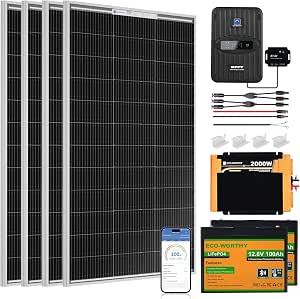 | Best Complete Starter Kit | Panel output: 400W | Panels: 4 × 100W bifacial panels | System voltage: 12V | VIEW LATEST PRICE | See Our Full Breakdown |
| ECO-WORTHY 48V Off-Grid Solar System Kit, 1560W Panels, 5kWh Battery |  | Best for Higher-Demand Off-Grid Loads | Total panel power: 1560W | Panel configuration: 8 × 195W bifacial panels | Battery: 48V 100Ah LiFePO4 | VIEW LATEST PRICE | See Our Full Breakdown |
| ECO-WORTHY 1200W 24V Off-Grid Solar System with Lithium Batteries |  | Best for Larger Battery Storage | Panel configuration: 6 × 195W panels | Total panel power: 1170W | Battery configuration: 2 × 12.8V 280Ah lithium batteries | VIEW LATEST PRICE | See Our Full Breakdown |
| solar panel kits for home | Charge controller |
|---|---|
| Renogy 400W 12V Premium Solar | 40A MPPT Rover |
| ECO-WORTHY 200W 12V/24V Monocr | 30A PWM |
| ECO-WORTHY 1170W Solar Panel K | — |
| ECO-WORTHY 10 kW Off-Grid Sola | — |
| ECO-WORTHY 400W 12V Solar Pane | 40A MPPT |
| ECO-WORTHY 10 kW Off-Grid Sola | — |
| ECO WORTHY 10kW Off-Grid Solar | — |
| ECO-WORTHY 400W Solar Panel Ki | 40 A MPPT |
| ECO-WORTHY 10 kW Off-Grid Sola | — |
| ECO-WORTHY 5 kW Off-Grid Solar | — |
| ECO-WORTHY 400W 12V Solar Pane | 40A MPPT |
| ECO-WORTHY 48V Off-Grid Solar | 80A MPPT |
| ECO-WORTHY 1200W 24V Off-Grid | 60A MPPT |
More Details on Our Top Picks
Renogy 400W 12V Premium Solar Kit with 40A MPPT Charge Controller
For a home setup built around a 12V battery bank, this Renogy kit combines four 100W panels with a 40A MPPT controller, mounting brackets, cables, and an adaptor kit. The included Bluetooth module adds phone-based system monitoring, a practical advantage over the ECO-WORTHY 200W kit, which uses a 30A PWM controller and is aimed at smaller installations. Compared with the ECO-WORTHY 400W kit, Renogy offers a similarly complete panel-and-controller package, but its listed 56.4 lb weight makes handling a bigger job. The panels’ five-year materials-and-workmanship warranty is useful, though buyers should check the full system’s warranty separately. This is an off-grid kit, not a turnkey grid-connected home system: battery selection, wiring, and installation still need planning.
Pros:- Four 100W monocrystalline panels provide 400W of total panel capacity.
- 40A MPPT controller is included for the 12V system.
- Bluetooth module supports phone monitoring.
- Includes Z-brackets, cables, and an adaptor kit; panels have a five-year materials-and-workmanship warranty.
Cons:- At 56.4 lb, the kit may be cumbersome to transport and handle.
- The supplied package does not list a battery or inverter, so those require separate planning.
- The listing’s 100W maximum-power wording can be confusing beside the 400W total kit rating.
Best for: Off-grid homeowners building a 12V battery system who want four panels, MPPT charging, phone monitoring, and basic mounting hardware in one kit.
Not ideal for: Homeowners seeking a grid-tied system or a lightweight kit that one person can easily move and install.
- Total panel power:400W
- System voltage:12V
- Panel configuration:4 × 100W monocrystalline panels
- Charge controller:40A MPPT Rover
- Maximum battery voltage:32V
- Panel dimensions:41.8 × 20.9 × 1.38 in
- Item weight:56.4 lb
- Included accessories:Bluetooth module, Z-brackets, adaptor kit, and tray cable
- Panel warranty:5 years for materials and workmanship
Our verdict“Choose the Renogy kit for a well-equipped 12V off-grid starting point, but skip it if you need a complete grid-connected home system or an included battery.”
ECO-WORTHY 200W 12V/24V Monocrystalline Solar Panel Kit with 30A PWM Charge Controller
This is the lineup’s simpler, lower-capacity choice: two 100W panels, a 30A PWM controller, mounting brackets, and cables. Its ability to wire for 12V or 24V gives buyers some flexibility as an off-grid setup takes shape, while the Renogy 400W kit doubles the panel capacity and adds an MPPT controller and Bluetooth monitoring. That makes Renogy a stronger fit when energy needs are larger, but this ECO-WORTHY kit may be easier to place where roof or ground space is limited. The corrosion-resistant aluminum frame and IP65-rated junction box suit outdoor use; they do not remove the need for sound mounting and wiring. Since the package has no listed battery or inverter, it is a component kit rather than a ready-to-power home system.
Pros:- Includes two 100W monocrystalline panels, controller, mounting brackets, and cables.
- Panels can be connected for either 12V or 24V system configurations.
- Aluminum frame is corrosion-resistant, and the junction box is IP65-rated.
- At 31.6 lb, it is lighter than the Renogy 400W kit.
Cons:- Its 200W panel capacity is limited for a household with substantial energy needs.
- The 30A controller uses PWM rather than the MPPT controller supplied with the Renogy and ECO-WORTHY 400W kits.
- Battery and inverter are not listed as included, and installation requires wiring.
Best for: Owners of small cabins, sheds, or other off-grid spaces who want a modest panel array with 12V/24V wiring options and included mounting hardware.
Not ideal for: Households aiming to run substantial home loads or buyers who want MPPT charging, battery storage, or an inverter included.
- Maximum power:200W
- Panel configuration:2 × 100W monocrystalline panels
- System voltage:12V or 24V
- Charge controller:30A PWM
- Panel efficiency:Up to 21.5%
- Panel dimensions:35.2 × 23.1 × 1.3 in
- Item weight:31.6 lb
- Frame and junction box:Aluminum frame; IP65-rated junction box
- Included components:Panels, Z-brackets, controller, solar cables, 2-in-1 connectors, and tray cable
Our verdict“Pick this ECO-WORTHY kit for a compact, modest off-grid array, not as the sole solar solution for a home with larger loads.”
ECO-WORTHY 1170W Solar Panel Kit with 48V 50Ah Battery and 3500W Inverter
Unlike the Renogy 400W and ECO-WORTHY 200W kits, which focus on panels and charge control, this package includes the major parts of an off-grid system: 1,170W of panels, a 48V battery, and a 3,500W inverter. That makes it a more direct choice for buyers who want storage and AC output bundled with the array rather than sourcing them separately. The inverter’s 80A MPPT controller, Wi-Fi monitoring, and 7,000W surge capacity add useful system functions; the battery is rated for 2,560Wh of usable energy. Its six bifacial N-type panels are a more substantial installation than the smaller 12V kits, but this is still far below the 10kW ECO-WORTHY system’s capacity and 32.2kWh storage. Package components may arrive separately, and output depends on available sunlight.
Pros:- Bundles six panels, a 48V LiFePO4 battery, an inverter, cables, and mounts.
- Battery provides 2,560Wh of usable energy and is rated for more than 4,000 cycles.
- Inverter includes an 80A MPPT controller, Wi-Fi monitoring, and 7,000W surge capacity.
- N-type bifacial panels are listed at 25% conversion efficiency.
Cons:- The 2,560Wh battery is much smaller than the 32.2kWh storage in the ECO-WORTHY 10kW kit.
- Listed energy estimates depend on sunlight; real output varies with site and conditions.
- Multiple packages may arrive separately, which can complicate delivery and installation planning.
Best for: Cabin or small-home owners seeking an off-grid package with panels, battery storage, inverter, and monitoring together.
Not ideal for: Households with high daily energy demand, buyers who need 120/240V split-phase output, or anyone seeking a small, simple panel-only installation.
- Total panel output:1,170W (6 × 195W)
- Panel type:N-type bifacial monocrystalline silicon
- Panel conversion efficiency:25%
- Battery:48V 50Ah LiFePO4
- Usable battery energy:2,560Wh
- Inverter output:48V DC to 110/120V AC
- Inverter surge power:7,000W
- Inverter features:80A MPPT controller, Wi-Fi monitoring/control, and 20ms UPS switching
- Battery cycle life:More than 4,000 cycles
Our verdict“Choose this package when you want a bundled mid-size off-grid system with battery and inverter, but look to the 10kW ECO-WORTHY kit for much larger loads and storage needs.”
ECO-WORTHY 10 kW Off-Grid Solar Panel Kit with Split-Phase Inverter and 32.2 kWh Battery Storage
This is the lineup’s largest system, built for buyers whose off-grid plans extend well beyond a few small appliances. It pairs 10,620W of panel capacity with a 10,000W split-phase inverter and 32.2kWh of LiFePO4 storage, a very different scale from the ECO-WORTHY 1170W package, which has 2,560Wh of usable battery energy. The 120/240V output can suit homes with split-phase loads, while the listed peak output reaches 20,000W. Scale brings real demands: the 18 panels are large, professional installation is recommended, and delivery needs an address able to accept a pallet truck delivery. The stated daily generation is an up-to figure under optimal conditions, not a guaranteed household energy supply; site design, sunlight, and load planning still matter.
Pros:- Combines 10.62kW of panels with a 10kW continuous inverter.
- Provides 32.2kWh of total LiFePO4 battery storage.
- Split-phase output supports 120V or 120/240V loads.
- Battery monitoring includes display, Bluetooth, Wi-Fi, and PC options.
Cons:- Professional installation is recommended, adding planning and setup requirements.
- Pallet delivery requires an address that can accommodate truck delivery.
- The large panels and system capacity are excessive for modest off-grid needs, and stated generation depends on optimal conditions.
Best for: Owners of larger off-grid homes who need split-phase output, substantial battery storage, and are prepared for professional system planning and installation.
Not ideal for: Small cabins, partial-load backup buyers, or homeowners without the space, delivery access, and installation support for a large system.
- Solar panel count:18 monocrystalline panels
- Total PV capacity:10,620W
- Maximum daily generation:Up to 39.36kWh under optimal conditions
- Inverter continuous output:10,000W
- Inverter peak output:20,000W
- Output voltage:120V or 120/240V split-phase
- Battery storage:32.2kWh total from two LiFePO4 batteries
- Battery voltage and capacity:48V, 314Ah each
- Installation:Professional installation recommended
Our verdict“Choose this kit for a high-demand off-grid home with room and professional installation support; smaller systems make more sense for limited loads.”
ECO-WORTHY 400W 12V Solar Panel Kit with MPPT Controller and Bluetooth
This ECO-WORTHY kit targets buyers who want a 400W, 12V panel-and-controller package with phone monitoring. Like the Renogy 400W kit, it includes four 100W panels and a 40A MPPT controller; the listed average output of 1.6kWh per day offers a useful planning reference, though sunlight conditions can shift actual production. Its Bluetooth module reports system data to a phone, while the Renogy listing also includes monitoring and specifies a five-year panel materials-and-workmanship warranty. ECO-WORTHY lists 21% panel efficiency, bypass diodes, and an IP65 junction box. The package lists mounting brackets but does not list a battery or inverter, so it is not a complete home power system. At 32.66kg, moving and mounting the panels calls for careful handling.
Pros:- Includes four 100W monocrystalline panels and a 40A MPPT controller.
- Bluetooth module sends system data to a mobile phone, with a listed range up to 82 feet.
- Panels include bypass diodes and an IP65-rated junction box.
- Listed average daily production is 1.6kWh, depending on sunlight.
Cons:- No battery or inverter is listed, so additional equipment is needed for stored and AC power.
- The 32.66kg item weight can make transport and installation difficult.
- Daily production depends on sunlight and should not be treated as a guaranteed output.
Best for: Off-grid users with a 12V battery setup who want a 400W array, MPPT charging, and Bluetooth data on a phone.
Not ideal for: Homeowners wanting a battery and inverter in the same package, or buyers who need a lighter kit that is easy to move alone.
- Total panel power:400W
- System voltage:12V DC
- Panel configuration:4 × 100W monocrystalline panels
- Charge controller:40A MPPT
- Panel efficiency:21%
- Average daily energy production:1.6kWh, depending on sunlight
- Bluetooth range:Up to 82 feet
- Panel dimensions:35.2 × 23 × 1.37 in
- Item weight:32.66kg
Our verdict“Pick this kit over the ECO-WORTHY 200W option when you need more panel capacity and phone monitoring, but plan separately for battery storage and AC power.”
ECO-WORTHY 10 kW Off-Grid Solar System Kit with 9.36 kWh Daily Output
This kit pairs a 10,000 W inverter with 120 V/240 V output and 10.24 kWh of battery storage, making it a more complete fit for a home with mixed household loads than the smaller ECO-WORTHY 5 kW Off-Grid Solar System Kit. Its twelve 195 W panels total 2,340 W, with stated daily production of 9.36 kWh under four hours of full sunshine. That output figure depends on favorable sun, so it should not be treated as a guaranteed daily supply. App monitoring and multiple charging modes give owners ways to track storage and combine solar with mains power. The tradeoff is the gap between the inverter’s high rating and the relatively modest panel array: professional installation is recommended, and this is not a simple starter setup.
Pros:- Includes panels, batteries, inverter, and mounting accessories.
- 120 V/240 V AC output supports a wider range of household appliances.
- App-based battery monitoring and several charging modes add operating flexibility.
- Panels are rated IP68 and have a stated 30-year lifespan.
Cons:- Professional installation is recommended, adding complexity for DIY buyers.
- The 9.36 kWh daily figure assumes four hours of full sunshine.
- The 2,340 W panel array may not make full use of the inverter’s 10,000 W rating.
Best for: Off-grid homeowners who need 120 V/240 V appliance support and want a bundled battery, inverter, and panel system.
Not ideal for: Buyers seeking a small, straightforward DIY system or dependable high daily generation in areas with limited sunshine.
- Inverter maximum output:10,000 W
- Solar panel configuration:12 × 195 W; 2,340 W total
- Stated daily solar output:9.36 kWh under 4 hours of full sunshine
- Battery capacity:10.24 kWh
- Battery configuration:2 × 48 V (51.2 V) 100 Ah lithium batteries
- AC output:120 V / 240 V
- Panel dimensions:58.86 × 26.18 × 1.18 in
- Battery monitoring:Mobile app via Bluetooth or Wi-Fi
Our verdict“Choose this kit for an off-grid home that needs split-voltage appliance support, but not if you want a simple installation or a larger solar array.”
ECO WORTHY 10kW Off-Grid Solar Panel Kit with 16kWh Battery
The standout here is its 16.076 kWh LiFePO₄ battery, which gives this kit more stored energy than the 10.24 kWh ECO-WORTHY 10 kW Off-Grid Solar System Kit with 9.36 kWh Daily Output. That extra reserve can help cover household use after sunlight fades, while the 10 kW split-phase inverter supplies 120 V/240 V power. The five 590 W panels total 2,950 W and are rated for up to 11.8 kWh per day under optimal conditions; actual production depends on site and weather. Battery expansion up to 15 units provides a growth path, but the large panels weigh 72.8 lb each and arrive by truck on a pallet. This is a stronger storage-first choice than a small cabin kit, but shipping access and professional installation make it a poor pick for a casual DIY project.
Pros:- 16.076 kWh battery capacity provides substantial stored energy.
- 120 V/240 V split-phase output suits a broad range of household loads.
- Battery supports parallel expansion up to 15 units.
- Dual MPPT controllers and Wi-Fi monitoring are built into the inverter.
Cons:- Professional installation is recommended.
- Each panel weighs 72.8 lb and is nearly 90 in long, complicating handling and placement.
- Truck delivery requires an address that can accommodate a pallet shipment.
Best for: Off-grid homeowners who value a larger battery reserve now and may want to expand storage as household needs grow.
Not ideal for: DIY buyers without electrical experience, or households that cannot receive a pallet shipment and handle large, heavy panels.
- Inverter continuous output:10,000 W
- Inverter peak output:20,000 W
- AC output:120 V/240 V split-phase
- Battery:48 V 314 Ah LiFePO₄
- Battery energy capacity:16.076 kWh
- Solar panel configuration:5 × 590 W; 2,950 W total
- Estimated daily generation:Up to 11.8 kWh under optimal conditions
- Panel dimensions and weight:89.69 × 44.65 × 1.18 in; 72.8 lb each
Our verdict“Pick this system when battery capacity and future storage expansion matter more than easy delivery or a lightweight installation.”
ECO-WORTHY 400W Solar Panel Kit with 12V 100Ah Lithium Battery
Among this group, this is the clearest choice for a small cabin, shed, RV, or backup circuit rather than a whole home: it combines 400 W of panels, a 12 V 100 Ah lithium battery, an MPPT controller, and an 1,100 W pure sine wave inverter. That all-in-one package is easier to match to modest loads than the 10 kW ECO-WORTHY kits, but it cannot serve the same range of household appliances or provide 120 V/240 V split-phase power. The stated 1.6 kWh daily output assumes four hours of sunlight, and the inverter’s 1,100 W ceiling limits what can run at once. Bluetooth monitoring and a built-in battery management system help with basic system oversight. Its one-year warranty and modest capacity make it a limited home-power option, not a whole-house solution.
Pros:- Complete bundle includes panels, lithium battery, MPPT controller, inverter, and Bluetooth module.
- 40 A MPPT controller is rated for up to 99% tracking efficiency.
- Battery has a built-in management system and a stated life of more than 3,000 deep cycles.
- Pure sine wave inverter has a stated 95% conversion efficiency.
Cons:- The 1,100 W inverter limits simultaneous and high-draw appliance use.
- The 1.6 kWh daily output assumes ideal sunlight conditions.
- The one-year warranty is limited compared with the long service life expected of a home energy system.
Best for: RV owners and cabin users powering lights, electronics, and other modest loads from a compact 12 V system.
Not ideal for: Homeowners seeking whole-house backup, 240 V appliance support, or enough inverter capacity for multiple high-draw devices.
- Solar panel capacity:400 W (4 × 100 W)
- Battery:12 V 100 Ah lithium
- Charge controller:40 A MPPT
- Inverter:1,100 W; 12 V DC to 110 V AC
- Ideal daily output:Up to 1.6 kWh under 4 hours of sunlight
- Panel conversion rate:23%
- Battery cycle life:More than 3,000 deep cycles
- Warranty:1 year
Our verdict“Choose this kit for modest 12 V off-grid needs, not as a replacement for a larger home system such as the ECO-WORTHY 5 kW kit.”
ECO-WORTHY 10 kW Off-Grid Solar System Kit with Split-Phase Inverter, Batteries, and Solar Panels
With 20.48 kWh of battery storage and 5,310 W of panels, this is the most storage-heavy option in this five-product group. It gives an off-grid home more stored energy and a larger array than the ECO-WORTHY 10kW Off-Grid Solar Panel Kit with 16kWh Battery, though that rival has a specified path to expand its battery bank up to 15 units. Here, four LiFePO₄ batteries and a 10,000 W split-phase inverter form a substantial base system, with 120 V or 120/240 V output for different household needs. Bifacial N-type panels and dual MPPT controllers add generation and system-monitoring features, but actual yield depends on installation and sunlight. The panels are nearly 90 in long and ship by pallet, while professional installation is recommended. This capacity is useful for serious off-grid use, but excessive for buyers with only modest backup needs.
Pros:- Includes 20.48 kWh of LiFePO₄ battery storage.
- 5,310 W total panel capacity exceeds the arrays in the other 10 kW kits in this batch.
- Inverter supports 120 V or 120/240 V split-phase output.
- Dual MPPT controllers, Wi-Fi monitoring, and battery app monitoring support system oversight.
Cons:- Professional installation is recommended.
- Panels are large and heavy, and pallet delivery requires suitable access.
- The 100 A battery BMS rating may shape how the battery bank handles discharge demands.
Best for: Off-grid homeowners who want a large included battery bank, a substantial panel array, and 120 V/240 V household output.
Not ideal for: Small homes or occasional backup users who do not need 20.48 kWh of storage and cannot accommodate pallet delivery or large panels.
- Inverter continuous power:10,000 W
- Inverter peak power:20,000 W
- Inverter output:120 V or 120/240 V split-phase
- Battery configuration:4 × 48 V 100 Ah LiFePO₄
- Total battery storage:20.48 kWh
- Solar panel configuration:9 × 590 W; 5,310 W total
- Panel efficiency:23.23%
- Panel dimensions:89.7 × 44.6 × 1.4 in
- Battery BMS:100 A
Our verdict“Choose this kit when you want the largest included storage and panel array in this group, and have the site and delivery access to support it.”
ECO-WORTHY 5 kW Off-Grid Solar System Kit with 2,340 W Panels
This kit sits between the compact 400 W ECO-WORTHY kit and the larger 10 kW systems: its 5,000 W inverter and 2,340 W panel array suit a cabin, RV, or modest off-grid home better than the smaller kit, without stepping up to the 10 kW inverter class. It includes a 51.2 V 100 Ah LiFePO₄ battery, cables, and Z brackets, so buyers get the main system pieces in one package. The 12 panels are each 21.9 lb, which makes handling more manageable than the 72.8 lb panels in the ECO WORTHY 10kW Off-Grid Solar Panel Kit with 16kWh Battery, though roof layout and transport still need planning. The listing describes it as DIY-oriented, but electrical and mounting work still calls for appropriate expertise. Its 120 V output also lacks the 240 V flexibility offered by the larger kits.
Pros:- Includes inverter, battery, panels, cables, and mounting brackets.
- LiFePO₄ battery is suited to deep-cycle energy storage.
- Panels can be mounted on a roof, ground, or shed.
- Each panel weighs 21.9 lb, making handling less demanding than the larger 590 W panels in this batch.
Cons:- DIY installation still requires electrical and mounting knowledge.
- 120 V output does not provide the 120 V/240 V flexibility of the 10 kW kits.
- The 2,340 W panel array is smaller than the 5,310 W array in the ECO-WORTHY 10 kW system with four batteries.
Best for: DIY-capable cabin, RV, or small off-grid home owners who want a bundled system with a mid-range inverter and battery.
Not ideal for: Households that need 240 V output, large battery reserves, or a system suited to heavier whole-home loads.
- Solar panel configuration:12 × 195 W; 2,340 W total
- Inverter:48 V, 5,000 W off-grid
- Battery:51.2 V 100 Ah LiFePO₄
- Maximum voltage:48 V DC
- Output voltage:120 V
- Amperage capacity:100 A
- Panel dimensions:58.86 × 26.18 × 1.18 in
- Panel weight:21.9 lb
- Included components:Inverter, battery, 12 panels, cables, and Z brackets
Our verdict“Pick this as a mid-size, DIY-oriented off-grid package if 120 V power and a 5,000 W inverter fit your loads.”
ECO-WORTHY 400W 12V Solar Panel Kit with Lithium Batteries and 2000W Inverter
I’d choose this kit when I want a coordinated off-grid setup rather than panels alone: it includes 400W of bifacial panels, two lithium batteries, an MPPT controller, and a 2000W pure sine wave inverter. That makes it more ready for cabin, shed, or RV use than the Renogy 400W 12V Premium Solar Kit, which does not include the battery-and-inverter package described here. The 12V design and Bluetooth monitoring also make system status easier to check without adding separate monitoring gear. The tradeoff is scale: its 200Ah battery bank and 400W array suit modest loads, not a whole home or sustained high-demand appliances. The stated daily generation assumes four hours of sunlight, so real output will vary with location, shading, and panel placement.
Pros:- Includes panels, lithium batteries, MPPT controller, and inverter as one system
- Two batteries provide 200Ah of 12V storage and include built-in battery management
- Bifacial panels can make use of reflected light when the installation allows it
- Bluetooth monitoring provides a convenient way to check system information
Cons:- The 400W array is modest for regular household loads or extended cloudy periods
- The listed 1.6kWh daily output assumes four hours of sunlight and is not guaranteed
- A 12V setup may be less suited to larger systems than the 24V or 48V alternatives in this roundup
Best for: RV, cabin, or shed owners who want panels, lithium storage, a controller, and an inverter in one modest off-grid package.
Not ideal for: Households seeking whole-home backup or high daily energy production; the 400W array and 12V, 200Ah battery bank are better suited to limited loads.
- Panel output:400W
- Panels:4 × 100W bifacial panels
- System voltage:12V
- Battery bank:2 × 12V 100Ah lithium batteries
- Charge controller:40A MPPT
- Inverter:2000W pure sine wave
- Panel conversion rate:23%
- Battery cycle life:More than 3,000 deep cycles
Our verdict“Pick this kit for a small off-grid site that needs an included battery and inverter, but skip it if you need substantial home-scale output.”
ECO-WORTHY 48V Off-Grid Solar System Kit, 1560W Panels, 5kWh Battery
Among these three kits, this is the stronger fit when a cabin or backup setup needs more solar input and a higher-voltage system. Its 1560W array, 48V 100Ah LiFePO4 battery, and 80A MPPT controller give it substantially more generating capacity than the 400W ECO-WORTHY 12V kit. The 3500W inverter rating also supports common 110V/120V appliances, while WiFi, Bluetooth, and a touchscreen provide several ways to monitor operation. Its listed maximum daily generation of 6.24kWh relies on four hours of full sunlight, so I would not treat that figure as a guaranteed household supply. The eight panels also need considerable mounting space, making this less convenient for compact roofs or small outbuildings. Low-temperature charging down to -4°F is a useful distinction, though cold-weather system performance still depends on conditions and installation.
Pros:- 1560W of bifacial panels offers more solar input than the two 12V kits in this batch
- 48V 100Ah LiFePO4 battery and 3500W inverter suit a larger off-grid system
- WiFi, Bluetooth, and a 4.3-inch touchscreen offer multiple monitoring options
- Battery charging is specified down to -4°F
Cons:- Eight panels require substantial installation space
- The stated 6.24kWh daily generation assumes four hours of full sunlight
- The complete system may arrive in multiple packages
Best for: Cabin owners or backup-power planners who need a larger off-grid array, 110V/120V appliance support, and built-in monitoring.
Not ideal for: Buyers with limited roof or ground-mount space, or anyone expecting dependable daily output regardless of sun and weather.
- Total panel power:1560W
- Panel configuration:8 × 195W bifacial panels
- Battery:48V 100Ah LiFePO4
- Inverter:3500W inverter; 7000W peak power
- Charge controller:80A MPPT
- Maximum daily energy generation:6.24kWh under four hours of full sunlight
- Panel efficiency:25%
- Battery cycle life:6,000+ cycles
- Monitoring and display:WiFi, Bluetooth, and 4.3-inch color touchscreen
Our verdict“Choose this 48V kit for a space-ready cabin or backup system with heavier loads, not for a small installation or guaranteed daily production.”
ECO-WORTHY 1200W 24V Off-Grid Solar System with Lithium Batteries
I’d put this kit on the shortlist when stored energy matters more than choosing the highest panel output in this group. It pairs two 12.8V 280Ah lithium batteries for a stated 7.168kWh of storage with six 195W panels, a 60A MPPT controller, and a 3000W pure sine wave inverter. That battery capacity exceeds the 5kWh bank in the ECO-WORTHY 48V 1560W kit, while its 1170W panel total is lower, so replenishing stored power may take longer under similar sunlight. Bluetooth monitoring and built-in battery management add practical system oversight. The supplied information has a material ambiguity: it lists ideal daily output as both 4.68kWh and 4.68Wh. I would verify expected production with the seller before sizing loads around it. This is an off-grid kit, not a complete whole-home energy guarantee.
Pros:- Two 280Ah lithium batteries provide a stated 7.168kWh of storage
- Includes six panels, batteries, MPPT controller, inverter, and cables
- 3000W pure sine wave inverter supports compatible AC loads
- Battery management and Bluetooth monitoring are included
Cons:- The product information conflicts on daily output, listing both 4.68kWh and 4.68Wh
- Its 1170W panel total is lower than the 1560W ECO-WORTHY 48V kit
- Actual solar production varies with sunlight, orientation, shading, and weather
Best for: Cabin, trailer, or backup-power users who prioritize a larger lithium battery reserve and a 24V system over maximum panel wattage.
Not ideal for: Buyers who need clearly stated daily generation before purchase or want the higher 1560W panel output of the ECO-WORTHY 48V kit.
- Panel configuration:6 × 195W panels
- Total panel power:1170W
- Battery configuration:2 × 12.8V 280Ah lithium batteries
- Battery storage capacity:7.168kWh
- Charge controller:60A MPPT
- Inverter:3000W pure sine wave
- Battery cycle life:More than 6,000 cycles
- Connector type:MC4
Our verdict“Choose this kit if its 7.168kWh battery reserve suits your off-grid needs, but confirm the inconsistent generation figure before planning around it.”

How We Picked
I compared these kits as home power systems, not just panel bundles. The main criteria were stated panel capacity, system voltage, charge-controller type, inverter output where listed, battery capacity, and how clearly the package components matched a plausible use. Those details shape whether a kit is better suited to small DC loads, a cabin-scale setup, or a larger off-grid installation. I also weighed system scope and the likely planning burden: a bundle with storage and an inverter can be more turnkey, but it still needs correct sizing and installation.
The ranking favors useful balance and clarity of fit over the biggest headline wattage. That puts a bundled mid-sized system ahead of basic panel kits for buyers seeking home-use capability, while smaller kits remain relevant for limited loads and learning setups. Larger ECO-WORTHY systems rank well for buyers who need substantial off-grid capacity, but their scale, storage differences, and installation demands make them poor default choices for every home. Product names and listed specifications do not establish grid interconnection approval, complete installation hardware, or real-world output, so buyers should verify those points before purchase.
Factors to Consider When Choosing Solar Panel Kits For Home
Before choosing a kit, I’d work backward from the appliances and the way you plan to use them. A home setup can mean backup for a few essentials, a cabin without utility service, or a more extensive off-grid system; those goals call for different panel, battery, and inverter sizes. These checks help avoid paying for capacity you cannot use—or buying a kit that cannot support your intended loads.
1. Start With Energy Use, Not Panel Wattage
List the devices you want to run, their power draw, and how many hours each will operate in a typical day. Add the daily energy use in watt-hours, then account for devices with motors or heating elements that may need a higher startup or continuous power supply. Panel wattage describes potential generation under suitable conditions, not the amount of energy your home will receive every day. A 400W kit may suit limited loads, but it should not be treated as a small version of a whole-home array. I’d also leave room for seasonal sunlight variation rather than sizing to a clear summer day. This load-first approach often changes the shortlist before brand or kit format matters.
2. Match Battery Storage to the Hours Without Sun
Panels make energy when sunlight is available; batteries determine how much can be used later. Estimate overnight use and the number of low-sun hours or days you want to cover, then compare that need with the battery’s stated capacity. Usable capacity can be lower than a battery’s headline rating, so check the manufacturer’s guidance on discharge limits and operating conditions. The large ECO-WORTHY kits in this roundup list markedly different storage amounts, and a 10 kW label alone does not tell you how long a home can run. More storage adds cost, weight, and space requirements, so it makes sense when your backup or off-grid schedule needs it. If you are grid-connected, decide whether storage is for short outages or routine energy shifting before paying for a large bank.
3. Check Inverter Output and Surge Needs
The inverter converts battery power into the AC electricity used by many household appliances. Its continuous output needs to cover the devices running at the same time, while its surge rating must handle brief startup loads from equipment such as pumps or refrigerators. A kit with ample panels but an undersized inverter can still fail to run a planned appliance. Check whether the system provides the voltage and split-phase output your intended loads require; do not assume a listed inverter suits every home circuit. Also verify what is included, since some panel kits may require a separate inverter. Matching inverter capacity to actual simultaneous use is often more useful than choosing the largest panel total.
4. Decide Whether the Kit Is Truly Complete
“Kit” can mean a different set of components from one listing to another. Confirm whether panels, mounting hardware, wiring, fuses or breakers, charge control, batteries, and an inverter are included, and check the quantities and ratings for each. A controller-and-panel bundle may be a sensible starting point for a small system, but it is not ready to power household AC devices without additional compatible equipment. Before purchase, map every component to a simple system diagram and identify anything you still need. Check connector types, cable lengths, and compatibility across the panels, controller, and battery. This prevents a low-friction bundle from turning into a collection of mismatched parts.
5. Choose System Voltage for the Scale You Need
Small 12V kits are common for limited loads and can be easier to understand, while higher-voltage battery systems are often used as power needs grow. Voltage affects current, wiring requirements, compatible equipment, and the design of the complete system; it is not a direct measure of how much energy a kit produces. Moving from a 12V kit to a 48V setup can make sense for larger loads, but only when the inverter, controller, and batteries are designed to work together. Avoid mixing components based on connector fit alone. If you already own equipment, check its voltage and compatibility before choosing a bundle. For a new system, plan the whole architecture rather than buying one component at a time without a target.
6. Treat Roof, Permits, and Grid Connection as Separate Questions
A solar kit does not automatically include everything required for a legal, durable home installation. Roof condition, mounting method, wind and snow exposure, electrical protection, local permits, and utility interconnection rules all affect the project. An off-grid kit may be intended for a standalone system and may not be approved for connection to a home’s utility supply. Ask a qualified installer or local authority which requirements apply before purchasing components. Ground mounting can be an alternative where roof orientation or condition is unsuitable, though it needs clear space and secure foundations. Paying for professional design can be worthwhile when the system connects to household wiring or supports essential loads.
Frequently Asked Questions
Can a 400W solar panel kit power a house?
A 400W kit is generally better viewed as a small-system starting point than a complete source of household power. It may support limited DC loads or recharge a compatible battery, but household appliances often need an inverter and more generation and storage than a basic panel bundle provides. The Renogy and ECO-WORTHY 400W options in this roundup differ in included equipment, so check each package rather than relying on panel wattage alone. Add up daily energy use and peak simultaneous loads before deciding. For multiple household circuits or major appliances, look at a larger, properly designed system.
What is the practical difference between a 5 kW and a 10 kW off-grid kit?
The panel and inverter capacities are only part of the difference; the loads you plan to run and the included battery storage matter just as much. A 10 kW system may suit a larger set of simultaneous loads, but it cannot provide sustained power without enough stored energy and suitable sunlight. This roundup includes several 10 kW ECO-WORTHY kits with different battery configurations, so the shared label does not make them interchangeable. Compare inverter output, battery capacity, panel wattage, and included components side by side. Choose the smaller system if it meets your measured needs and you prefer a less extensive installation.
Should I choose a kit with a battery and inverter included?
A bundled battery and inverter can reduce compatibility work because key parts are packaged for a planned system, as with several larger kits in this roundup. It can also mean paying for equipment that does not match your load profile or future expansion plans. A panel-and-controller kit may be a better fit if you already own compatible storage or want to build gradually. In either case, verify battery chemistry and capacity, inverter output and surge rating, system voltage, and all required protection and wiring. A bundle is only convenient when its components actually cover your intended use.
Can I connect an off-grid solar kit to my home’s utility power?
Do not assume an off-grid kit is designed or approved for utility interconnection. Grid-connected systems have specific inverter, electrical protection, metering, permit, and utility requirements that vary by location. A kit marketed for off-grid use may lack the equipment or approvals needed for that role, even if it can power household AC loads through an inverter. Ask the manufacturer and your utility about compatibility, then have a qualified professional review the design before connecting it to household wiring. If your main goal is outage backup, a properly isolated setup may be more suitable than a direct grid connection.
How do I choose between the 10 kW ECO-WORTHY kits with different battery sizes?
Compare the listed battery capacity and the full component list rather than selecting by the 10 kW name. This roundup includes options described with 9.36 kWh daily output, 16 kWh of battery storage, and 32.2 kWh of battery storage; daily production and stored energy are different measures. Larger storage can support longer periods without sunlight, but it does not increase panel generation by itself. Match usable storage to overnight demand and the backup duration you want, then check inverter output and panel capacity. Confirm the precise included battery configuration with the seller before ordering.
Conclusion
For the broadest balance of included components and home-use potential, I’d choose the ECO-WORTHY 1170W kit with 48V battery and 3500W inverter as best overall, while recognizing it still needs to match your measured loads. For best value in a small setup, the ECO-WORTHY 200W kit is the simpler, lower-capacity route; choose it only for modest needs and check whether its PWM controller fits your plans. For beginners starting with limited 12V loads, the Renogy 400W kit’s MPPT controller makes a clear starting point, though it is not a whole-home solution. For premium off-grid capacity, compare the ECO-WORTHY 10 kW options by their actual battery storage and included equipment rather than their shared power label. If you need a compact system, focus on the 200W and 400W kits; if you need substantial home-scale off-grid power, shortlist the 5 kW and 10 kW systems and get the design and installation checked before buying.
Fall Picks

Arlo Essential Outdoor Pan-Tilt-Zoom Security Camera, 2K, Wired, 2-Camera Pack
As an affiliate, we earn on qualifying purchases.