Solar-powered phone chargers can provide portable backup power, but their small panels generally recharge a power bank slowly; most buyers will rely mainly on USB charging. I’d choose the BLAVOR 20,000mAh Solar Power Bank with Wireless Charging as the best overall balance of capacity and everyday flexibility. The 20,000mAh 22.5W models with built-in cables stand out for faster wired charging, while the BLAVOR 10,000mAh models suit lighter loads and easier carry. The main tradeoffs are capacity versus weight, built-in convenience versus cable flexibility, and solar backup versus realistic recharge time. Read on for the full comparison and advice on matching a charger to your phone, trip, and backup-power needs.

Get backup power and energy gear delivered free with Prime
- Fast, free delivery on millions of items
- Prime Video, Amazon Music and more included
- Member-only deals all year
Key Takeaways
- USB charging matters more than panel size: Across this group, solar is best treated as an emergency trickle-charge feature, not a dependable way to refill a large power bank quickly.
- 20,000mAh models are the most balanced group: They offer more reserve than the 10,000mAh BLAVOR options without the bulk associated with the 38,800mAh and 49,800mAh models.
- 22.5W wired output is the speed-focused distinction: The two listed 20,000mAh 22.5W models have a clearer case for buyers prioritizing wired charging speed than models described only as 20W.
- Built-in cables trade flexibility for convenience: They reduce what you need to pack, but buyers who use unusual connectors or want to replace a damaged cable may prefer separate cables.
- High stated capacity is not the same as easy everyday carry: The 38,800mAh and 49,800mAh options favor longer backup needs, while smaller units make more sense for daily bags and short outings.
| BLASOUL 49,800mAh Solar Power Bank with Wireless Charging and 4 Built-In Cables |  | Best for High-Capacity Emergency Backup | Battery capacity: 49,800mAh | Battery type: Lithium-ion | Maximum wired output: 22.5W | VIEW LATEST PRICE | See Our Full Breakdown |
| 20,000mAh Solar Power Bank with 22.5W Fast Charging and Built-In Cables |  | Best for Water-Exposed Trips | Battery capacity: 20,000mAh | Battery technology: Solid-state cells | Maximum charging output: 22.5W | VIEW LATEST PRICE | See Our Full Breakdown |
| BLAVOR 10,000mAh Solar Power Bank with Wireless Charging and 20W USB-C Output |  | Best Compact Pick | Battery capacity: 10,000mAh | Battery type: Lithium-cobalt | USB-C output: Up to 20W | VIEW LATEST PRICE | See Our Full Breakdown |
| BLAVOR 10,000mAh Solar Power Bank with 20W USB-C and Wireless Charging |  | Best for Planned Day Trips | Battery capacity: 10,000mAh | Battery type: Lithium-cobalt | USB-C output: Up to 20W | VIEW LATEST PRICE | See Our Full Breakdown |
| Durecopow 20,000mAh Solar Power Bank with Built-In Cables, 3 Ports, and Dual Flashlight |  | Best for Cable-Free Packing | Battery capacity: 20,000mAh | Battery type: Lithium-ion | Built-in cables: USB-C, Lightning, and Micro-USB output; USB-A input | VIEW LATEST PRICE | See Our Full Breakdown |
| Luvknit 20000mAh Solar Power Bank with Wireless Charging and Built-In Cables | 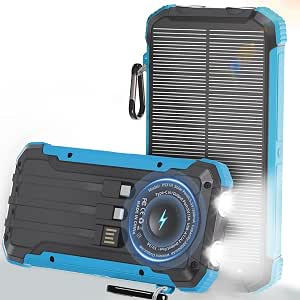 | Best for Cable-Free Flexibility | Battery capacity: 20,000mAh | Battery type: Lithium | Charging methods: Solar, Qi wireless, USB-C input | VIEW LATEST PRICE | See Our Full Breakdown |
| YELOMIN 38800mAh Solar Power Bank with LED Flashlights |  | Best for High-Capacity Backpacking | Battery capacity: 38,800mAh | Ports: 2 USB-A outputs; 1 USB-C input/output | Charging methods: Solar and USB-C | VIEW LATEST PRICE | See Our Full Breakdown |
| Luvknit 20,000mAh Solar Power Bank with USB-C |  | Best for Weather-Exposed Day Trips | Battery capacity: 20,000mAh | Battery type: Lithium polymer | Maximum output: 15W | VIEW LATEST PRICE | See Our Full Breakdown |
| 20,000mAh Solar Power Bank with 22.5W Fast Charging and Built-In Cables |  | Best for Fast Wired Charging | Battery capacity: 20,000mAh | Maximum output: 22.5W | Charging claim: Up to 70% in 30 minutes | VIEW LATEST PRICE | See Our Full Breakdown |
| YOLOSKS 49,800mAh Solar Power Bank with Wireless Charging and Built-In Cables |  | Best for Multi-Device Emergency Kits | Battery capacity: 49,800mAh | Battery type: Lithium polymer | Charging methods: USB and solar | VIEW LATEST PRICE | See Our Full Breakdown |
| 20,000mAh Solar Power Bank with 20W Fast Charging and Built-In Cables |  | Best for Cable-Free Charging | Battery capacity: 20,000mAh | Maximum charging power: 20W | Built-in cables: Micro USB, USB-C, Apple-compatible cable, USB-A input cable | VIEW LATEST PRICE | See Our Full Breakdown |
| BLAVOR 10,000mAh Solar Power Bank with 20W USB-C and Qi Wireless Charging |  | Best Compact Wireless Pick | Battery capacity: 10,000mAh | USB-C output: Up to 20W | Wireless charging: Qi-compatible | VIEW LATEST PRICE | See Our Full Breakdown |
| BLAVOR 20,000mAh Solar Power Bank with Wireless Charging |  | Best for Outdoor Extras | Battery capacity: 20,000mAh | Maximum output power: 20W | Charging ports: USB-C, USB-A, and iOS | VIEW LATEST PRICE | See Our Full Breakdown |
| Durecopow 20,000mAh Solar Power Bank with Built-In Cables and Dual Flashlight |  | Best Simple Outdoor Workhorse | Battery capacity: 20,000mAh | Battery cell type: Lithium polymer | Built-in cables: Type-C, Lightning, Micro USB, and USB-A input | VIEW LATEST PRICE | See Our Full Breakdown |
| TRASHBINEAN 49,800mAh Solar Power Bank with Wireless Charging, Built-In Cables, and Dual LED Flashlights |  | Best for Maximum Listed Capacity | Battery capacity: 49,800mAh | Maximum output power: 15W | Wireless charging: 15W | VIEW LATEST PRICE | See Our Full Breakdown |
| solar powered phone charger | Battery capacity | Built-in cables | Weight | Dimensions |
|---|---|---|---|---|
| BLASOUL 49,800mAh Solar Power | 49,800mAh | iOS, USB-C, and Micro-USB output; USB-A input | 490g | — |
| 20,000mAh Solar Power Bank wit | 20,000mAh | USB-C, Lightning, and Micro USB | — | — |
| BLAVOR 10,000mAh Solar Power B | 10,000mAh | — | 9.3 oz | 5.91 × 3.07 × 0.87 in |
| BLAVOR 10,000mAh Solar Power B | 10,000mAh | — | 9.3 oz | — |
| Durecopow 20,000mAh Solar Powe | 20,000mAh | USB-C, Lightning, and Micro-USB output; USB-A input | — | — |
| Luvknit 20000mAh Solar Power B | 20,000mAh | Lightning, USB-C, USB-A | — | 2.87 x 2.48 x 1.14 inches |
| YELOMIN 38800mAh Solar Power B | 38,800mAh | — | 9.9 oz | 5.9 x 2.95 x 0.98 inches |
| Luvknit 20,000mAh Solar Power | 20,000mAh | — | 0.52 lb | 5.63 x 2.91 x 0.85 inches |
| 20,000mAh Solar Power Bank wit | 20,000mAh | USB-C, Lightning, Micro USB | — | — |
| YOLOSKS 49,800mAh Solar Power | 49,800mAh | — | 16 oz | 6.5 x 3.5 x 1.2 inches |
| 20,000mAh Solar Power Bank wit | 20,000mAh | Micro USB, USB-C, Apple-compatible cable, USB-A input cable | — | — |
| BLAVOR 10,000mAh Solar Power B | 10,000mAh | — | 9.3 ounces | 5.91 × 3.07 × 0.87 inches |
| BLAVOR 20,000mAh Solar Power B | 20,000mAh | 2 USB-C, 1 iOS, and 1 USB-A input | — | 1.5 × 3.85 × 7.28 inches |
| Durecopow 20,000mAh Solar Powe | 20,000mAh | Type-C, Lightning, Micro USB, and USB-A input | — | — |
| TRASHBINEAN 49,800mAh Solar Po | 49,800mAh | USB-A input, USB-C, Micro-USB, and iOS | 580g | 5.8 × 1.11 × 2.92 inches |
More Details on Our Top Picks
BLASOUL 49,800mAh Solar Power Bank with Wireless Charging and 4 Built-In Cables
The BLASOUL’s 49,800mAh capacity and mix of wired and wireless charging make it the most versatile high-capacity pick in this group. Its three built-in output cables cover iOS, USB-C, and Micro-USB devices, while the separate USB-A input cable reduces the number of accessories to pack. Up to 22.5W wired output is a better fit for quick phone top-ups than the Durecopow’s listed 2.4A output, and wireless charging adds convenience when cables are awkward to use.
The tradeoff is its 490g weight, and solar is described as emergency backup rather than a dependable primary recharge method. Its IP65 protection and SOS flashlight suit outdoor contingencies, but buyers should plan to charge it by other means before a trip. Choose it for capacity and connection flexibility, not for fast solar replenishment.
Pros:- Large 49,800mAh capacity for keeping phones and other small devices charged across longer outings.
- Three built-in output cables support iOS, USB-C, and Micro-USB devices.
- Up to 22.5W wired and 15W wireless output provide more charging options than the cable-only Durecopow.
- IP65-rated, shock-resistant design with steady, SOS, and strobe flashlight modes.
Cons:- At 490g, it is a substantial carry for day hikes or minimalist packing.
- Solar charging is positioned as emergency backup, not a practical primary recharge method.
- Wireless charging speed varies with the phone and charging conditions.
Best for: Campers and emergency-kit owners who want a large reserve, built-in cables for several device types, and wireless charging.
Not ideal for: Ultralight hikers or buyers relying on sunlight as their main way to refill a power bank; it weighs 490g and solar charging is backup-only.
- Battery capacity:49,800mAh
- Battery type:Lithium-ion
- Maximum wired output:22.5W
- Wireless output:Up to 15W
- Built-in cables:iOS, USB-C, and Micro-USB output; USB-A input
- Protection:IP65-rated enclosure; shock-resistant design
- Weight:490g
- Flashlight modes:Steady, SOS, and strobe
Our verdict“Choose the BLASOUL if you want a large, rugged reserve with built-in cables and wireless charging, and can recharge it from a non-solar source.”
20,000mAh Solar Power Bank with 22.5W Fast Charging and Built-In Cables
This 20,000mAh model pairs 22.5W fast charging with built-in USB-C, Lightning, and Micro-USB cables, so it is easier to share across devices than the BLAVOR 10,000mAh models, which have less capacity. Its standout distinction is the IPX8-rated construction, alongside dual flashlights, a compass, and a carabiner. That makes it a stronger match for wet-weather outings than the IPX5-rated BLAVOR options, though the product data does not specify a solar charging rate.
The built-in cables and five ports support charging multiple devices, but that convenience comes with a less compact form than a simpler power bank. Solar should be treated as backup replenishment, not a substitute for charging before departure. This is the pick for buyers who value water resistance and connection variety more than a minimal carry or proven solar refill speed.
Pros:- IPX8-rated water resistance offers a stronger wet-condition focus than the IPX5-rated BLAVOR models.
- Built-in USB-C, Lightning, and Micro-USB cables reduce the need to pack separate cords.
- Up to 22.5W output and five ports support faster charging and multiple connected devices.
- Dual flashlights, compass, and carabiner add useful outdoor features.
Cons:- Solar charging is backup power, with no solar charging rate provided.
- Built-in cables and outdoor accessories can make it less compact than a basic bank.
- Its 20,000mAh capacity is below the BLASOUL’s 49,800mAh reserve.
Best for: Kayakers, campers, and group travelers who need multiple device connections and a water-resistant power bank for wet conditions.
Not ideal for: Minimalist hikers or anyone expecting the solar panel to reliably refill the battery during a short outing; solar speed is not specified and the built-in cables add bulk.
- Battery capacity:20,000mAh
- Battery technology:Solid-state cells
- Maximum charging output:22.5W
- Built-in cables:USB-C, Lightning, and Micro USB
- Ports:5
- Water resistance:IPX8
- Outdoor features:Dual LED flashlights, compass, and metal carabiner
- Materials:Flame-retardant ABS and PC with waterproof silicone protection
Our verdict“Pick this model for wet outdoor use and multi-device convenience, but do not count on its solar panel as the main way to recharge it.”
BLAVOR 10,000mAh Solar Power Bank with Wireless Charging and 20W USB-C Output
At 9.3 ounces and 10,000mAh, this BLAVOR is the lighter, smaller-capacity alternative to the 20,000mAh built-in-cable model from Durecopow. It combines 20W USB-C output with Qi wireless charging, so a compatible phone can be charged without a cable while wired charging remains available for a quicker top-up. Three ports also let it serve several devices, though capacity is better suited to shorter outings than extended trips with heavy phone use.
The IPX5-rated, dustproof and shockproof design, plus dual flashlights and a compass carabiner, give it an outdoor role beyond basic backup power. But the solar charging rate is not specified, so I would treat sunlight as a secondary option rather than a reliable refill plan. Compared with the larger BLASOUL, this model is easier to carry but offers far less stored energy.
Pros:- 9.3-ounce weight and pocket-size design are easier to carry than the larger-capacity BLASOUL.
- Up to 20W USB-C output supports wired fast charging.
- Qi-compatible wireless charging offers a cable-free option for compatible phones.
- IPX5-rated construction, dual flashlights, and compass carabiner suit outdoor use.
Cons:- The 10,000mAh capacity is limited for extended trips or charging several devices repeatedly.
- Solar charging performance and charging speed are not specified.
- IPX5 water resistance is less suited to sustained water exposure than the IPX8-rated 20,000mAh model.
Best for: Day hikers and travelers who want a relatively compact bank with Qi charging, 20W USB-C output, and basic outdoor features.
Not ideal for: People on multi-day trips without access to another charging source or anyone needing a high-capacity reserve; 10,000mAh can run short under heavy use.
- Battery capacity:10,000mAh
- Battery type:Lithium-cobalt
- USB-C output:Up to 20W
- Wireless charging:Qi-compatible
- Ports:3
- Weight:9.3 oz
- Dimensions:5.91 × 3.07 × 0.87 in
- Water resistance:IPX5
- Warranty:3 years
Our verdict“Choose this BLAVOR for a lighter carry and wireless convenience on shorter outings, not for long trips that demand a large battery reserve.”
BLAVOR 10,000mAh Solar Power Bank with 20W USB-C and Wireless Charging
This BLAVOR shares the compact 10,000mAh capacity, 20W USB-C output, Qi charging, and outdoor accessories of the other BLAVOR 10,000mAh model in this roundup. Its distinguishing practical detail is a listed seven-hour battery recharge time, which gives buyers a clearer planning reference than the B07FDXDB3W listing, though that model specifies four hours. Neither listing provides a solar charging rate, so that difference should not be read as a promise of faster solar replenishment.
Three ports, an IPX5-rated case, dual flashlights, and a compass carabiner make it a capable day-trip companion. Yet its modest capacity places it well behind the Durecopow and the 20,000mAh cable-equipped model for repeated multi-device charging. I’d choose it when a known USB recharge window and a compact wireless-capable setup matter more than maximum stored power.
Pros:- Up to 20W USB-C output and Qi wireless charging cover wired and cable-free phone charging.
- Three ports support charging more than one device.
- IPX5-rated, dustproof, and shockproof design is suited to ordinary outdoor use.
- Listed seven-hour recharge time helps with USB charging plans.
Cons:- Its 10,000mAh capacity is less suitable for extended trips than the 20,000mAh Durecopow.
- No solar charging rate or solar recharge time is provided.
- The listed seven-hour recharge time requires advance planning.
Best for: Day-trip users who want a compact wireless-capable charger and can plan a USB recharge before heading out.
Not ideal for: Backpackers needing several days of charging or buyers who expect the solar panel to provide a predictable refill; solar speed is not listed.
- Battery capacity:10,000mAh
- Battery type:Lithium-cobalt
- USB-C output:Up to 20W
- Wireless charging:Qi-compatible
- Ports:3
- Battery recharge time:7 hours
- Water resistance:IPX5
- Weight:9.3 oz
Our verdict“Choose this BLAVOR for planned day trips when compact size and wireless charging matter more than long-duration capacity or solar refill certainty.”
Durecopow 20,000mAh Solar Power Bank with Built-In Cables, 3 Ports, and Dual Flashlight
The Durecopow’s main advantage is practical packing: it includes USB-C, Lightning, and Micro-USB output cables, plus a USB-A input cable, alongside a 20,000mAh battery. Compared with the BLAVOR 10,000mAh models, it doubles the listed capacity and makes a better fit for users carrying several phone types. It can also recharge by USB or solar, while the dual LED light has steady, SOS, and strobe modes for outdoor or emergency use.
The tradeoff is that its 2.4A output is less compelling for speed-focused buyers than the 22.5W options from BLASOUL and the other 20,000mAh model. No solar charging rate is supplied, so sunlight remains an uncertain backup rather than a predictable power source. The drop-, dust-, and water-resistant construction and carabiner suit outdoor packing, but this is a utility-first choice rather than a fast-charging leader.
Pros:- Built-in USB-C, Lightning, and Micro-USB output cables reduce loose accessories.
- 20,000mAh capacity offers more reserve than the BLAVOR 10,000mAh models.
- Can recharge through USB or solar power.
- Dual flashlight modes, carabiner, compass, and protective ABS-and-silicone construction suit outdoor use.
Cons:- The listed 2.4A output is less suited to buyers seeking the faster charging offered by 22.5W models.
- Solar charging speed is not specified, limiting its usefulness as a planned recharge method.
- The built-in cables and outdoor features may make it bulkier than a simple power bank.
Best for: Families or small groups with mixed phone connectors who want a 20,000mAh outdoor bank without packing a separate cable set.
Not ideal for: Buyers who prioritize fast phone charging or need a known solar refill time; its listed output is 2.4A and solar speed is unspecified.
- Battery capacity:20,000mAh
- Battery type:Lithium-ion
- Built-in cables:USB-C, Lightning, and Micro-USB output; USB-A input
- Ports:3
- Output current:2.4A
- Power sources:Solar or USB
- Lighting:Dual LED flashlight with steady, SOS, and strobe modes
- Materials:ABS and silicone rubber
Our verdict“Choose the Durecopow when built-in connector variety and 20,000mAh capacity matter more than high-speed output or predictable solar charging.”
Luvknit 20000mAh Solar Power Bank with Wireless Charging and Built-In Cables
The Luvknit stands out for charging flexibility: built-in Lightning, USB-C, and USB-A cables handle common wired connections, while Qi wireless charging offers another option when cables are inconvenient. Compared with the Luvknit 20,000mAh Solar Power Bank with USB-C, this model trades that alternative’s stated IP65 rating for wireless charging and a broader selection of built-in connections. Its three ports, solar panel, and USB-C input make it useful as a multi-device backup, but the solar panel is best treated as an emergency top-up rather than a dependable way to refill the battery. The compact body and included buckle suit pack attachment, and the SOS flashlight adds practical utility. The description calls the case water-resistant but provides no rating, so I would not choose it for wet-weather exposure.
Pros:- Built-in Lightning, USB-C, and USB-A cables reduce the need to pack separate charging leads.
- Qi wireless charging adds a cable-free option for compatible phones.
- Three ports support charging multiple devices.
- Three-mode flashlight includes steady, strobe, and SOS settings.
Cons:- Solar charging depends on sunlight and is not presented as a fast primary recharge method.
- No specific waterproof rating is provided despite the ruggedness claims.
- 15W maximum output may be less suited to buyers prioritizing faster charging.
Best for: Travelers carrying a mix of Lightning and USB-C phones who want wireless charging and fewer loose cables.
Not ideal for: Hikers who need a clearly specified water-resistance rating or expect the solar panel to recharge the bank quickly.
- Battery capacity:20,000mAh
- Battery type:Lithium
- Charging methods:Solar, Qi wireless, USB-C input
- Built-in cables:Lightning, USB-C, USB-A
- Ports:3
- Maximum output:15W; 5V, 3A
- Flashlight modes:Steady, strobe, SOS
- Dimensions:2.87 x 2.48 x 1.14 inches
- Warranty:12 months
Our verdict“Choose this Luvknit for varied wired and wireless charging options, but skip it if verified water protection matters more than connection flexibility.”
YELOMIN 38800mAh Solar Power Bank with LED Flashlights
The YELOMIN’s main advantage is its 38,800mAh stated capacity, giving it a larger reserve than either 20,000mAh Luvknit model for trips where outlets are scarce. Its 9.9-ounce weight, carabiner, and protective port covers make it easier to carry outdoors than its capacity alone might suggest. Two USB-A outputs and a USB-C input/output provide straightforward charging, though this is a more basic setup than the built-in cable and wireless options on the Luvknit 20000mAh Solar Power Bank with Wireless Charging. The tradeoff is that the solar panel is explicitly supplemental: a full recharge can take dozens of hours of effective sun or longer. I’d treat it as a reserve battery topped up by USB-C before a trip, not a solar charger that can quickly recover during a day on the trail.
Pros:- 38,800mAh capacity provides a larger stated reserve than the 20,000mAh options in this batch.
- Two USB-A outputs and one USB-C input/output support several charging arrangements.
- 9.9-ounce weight and included carabiner suit pack carry.
- Two LED lights include steady, SOS, and strobe modes, with port covers for added outdoor protection.
Cons:- Solar charging is slow and intended as supplemental emergency power.
- A full solar recharge may take dozens of hours of effective sunlight or longer.
- No built-in charging cables or wireless charging are specified.
Best for: Backpackers who want a substantial battery reserve, a light attachment point, and simple USB charging for several devices.
Not ideal for: Travelers who need quick solar replenishment, built-in phone cables, or wireless charging.
- Battery capacity:38,800mAh
- Ports:2 USB-A outputs; 1 USB-C input/output
- Charging methods:Solar and USB-C
- Weight:9.9 oz
- Dimensions:5.9 x 2.95 x 0.98 inches
- LED modes:Steady, SOS, strobe
- Included accessory:Carabiner
- Warranty:12 months
Our verdict“Pick the YELOMIN for a large, packable battery reserve, not for fast solar charging or cable-free convenience.”
Luvknit 20,000mAh Solar Power Bank with USB-C
This Luvknit makes a clearer case for outdoor use than the Luvknit 20000mAh Solar Power Bank with Wireless Charging: its IP65 rating specifies water and dust resistance, and its 0.52-pound weight keeps the 20,000mAh capacity manageable for a day pack. USB-C and USB-A outputs can charge two devices at once, with up to 15W output and a flashlight offering strong, strobe, and SOS modes. The tradeoff is a simpler charging setup: unlike its wireless-charging sibling, it has no Qi charging or built-in phone cables. Its solar panel is described as slow emergency backup, and the product recommends a wall charge before travel. That makes it a sensible choice for someone who values documented protection and straightforward ports over extra charging conveniences or a larger battery.
Pros:- IP65-rated shell provides specified water and dust resistance.
- 20,000mAh capacity and USB-A/USB-C outputs support charging two devices at once.
- 0.52-pound weight is manageable for day-trip carry.
- Flashlight includes strong, strobe, and SOS modes, with overcharge and short-circuit protection.
Cons:- Solar charging is slow and intended only for emergency backup.
- A wall outlet charge is recommended before travel.
- No wireless charging or built-in cables are listed.
Best for: Day hikers and campers who want a reasonably light 20,000mAh bank with a stated water- and dust-resistance rating.
Not ideal for: Buyers who want wireless charging, integrated cables, or a large-capacity reserve for extended trips.
- Battery capacity:20,000mAh
- Battery type:Lithium polymer
- Maximum output:15W
- Outputs:USB-A and USB-C; two devices at once
- Water and dust resistance:IP65
- Weight:0.52 lb
- Dimensions:5.63 x 2.91 x 0.85 inches
- Flashlight modes:Strong, strobe, SOS
- Warranty:24 months stated in product description
Our verdict“Choose this model for stated IP65 protection and a practical day-trip battery, but look elsewhere for wireless charging or built-in cables.”
20,000mAh Solar Power Bank with 22.5W Fast Charging and Built-In Cables
Among the 20,000mAh options here, this model puts the clearest emphasis on fast wired output, listing up to 22.5W and a claim of up to 70% charge in 30 minutes. Its built-in USB-C, Lightning, and Micro USB cables and five ports make it more convenient for mixed-device groups than the YELOMIN, which relies on separate cables. A compass, carabiner, and dual LED flashlights also make it more trail-oriented than the USB-C-focused Luvknit 20,000mAh Solar Power Bank with USB-C. The catch is that the supplied information gives no solar charging speed, so the panel should be viewed as backup rather than a way to restore the battery quickly. The fast-charge claim will also vary by phone and charging conditions, and not every device will reach the stated percentage in the same time.
Pros:- Up to 22.5W output is a faster wired-charging specification than the 15W Luvknit options.
- Built-in USB-C, Lightning, and Micro USB cables reduce loose accessories.
- Five ports and cables support charging several devices.
- Dual flashlights, compass, and carabiner add practical outdoor features.
Cons:- No solar charging speed is specified, limiting confidence in solar replenishment.
- Actual charging time and capacity vary by device.
- The IPX8 claim does not itself specify dust protection, despite the product description’s dust-resistant wording.
Best for: Travelers with mixed USB-C, Lightning, and Micro USB devices who want faster wired charging and several connection options.
Not ideal for: Buyers choosing mainly for solar replenishment or those who need a stated solar charging rate.
- Battery capacity:20,000mAh
- Maximum output:22.5W
- Charging claim:Up to 70% in 30 minutes
- Built-in cables:USB-C, Lightning, Micro USB
- Ports:5
- Water resistance:IPX8
- Special features:Dual LED flashlights, compass, carabiner
- Voltage and amperage:5V, 3A
Our verdict“Choose this power bank for fast wired charging and built-in cable variety, not for a predictable solar recharge.”
YOLOSKS 49,800mAh Solar Power Bank with Wireless Charging and Built-In Cables
The YOLOSKS offers the biggest stated reserve in this batch at 49,800mAh, paired with wireless charging, built-in cables, and a claimed ability to charge up to six devices. That makes it more suitable for a shared emergency kit than the YELOMIN 38800mAh Solar Power Bank, which has less capacity and a simpler port setup. Its IP65 housing and three-mode flashlight add useful outdoor protection and visibility. The tradeoffs are real: at 16 ounces, it is heavier than the YELOMIN, and its solar charging speed depends on sunlight, with USB charging recommended before travel. The product details also conflict on charging cables and output: the title mentions 22.5W QC3.0 and four built-in cables, while the listed specifications give a 5V/3.1A USB-C output and a different cable count. I would verify those details before relying on them.
Pros:- 49,800mAh stated capacity is the largest in this batch.
- Wireless charging and built-in cables offer several ways to charge compatible devices.
- Six-output configuration is listed for simultaneous multi-device charging.
- IP65 housing and a steady, SOS, and strobe flashlight suit emergency and outdoor use.
Cons:- At 16 ounces, it is heavier than the 9.9-ounce YELOMIN.
- Solar charging speed varies with light, and USB charging is recommended before travel.
- Product details conflict on cable count and fast-charging output.
Best for: Families or group-trip organizers who want one high-capacity bank with wireless charging and several ways to connect devices.
Not ideal for: Solo hikers prioritizing low pack weight, or buyers who need consistent, clearly documented output and cable specifications.
- Battery capacity:49,800mAh
- Battery type:Lithium polymer
- Charging methods:USB and solar
- Outputs:6 listed
- Wireless charging:Supported
- Water and dust resistance:IP65
- Weight:16 oz
- Dimensions:6.5 x 3.5 x 1.2 inches
- Flashlight modes:Steady, SOS, strobe
Our verdict“Choose the YOLOSKS for a shared, high-capacity charging kit, but verify its cable and output details and expect to recharge it by USB before travel.”
20,000mAh Solar Power Bank with 20W Fast Charging and Built-In Cables
This model makes the most sense for people who often forget charging leads: four built-in cables cover Micro USB, USB-C, an Apple-compatible connection, and USB-A input. Its 20,000mAh capacity and 20W maximum output give it more wired-charging headroom than the 10,000mAh BLAVOR, while the flashlight adds practical emergency use. The tradeoff is that the Apple-compatible cable’s exact connector is not identified, so buyers should confirm it suits their device before relying on it. Like the other solar power banks here, its panel is backup charging, not a dependable primary recharge method; sunlight and weather affect performance. Choose this for cable convenience and capacity, not for fast solar recovery or wireless charging.
Pros:- Four built-in cables reduce the need to pack separate leads.
- 20,000mAh capacity provides more reserve than the 10,000mAh BLAVOR option.
- 20W maximum charging power supports faster wired charging for compatible devices.
- Three flashlight modes and a carabiner add utility outdoors.
Cons:- Solar charging is weather-dependent and slower than cable charging.
- The Apple-compatible cable’s exact connector and device compatibility are not specified.
- No wireless charging is listed.
Best for: Travelers and campers carrying a mix of older and newer phones who want common cables attached to the power bank.
Not ideal for: Buyers who need Qi wireless charging, a clearly specified Apple connector, or reliable solar-only recharging.
- Battery capacity:20,000mAh
- Maximum charging power:20W
- Built-in cables:Micro USB, USB-C, Apple-compatible cable, USB-A input cable
- Number of ports:7
- Voltage:5V
- Flashlight modes:Steady, strobe, SOS
- Cable length:5 inches
- Power sources:Battery and solar panel
Our verdict“Choose it if attached cables and a substantial battery matter more than wireless charging or dependable solar recharging.”
BLAVOR 10,000mAh Solar Power Bank with 20W USB-C and Qi Wireless Charging
The BLAVOR is the more compact choice for a daypack: at 9.3 ounces and under six inches long, it is easier to carry than the 20,000mAh BLAVOR with its longer, cable-heavy design. Its Qi wireless charging suits phones that can charge without a lead, while USB-C output reaches 20W for compatible wired charging. That convenience comes with half the stated capacity of the larger BLAVOR, so it is better for topping up a phone than supporting several devices through a long trip. The IPX5 rating and dual flashlights add outdoor readiness, but the solar recharge speed is not specified. I’d pick it for lighter carry and wireless charging, not for maximum reserve or a solar-first setup.
Pros:- Qi wireless charging avoids carrying a cable for compatible phones.
- USB-C output supports up to 20W for compatible devices.
- Can charge up to three devices simultaneously.
- IPX5 water resistance and dual flashlights suit outdoor carry.
Cons:- 10,000mAh capacity is lower than the 20,000mAh options in this roundup.
- Solar charging performance and recharge time are not specified.
- At 9.3 ounces, it may not suit buyers seeking the lightest possible carry.
Best for: Day hikers and travelers with Qi-compatible phones who want a relatively compact power bank with wired and wireless charging.
Not ideal for: Multi-day campers or groups needing high capacity, and buyers choosing chiefly for documented solar charging performance.
- Battery capacity:10,000mAh
- USB-C output:Up to 20W
- Wireless charging:Qi-compatible
- Simultaneous devices:Up to 3
- Water resistance:IPX5
- Dimensions:5.91 × 3.07 × 0.87 inches
- Weight:9.3 ounces
- Battery charge time:7 hours
Our verdict“Pick this BLAVOR for compact wireless convenience, but choose a 20,000mAh model for longer trips or more device charging.”
BLAVOR 20,000mAh Solar Power Bank with Wireless Charging
This BLAVOR pairs 20,000mAh capacity with Qi wireless charging and four built-in cables, making it a more flexible charging kit than the simpler 20,000mAh Durecopow. It also lists wireless compatibility with Apple Watch, plus a camping light, compass, thermometer, and red indicator light. Those extras give it a distinct role for trips where one device needs to cover charging and basic camp-side utility. The cost of that versatility is bulk: its listed 7.28-inch length may be awkward in a small pocket, and solar charging speed is not provided. Its IPX5 rating offers some water resistance, but it does not make the panel a dependable daily power source. Choose it when the extra tools matter; skip it if a smaller, simpler bank is the priority.
Pros:- 20,000mAh capacity and 20W output provide substantial wired charging capability.
- Four built-in cables and three ports support varied charging needs.
- Qi charging is listed for phones and Apple Watch.
- IPX5 protection and several lighting and outdoor accessories add versatility.
Cons:- At 7.28 inches long, it may be bulky for small packs or pockets.
- Solar charging speed and performance are not specified.
- Its many accessories may be unnecessary for buyers seeking a simple phone charger.
Best for: Campers carrying a phone and Apple Watch who want attached charging leads and useful lighting and navigation accessories in one unit.
Not ideal for: Minimalist hikers who prioritize pocketable size, or buyers who need a stated solar charging rate.
- Battery capacity:20,000mAh
- Maximum output power:20W
- Charging ports:USB-C, USB-A, and iOS
- Built-in cables:2 USB-C, 1 iOS, and 1 USB-A input
- Wireless charging:Qi; compatible with phones and Apple Watch
- Water resistance:IPX5
- Dimensions:1.5 × 3.85 × 7.28 inches
- Additional features:Three-mode flashlight, three-level camping light, red indicator light, compass, thermometer, carabiner, and rope
Our verdict“Choose this BLAVOR when wireless charging and camp-oriented extras justify carrying a longer, feature-packed power bank.”
Durecopow 20,000mAh Solar Power Bank with Built-In Cables and Dual Flashlight
The Durecopow focuses on the basics: 20,000mAh capacity, three output ports, attached Type-C, Lightning, and Micro USB cables, and dual LED lights with SOS and strobe modes. Compared with the feature-heavy BLAVOR 20,000mAh model, it leaves out wireless charging and extras such as a thermometer and camping light, which makes its appeal more straightforward: wired charging and emergency visibility. Its stated 2.4A output is less compelling for buyers seeking higher-speed charging than the 20W models. The USB-A built-in cable is for input rather than device output, a distinction worth noticing when planning what you can connect. It can recharge from USB or solar, but sunlight remains an uncertain backup source rather than a predictable refill method.
Pros:- 20,000mAh capacity suits trips beyond a short day outing.
- Built-in Type-C, Lightning, and Micro USB outputs reduce cable packing.
- Solar and USB charging provide two ways to recharge the bank.
- Dual LED lights offer steady, SOS, and strobe modes.
Cons:- Solar recharging depends on available sunlight and may be slow.
- The built-in USB-A cable is for input, not device charging.
- The listed 2.4A output offers less stated power than the 20W models.
Best for: Campers who want a straightforward high-capacity wired bank with common built-in phone cables and emergency lighting.
Not ideal for: Buyers who want wireless charging, higher stated charging power, or several USB-A output connections.
- Battery capacity:20,000mAh
- Battery cell type:Lithium polymer
- Built-in cables:Type-C, Lightning, Micro USB, and USB-A input
- Number of ports:3
- Output current:2.4A
- Charging methods:Solar and USB
- Flashlight modes:Steady, SOS, and strobe
- Materials:ABS plastic and silicone rubber
Our verdict“Pick the Durecopow for practical wired charging and emergency lights, but choose a wireless-capable model for cable-free phone charging.”
TRASHBINEAN 49,800mAh Solar Power Bank with Wireless Charging, Built-In Cables, and Dual LED Flashlights
With a listed 49,800mAh capacity, the TRASHBINEAN is the high-reserve option in this group, aimed at trips where several devices may need charging before a wall outlet is available. It combines wireless charging, USB-C PD, four attached cables, and a stated maximum of six devices at once. That is a broader charging setup than the 20,000mAh BLAVOR, though it also weighs 580g and takes more room than a compact day-hike bank. Its stated wireless and maximum output are 15W, below the 20W wired output on several alternatives. Solar is listed as an additional power source, but its real-world contribution is not quantified. I’d favor it for capacity and connection options, while treating solar as backup rather than the main recharge plan.
Pros:- Highest listed capacity among these five products at 49,800mAh.
- Wireless charging, USB-C PD, and four built-in cables provide varied charging options.
- Can charge up to six devices simultaneously according to the supplied specifications.
- Dual LED flashlights include SOS mode for emergency use.
Cons:- At 580g, it is substantially heavier than compact carry options.
- Maximum listed output is 15W, below the 20W models in this batch.
- Solar charging depends on sunlight, and its performance is not quantified.
Best for: Group campers or travelers carrying several phones who value high listed capacity and multiple built-in charging options over low pack weight.
Not ideal for: Day hikers, ultralight packers, and buyers who need a documented solar recharge rate or faster-than-15W output.
- Battery capacity:49,800mAh
- Maximum output power:15W
- Wireless charging:15W
- Built-in cables:USB-A input, USB-C, Micro-USB, and iOS
- Number of ports:5
- Maximum simultaneous devices:6
- Weight:580g
- Dimensions:5.8 × 1.11 × 2.92 inches
Our verdict“Choose it for a high-capacity multi-device kit when weight and a 15W output ceiling are acceptable.”
How We Picked
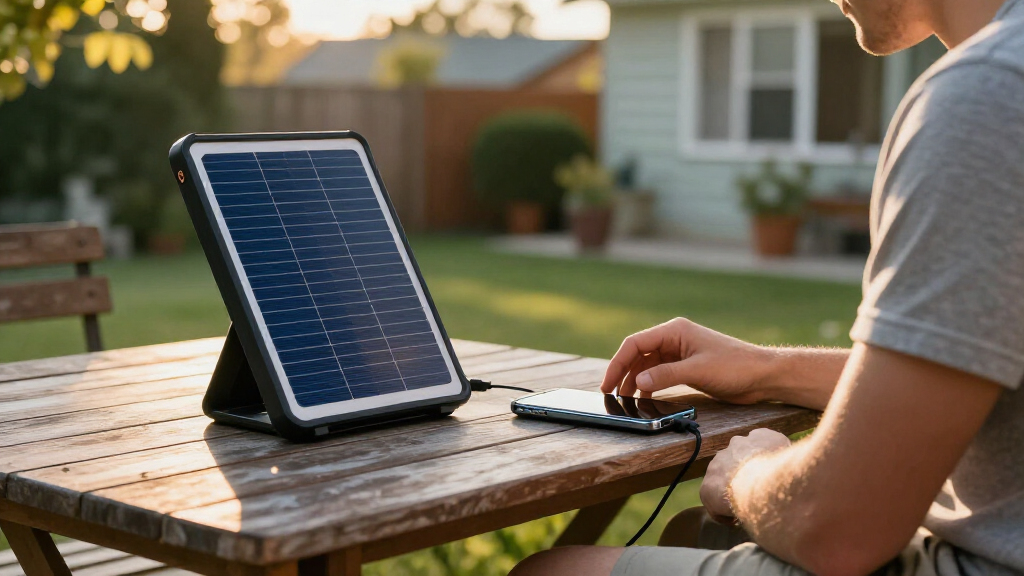
I compared the 15 listed chargers by the factors that change how useful they are away from an outlet: stated capacity, wired output, charging methods, built-in cable arrangements, portability cues, and practical extras such as flashlights. I gave more weight to features that support repeatable phone charging, since solar panels on compact power banks are better viewed as backup input than as a primary refill source. I also treated product descriptions carefully: where two listings share very similar names or stated specifications, I avoided assuming a meaningful performance difference without evidence.
The ranking favors a balanced mix of capacity, charging flexibility, and manageable everyday use. Models with 20,000mAh capacities lead the general-purpose choices; the 10,000mAh BLAVOR models rank higher for compact carry, and higher-capacity units suit buyers who accept extra bulk for a larger reserve. Faster stated output, wireless charging, built-in cables, and flashlights affect placement according to the needs they serve, not as universal upgrades. Duplicate or near-duplicate listings are grouped by their stated distinctions rather than presented as clearly different performers.
Factors to Consider When Choosing Solar Powered Phone Chargers
Choosing among these chargers is less about finding the biggest number and more about matching the power bank to how you will carry and recharge it. I’d start with your typical time away from an outlet, then weigh charging speed and convenience against size and realistic solar expectations.
Choose Capacity for the Trip, Not the Headline Number
Capacity indicates how much stored energy a power bank is designed to hold, but the usable amount at your phone will be lower because energy conversion and charging create losses. A 10,000mAh model can suit a light day out or a compact backup, while 20,000mAh is a more flexible middle ground for longer days and multiple top-ups. The 38,800mAh and 49,800mAh listings target extended backup, but their larger reserves can make them less appealing to carry every day. A common mistake is buying the highest stated capacity without considering weight, dimensions, or how often you can recharge the bank from a wall outlet. For trips with reliable access to power, a smaller unit may be easier to live with; for remote outings, reserve capacity may matter more.
Treat Solar as Backup Input, Not Your Main Recharging Plan
Small panels built into portable chargers have limited surface area, so sunlight conditions and how the device is positioned can affect solar input substantially. Clouds, shade, and short daylight windows all make recharging slower, while a large-capacity bank has more stored energy to replace. Plan to charge the bank through USB before leaving and use sunlight as a supplement when an outlet is unavailable. Do not assume that leaving a power bank in the sun will quickly restore enough energy for a phone emergency. Also check the maker’s guidance for sun exposure and operating temperature; prolonged heat can be hard on batteries and devices. If you need dependable off-grid charging, compare dedicated fold-out solar panels and separate power banks rather than relying only on a small built-in panel.
Match Output Speed to Your Phone and Charging Habits
A higher wattage rating can shorten wired charging time when both the phone and cable support the relevant charging standard. In this lineup, the 22.5W models are the clearest fit for buyers who value faster wired output, while models described as 20W still offer a useful fast-charging tier for compatible phones. The phone controls how much power it accepts, so a larger charger rating does not guarantee that every handset charges at that speed. Check the exact port specifications and supported protocols before buying, especially if you use a newer phone or tablet. Wireless charging can simplify short top-ups, but it may charge more slowly than a suitable cable and can be less efficient. If speed matters, prioritize a compatible wired connection over wireless convenience.
Decide Whether Built-In Cables Simplify or Limit Your Kit
Built-in cables reduce the chance of arriving without a charging lead, which is useful for travel, emergency kits, and shared bags. They can also limit flexibility: a fixed cable may not match every device, and damage to an integrated lead may be harder to address than replacing a standard cable. Before choosing one, check which connector types are included and whether the power bank also has ports for cables you already own. If you switch devices often, use adapters, or want a cable suited to a particular length, a port-based model may fit better. Buyers who value a compact all-in-one setup can reasonably accept fewer cable choices. This is a convenience-versus-repairability decision, not simply a feature-count contest.
Balance Wireless Charging Against Carry Size and Efficiency
Wireless charging is handy when you want to place a compatible phone on the power bank without plugging in a cable, but it adds little value if your phone does not support the required standard. Alignment, a case, and movement can affect the connection, so it is less dependable for charging while walking than a cable. Wireless power transfer also tends to waste more energy than a direct wired connection, which matters when you are trying to stretch a limited reserve. A 10,000mAh wireless model may be easier to carry than a high-capacity wireless option, but it also holds less backup energy. Choose wireless for convenience during stationary top-ups; choose wired capacity and output when the priority is making the stored charge go further.
Pay for Useful Extras, Not a Longer Feature List
Flashlights can earn their place in a camp kit, vehicle, or emergency drawer, but they do not improve phone-charging speed or battery capacity. Multiple built-in cables and ports are useful when several people carry different devices, though more connection options can make it harder to identify the setup that best fits your own phone. A rugged design can help for outdoor use, but check for specific water- or dust-resistance claims rather than assuming a solar charger is weatherproof. Avoid leaving any power bank exposed to rain or extreme heat unless its instructions explicitly allow it. When comparing similar listings, focus on clearly stated capacity, output, connector types, and protection information. A feature is valuable only when it solves a need you actually have.
Frequently Asked Questions
Can a solar-powered phone charger recharge itself fully in a day?
That depends on the panel’s size, sunlight, angle, temperature, and the power bank’s capacity, so there is no reliable one-day guarantee. Compact panels built into power banks usually provide supplemental input rather than a fast full recharge. Replacing a large 20,000mAh or higher reserve from sunlight can take much longer than buyers expect, especially with cloud or shade. For planned travel, charge the bank from a wall outlet before leaving and treat solar input as an emergency aid. If regular solar refills are central to your trip, look at a larger separate panel and verify its output specifications.
Should I choose a 10,000mAh or 20,000mAh model for one phone?
Choose based on how long you will be away from an outlet and how much extra weight you are willing to carry. A 10,000mAh option is a sensible lighter backup for day trips or occasional top-ups, though the amount delivered to a phone is reduced by conversion losses. A 20,000mAh model offers more reserve for longer outings, repeated charging, or sharing power. If you can recharge nightly, the smaller capacity may be enough; if you expect several days between outlets, the larger class is more reassuring. Compare the charger’s size and weight alongside its capacity rather than choosing by the number alone.
Is 22.5W meaningfully better than 20W for charging a phone?
The difference may be small in everyday use, and your phone must support a compatible charging rate and protocol to benefit. A device that accepts no more than 20W will not charge faster just because the power bank is rated at 22.5W. Cable quality and port specifications also affect the result, so check the complete charging path rather than the headline output. The 22.5W listings make more sense when your phone can use that output and wired speed is a priority. Otherwise, capacity, portability, or a convenient cable setup may matter more.
Are built-in cables a better choice than carrying my own?
Built-in cables are convenient when you want fewer loose accessories and the included connectors match your devices. Separate cables offer more choice of connector, length, and replacement options, which can matter if you use several phones or want a durable cable suited to a specific task. With a built-in-cable charger, inspect the connector list carefully before buying; not every listing includes the type you need. Consider whether the power bank still has standard ports as a fallback. For a shared travel kit, built-in cables can save time, while a flexible port-based setup may age better as devices change.
Can I rely on a solar power bank as my only off-grid charging source?
For a short outing, a precharged power bank may cover your phone needs, but its built-in panel is not a dependable substitute for a planned power source on a long trip. Cloud cover, shade, and limited daylight can sharply reduce solar input, and higher-capacity banks take more energy to refill. Estimate how often you use your phone for navigation, photos, or communication, then carry enough stored capacity for that use with a margin. For longer trips, a dedicated solar panel or another backup charging method can provide more consistent input. Keep an offline map and conserve battery where possible rather than treating solar charging as guaranteed.
Conclusion
For most buyers, I’d start with the BLAVOR 20,000mAh Solar Power Bank with Wireless Charging as the best overall balance of reserve capacity and flexible charging. The best value in practical terms is a 20,000mAh built-in-cable model if its connectors fit your devices and you want a simple travel setup; the two 22.5W listings are the speed-oriented choices. For a premium-capacity role, the 49,800mAh BLASOUL, YOLOSKS, or TRASHBINEAN models make more sense when a larger backup reserve outweighs carry bulk, though their similar headline capacity does not establish that one charges better. Beginners and light packers should look at the 10,000mAh BLAVOR options for a less demanding everyday backup, while campers and emergency-kit buyers may prefer a larger unit with a flashlight. If reliable solar recharging is the main requirement, choose a dedicated panel-and-power-bank setup instead of expecting a small built-in panel to do the heavy lifting.