TL;DR
A GreenBuildingAdvisor report says radiant cooling can be practical in humid climates, but it cannot replace humidity control: a separate dehumidifier is required to reduce condensation risk. The report estimates 15,000 to 25,000 BTU per hour of sensible cooling per 1,000 square feet of panel area, while noting that suitability depends on the building and its cooling load.
A GreenBuildingAdvisor report says radiant cooling can work in humid climates, but only if a home also has reliable humidity control to keep moisture from condensing on cool floors, walls or ceiling panels. The report separates the system’s role in lowering room temperatures from the separate job of removing moisture, a distinction that matters to homeowners weighing radiant panels against conventional air-conditioning.

Get backup power and energy gear delivered free with Prime
- Fast, free delivery on millions of items
- Prime Video, Amazon Music and more included
- Member-only deals all year
Radiant systems cool people and rooms through heat exchange with cooler surfaces, rather than relying solely on cooled air moving through ducts. The report says this can provide comfort and avoid the space taken up by ductwork. It also describes a potential indoor-air-quality benefit because radiant panels do not send air across an air-conditioning coil and drain pan, where microbial growth may occur. The source qualifies that benefit: effective filtration and airtight ducts can help keep conventional equipment clean.
The main concern in a humid home is condensation. When moist indoor air meets a surface below its dew point, water can form on that surface. The report gives an example: at 75°F and 65% relative humidity, the indoor dew point is about 62°F. To reduce condensation risk under humid conditions, it says radiant-cooling professionals commonly recommend keeping the cooling surfaces at about 65°F or warmer.
That temperature limit constrains how much cooling the panels can provide. The report estimates a capacity of 15,000 to 25,000 BTU per hour per 1,000 square feet of panel area, depending on conditions. It says this may be sufficient for many new, energy-efficient homes, but the excerpt does not provide a universal sizing rule or detailed performance data for every home type.
Humidity Control Sets the Limits
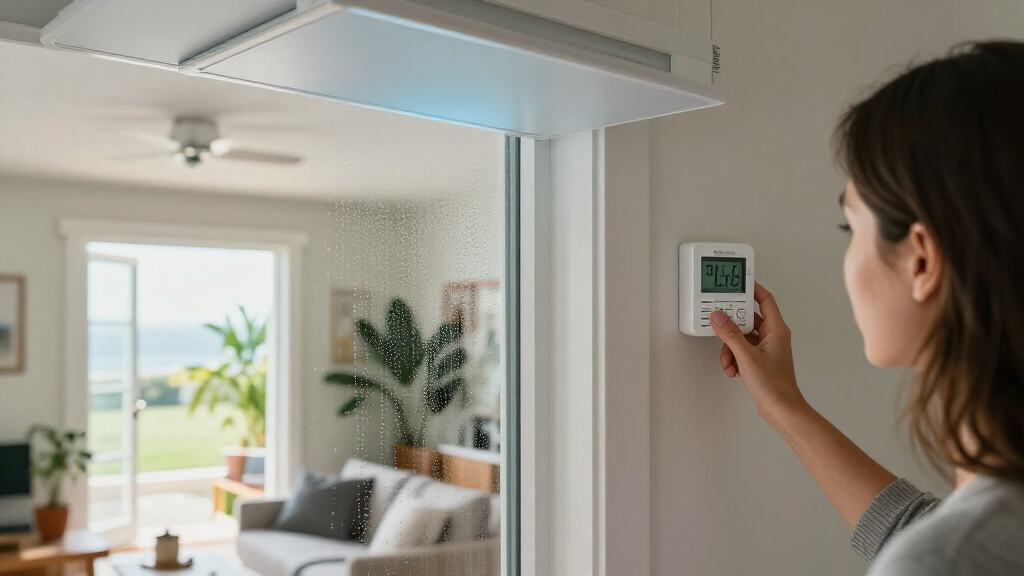
The practical issue is not simply whether radiant panels can make a room feel cooler. In a humid climate, the system must also prevent indoor moisture from reaching cool surfaces. If humidity is not controlled, occupants could face condensation on the cooled surface, while excess moisture in the home can create conditions associated with mold growth. The source warns that a radiant system alone does not remove humidity.
That requirement affects both design and household costs. A homeowner considering radiant cooling must account for a separate dehumidification system, suitable controls and the energy used to operate them. The report frames the panels as handling sensible cooling—lowering temperature—and dehumidification as handling latent cooling—removing moisture. Whether the combination is a good fit depends on the home’s cooling load, panel area and ability to maintain safe humidity and surface temperatures.
The trade-off may be attractive where avoiding ductwork or improving radiant comfort is a priority. But the report does not establish that radiant cooling is cheaper or more efficient than a well-designed air-conditioning system in all humid-climate homes. Those comparisons require project-specific equipment, energy and cost information.
Products Worth Considering

Philips Hue Play Gradient Light Tube, Large, Black

Dyson V9 Motorbar Cordless Vacuum

Roborock Q10 S5+ Robot Vacuum and Mop with 10,000 Pa Suction
As an affiliate, we earn on qualifying purchases.
How Dew Point Shapes Design
Radiant cooling uses relatively cool building surfaces to absorb heat from people and the room. The source notes that people exchange heat with their surroundings through radiation as well as through air and contact with surfaces, which helps explain why a room can feel comfortable even when its air temperature alone does not tell the whole story.
In dry climates, the report says, condensation is less likely to constrain surface temperatures. Humid climates present a different challenge: indoor air can carry enough moisture to condense on surfaces chilled too far. The report cites Atlanta as an example, noting that indoor relative humidity can sometimes reach the mid-60% range even with air-conditioning. It also refers to radiant heating and cooling panels installed at ASHRAE’s Atlanta-area headquarters, photographed at a 2021 ribbon-cutting ceremony. That example shows the technology is in use, but does not establish that every home can use it successfully.
“This isn’t optional for radiant cooling in a humid climate.”
— GreenBuildingAdvisor report
Performance Depends on Each Home
The report’s capacity range is not a guarantee of performance for any particular house. The excerpt does not specify all assumptions behind the estimate, such as panel construction, operating conditions or room-by-room heat gains. It also does not provide a full cost comparison, operating-cost figures or measured results from the ASHRAE headquarters installation.
It remains unclear from the supplied material how much dehumidification equipment a particular home would need, how often it would run, or whether radiant cooling would cost less to operate than conventional air-conditioning. Those answers depend on local weather, building airtightness, insulation, occupancy and the design of the cooling and humidity-control systems. Homeowners should not treat the example dew point or the stated capacity range as a substitute for a project-specific assessment.
What a Home Design Must Establish
For a proposed installation, the next step is a building-specific design that calculates the home’s sensible cooling load and moisture load, sizes the radiant panels and dehumidifier, and sets controls to keep surfaces above the indoor dew point. The design should also explain how the system responds when humidity rises or equipment stops working.
The report does not announce a new product, rule or installation deadline; it presents technical considerations for evaluating the approach. The decision therefore turns on project-level evidence: expected comfort, equipment and installation costs, energy use, and how reliably the system can control humidity during local peak conditions.
Key Questions
Can radiant cooling be used in a humid climate?
Yes, the report says it can be practical, provided the home has active dehumidification and controls that limit condensation on cooled surfaces. Radiant panels alone do not remove moisture.
Why can radiant cooling cause condensation?
Condensation can form when a cooled floor, wall or ceiling is below the dew point of the surrounding air. The report’s example puts the dew point at about 62°F for indoor air at 75°F and 65% relative humidity.
How much cooling can radiant panels provide?
The report estimates 15,000 to 25,000 BTU per hour per 1,000 square feet of panel area. Actual output depends on design and operating conditions, so the estimate does not determine whether a specific home can be cooled by radiant panels.
Do radiant cooling panels replace air-conditioning?
Not by themselves in a humid climate, according to the report. Panels can handle sensible cooling, while a separate system must remove moisture and keep indoor humidity under control.
Source: rss