
TL;DR

Get backup power and energy gear delivered free with Prime
- Fast, free delivery on millions of items
- Prime Video, Amazon Music and more included
- Member-only deals all year
A Hunker report describes gabion walls—wire cages filled with stones—as an alternative to concrete retaining walls. The design allows water to drain and is not vulnerable to freeze-thaw damage in the same way concrete can be, but costs, appearance and installation needs depend on the site.
A Hunker report describes gabion retaining walls, made from wire cages filled with stones, as an alternative to concrete for holding back sloped ground. The design lets water drain through the stones and can withstand freeze-thaw conditions that may damage concrete, though suitability and cost depend on the site and installation.
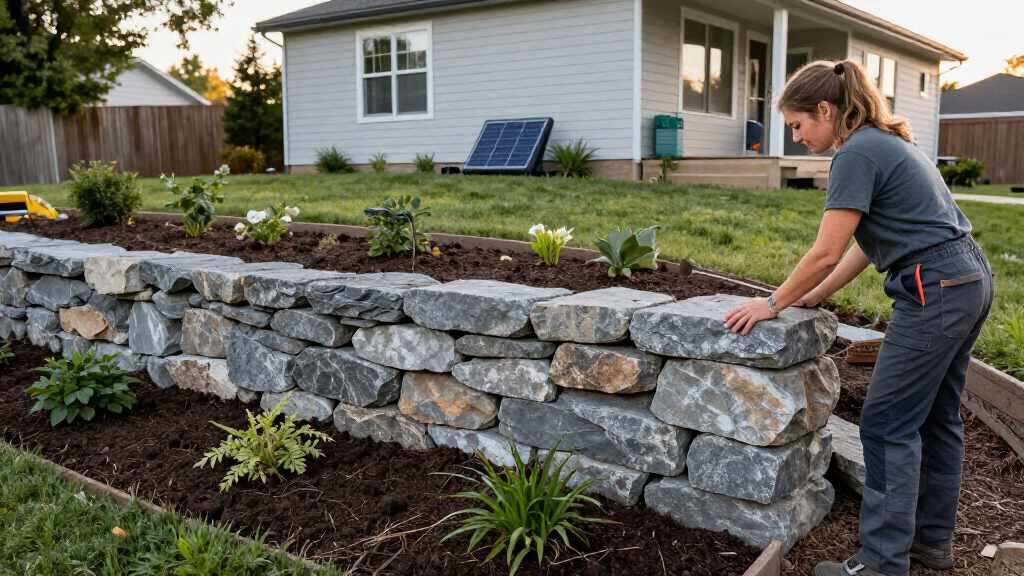
Gabion walls are built by connecting large wire baskets or cages and filling them with rocks. The cages keep the stones in place, while gaps between the stones allow water to pass through. Hunker says this drainage can make the walls useful on steep properties where erosion is a concern.
The report contrasts gabions with poured and block concrete, which it says can crack or spall if not installed correctly. Gabion walls are described as resistant to damage from freeze-thaw cycles. Their appearance is another difference: stones may blend with a landscape, while the wire cages can give the structure an industrial look that may not suit every property.
Hunker gives a general sizing guideline of one foot of wall thickness for every two feet of height. Under that rule, a four-foot wall would be two feet thick. The report says smaller projects may be manageable as DIY work, while larger walls—particularly those involving trench digging or ground leveling—may require professional installation.
Drainage and Durability Trade-Offs
Retaining walls must hold soil in place while managing water and weather. Gabion construction offers a different approach from a solid concrete barrier: water can move through the stone fill, and the report says the structure is not subject to freeze-thaw damage in the same way concrete is. That may make it worth considering where drainage and seasonal freezing are concerns, but it does not establish that gabions are suitable for every slope.
Cost is not automatically lower. Hunker estimates professional gabion installation at $25 to $50 per square foot, compared with $25 to $40 per square foot for concrete. DIY costs may be reduced when builders can use free or recycled stones, according to the report. The material choice also affects the look of a yard, so structural needs and design preferences both matter.
As an affiliate, we earn on qualifying purchases.
How Gabion Walls Are Built
The word “gabion” comes from the Italian “gabbionne,” which the report translates roughly as “big cage.” The method has roots going back thousands of years, though the supplied report does not give a more detailed history. In contemporary home projects, the basic system uses connected metal cages packed with stones.
Hunker notes that gabion baskets can also be used for features such as accent walls and garden pillars. Its price figures and sizing ratio are presented as general guidance, not a site-specific engineering assessment. The report’s central comparison is practical: concrete offers a consistent finish, while gabions rely on stone-filled cages that drain and have a more rugged appearance.
““Gabion retaining walls can be very effective, especially on steep properties where erosion is a particular concern.””
— Hunker report
wire cages for stone retaining wall
As an affiliate, we earn on qualifying purchases.
As an affiliate, we earn on qualifying purchases.
Site Requirements Still Matter
The supplied report does not provide engineering specifications, local building-code guidance, or a method for deciding whether a particular slope can safely use a gabion wall. It also does not identify the source or date for its cost estimates, which can vary by location, materials and labor. Its thickness ratio should be treated as a broad rule of thumb, not a universal design standard.
Details such as soil conditions, wall height, drainage needs, ground preparation and local requirements are not assessed in the report. It is therefore unclear from this source alone whether a gabion wall would be appropriate for any specific property or what its final installed cost would be.
As an affiliate, we earn on qualifying purchases.
Check the Project Before Building
Homeowners considering a gabion wall would need to compare the site’s slope and drainage conditions with the design, verify local permit and code requirements, and obtain project-specific cost estimates. Hunker says larger installations may call for professional help, particularly where excavation or leveling is involved. The report does not announce a new product or scheduled follow-up; the next step for a property owner is a site-specific evaluation rather than relying on a general sizing rule.
As an affiliate, we earn on qualifying purchases.
Key Questions
What is a gabion retaining wall?
It is a retaining wall made from wire cages filled with stones. The cages hold the rocks in place, and the spaces between them allow water to drain.
Are gabion walls cheaper than concrete?
Not necessarily. Hunker estimates professional gabion work at $25 to $50 per square foot and concrete at $25 to $40 per square foot. DIY gabions may cost less if suitable free or recycled stones are available.
How thick should a gabion wall be?
The report gives a general guideline of one foot of thickness for every two feet of height. It does not provide site-specific engineering advice, so the ratio should not be treated as a universal design specification.
Can homeowners build a gabion wall themselves?
Hunker says a smaller project may be manageable as DIY work, while larger walls—especially those needing trench digging or ground leveling—may require professional installation. Local requirements and site conditions are not covered by the report.
What are the main drawbacks of gabion walls?
The wire cages can create an industrial appearance that may not fit every landscape. Costs also vary, and the supplied report does not establish whether the design is suitable for a particular property.
Source: rss
Halloween Picks
halloween
As an affiliate, we earn on qualifying purchases.