TL;DR

Get backup power and energy gear delivered free — and shop member deals
- Fast, free delivery on millions of items
- Access to Prime Big Deal Days deals on October 6–7
- Prime Video, Amazon Music and more included
Solar string lights are decorative outdoor lighting strands with an attached solar panel that charges a battery by day and lights LEDs automatically at dusk, typically running 6–10 hours per charge. They cost nothing to operate and install in minutes, but they’re ambiance lights — not task lighting — and most failures trace back to dead batteries, dirty panels, or water ingress at the panel connection.
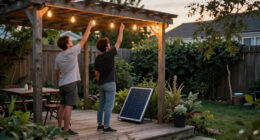
Your neighbor’s patio glows every evening at dusk — no cords, no outlets, no electricity bill. That’s the quiet magic of solar-powered outdoor string lights: they charge all day, switch themselves on at sunset, and cost literally nothing to run.
But here’s the part the product listings skip: plenty of people buy a cheap set, get two dim hours of glow in November, and conclude the whole category is junk. It isn’t. You just need to know what these lights do well, what they can’t do, and how to spot the sets that survive more than one summer.
In this guide, you’ll learn how solar string lights work, which specs actually matter, where to mount the panel, and how to fix the three problems that kill most sets. Let’s get into it.
Solar string lights run 6–10 hours per charge, but each LED emits only 1–5 lumens — plan for ambiance, not task lighting.
The panel needs 6–8 hours of direct sun daily; use the 6–10 feet of included cable to place the panel in sun even when the strand sits in shade.
A dead battery (not broken bulbs) causes most failures after 1–2 years, and a ~$5 replacement AA NiMH or lithium cell revives most sets.
Check for IP44–IP65 weather ratings and a replaceable battery before buying — sealed cheap sets are the ones that die within a season.
In winter or cloudy climates, expect 50% less runtime or less, or buy a USB-charging hybrid model as backup.
What Solar String Lights Actually Are (In Plain English)
Solar string lights are decorative outdoor lighting strands with an attached solar panel that charges a built-in battery during the day. A small light sensor turns the LEDs on automatically at dusk and off at dawn — no switches, no timers to program, no remembering anything.
Think of the whole setup as a tiny off-grid power plant. The panel (usually on a ground stake or clip) feeds a rechargeable battery — typically a AA NiMH cell or a lithium-ion pack rated 600–2000 mAh. That battery powers LED bulbs rated for 25,000–50,000 hours, which is why the bulbs almost never die before the battery does. This matters more than it sounds: it means the ‘light’ you buy is really a battery product wearing a light costume. The LEDs will outlive the rest of the system many times over, so the panel, battery, and connections — not bulb count or lumen claims — are where quality actually lives.
There’s also a physics tradeoff baked into the design, and understanding it prevents most disappointment. Sunlight delivers a fixed amount of energy per day, the panel converts only a fraction of that to electricity, and the battery can only store what the panel produces. A typical 48-foot Edison-style set sips just a few watt-hours per evening — which is why a thumb-sized battery can run it all night. But that same math means manufacturers can’t make these bulbs genuinely bright without either a much larger panel (ugly, expensive) or a much shorter runtime. Brightness and endurance compete for the same stored energy, and every set on the market chooses endurance. That’s not a flaw; it’s the design working as intended — for ambiance, not illumination.
Plain-language summary: sun goes in the panel, energy sits in the battery, and a light sensor flips the switch at sunset. And because the battery is the weakest link, it — not the bulbs — decides how long your investment lasts.
What You Get vs. What You Give Up: Solar vs. Plug-In
Solar string lights trade brightness and consistency for freedom — freedom from outlets, extension cords, and electricity costs. Whether that trade is worth it depends entirely on what you want the lights to do.
Here’s the honest comparison:
| Feature | Solar String Lights | Plug-In String Lights |
|---|---|---|
| Brightness per bulb | 1–5 lumens (ambiance) | 100+ lumens (real light) |
| Operating cost | $0 | A few dollars/month |
| Installation | Minutes, anywhere with sun | Needs an outdoor outlet |
| Runtime consistency | Weather-dependent (6–10 hrs) | Always identical |
| Cord trip hazards | None | Extension cords required |
| Upfront cost | $15–60 | $10–100+ plus timers |
The pattern is clear: if you’re setting a mood — dinner on the patio, soft glow over a fire pit — solar wins easily. If you’re trying to actually light a workspace or grill area, wired lights (or a combination of both) make more sense.
But notice what the table is really telling you: you’re not choosing between two products, you’re choosing between two definitions of reliability. Plug-in lights are reliable in the sense that they behave identically every single night, rain or shine. Solar lights are reliable in the sense that they will always be there — no cord to trip over, no outlet to find, no bill to pay — but what they deliver varies with yesterday’s weather. If a dimmer evening after three cloudy days would bother you, that inconsistency is the real cost of solar, and no amount of money spent on premium sets fully eliminates it. What money does buy is a bigger battery that smooths out the bad days, which is why capacity matters more than any other spec.
A real scenario: you want lights draped across a backyard fence 60 feet from the house. Running power means buried cable or a trip-hazard extension cord across the lawn. Solar means a stake in the flowerbed. That’s the decision in a nutshell for most buyers — and it’s why the answer is usually ‘both’: solar strands for the far reaches of the yard, one wired run where you genuinely need to see what you’re doing.
5 Specs That Separate Good Solar Lights From Season-Long Disappointments
Not all solar string lights are equal, and the difference between a $20 set and a $50 set is usually five specific specs. Check these before you buy anything:
- Battery type and capacity. Lithium-ion beats older NiMH for cold-weather performance and lifespan. Look for at least 1000 mAh if you want reliable 8-hour runtimes. Why this threshold: capacity is your buffer against bad weather. A 1000 mAh cell stores roughly a full evening plus margin, so one weak charging day doesn’t ruin the night; a 600 mAh cell has no margin at all, and every cloudy afternoon shows up directly as a dim evening.
- Weather rating. You want IP44 minimum, IP65 ideally. Water ingress at the panel connection is the single most common failure point, so check that the connection sits snug and raised. The tradeoff to understand: IP65 costs more and often means a more rugged, heavier panel housing — worth it if your set faces driving rain or stays up year-round; overkill if it lives under a covered porch.
- Panel quality. Monocrystalline panels charge noticeably faster than cheaper amorphous ones on short winter days. This matters exactly when you need it most: an amorphous panel that’s adequate in June may simply not generate enough from six weak December daylight hours to charge the battery at all — the same lights, same battery, dramatically different winter behavior.
- Bulb style. Edison/globe bulbs (G40, ST58) cast the warm café look; fairy and copper-wire LEDs suit fences, railings, and shrubs. This is aesthetic, not performance — but it’s also the spec you’ll notice every single evening, so don’t treat it as an afterthought.
- Replaceable battery. This is the sleeper spec. A set with a swappable battery can last a decade; a sealed one is trash in 18 months. The implication is bigger than it looks: a $40 set with a replaceable battery is cheaper over five years than three $15 sealed sets — and keeps e-waste out of the landfill. When a listing doesn’t mention the battery at all, assume it’s sealed, because manufacturers of replaceable-battery sets always say so.
Quick temperature note: warm white (~2700K) is the most popular color for good reason — it flatters skin tones and reads as cozy rather than clinical. Cool white looks great in evergreen landscaping but harsh over a dinner table.
Where You Put the Panel Decides Everything
Panel placement is the make-or-break factor for solar string lights, and it’s the one thing buyers most often get wrong. The panel needs 6–8 hours of direct sunlight daily for a full charge; shade cuts runtime dramatically.
That south-facing fence post in full sun? Perfect. The charming spot under the maple tree where you want the lights? That shaded panel will give you maybe 3 hours of weak glow by August.
Here’s the good news: most sets include 6–10 feet of cable between panel and strand, so the lights and the panel don’t have to live in the same spot. Mount the strand where you want it, then run the panel to the sunniest spot within cable range — staked in a flowerbed, clipped to a gutter, or screwed to a post.
Two placement rules worth tattooing somewhere:
- Tilt the panel toward the sun (roughly south-facing if you’re in the Northern Hemisphere) rather than laying it flat. A tilted panel catches more direct rays per hour, which means faster charging in the same amount of daylight — effectively free extra runtime.
- Keep the panel face clean. A film of pollen or dust can cut charging efficiency substantially — wipe it monthly with a damp cloth. The reason is simple: the panel is the only source of energy in the entire system, so anything blocking it degrades everything downstream, and the damage is invisible until you notice the lights fading weeks later.
One more implication worth internalizing: placement is permanent in a way the lights aren’t. You can replace a battery in five minutes, but if you staple the strand along a shaded pergola with the panel zip-tied right there, you’ve locked in weak charging for the life of the set. Before you hang anything, walk your yard at 10 a.m., noon, and 3 p.m. and note where sun actually falls — trees, the house itself, and a neighbor’s roof all cast shadows that move through the day, and the panel’s spot needs to dodge all of them.
Warning: the connection point where the panel cable meets the first bulb is the most common water-entry point on every budget set. Keep it angled downward and off the ground.
Why Your Solar Lights Died (And the $5 Fix That Revives Most of Them)
When solar string lights stop working, the culprit is almost never the bulbs — it’s one of three fixable problems. In order of likelihood: a dead rechargeable battery, a dirty panel, or water damage at the panel connection.
Batteries in these lights typically last 1–2 years before they stop holding a useful charge. If your set worked fine last summer and glows weakly for an hour this year, the battery is almost certainly done. Most sets open with a small screwdriver, and a replacement AA NiMH cell costs about $5. Five minutes of work, set resurrected.
Why batteries die first comes down to chemistry. Every charge-discharge cycle slightly degrades a rechargeable cell, and these batteries cycle every single night — 365 cycles a year, rain or shine, whether the lights were on or not. That daily grind is why a cell rated for hundreds of cycles gives out in a season or two, and why ‘the lights worked last year’ is the classic symptom of battery death rather than a defect: the failure tracks calendar age, not usage. This is also why the replaceable-battery spec matters so much — on a sealed set, this inevitable chemical death sentences the whole product.
Here’s a simple diagnostic sequence:
- Wipe the panel clean and give it a full day of direct sun.
- Cover the panel with your hand — the lights should trigger within seconds (that’s the dusk sensor).
- If they trigger but fade fast, replace the battery.
- If nothing happens at all, check the panel-to-strand connection for corrosion or water intrusion.
The logic behind this order: each step isolates one component, cheapest fix first. If the sensor triggers, the electronics and panel are alive and the battery is the suspect; if nothing triggers, the problem is upstream of the battery — power never arriving at all. You’re tracing the energy path from sun to bulb, and the failure point tells you which $5 part to touch.
One homeowner I know nearly tossed a ‘dead’ set after a rainy spring — until she opened the panel housing and found the battery contact coated in green corrosion. A quick scrub with a pencil eraser and a fresh battery, and the set has run two more seasons since.
Winter, Cloudy Weeks, and the Hybrid Lights That Solve Them
Solar string lights do work in winter and cloudy weather — but expect runtime to drop by 50% or more when the panel gets only diffuse light through gray skies. Short winter days plus low sun angles are the worst combination. The reason it compounds: a December day delivers fewer total hours of light and each of those hours is weaker and arrives at a lower angle — so the panel produces a fraction of its summer output right when you’d most want cozy evening light. It’s the one season where the technology’s core weakness and your desire to use it peak simultaneously.
You have three realistic options, each with its own tradeoff. First, accept dimmer, shorter glow in December and enjoy full performance May through October — most people find this perfectly acceptable for decorative lighting, and it costs nothing. Second, reposition the panel seasonally to catch the lower winter sun — effective, but it means remounting hardware twice a year, which most people realistically won’t do past the first winter. Third, buy a USB-charging hybrid model, a growing category that lets you top up the battery from an indoor outlet when solar falls short — you sacrifice some of the ‘zero grid energy’ purity, but you keep the no-outdoor-wiring advantage, which is the part most buyers actually care about.
Should you leave them out year-round? Most sets with an IP44–IP65 rating handle rain and snow, but extreme climates — desert heat, hard freezes, coastal salt air — will shorten lifespan. The logic behind the usual advice: the strand itself is just LEDs and wire, which tolerate weather well, while the panel housing contains the battery and electronics, which don’t. So if a set is cheap and replaceable, leave it up. If it’s a $60 premium strand, bring the panel indoors for the harsh months; the strand itself can usually stay. You’re protecting the expensive, fragile 10% and letting the durable 90% weather the season.
Also worth knowing: lithium-ion batteries hold up better in cold than NiMH, which is one more reason to prefer them if you live somewhere with real winters — cold temporarily reduces any battery’s output, but NiMH suffers the drop much harder.
Frequently Asked Questions
How long do solar string lights stay on at night?
Most quality sets run 6–10 hours on a full charge, which covers a typical evening from dusk to midnight. Runtime depends on how much direct sun the panel received that day — a fully charged set on a long summer day will outlast a panel that sat in partial shade.
Do solar string lights work on cloudy days or in winter?
Yes, but with reduced performance. Overcast conditions and short winter days can cut runtime by 50% or more. Lithium-ion battery models handle cold better than NiMH, and USB-charging hybrid models let you top up the battery indoors when solar charging falls short.
Why did my solar string lights stop working?
The most common cause is a depleted battery — rechargeable cells in these lights typically last 1–2 years and are usually replaceable for around $5. Also check for a dirty solar panel (wipe it clean) and corrosion or water intrusion at the panel-to-strand connection, the top failure point on budget sets.
Are solar string lights bright enough to light a patio for activities?
Not really. Each solar LED produces roughly 1–5 lumens versus 100+ lumens for wired incandescent bulbs, so solar strands create ambiance rather than usable task lighting. For grilling or reading, pair them with a solar lantern or wired fixture; for mood lighting over a dining table, they’re ideal.
Can I leave solar string lights outside year-round?
Most sets rated IP44–IP65 tolerate rain and snow, but extreme heat, hard freezes, and coastal salt air shorten their lifespan. A practical compromise: leave the strand up but bring the panel and battery housing indoors during the harshest months.
Conclusion
If you take one thing from this guide: buy for the battery and place for the sun. A mid-priced set with a replaceable lithium battery and an IP65 rating, mounted with its panel in genuine direct sunlight, will glow every evening for years at zero operating cost. The people who hate solar lights almost always bought a sealed $15 set and stuck the panel under a tree.
Do those two things right, and you get the version worth having: warm light that switches itself on at dusk, all summer, with no cord crossing your lawn and no line on your power bill. That’s a pretty good deal for a light you never have to remember to turn on.
Evergreen bestsellers Picks
bestsellers
As an affiliate, we earn on qualifying purchases.