
TL;DR

Get backup power and energy gear delivered free with Prime
- Fast, free delivery on millions of items
- Prime Video, Amazon Music and more included
- Member-only deals all year
Prebuilt AI workstations are often more cost-effective now due to component shortages and bulk buying, making them a smart choice for quick deployment and support. Building offers customization and upgrades but may cost more and take longer. The best option depends on your workload, skills, and priorities.
Ever wonder if you should build your own AI workstation or just buy a ready-made system? The answer isn’t as simple as it used to be, especially when considering Build vs Buy a Prebuilt AI Workstation. With supply chain hiccups and soaring component prices, the game has shifted. Now, the choice depends less on saving money and more on fitting your specific needs.
Whether you’re a researcher, a hobbyist, or part of a small team, understanding the real trade-offs can save you time, money, and frustration. Let’s explore what’s really happening in 2026 — and how you can decide what’s best for you.
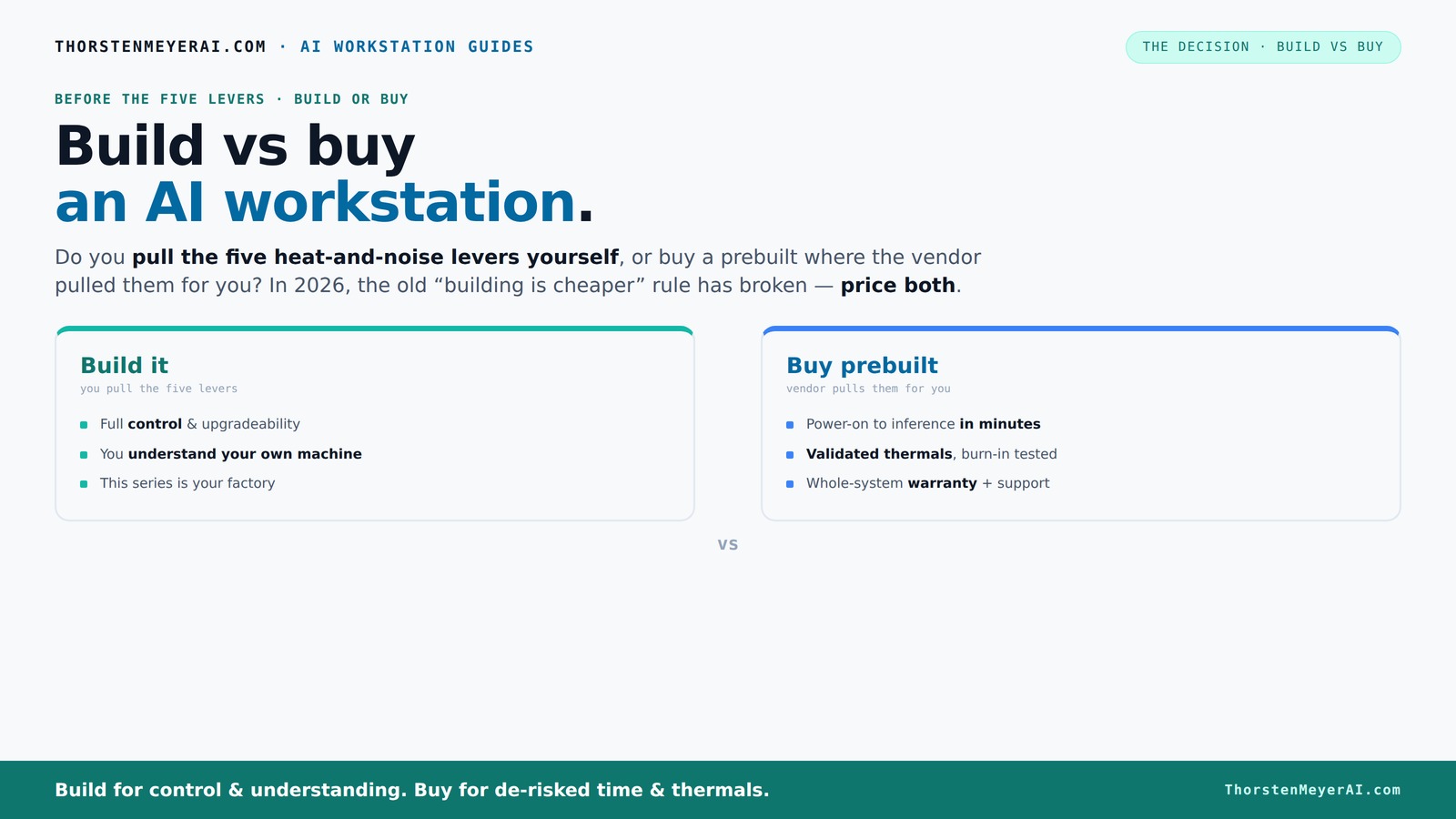
Build vs buy
an AI workstation.
The real question behind this whole series: do you pull the five heat-and-noise levers yourself, or buy a prebuilt where the vendor pulled them for you? And in 2026, the old “building is cheaper” rule has broken. Match your situation in Part 3.
Why Building Your Own AI Workstation Might Cost More Than You Think
Building your own AI rig in 2026 isn’t automatically cheaper anymore. Component shortages mean GPUs, RAM, and SSDs are more expensive than in the recent past, making it worth exploring whether building or buying is more cost-effective.
For example, a typical high-end GPU used for AI — like an RTX 4090 — used to cost around $1,200. Now, it’s often over $1,500 due to demand and shortages. Meanwhile, prebuilt vendors have bought in bulk, securing lower prices and passing savings on to you, or at least matching DIY costs.
So, a system that used to cost under $1,000 now pushes $1,250+ before adding an OS or software. The traditional rule—DIY is always cheaper—no longer holds. It’s time to actually compare prices for your specific setup.
Beyond just initial costs, building can introduce hidden expenses like the need for troubleshooting, compatibility checks, and component compatibility issues. These factors can extend your build time and increase costs, especially if you’re not experienced. Therefore, while DIY might seem cheaper on paper, the true tradeoff involves your time, potential delays, and the risk of component incompatibilities that can compromise performance or stability.
As an affiliate, we earn on qualifying purchases.
The Real Deal: Who Pulls the Thermals, and Why Does It Matter?
When it comes to heat and noise, the question is: do you tune your system or does the vendor?
Prebuilt systems from companies like Lambda or BIZON come with validated cooling — they run burn-in tests, optimize fan curves, and often include water-cooling options. This means you get a machine ready to handle sustained AI loads without throttling, and with quieter operation.
If you build it yourself, you’re responsible for choosing the right cooler, case, and airflow setup. It’s doable but requires expertise. For example, undervolting a GPU or selecting a low-noise case can cut noise significantly, but you need to know what you’re doing — or risk crippling thermal performance.
Thermal management directly impacts your system’s performance and longevity, which is why prebuilt systems often come with validated cooling — see how Build vs Buy options compare. Overheating can cause thermal throttling, reducing GPU and CPU speeds during intensive workloads, which in turn hampers your AI training or inference tasks. Excessive noise isn’t just a nuisance; it’s often a sign of inefficient cooling or inadequate airflow, which can lead to hardware degradation over time. Prebuilts with validated thermals minimize these risks, ensuring consistent performance and quieter operation. For DIY builders, mastering thermal tuning is crucial but can be time-consuming and complex, especially with high-power components. The tradeoff is the potential for optimized performance tailored precisely to your environment, but at the cost of increased setup effort and ongoing monitoring.
As an affiliate, we earn on qualifying purchases.
Comparing Build and Buy: The Key Features Side-by-Side
| Feature | Build Your Own | Buy Prebuilt |
|---|---|---|
| Cost | Potentially cheaper upfront, but watch for rising component prices and hidden costs like troubleshooting and compatibility checks. Over time, these can erode savings. | Often comparable or cheaper due to bulk buying and discounts, with the added benefit of predictable costs and support. |
| Speed of Deployment | Weeks to assemble, troubleshoot, and optimize, which can delay project timelines—especially if issues arise. | Ready to use in days, with OS and AI tools preinstalled, ensuring rapid deployment for urgent needs. |
| Customization | Full control over every part — CPU, GPU, cooling, case — allowing tailored performance and features specific to your workload. | Limited to vendor options, but many configurable specs and some upgrade paths; less granular control but sufficient for most needs. |
| Thermal & Noise Tuning | You tune it — undervolt, adjust fans, optimize airflow. This can lead to quieter, cooler systems if done correctly, but requires expertise and time. | Validated at factory — often quieter and cooler under load, with less effort needed to achieve optimal thermal performance. |
| Support & Warranty | Separate warranties for each part, DIY troubleshooting, and potential delays resolving issues. | Single support contact, often 3–5 years warranty, with professional support to resolve hardware or thermal issues quickly. |
| Upgradeability | Typically easier — swap GPUs, add RAM, update CPU, or even change cooling solutions with minimal fuss. | May be limited by proprietary parts or connectors, making future upgrades more complex or costly. |
As an affiliate, we earn on qualifying purchases.
When to Build: Perfect for Hobbyists and Custom Workloads
If you love tinkering or need a machine tailored exactly to your workload, building makes sense. Imagine tuning your GPU to undervolt it, reducing power draw and noise — or choosing a case with optimal airflow for long training runs. That’s your playground.
For example, a researcher might want a system with 128GB RAM, multiple GPUs, and custom cooling. Building allows you to pick each component, ensuring it matches your specific AI tasks — whether inference, fine-tuning, or training.
Plus, if you’re comfortable with the process, you can save some money by sourcing parts directly from Amazon or other suppliers, or consider building your own. However, it’s important to consider the long-term implications: a DIY build can be upgraded more easily over time, allowing you to adapt to evolving workloads without replacing the entire system. Additionally, the process of building your own system can deepen your understanding of hardware, which is invaluable for troubleshooting and optimizing performance, similar to what you might learn from building vs buying.
As an affiliate, we earn on qualifying purchases.
When to Buy: The Smart Choice for Speed, Support, and Reliability
If you need a workstation fast, with minimal fuss, prebuilt is the way to go. It arrives ready to run, with software preinstalled — no BIOS tweaks, no compatibility headaches.
For instance, a small AI startup might need to deploy a multi-GPU system for training models in two weeks. Buying prebuilt ensures they can start immediately, backed by support if anything goes wrong.
Support and warranty matter here, and choosing prebuilt systems can simplify this process. Vendors like Puget or Lambda test systems extensively, so you can trust they won’t throttle under heavy load or produce unexpected noise. This reduces downtime and the risk of hardware failure disrupting your projects. Moreover, prebuilt systems often come with professional thermal design and testing, which minimizes the likelihood of thermal throttling or overheating during intensive workloads. This reliability is crucial for maintaining consistent training times and avoiding costly downtime. For teams or individuals who lack the time, expertise, or desire to troubleshoot hardware, prebuilt systems provide peace of mind and dependable performance from day one.
A Hybrid Approach: The Best of Both Worlds in 2026
Some buyers want control but also value support. Enter the hybrid approach. You can buy a preconfigured system from a vendor and then upgrade or customize parts later.
For example, you might start with a prebuilt but swap out the GPU later or add more RAM as your needs grow. Many OEMs now offer options to customize after purchase or provide modular systems designed for upgrades.
This way, you get immediate deployment plus flexibility for future growth — a smart move if your workload or budget might change. The hybrid approach also allows you to leverage the stability and support of a prebuilt while gradually enhancing your system’s performance. For instance, you might initially purchase a system with a mid-range GPU and upgrade to a more powerful model as your AI models become more complex. This strategy can optimize your initial investment, reduce downtime during upgrades, and help you stay current without replacing the entire system. It’s particularly advantageous if your project timelines are uncertain or if your workload will evolve over time.
Key Takeaways: Making the Right Choice in 2026
- Component shortages have leveled the playing field: Prebuilts often match or beat DIY prices now, but consider the hidden costs of building yourself.
- Thermal validation matters: Prebuilts come with factory-tested cooling, saving you time and reducing noise and overheating risks, which are critical for sustained AI workloads.
- Speed often beats savings: Buying prebuilt gets you started immediately, which is essential for urgent projects or time-sensitive deployments.
- Customization is king for experts: Building offers tailored setups, easier upgrades, and deeper learning, but requires more effort and expertise.
- Support and warranty provide peace of mind: Prebuilts come with professional support, while DIY builds depend on multiple warranties and troubleshooting skills, which can impact downtime and project timelines.
Frequently Asked Questions
Is a prebuilt AI workstation worth it in 2026?
Yes. With component shortages and bulk buying, prebuilts often cost less or the same as building, plus they save you time and offer support. If you need to start working fast, prebuilt is a smart choice.
Is building cheaper than buying prebuilt?
Not always anymore. Rising component prices and shortages mean DIY parts might cost more than a preconfigured system from a vendor, especially if you factor in your time and troubleshooting. The tradeoff is that building allows for more customization and learning, but these benefits come with increased complexity and potential delays.
Which gives better AI performance per dollar?
It depends. Prebuilts often optimize thermal and power settings, which can improve performance stability, especially during prolonged workloads. Building allows you to fine-tune for maximum efficiency and potentially squeeze out extra performance, but requires expertise. Comparing specific configurations tailored to your workload is essential to determine which approach offers better value.
Do prebuilts have better warranties than DIY builds?
Generally, yes. Prebuilt vendors bundle support and warranties for the entire system, often 3–5 years, providing a single point of contact for troubleshooting and repairs. DIY warranties are split among individual parts, which can complicate support and prolong downtime. This unified support can be a significant advantage for those who prefer hassle-free maintenance.
Will a prebuilt limit future upgrades?
Sometimes. Proprietary parts or connectors in prebuilt systems can restrict upgrading certain components, particularly GPUs or motherboards. Building your own system typically offers greater flexibility, allowing you to replace or upgrade individual parts more easily. However, some high-end prebuilt systems are designed with upgradeability in mind, so it’s important to review the specifications and support options before purchasing.
Conclusion
In 2026, the build-vs-buy debate isn’t about saving money — it’s about what fits your work style, workload, and timeline. If you crave control, customization, and learning, building your own rig makes sense. But if speed, support, and reliability are your priorities, a prebuilt can be a smarter move.
Picture your ideal setup: does it look like a ready-to-run machine or a DIY masterpiece? Whatever you choose, remember — the right system powers your work, not just your wallet. So pick the path that keeps your focus where it belongs: on your AI projects, not on troubleshooting hardware.
Halloween Picks
halloween
As an affiliate, we earn on qualifying purchases.