
TL;DR

Get backup power and energy gear delivered free — and shop member deals
- Fast, free delivery on millions of items
- Access to Prime Big Deal Days deals on October 6–7
- Prime Video, Amazon Music and more included
Fraunhofer ISE has developed a III-V germanium solar module that reaches 34.4% efficiency, setting a new global record. This breakthrough utilizes shingle-matrix technology to maximize cell utilization. The development advances solar power efficiency and potential applications.
Fraunhofer ISE has set a new world record for solar module efficiency at 34.4%, using a III-V germanium-based PV module with advanced shingle-matrix interconnection technology. This achievement marks a significant milestone in solar energy research, demonstrating the potential for higher efficiency modules that could impact future solar deployments worldwide.
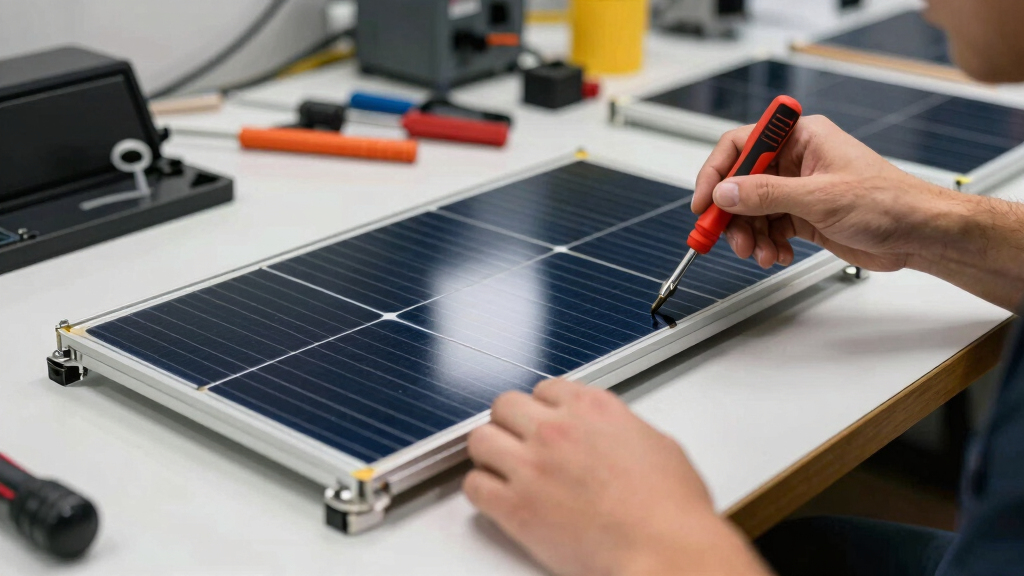
The record was achieved by Fraunhofer ISE’s research team, building on a previous record of 34.2% efficiency set earlier this year. The new module was developed through a collaboration with AZUR SPACE Solar Power, which adapted triple III-V germanium cells originally optimized for space applications for terrestrial use. The key technological innovation is the use of shingle-matrix interconnection, which involves overlapping solar cells in a pattern that eliminates traditional interconnects, reducing shading and increasing active cell area.
This architecture allows for direct cell-to-cell contact, avoiding the use of solder-coated copper ribbons and significantly improving area utilization. The result is a module that not only surpasses previous efficiency benchmarks but also demonstrates the viability of high-performance, space-inspired solar cell technology for terrestrial applications. The module’s size is 833 square centimeters, and it incorporates anti-reflective coatings provided by temicon, further enhancing its efficiency.
Implications for Solar Power Efficiency and Deployment
This record signifies a major step forward in solar photovoltaic technology, highlighting the potential for even more efficient solar modules that could lower costs and increase energy yields. Higher efficiency modules like this could accelerate the adoption of solar power, especially in space-constrained environments or areas where maximizing energy output is critical. The use of shingle-matrix technology also demonstrates a scalable manufacturing approach, making such high-efficiency modules more feasible for commercial production in the future.
Industry experts see this as a proof of concept that could influence future solar panel designs, pushing the boundaries of what is technically achievable and potentially reducing the levelized cost of solar energy. It also underscores ongoing innovation in the field, with research institutions and manufacturers collaborating to adapt space-grade solar technology for terrestrial use, expanding the horizon for renewable energy solutions.
As an affiliate, we earn on qualifying purchases.
Recent Advances in High-Efficiency Solar Modules
Fraunhofer ISE has been at the forefront of solar efficiency records, with earlier achievements in 2026 including a 34.2% efficiency module built from triple III-V germanium cells. The development of this technology stems from ongoing research into multi-junction solar cells designed for space applications, now adapted for terrestrial use. The adoption of shingle-matrix interconnection technology has been a key driver in boosting efficiency, representing a departure from traditional interconnected solar cells that rely on soldered ribbons, which can cause shading and reduce active area.
This recent record builds on prior milestones and reflects a broader trend of integrating advanced materials and innovative cell interconnection techniques to push solar efficiency limits. The collaboration with AZUR SPACE and the involvement of Fraunhofer ISE’s research teams exemplify the global effort to improve solar technology performance and commercial viability.
“The use of shingle-matrix technology allows us to eliminate traditional interconnects, significantly boosting the active area and efficiency of the module.”
— an anonymous researcher
As an affiliate, we earn on qualifying purchases.
Uncertainties About Commercial Scalability
It is not yet clear how soon this high-efficiency technology can be scaled for mass production or integrated into commercial solar panels. The current module size and manufacturing processes are still in the research and development phase, and further testing is needed to evaluate durability, cost, and real-world performance in various environments.
Additionally, the long-term stability of shingle-matrix interconnection technology and its compatibility with existing manufacturing infrastructure remain to be fully assessed.
shingle-matrix solar panel technology
As an affiliate, we earn on qualifying purchases.
As an affiliate, we earn on qualifying purchases.
Next Steps Toward Commercial Adoption
Researchers and manufacturers are expected to focus on scaling up production, testing long-term durability, and evaluating cost-effectiveness. Industry stakeholders will monitor further developments and potential pilot projects that incorporate this technology. Regulatory and certification processes will also need to be navigated before commercial deployment becomes feasible.
Further research may explore adapting the technology for different module sizes and configurations, aiming to bring high-efficiency modules closer to widespread commercial use within the next few years.
space-grade solar panels for home use
As an affiliate, we earn on qualifying purchases.
As an affiliate, we earn on qualifying purchases.
Key Questions
When will this high-efficiency solar technology be available commercially?
It is currently in the research and development stage, with commercial availability likely several years away after further testing and scaling.
What makes this solar module more efficient than previous ones?
The use of shingle-matrix interconnection technology eliminates traditional interconnects, maximizing active cell area and reducing shading, which boosts overall efficiency.
Can this technology be used in existing solar panels?
Adapting this technology for existing panels will require significant modifications, and it is primarily designed for new high-efficiency modules at this stage.
What are the potential benefits of this record-breaking efficiency?
Higher efficiency can lead to lower costs per watt, increased energy output in limited space, and accelerated adoption of solar power globally.
Are there any drawbacks or risks associated with this new technology?
Long-term durability and manufacturing scalability are still under investigation, and these factors will influence its commercial viability.
Source: CleanTechnica
Fall Picks
fall essentials
As an affiliate, we earn on qualifying purchases.