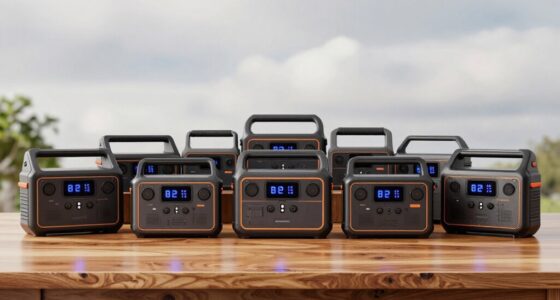
Portable power stations with solar panels bundle two products that are tricky to match on your own: a battery that stores energy and panels that refill it at the right voltage and connector. My top pick overall is the Jackery Solar Generator 1000 V2, which pairs a well-built 1,070Wh-class station with a 200W panel — enough output for meaningful recharging and enough capacity for real appliances. For whole-home backup ambitions, the Jackery HomePower 3600 Plus with two 200W panels is the heavy-hitting alternative, while budget shoppers get genuine capability from the EnginStar 300W kit at the small end. The main tradeoffs in this category are capacity versus portability, solar input speed versus price, and battery chemistry versus lifespan. Read on for the full breakdown of all 14 kits.

Get backup power and energy gear delivered free — and shop member deals
- Fast, free delivery on millions of items
- Access to Prime Big Deal Days deals on October 6–7
- Prime Video, Amazon Music and more included
Complete the kit


Key Takeaways
- Panel wattage matters as much as battery size: kits with 200W panels (Jackery 1000 V2, BLUETTI AC180, BLUETTI Elite 100 V2) can realistically recharge in a day of sun, while 21W–40W bundles can take days to refill the same capacity.
- The sub-$150 tier (MARBERO 88Wh, Apowking 100W, DaranEner 300W) is best treated as emergency lighting and phone charging, not camping power — buyers expecting refrigerator runtime will be disappointed.
- Two products in this lineup share nearly identical 300W/40W configs (ZeroKor and the unnamed 350W kit), and their differences come down to battery chemistry and included accessories rather than performance.
- Built-in solar (BROWEY 1600W) trades charging speed for all-in-one convenience — no cables to lose, but you cannot angle the panel independently toward the sun.
- The Jackery HomePower 3600 Plus with dual 200W panels is the only kit here sized for home backup; everything else is oriented toward camping, van life, or emergency kits.
| Jackery Solar Generator 1000 V2 with 200W Solar Panel |  | Best Overall | Battery capacity: 1,070Wh LFP | AC output: 1,500W (3,000W surge) | Included solar panel: 200W | VIEW LATEST PRICE | See Our Full Breakdown |
| Jackery HomePower 3600 Plus Portable Power Station with Two 200W Solar Panels |  | Best Premium Home Backup | Capacity: 3,584Wh, expandable to 21kWh per unit | AC output: 3,600W (7,200W parallel) | Battery cycle life: 6,000 cycles | VIEW LATEST PRICE | See Our Full Breakdown |
| BROWEY 1600W Portable Power Station with Built-In Solar Panel |  | Best All-in-One Design | Battery capacity: 1024Wh LiFePO4 | Output: 1600W (3200W peak), pure sine wave | Solar charging: Built-in panels, 40W | VIEW LATEST PRICE | See Our Full Breakdown |
| EnginStar 300W Portable Power Station with 60W Foldable Solar Panel |  | Best Budget Starter Kit | Battery capacity: 296Wh (80,000mAh) lithium-ion | AC output: 300W, 2 × 110V pure sine wave | Included solar panel: 60W monocrystalline, 23% conversion efficiency | VIEW LATEST PRICE | See Our Full Breakdown |
| 350W Portable Power Station with 40W Foldable Solar Panel, 288Wh LiFePO4 Battery |  | Best Value LiFePO4 Compact | Battery capacity: 288Wh LiFePO4 | AC output: 350W, 110V pure sine wave (600W surge) | AC outlets: 2 | VIEW LATEST PRICE | See Our Full Breakdown |
| Jackery Explorer 300 Portable Power Station with 40W Solar Panel |  | Best Ultralight Pick | Capacity: 292Wh | Battery Chemistry: LiFePO4, 4,000+ cycles to 70% | Weight: 7.5 lbs | VIEW LATEST PRICE | See Our Full Breakdown |
| BLUETTI Elite 100 V2 Solar Generator with 200W Solar Panel, 1024Wh |  | Best Home Backup Value | Battery Capacity: 1024Wh LiFePO4 | AC Output: 1800W (2700W Power Lifting), 3600W surge | Maximum Solar Input: 1000W | VIEW LATEST PRICE | See Our Full Breakdown |
| DaranEner 300W Portable Power Station with 30W Solar Panel |  | Best Port-Heavy Compact Pick | Battery Capacity: 192Wh LiFePO4 | AC Output: Two 300W pure sine wave outlets, 600W surge | Ports: 8 total, including 2 USB-C (60W PD) and 2 DC5521 | VIEW LATEST PRICE | See Our Full Breakdown |
| MARBERO 88Wh Portable Power Station with 21W Solar Panel |  | Best Minimalist Starter Kit | Capacity: 88Wh | Surge Power: 120W | Included Solar Panel: 21W folding panel | VIEW LATEST PRICE | See Our Full Breakdown |
| BLUETTI AC180 Portable Power Station with 200W Solar Panel, 1152Wh |  | Best for Whole-Weekend Power | Battery Capacity: 1152Wh LiFePO4 | AC Output: 1800W continuous, 2700W lifting mode | Included Solar Panel: 200W | VIEW LATEST PRICE | See Our Full Breakdown |
| MARBERO M823 Portable Power Station with 60W Foldable Solar Panel |  | Best Solar Charging Pair for Small Gear | Battery capacity: 237Wh / 64,000mAh | Battery type: Lithium-ion | AC output: 2 pure sine wave outlets; 300W rated, 375W peak | VIEW LATEST PRICE | See Our Full Breakdown |
| ZeroKor 300W Portable Power Station with 40W Foldable Solar Panel |  | Best Two-Unit Emergency Kit | Power station output: 300W (100W secondary pack) | Battery capacity: 280Wh | Solar panel: 40W foldable | VIEW LATEST PRICE | See Our Full Breakdown |
| ZeroKor 300W Portable Power Station with 60W Solar Panel | 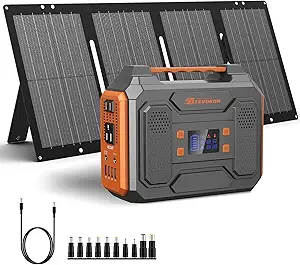 | Best for Car-Based Camping | Power station output: 300W maximum | Solar panel: 60W monocrystalline, 20.5% efficiency | Solar panel outputs: USB-A, USB-C, DC 18V/3.3A (60W max) | VIEW LATEST PRICE | See Our Full Breakdown |
| Apowking 100W Portable Solar Power Station with 40W Solar Panel |  | Best Lightweight Grab-and-Go Kit | Battery capacity: 146Wh / 39,600mAh | Running / peak wattage: 100W running, 200W peak | AC outlets: 2 | VIEW LATEST PRICE | See Our Full Breakdown |
| portable power stations with solar panel | Battery capacity | Included solar panel | AC output | Weight |
|---|---|---|---|---|
| Jackery Solar Generator 1000 V | 1,070Wh LFP | 200W | 1,500W (3,000W surge) | 23.8 lbs |
| Jackery HomePower 3600 Plus Po | — | — | 3,600W (7,200W parallel) | — |
| BROWEY 1600W Portable Power St | 1024Wh LiFePO4 | — | — | — |
| EnginStar 300W Portable Power | 296Wh (80,000mAh) lithium-ion | 60W monocrystalline, 23% conversion efficiency | 300W, 2 × 110V pure sine wave | 6.5 lbs station; 4 lb panel |
| 350W Portable Power Station wi | 288Wh LiFePO4 | 40W foldable | 350W, 110V pure sine wave (600W surge) | 8.2 lbs |
| Jackery Explorer 300 Portable | — | 40W | — | 7.5 lbs |
| BLUETTI Elite 100 V2 Solar Gen | 1024Wh LiFePO4 | 200W | 1800W (2700W Power Lifting), 3600W surge | 25 lbs |
| DaranEner 300W Portable Power | 192Wh LiFePO4 | 30W | Two 300W pure sine wave outlets, 600W surge | 5.84 lbs |
| MARBERO 88Wh Portable Power St | — | 21W folding panel | — | — |
| BLUETTI AC180 Portable Power S | 1152Wh LiFePO4 | 200W | 1800W continuous, 2700W lifting mode | — |
| MARBERO M823 Portable Power St | 237Wh / 64,000mAh | 60W foldable | 2 pure sine wave outlets; 300W rated, 375W peak | — |
| ZeroKor 300W Portable Power St | 280Wh | — | — | — |
| ZeroKor 300W Portable Power St | — | — | — | — |
| Apowking 100W Portable Solar P | 146Wh / 39,600mAh | — | — | 3.3 lb |
More Details on Our Top Picks
Jackery Solar Generator 1000 V2 with 200W Solar Panel
This pairing strikes the balance most buyers actually need: 1,070Wh of LFP capacity, a real 200W solar panel, and 1,500W of AC output in a package that still fits in a trunk. Compared with the BROWEY 1600W, which relies on a built-in 40W panel, the Explorer 1000 V2 recharges from sunlight roughly five times faster, which matters when you’re off-grid for more than a weekend. The LFP cells are rated past 4,000 cycles, so this kit should outlive smaller lithium-ion options like the EnginStar 300W by years. The headline one-hour charge time requires enabling an emergency mode in the app, which stresses the battery — treat it as a backup feature, not the default. The main letdown is logistics: the station and panel ship separately, so they may not arrive together.
Pros:- 200W panel gives realistic off-grid recharging
- LFP battery rated for 4,000+ cycles
- 1,500W output handles most portable appliances
- App-controlled charging modes add flexibility
Cons:- One-hour fast charging only works via app-enabled emergency mode
- Station and solar panel ship separately
Best for: Campers and road-trippers who want a genuinely solar-capable kit that can run a fridge, laptops, and lights for a long weekend
Not ideal for: Whole-home backup seekers — 1,070Wh won’t carry a household through an outage the way the Jackery HomePower 3600 Plus can
- Battery capacity:1,070Wh LFP
- AC output:1,500W (3,000W surge)
- Included solar panel:200W
- Ports:3 AC, 2 USB-C, 1 USB-A, 1 DC car port
- Weight:23.8 lbs
- Battery lifespan:Over 70% capacity after 4,000 cycles
- Warranty:5 years
Our verdict“The most sensible all-around solar generator here — big enough to matter, small enough to carry, and built on a battery that lasts.”
Jackery HomePower 3600 Plus Portable Power Station with Two 200W Solar Panels
If the rest of this list is about camping, this one is about keeping a house running. With 3,584Wh of capacity and 3,600W of output, it can run refrigerators, well pumps, and HVAC startup loads that would trip the Jackery 1000 V2 instantly. Capacity is expandable to 21kWh per unit (43kWh when paralleled), and the 6,000-cycle battery rating points to a decade of service. The wheels and telescopic handle are not a gimmick — at this capacity, they’re the difference between manageable and immovable. The two included 200W panels are honest trickle-chargers relative to this tank, taking about four hours for a full solar recharge under good conditions. Two annoyances: the panels ship separately from the station, and unlike every smaller kit here, this is an investment that only makes sense if you genuinely have backup-power needs.
Pros:- 3,600W output runs major household appliances
- Expandable to 21kWh (43kWh in parallel)
- 6,000-cycle battery with 10-year claimed lifespan
- Wheels and telescopic handle make it movable despite its size
Cons:- Two 200W panels charge slowly relative to the huge capacity
- Station and panels ship separately
- Far more cost and bulk than most users need
Best for: Homeowners in outage-prone areas who want solar-rechargeable whole-circuit backup instead of a gas generator
Not ideal for: Campers and van-lifers — the capacity and weight are wasted money and cargo space on a campsite
- Capacity:3,584Wh, expandable to 21kWh per unit
- AC output:3,600W (7,200W parallel)
- Battery cycle life:6,000 cycles
- Included solar panels:2 × 200W
- Recharge time:2 hrs hybrid AC+DC; 4 hrs solar
- Charging options:Hybrid AC+DC, AC, solar, gas generator
- Portability:Wheels and telescopic handle
Our verdict“The kit to buy when an outage means spoiled food and a cold house, not just a dead phone.”
BROWEY 1600W Portable Power Station with Built-In Solar Panel
This is the only kit in the lineup where the solar panel is built into the unit itself — no separate panel to carry, fold, or leave behind at the campsite. That self-contained design (an iF Design Award winner) makes it the pick for anyone who values grab-and-go simplicity over raw charging speed. The tradeoff is real, though: 40W of onboard solar is trickle-charging territory, roughly a fifth of what the Jackery 1000 V2’s external panel delivers. Where it holds its own is power delivery — 1600W of pure sine wave output across eight ports beats the Jackery on continuous wattage, and the 1024Wh LiFePO4 battery with 3,000+ cycles puts it far ahead of lithium-ion budget kits like the EnginStar 300W. The fast 3-hour recharge to 80% only happens when you combine the AC adapter and a 100W USB-C input simultaneously.
Pros:- Built-in solar panel and MPPT controller, nothing to lose or forget
- 1600W pure sine wave output across 8 ports
- LiFePO4 battery rated 3,000+ cycles
- Fast 3-hour recharge to 80% with combined AC + USB-C input
Cons:- Built-in solar is limited to 40W — slow off-grid recovery
- Advertised fast recharge requires simultaneous dual-input charging
Best for: Design-minded campers and emergency-prep buyers who want one integrated unit with zero loose accessories
Not ideal for: Off-grid users relying primarily on solar — 40W built-in charging can’t keep pace with daily power draws
- Battery capacity:1024Wh LiFePO4
- Output:1600W (3200W peak), pure sine wave
- Solar charging:Built-in panels, 40W
- Ports:8 (AC/DC/USB-C PD, 100W USB-C)
- Battery life:3000+ cycles to 80%
- Recharge time:3 hours to 80% with AC + 100W USB-C simultaneously
- Design:iF Design Award 2022 Winner
Our verdict“A smart single-unit solution for people who prioritize convenience and output over solar charging speed.”
EnginStar 300W Portable Power Station with 60W Foldable Solar Panel
For a first dip into solar generators, this bundle gets the fundamentals right: a 296Wh station paired with a genuine 60W foldable monocrystalline panel — a stronger panel than the 40W units bundled with the BROWEY or the 288Wh LiFePO4 kit below. At 6.5 lbs plus a 4 lb panel that folds to the size of a hardcover book, it’s a real backcountry-friendly setup. The compromises are structural: 300W of output means phones, cameras, drone batteries, and a small fan, not a refrigerator or electric kettle, and the 65W maximum charging input caps how fast sunlight refills the tank regardless of panel wattage. The lithium-ion chemistry is also rated for about 1,000 cycles — a third of what LiFePO4 options like the BROWEY promise. For weekend campers and emergency phone-charging duty, those limits rarely bite.
Pros:- 60W foldable panel outcharges most bundled budget panels
- Light and compact for genuine backcountry use
- Pure sine wave AC plus varied DC and USB outputs
- Charges via solar, wall outlet, or car socket
Cons:- 65W maximum charging input limits recharge speed
- Lithium-ion battery rated for only ~1,000 cycles
- 300W output caps appliance compatibility
Best for: First-time buyers and weekend campers who want a complete solar setup for phones, cameras, and small devices at low cost
Not ideal for: Anyone running appliances — 300W AC output rules out fridges, kettles, and most power tools
- Battery capacity:296Wh (80,000mAh) lithium-ion
- AC output:300W, 2 × 110V pure sine wave
- Included solar panel:60W monocrystalline, 23% conversion efficiency
- Maximum charging input:65W
- Full recharge time:About 3 hours
- Weight:6.5 lbs station; 4 lb panel
- Cycle life:1,000+ cycles
- Warranty:12-month limited
Our verdict“The cheapest credible way to learn whether solar generators fit your lifestyle before committing to a bigger kit.”
350W Portable Power Station with 40W Foldable Solar Panel, 288Wh LiFePO4 Battery
This kit quietly fixes the biggest weakness of budget lithium-ion stations like the EnginStar 300W: battery longevity. The 288Wh LiFePO4 cells are rated for roughly four times the cycle life, which means this unit should still be holding a usable charge years after a cheaper lithium-ion pack has faded. With 350W of pure sine wave AC, a 60W USB-C PD port, and the ability to charge six devices at once, it covers the small-kit bases well, and the four-mode LED light earns its place during outages. The 40W bundled panel is modest — half the wattage EnginStar includes — so solar recharging is a slow drip rather than a real energy strategy. And oddly for a budget kit, the car charging cable isn’t included, so budget for that accessory if vehicle charging matters to you.
Pros:- LiFePO4 chemistry with roughly 4× the cycle life of lithium-ion
- Charges up to six devices with 60W USB-C PD
- Compact 8.2 lb design with four-mode LED light
- Supports AC, car, and solar recharging
Cons:- 40W panel is underpowered for meaningful solar recovery
- Car charging cable not included
- 350W output limits AC device options
Best for: Budget-conscious buyers who want long-lived LiFePO4 chemistry for emergency lighting, CPAP-adjacent small devices, and phone charging
Not ideal for: Solar-first off-gridders — the 40W panel charges this unit slowly, and 350W output won’t run kitchen appliances
- Battery capacity:288Wh LiFePO4
- AC output:350W, 110V pure sine wave (600W surge)
- AC outlets:2
- Included solar panel:40W foldable
- USB-C output:60W PD
- Weight:8.2 lbs
- Charging methods:AC, car (cable not included), solar
- LED light:4 modes
Our verdict“The smart small-kit pick if battery lifespan matters more to you than solar charging speed.”
Jackery Explorer 300 Portable Power Station with 40W Solar Panel
At 7.5 lbs with an integrated handle, this is the lightest meaningful solar kit in the lineup, and it still packs a 292Wh LiFePO4 battery rated for over 4,000 cycles. Compared with the DaranEner 300W, you give up some raw outlet count but gain a slightly larger battery, a 100W USB-C PD port, and a bigger bundled panel (40W versus 30W). Six devices can charge at once, which is generous for a station this size. The honest tradeoff is solar speed: the 40W panel needs roughly 7.5 hours to reach 80%, so this works best as a trickle-charging setup rather than a rapid-recovery system. For hikers, van lifers, and anyone weight-conscious, that slow-charge penalty is easier to accept than for base-camp users.
Pros:- Featherweight 7.5 lb build with a carry handle that makes it genuinely portable
- LiFePO4 chemistry rated for 4,000+ cycles, far outlasting older lithium-ion units
- 100W USB-C PD port charges laptops at full speed
- Six devices can charge simultaneously
Cons:- The 40W panel takes about 7.5 hours to reach 80%, making solar recovery slow
- Station and panel may arrive in separate shipments
Best for: Backpackers, kayakers, and weight-conscious travelers who need reliable phone, camera, and small-device power off-grid
Not ideal for: Anyone hoping to run appliances like blenders or hair dryers — 300W rated output rules out most kitchen gear
- Capacity:292Wh
- Battery Chemistry:LiFePO4, 4,000+ cycles to 70%
- Weight:7.5 lbs
- Ports:2 AC, 100W USB-C PD, 2 USB-A, 120W car port
- Included Solar Panel:40W
- Solar Charge Time:Approximately 7.5 hours to 80%
Our verdict“This pick makes the most sense for mobile adventurers who value portability over charging speed.”
BLUETTI Elite 100 V2 Solar Generator with 200W Solar Panel, 1024Wh
This kit hits a sweet spot the smaller units can’t reach: a 1024Wh LiFePO4 battery, 1800W of AC output, and a bundled 200W panel at a midrange capacity. Against the MARBERO 88Wh kit, it’s a different category entirely — enough to run a fridge, and the 10ms UPS switchover means plugged-in devices keep running through an outage without noticing. Compared with its sibling, the BLUETTI AC180, you get slightly less capacity (1024Wh versus 1152Wh) but quieter 30dB operation and app monitoring, which matters if it lives indoors. The 1000W maximum solar input leaves room to expand well beyond the included panel. Just know the solar panel ships separately, and real-world runtime depends entirely on what you plug in — power tools will drain it fast.
Pros:- 200W solar panel included with headroom to accept up to 1000W of solar input
- 10ms UPS switchover keeps sensitive electronics running through outages
- Whisper-quiet 30dB silent mode suitable for bedrooms or offices
- 11 ports plus five charging sources including generator and lead-acid
Cons:- Solar panel ships separately from the station
- Runtime varies sharply with load — high-draw appliances deplete it quickly
Best for: Homeowners who want quiet, apartment-friendly outage backup for a fridge, router, and laptops with room to grow
Not ideal for: Campers counting ounces — at 25 pounds this is a car-camping or stationary unit, not a trail companion
- Battery Capacity:1024Wh LiFePO4
- AC Output:1800W (2700W Power Lifting), 3600W surge
- Maximum Solar Input:1000W
- Included Solar Panel:200W
- UPS Switchover:≤10ms
- Noise Level:30dB in silent mode
- Battery Cycle Life:4,000+ cycles to 80%
- Weight:25 lbs
Our verdict“A strong middleweight for buyers who want genuine home backup with solar charging without stepping up to a full-size whole-home unit.”
DaranEner 300W Portable Power Station with 30W Solar Panel
Where most small stations force you to prioritize, this one spreads power across eight output ports, including two pure sine wave AC outlets, dual USB-C, and two DC5521 barrel jacks — the kind of port variety you normally only see on the BLUETTI Elite 100 V2. At 5.84 lbs and roughly the size of a lunchbox, it undercuts the Jackery Explorer 300 on weight while adding a built-in four-mode LED flashlight for emergencies. The 3,500+ cycle LiFePO4 battery should outlast the station itself. The catch is arithmetic: 192Wh means a laptop gets a few charges, not a weekend of power, and the 30W panel is more of a battery-maintainer than a fast recharger. Treat solar here as a supplement to wall charging, not a replacement.
Pros:- Eight output ports let you charge a full kit of phones, cameras, and lights simultaneously
- True sine wave AC output that’s safe for sensitive electronics
- Under 6 lbs with an emergency LED flashlight built in
- Charges via AC, car socket, or solar for flexible top-ups
Cons:- 192Wh capacity limits it to phones, tablets, and short laptop sessions
- The 30W panel recharges slowly and depends heavily on good sun
Best for: Budget-minded campers and emergency-prep beginners who charge many small devices at once and mostly recharge at home
Not ideal for: Anyone running anything above 300W — no kettles, induction plates, or power tools
- Battery Capacity:192Wh LiFePO4
- AC Output:Two 300W pure sine wave outlets, 600W surge
- Ports:8 total, including 2 USB-C (60W PD) and 2 DC5521
- Recharging:AC up to 90W, car up to 60W, or solar
- Included Solar Panel:30W
- Cycle Life:3,500+ cycles to 80%
- Weight:5.84 lbs
Our verdict“A sensible low-cost entry point if port variety matters more to you than raw capacity.”
MARBERO 88Wh Portable Power Station with 21W Solar Panel
This is the smallest kit in the roundup, and it owns that identity: an 88Wh station paired with a 21W folding panel that slips into a daypack without a second thought. Compared with the DaranEner 300W, you sacrifice more than half the capacity and most of the port variety, but you also cut the price and bulk dramatically — this is a first-power-station purchase, not a lifestyle upgrade. The two-piece design is its real strength: charge the panel in sunlight during the day, drain the battery after dark, which covers the basic camping rhythm of phones, headlamps, and a GPS unit. Just be realistic that 88Wh is roughly six to eight phone charges, and the 21W panel needs long, direct sun exposure to refill the battery. Surge power of 120W rules out anything beyond small electronics.
Pros:- Genuinely packable size for day hikes and car camping
- Solar panel charges by day so stored power is available after sunset
- Low-cost way to test whether a solar generator fits your routine
Cons:- 88Wh capacity powers only small devices for short periods
- 21W panel output means multi-hour recharge windows in direct sun
Best for: First-time buyers and day-trip campers who want to try solar charging without a big commitment
Not ideal for: Laptop-heavy travelers or CPAP users — the 88Wh capacity and 120W surge ceiling are too tight for overnight device needs
- Capacity:88Wh
- Surge Power:120W
- Included Solar Panel:21W folding panel
- Charging Strategy:Solar by day, battery discharge after dark
- Best Use:Phones, headlamps, and small electronics
Our verdict“A low-risk gateway kit for casual campers who need phone-and-headlamp power, not appliance-grade energy.”
BLUETTI AC180 Portable Power Station with 200W Solar Panel, 1152Wh
With 1152Wh of capacity and 1800W of continuous AC output, this is the most capable kit in this batch, sitting just below the Jackery HomePower 3600 Plus in the broader roundup but at a far friendlier size. Compared with the BLUETTI Elite 100 V2, the extra 128Wh and fast 1440W AC input make it the better choice for extended off-grid trips where you want to refill the battery in under two hours from a wall outlet between stops. The 200W bundled panel recharges it in roughly 5 to 10 hours of good sun — workable, though serious boondockers will want a second panel. The 2700W lifting mode handles brief high-draw appliances like kettles, but it’s a burst feature, not a sustained one. With 11 outlets and 10ms UPS switching, it doubles credibly as home backup.
Pros:- 1152Wh capacity runs fridges and laptops through a full weekend off-grid
- 1440W AC input recharges the battery remarkably fast between uses
- 10ms UPS switching makes it a legitimate home-backup option
- 11 outlets cover an entire campsite’s charging needs at once
Cons:- Solar panels ship separately, so confirm delivery before a trip
- 2700W lifting mode suits only short bursts, not sustained high-wattage appliances
Best for: RV owners and multi-day base campers who need sustained appliance power and fast recharges between locations
Not ideal for: Buyers wanting to run high-wattage devices continuously — lifting mode is for short bursts only, and sustained loads above 1800W will shut it down
- Battery Capacity:1152Wh LiFePO4
- AC Output:1800W continuous, 2700W lifting mode
- Included Solar Panel:200W
- Solar Recharge Time:4.8–9.6 hours
- AC Charging Input:Up to 1440W
- UPS Switching:≤10 ms
- Outlets:11
- Cycle Life:3000+ cycles
Our verdict“The strongest all-around performer in this batch for buyers who need serious capacity paired with a real 200W panel.”
MARBERO M823 Portable Power Station with 60W Foldable Solar Panel
This kit stands out for pairing a 237Wh station with a 60W foldable panel — a better solar-to-battery ratio than the ZeroKor 300W kit’s 40W panel, which means faster off-grid recharges for the same class of device. Four USB-A ports plus USB-C make it the more flexible choice for charging several phones, cameras, and lights at once, and the pure sine wave AC keeps sensitive electronics like a CPAP or laptop safe. The tradeoff is the familiar one at this price tier: 300W is a hard ceiling, and pushing past it risks damage, so kettles, heaters, and hair dryers are off the menu. Compared with the Apowking kit, you give up portability in exchange for roughly 60% more stored energy and a beefier panel.
Pros:- 60W foldable panel recharges meaningfully faster than the 30–40W panels common at this price
- Four USB-A ports plus USB-C let a whole campsite charge simultaneously
- Pure sine wave AC is safer for laptops and medical devices than modified sine wave
- Flashlight includes strobe and SOS modes for emergencies
Cons:- Devices drawing over 300W may permanently damage the unit
- 237Wh runs out quickly if you’re topping up laptops daily rather than just phones
Best for: Campers and van-lifers who need to keep phones, cameras, lights, and a laptop alive over a multi-day trip without grid access
Not ideal for: Anyone hoping to run a mini fridge, electric blanket, or other heating appliances — the 300W limit rules them out
- Battery capacity:237Wh / 64,000mAh
- Battery type:Lithium-ion
- AC output:2 pure sine wave outlets; 300W rated, 375W peak
- USB output:2 × USB-A QC3.0 (18W), 2 × USB-A (15W), 1 × USB-C (18W PD)
- DC output:12–16.8V / 10A, 14A max
- Included solar panel:60W foldable
- Solar conversion rate:21.5–23.5%
Our verdict“The right pick for small-gear campers who want the fastest solar recharge per dollar without lugging a big unit.”
ZeroKor 300W Portable Power Station with 40W Foldable Solar Panel
What separates this kit from the MARBERO M823 and ZeroKor’s own 60W bundle is the second 100W power pack included in the box. That split design is genuinely useful in an outage: keep the main 280Wh station plugged into a router and modem in one room, and carry the small pack to a bedroom as a reading light and phone charger. The tradeoff is raw solar speed — the 40W panel is the weakest in this batch, so full off-grid recharges take noticeably longer than the M823’s 60W setup. Like its siblings, the 300W ceiling means heating elements and air compressors are explicitly off-limits. Compared with the Apowking kit, you get more total capacity but a heavier, less grab-and-go package.
Pros:- Two separate units let you power devices in two locations at once
- Built-in short-circuit, over-current, over-voltage, and overload protection
- Reading and SOS flashlight modes add genuine emergency utility
- Wide port spread across both units — AC, DC, USB-A, QC USB, and USB-C
Cons:- 40W panel is the slowest solar charging option here
- Neither unit handles appliances over 300W or anything with heating elements
Best for: Households preparing for power outages who want a main station plus a separate portable pack for phones and lighting
Not ideal for: Off-grid campers relying mostly on solar — the 40W panel recharges slowly and the kit is bulkier than single-unit options
- Power station output:300W (100W secondary pack)
- Battery capacity:280Wh
- Solar panel:40W foldable
- AC outlets:2 × 110V on station; 2 × 110V on 100W pack
- USB ports:3 × 5V/3A plus 1 × QC3.0
- DC output:9V–12.6V / 10A max
- AC waveform:Pure sine wave
Our verdict“A smart buy for outage prep where a divided, redundant kit beats one big battery.”
ZeroKor 300W Portable Power Station with 60W Solar Panel
This version of the ZeroKor bundle swaps the 40W panel for a 60W monocrystalline panel with its own USB-A, USB-C, and 18V DC outputs — meaning you can charge devices directly from the panel without draining the battery at all. That dual-use trick is something the MARBERO M823’s panel doesn’t offer as flexibly. Its other strength is charging flexibility: it tops up from AC, solar, or a 12V car outlet, and every cable and adapter you need ships in the box. The catches are real, though — the solar panel’s junction box isn’t waterproof, which demands care in wet weather, and it shares the 300W ceiling that keeps kettles and heaters out of reach. Protection circuitry and a temperature-controlled fan help it run cooler than cheaper rivals.
Pros:- Panel has its own USB-A, USB-C, and DC outputs for direct device charging
- Charges from AC, solar, or 12V car outlet with all cables included
- Full protection suite plus temperature-controlled cooling fan
- 60W monocrystalline panel recharges faster than the 40W ZeroKor bundle
Cons:- Solar panel junction box is not waterproof
- 300W output ceiling blocks higher-wattage appliances
Best for: Road-trippers and car campers who want to recharge the station from the cigarette lighter between stops and from solar at camp
Not ideal for: Wet-climate campers — the non-waterproof panel junction box makes rainy setups risky
- Power station output:300W maximum
- Solar panel:60W monocrystalline, 20.5% efficiency
- Solar panel outputs:USB-A, USB-C, DC 18V/3.3A (60W max)
- AC outlets:2, 300W maximum
- USB ports:3 × 5V/3A plus QC port (5V/3A, 9V/2A)
- Recharge methods:AC outlet, 13V–23V solar panel, or 12V car outlet
- Battery protection:Short-circuit, over-current, over-voltage, overload, overheating
Our verdict“The pick for anyone whose campsite moves with their car and wants three ways to refill the battery.”
Apowking 100W Portable Solar Power Station with 40W Solar Panel
At 3.3 lb and roughly the size of a large lunchbox, this is by far the most portable kit in this batch — the MARBERO M823 and both ZeroKor bundles all carry noticeably more bulk. That lightness is the entire point: it slots into a hiking pack or an emergency car kit where nothing else here would fit. You pay for that in capacity and power. The 146Wh battery is roughly 60% the size of the M823’s, and the 100W running output (200W peak) means even some small appliances are out of reach — this is a phone, headlamp, tablet, and camera charger, full stop. Seven outputs and dual LED lights with SOS mode give it real emergency credibility for its size, and the 12-month warranty backs the package.
Pros:- Lightest and most compact kit in this group at 3.3 lb
- Seven outputs including AC, USB, USB-C, and 12V DC
- Dual LED lights with flashlight, strobe, and SOS modes
- Battery management and temperature controls in a small package
Cons:- 100W running output limits it to genuinely small devices
- 146Wh capacity suits short trips only, not multi-day base camps
Best for: Hikers, backpackers, and car-trunk emergency kits where every ounce and inch counts
Not ideal for: Weekend car campers powering a 12V cooler or running laptops all day — the capacity and 100W ceiling run dry fast
- Battery capacity:146Wh / 39,600mAh
- Running / peak wattage:100W running, 200W peak
- AC outlets:2
- Total outputs:7 (AC, USB, USB-C, 12V DC)
- Solar panel output:40W monocrystalline
- Weight:3.3 lb
- Dimensions:7.5 × 3.7 × 6.1 in
- Warranty:12 months
Our verdict“Buy it when portability is the deciding factor and your devices are all small; skip it for anything beyond that.”
How We Picked
I evaluated each kit as a system, not two separate products. The first filter was solar input balance: a big battery starved by a tiny panel is a frustrating purchase, so I favored kits where the panel can refill the station in one to two sunny days. The second filter was capacity honesty — I looked at usable watt-hours, inverter size relative to common appliances, and whether the outputs (AC, USB-C, DC) match how people actually use these units in the field.
From there, I weighed battery chemistry and cycle life (LiFePO4 models like the BLUETTI AC180 and ZeroKor kits will outlast standard lithium-ion by years), build quality of the panels themselves (kickstands, junction boxes, weather resistance), and value per watt-hour once the panel is included. Ranking follows use-case fit: whole-home backup first, then versatile mid-size campers, then honest small emergency kits — because a well-matched cheap kit beats a mismatched expensive one for most buyers.
Factors to Consider When Choosing Portable Power Stations With Solar Panels
Before choosing a specific kit, it helps to understand what actually drives satisfaction in this category. These are the factors that separated the winners from the frustrating purchases in my comparison.Match Panel Wattage to Battery Size
The most common mistake in this category is buying a large battery bundled with a token panel. As a rough rule, you want panel wattage equal to at least 15–20% of battery capacity in watt-hours — a 1,000Wh station wants 150W–200W of solar to recharge in one sunny day. A 40W panel feeding a 300Wh station takes two full days of ideal sun, and real-world conditions (angle, clouds, heat) usually cut rated output by 20–30%. Small panels are fine for topping up, but if you plan to camp off-grid for multiple days, undersized solar converts your power station into a one-use battery. Conversely, oversized solar on a tiny station wastes money you could spend on capacity.
Battery Chemistry and Cycle Life
LiFePO4 (lithium iron phosphate) batteries handle roughly 2,500–4,000 charge cycles before degrading to 80% capacity, versus roughly 500–800 cycles for standard lithium-ion. That difference matters more than it first appears: a solar generator used weekly will exhaust a lithium-ion battery in two to three years, while LiFePO4 units like the BLUETTI AC180 can last a decade. The tradeoff is weight — LiFePO4 cells are heavier per watt-hour, which is why ultralight kits like the MARBERO 88Wh still use older chemistry. If your kit lives in a closet for emergencies and gets cycled a few times a year, chemistry matters less; if it’s a van-life workhorse, it’s the single most important spec.
Inverter Sizing and Surge Ratings
The wattage number on the box is the inverter limit, and it determines what you can run, not how long. A 300W inverter handles lights, fans, phones, and a TV, but a refrigerator needs 700–1,200W of continuous output plus surge headroom for compressor startup — that’s why kits like the Jackery HomePower 3600 Plus exist. Check the surge rating too: many compressors and power tools draw 2–3x their running wattage for a second at startup. A common regret is buying a mid-size station only to discover it cannot run the one appliance the buyer actually bought it for. List your must-run devices and their wattage before comparing kits.
Panel Build and Real-World Durability
Foldable panels vary widely in construction: look for ETFE coating (more scratch- and heat-resistant than PET), stitched vs. glued seams, and whether kickstands and a proper junction box with bypass diodes are included. Bypass diodes keep the panel producing when part of it is shaded — cheap panels without them can lose most output from a single leaf shadow. Also check the connector: proprietary connectors (common on Jackery and some budget brands) lock you into that brand’s panels, while standard MC4 or DC5521 connectors let you mix and match later. Weight and folded size matter if you’ll carry the kit to a campsite rather than car-camp beside it.
Pass-Through Charging and UPS Behavior
If you plan to use the station as home backup or an always-on power hub, check whether it supports charging while discharging (pass-through), and whether it switches to battery fast enough during an outage to keep computers running. Many budget kits either block pass-through entirely or degrade the battery faster when used that way. Mid-tier and premium models from Jackery and BLUETTI generally handle this well, with transfer times under 20 milliseconds on newer units. For emergency-only buyers this is a non-issue; for anyone running a home office or medical device from the kit, it should be a deciding factor.
When to Pay More (and When Not To)
Premium kits justify their cost through faster solar input, LiFePO4 chemistry, app control, and higher inverter capacity — worth it if you camp regularly, work remotely from a van, or want real home backup. But the sub-$150 kits in this roundup fill a legitimate role: a grab-and-go emergency bag for storms, outages, and car camping where you only need phones, lights, and maybe a CPAP for a night. The buyers who waste money are those in the middle — paying for capacity they never cycle, or buying a small kit and expecting refrigerator performance. Be honest about your worst-case scenario and buy for that, not the fantasy scenario.
Frequently Asked Questions
Can a small solar panel actually recharge these power stations, or is it just marketing?
Honestly, it depends on the ratio. A 21W panel like the one bundled with the MARBERO 88Wh can refill that small station in a long sunny day, so the pairing is legitimate. But a 30W or 40W panel feeding a 296Wh station needs two to three ideal days, and real conditions rarely deliver ideal days. Manufacturers quote panel output under standard lab sun (1,000 W/m² at 25°C), so expect 70–80% of the rated number on a good field day. If recharging speed matters to you, prioritize kits with 100W+ panels rather than assuming any bundled panel will keep up with your usage.
Is a built-in solar panel better than a separate foldable one?
Built-in panels, like on the BROWEY 1600W, win on convenience: nothing to connect, nothing to lose, and the whole unit deploys in seconds. The tradeoff is charging physics — a panel mounted flat on the station’s surface only produces full power when the entire unit faces the sun at the right angle, which usually means propping the whole battery on edge. A separate foldable panel lets you keep the battery in shade (heat degrades lithium batteries and reduces output) while aiming the panel independently. For occasional emergency use, built-in is fine; for daily off-grid living, a separate panel with a long cable is the better design.
How much capacity do I need for camping versus home backup?
For weekend car camping, 250–400Wh covers phones, a camp light or two, a small fan, and camera batteries — that’s the sweet spot of the EnginStar, ZeroKor, and Jackery Explorer 300 kits. A mini fridge, laptop work sessions, or a CPAP machine push you toward 1,000Wh (Jackery 1000 V2 or BLUETTI AC180 territory), which typically runs a fridge for 8–15 hours. Real home backup — refrigerator, router, some lights through a multi-hour outage — starts at 1,000Wh minimum and realistically wants 2,000Wh+, which is why the HomePower 3600 Plus sits in its own tier here. Add up the wattage of your must-run devices times the hours you need them, add 20% for inverter losses, and buy to that number.
Are the budget kits under $150 worth buying, or will I regret them?
They’re worth it if your expectations match their design. The MARBERO 88Wh and Apowking 100W kits are genuinely good emergency bags: they’ll recharge phones several times, run LED lights for nights, and top up a tablet. What they cannot do is run anything with a heating element, a compressor, or a real laptop charger for long. The regret cases come from buyers who see “power station” and imagine backup for their kitchen. If you want a storm-kit gift, a car-camping accessory, or a first taste of solar power without commitment, these deliver real value. If you already know you’ll want more capacity within a year, buy up once instead of twice.
Do I need to buy the same brand of panel as my power station?
Not always, but connector compatibility decides this. Jackery and some budget brands use proprietary solar input connectors, which means third-party panels need an adapter — cheap and widely available, but an extra failure point. Brands using standard MC4 or DC5521 inputs (most BLUETTI models and several budget kits here) accept almost any panel directly. Also check the station’s maximum solar input voltage and wattage: exceeding the voltage limit can damage the charge controller, while exceeding wattage is usually safe because the station simply caps the input. If you think you’ll expand your solar array later, favor a station with MC4 input and generous input headroom.
Conclusion
For most buyers, the Jackery Solar Generator 1000 V2 is the best overall choice — it balances capacity, fast 200W solar recharging, and build quality in a kit that handles camping, van life, and outages without excess weight or cost. The Jackery HomePower 3600 Plus is the premium pick for serious home backup, where its dual panels and high inverter output are the only configuration here that can carry a refrigerator through a long outage. On value, the EnginStar 300W kit with 60W panel offers the best solar-to-battery ratio in the budget tier, outperforming similarly priced bundles with token 30–40W panels. Beginners and emergency-preparedness shoppers should start with the MARBERO 88Wh — it’s cheap, simple, and honest about what it can do, which makes it a low-risk first solar purchase. For compact grab-and-go use with a bit more runtime, the Jackery Explorer 300 with 40W panel fits between the emergency kits and the mid-tier campers. Whatever you choose, match the panel to the battery and the capacity to your actual devices — that single habit separates satisfied owners from frustrated ones more than any brand choice.
Fall Picks
fall essentials
As an affiliate, we earn on qualifying purchases.