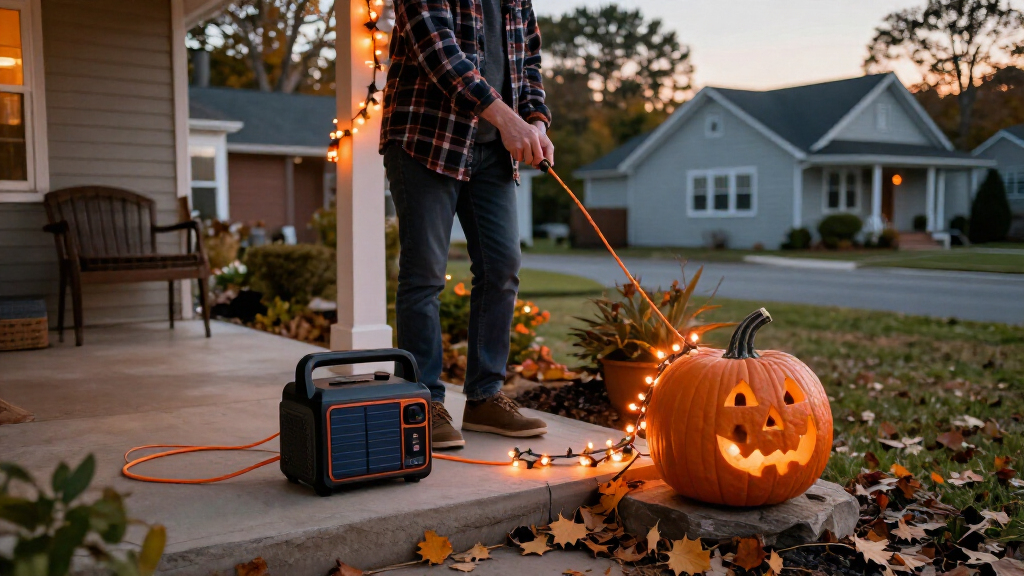
Choosing a solar generator for Halloween decorations comes down to more than the panel size: how much power your display draws, how long it runs after dark, and how much stored energy is available all matter. I’d start with the 146Wh Solar Powered Generator for a useful balance of capacity and portability, consider the Takki 88.8Wh for a small, low-draw display, and choose the 300W model when your decorations include devices that need more output headroom.
The tradeoff is straightforward: the Takki is easiest to carry but has the smallest battery; the 146Wh option offers more stored energy but is still limited to 100W output; and the 300W generator is better suited to more demanding loads, though its panel connection needs protection from rain. I rank these picks for Halloween lights, small props, and outdoor display setups, not for heaters, fog machines, or other high-draw equipment unless their power requirements fit the generator’s limits.
Complete the kit


Key Takeaways
- The 146Wh model has the largest stated battery capacity among the two smaller-output options, making it the stronger choice for extending a low-wattage display’s runtime.
- The Takki weighs 2.29 lb and has an 88.8Wh battery, so it suits a few LED decorations better than an all-night, multi-prop setup.
- The 300W model offers the highest stated output and a 60W solar panel, giving buyers more headroom for compatible decorations than either 100W-or-lower alternative.
- A 40W or 60W panel helps recharge during daylight, but actual solar input depends on conditions and does not replace stored battery capacity for nighttime use.
- None of these listings establishes a weatherproof rating for the complete setup; keep the generator and panel connections sheltered from rain and damp ground.
| Solar Powered Generator 100W with 40W Solar Panels – Portable Power Station |  | Best Overall for Modest Halloween Displays | Battery capacity: 146Wh / 39600mAh | Solar panel: 40W | Output ports: 7 | VIEW LATEST PRICE | See Our Full Breakdown |
| Portable Solar Generator 300W with 60W Solar Panel |  | Best for Higher-Wattage Compatible Loads | Solar panel: 60W foldable panel | Power sources: Battery, solar, AC/DC charging | Output voltage: 110V | VIEW LATEST PRICE | See Our Full Breakdown |
| Takki Solar Generator 120W Peak Portable Power Station with 21W Solar Panel, 88.8Wh Battery, 110V AC Outlet for Camping and Emergency Use |  | Best Compact Pick for a Few LED Decorations | Battery capacity: 88.8Wh | Peak power: 120W | Extended-use guidance: Devices under 80W | VIEW LATEST PRICE | See Our Full Breakdown |
| solar generators for Halloween decoration | Solar panel | Battery capacity | Output ports | Weight |
|---|---|---|---|---|
| Solar Powered Generator 100W w | 40W | 146Wh / 39600mAh | 7 | 3.3 lb |
| Portable Solar Generator 300W | 60W foldable panel | — | — | — |
| Takki Solar Generator 120W Pea | 21W | 88.8Wh | 2 AC, 2 USB QC3.0, 2 USB, 1 USB-C, 1 12V DC | 2.29 lb |
More Details on Our Top Picks
Solar Powered Generator 100W with 40W Solar Panels – Portable Power Station
I rank this model first for a typical small Halloween setup because its 146Wh battery gives it more stored energy than the Takki’s 88.8Wh, while its 40W solar panel is larger than the Takki’s 21W panel. That combination makes it a more flexible starting point for several LED strands or a few low-power decorations, provided their combined draw stays within the generator’s 100W output limit. The seven listed output options also make it easier to connect a mix of compatible devices, though the supplied information does not identify each port’s exact type or rating.
Compared with the 300W pick, this generator has a lower output ceiling, but the 300W model’s battery capacity is not given in the supplied specs. For shoppers prioritizing a clearly stated battery size over maximum wattage, that makes the 146Wh option easier to evaluate. Its 3.3 lb weight remains manageable for carrying between the house, porch, and yard, while a built-in flashlight adds emergency utility after setup.
The limit is endurance: 146Wh is still a modest reserve, and a display’s runtime depends on its actual draw and conversion losses. The 40W panel can support solar recharging in suitable conditions, but I would not count on it to maintain decorations through the night. This is the most balanced choice here for low-draw lights and small props, not for high-power effects, long runtimes without recharging, or equipment that exceeds 100W.
Pros:- 146Wh listed capacity exceeds the Takki’s 88.8Wh reserve.
- 40W solar panel is larger than the Takki’s 21W panel.
- Seven output ports provide options for compatible AC, USB, and DC devices.
- At 3.3 lb, it remains practical to move around a home or yard.
Cons:- 100W output rules out many high-draw Halloween effects and appliances.
- Solar recharge time varies with sunlight, and the listed capacity may not sustain a display for an entire evening.
- Exact port-by-port output details are not provided in the supplied specifications.
Best for: Buyers powering several low-wattage LED decorations who want more battery capacity than the Takki while keeping the unit portable.
Not ideal for: Anyone running a device above 100W, planning a large display for many hours without a recharge opportunity, or needing documented long-run performance.
- Battery capacity:146Wh / 39600mAh
- Solar panel:40W
- Output ports:7
- Weight:3.3 lb
- Dimensions:7.5 × 3.7 × 6.1 in
- Battery management:Battery Management System listed
- Other feature:Built-in LED flashlight with emergency modes
Our verdict“I’d choose this 146Wh model for the best balance of stated battery capacity, solar panel size, and portability for modest Halloween decorations.”
Portable Solar Generator 300W with 60W Solar Panel
This is the clear output leader in this lineup: its 300W rating is three times the listed output of the 100W model and well above the Takki’s stated 120W peak. That extra headroom can matter when a Halloween display combines multiple decorations or includes a compatible device with a higher startup or operating draw. Its 60W foldable solar panel is also the largest panel in this comparison, though charging remains dependent on usable sunlight and placement.
There is a meaningful information gap: the supplied specifications do not state the generator’s battery capacity. That means I can compare output limits, but I cannot rank its stored energy or make a sound runtime comparison against the 146Wh model. Buyers should check the manufacturer’s detailed capacity and port ratings before planning an evening display. A 300W output ceiling does not mean the unit will power a 300W load for long, and it does not make high-power appliances suitable.
Compared with the smaller generators, this model is the better fit when output capacity is the deciding factor, not when the buyer wants the most clearly documented battery reserve. Its protection features include overload and short-circuit protection, but the solar panel junction box is not waterproof. I would keep the panel connections sheltered and the power station protected from wet conditions. It earns its role for displays with compatible higher-draw components, but buyers seeking a simple light-string solution may find the 146Wh model easier to compare for runtime planning.
Pros:- 300W stated output offers the highest load ceiling in this comparison.
- 60W foldable solar panel has the largest stated panel rating here.
- AC, USB, and DC outlets support a range of compatible devices.
- Overload and short-circuit protection are listed.
Cons:- Battery capacity is not provided in the supplied specifications, limiting runtime comparison.
- The solar panel junction box is not waterproof and needs protection from moisture.
- It cannot operate devices above its 300W output rating.
Best for: Shoppers whose combined decoration load needs more than 100W of output and who can verify the battery capacity and port ratings before purchase.
Not ideal for: Buyers who need a confirmed battery capacity for runtime planning, want a rain-ready setup, or are powering devices over 300W.
- Solar panel:60W foldable panel
- Power sources:Battery, solar, AC/DC charging
- Output voltage:110V
- Output types:AC, USB, and DC
- Protection:Overload and short-circuit protection
- Additional feature:Built-in SOS flashlight
- Weather limitation:Solar panel junction box is not waterproof
Our verdict“I’d pick this model when compatible decorations need more output headroom, but I would verify its battery capacity and shelter its non-waterproof panel junction box.”
Takki Solar Generator 120W Peak Portable Power Station with 21W Solar Panel, 88.8Wh Battery, 110V AC Outlet for Camping and Emergency Use
The Takki’s standout advantage is how little space and carrying effort it asks of the buyer: at 2.29 lb, it is the lightest listed unit, and its compact 5.7 × 4.13 × 3-inch dimensions suit a porch or small yard setup. Its 88.8Wh battery and 21W solar panel are the smallest stated energy and panel figures in this group, so I see it as a focused power source for a few low-draw LED strands, not a hub for a full yard of props.
Its listed ports are unusually broad for such a small unit: two AC outlets, USB-A and USB-C options, and a 12V DC output. However, the 120W figure is peak power, and the listing says extended use is limited to devices under 80W. That distinction matters if a decoration has a motor or a brief startup surge. Compared with the 146Wh model, the Takki gives up battery capacity and solar-panel wattage in exchange for a lighter, smaller package. It also has less output headroom than the 300W unit.
The included flashlight with SOS mode is useful as an extra, but it does not change the generator’s Halloween role. The listing warns that charging while using the unit may reduce battery lifespan, so I would avoid treating it as a permanent pass-through supply for decorations and a charging panel at the same time. For a small display that needs to be carried in and out, this is the most convenient option; for longer runtimes, I would move up to the 146Wh pick.
Pros:- Lightest listed generator at 2.29 lb.
- Compact dimensions make it easy to place near a small display.
- Includes AC, USB, USB-C, and 12V DC output options.
- 21W solar panel and AC recharging provide more than one charging method.
Cons:- 88.8Wh capacity is lower than the 146Wh model and may limit runtime.
- Extended use is specified for devices under 80W despite a 120W peak rating.
- The listing cautions that charging while in use may reduce battery lifespan.
Best for: Anyone powering a small number of low-wattage LED decorations and prioritizing a lightweight unit that is easy to carry and store.
Not ideal for: Buyers running multiple decorations for a long evening, loads near or above 80W for extended periods, or equipment that needs reliable pass-through charging.
- Battery capacity:88.8Wh
- Peak power:120W
- Extended-use guidance:Devices under 80W
- Solar panel:21W
- Output ports:2 AC, 2 USB QC3.0, 2 USB, 1 USB-C, 1 12V DC
- Weight:2.29 lb
- Dimensions:5.7 × 4.13 × 3 in
- Runtime claim:Up to 2 hours for devices under 80W
Our verdict“I’d choose the Takki for a small, portable LED setup, but its lower capacity makes it a weaker fit than the 146Wh model for longer Halloween evenings.”

How We Picked
I ranked these generators around the practical needs of a Halloween display: usable output, stored energy, panel size, portability, and outdoor handling. Output wattage indicates the power ceiling for connected devices, while watt-hours are a more useful starting point for estimating how long a load may run. Those figures answer different questions, so I did not treat a higher wattage rating as proof of longer runtime.
I also looked at whether each listing provides a solar panel, the panel’s stated wattage, and the range of output connections. A foldable panel can help restore some charge during daylight, but sunlight, orientation, shading, and charging limits affect results. For decorations operating after sunset, the battery needs to carry the load; a panel cannot make a small battery behave like a large one.
My ranking favors different display types rather than pretending one generator suits every yard. The 146Wh, 100W model takes the lead for modest lights because its listed battery capacity exceeds the Takki’s while keeping a compact form. The Takki earns the portable, low-load role. The 300W unit ranks as the higher-output choice, but the supplied details do not state its battery capacity, which makes runtime comparisons less certain. I also account for limits plainly: these are portable power stations, not weatherproof outdoor wiring systems, and none should be used beyond its rated output.
Factors to Consider When Choosing Solar Generators For Halloween Decorations
I would choose a Halloween power station by working from the decorations outward: identify the actual load, decide how many hours it must run, then match those needs to the unit’s output and battery capacity.Add up the decoration wattage
Check labels or manuals for the wattage of each light string, projector, animated prop, or other device, then add the loads you expect to run at the same time. The total needs to remain under the generator’s rated output, with room for any startup surge. Among these picks, the Takki lists 120W peak but recommends extended use below 80W, the Solar Powered Generator is rated at 100W, and the 300W model has the highest stated output. Do not assume that a 300W rating makes every device suitable: the connected load still needs to fit the generator’s limits, and high-power appliances are outside the role of these compact models.
Use watt-hours to think about runtime
Output watts describe the maximum load a unit can supply; watt-hours describe the amount of energy stored. For a rough estimate, divide the battery’s watt-hours by the decoration’s wattage, then allow for conversion losses and other operating conditions. A 20W display draws energy much more slowly than a 60W display, but the exact runtime will not match a simple calculation perfectly. The 146Wh model has a clearer advantage over the Takki’s 88.8Wh for stored energy. The 300W model’s battery capacity is not supplied here, so I would verify that figure before relying on it for a planned run time.
Treat the panel as a recharging aid
The included panels are rated at 21W, 40W, and 60W. A larger panel can offer more solar input in suitable conditions, but cloud cover, shade, season, panel angle, and charging limits all affect the result. Since Halloween decorations usually operate after sunset, the panel’s role is generally to add charge during daylight; the battery supplies the evening load. If the generator is also being charged while powering decorations, check the manufacturer’s guidance. The Takki listing specifically warns that charging while in use may reduce battery lifespan, so I would not assume every unit supports continuous pass-through operation.
Check outlets against the decorations
Confirm whether each decoration uses a standard AC plug, USB, or DC connector, and check both the connector and its electrical rating. A collection of ports sounds versatile, but the number of outlets alone does not say how much power each can provide. The Takki lists its AC, USB, USB-C, and 12V DC options; the other listings describe AC, USB, and DC outputs but provide less port-by-port detail. Match the connection and rating to the device rather than relying on adapters to solve a power mismatch. Keep an eye on the combined draw when several items run at once.
Plan for damp fall weather
Outdoor decorations can sit through dew, drizzle, and wet leaves. The supplied product details do not establish that any complete generator setup is weatherproof, and the 300W model specifically has a non-waterproof solar panel junction box. Place the power station on a dry, stable surface under shelter, keep connectors off the ground, and protect the panel connection from moisture while following the manufacturer’s instructions. A covered location also helps prevent accidental contact with decorations or foot traffic. Do not use a damaged cable or connection in wet conditions.
Choose portability or capacity deliberately
If you need to move power between a porch, driveway, and storage area, the Takki’s 2.29 lb weight and small dimensions make it the easiest to carry. The 146Wh model weighs 3.3 lb but provides more stated stored energy, a useful exchange for shoppers who want to run lights longer. The 300W unit is the pick for higher output, but the available details do not give its weight or battery capacity, so compare those specifications before planning where it will sit. For a display that stays in one place, portability may matter less than battery size and output headroom.
Frequently Asked Questions
Which of these generators is best for a small Halloween light display?
I’d choose the 146Wh Solar Powered Generator for a modest display when its 100W output limit fits the combined load. It has more listed battery capacity than the Takki and a larger solar panel, which makes it the more balanced choice for several low-wattage LED decorations. For just a few lights and a strong preference for portability, the Takki is lighter, but its smaller 88.8Wh battery may mean less runtime.
Can a solar generator run Halloween decorations all night?
It depends on the decoration wattage, the generator’s usable battery energy, and how long the display runs. Estimate the load in watts and compare it with the battery capacity in watt-hours; then allow for power-conversion losses. The 146Wh model gives a stated capacity that is easier to use for a rough estimate than the 300W model, whose capacity is not provided in the supplied specifications. I would not promise an all-night runtime without knowing the actual load and battery capacity.
Does a 300W rating mean the generator will run decorations longer?
No. The 300W rating describes output capability, not how much energy the battery stores. A generator with more output headroom can handle a higher-wattage load within its limits, but runtime depends heavily on battery capacity and the connected load. Since the 300W listing does not state its battery capacity in the information available here, I would verify that specification before comparing its runtime with the 146Wh or 88.8Wh units.
Can I leave a solar generator outside overnight?
I would not leave these units exposed to rain or damp ground. The supplied information does not document a weatherproof rating for the complete generator setup, and the 300W model’s solar panel junction box is specifically described as not waterproof. Keep the power station and connections sheltered, raised from wet surfaces, and positioned so visitors will not trip over cables. Follow the manufacturer’s safety instructions for outdoor use.
Will the included solar panel power decorations after sunset?
The panel generates solar power when it receives suitable sunlight; after sunset, the generator’s battery supplies the decorations. A 21W, 40W, or 60W panel may recharge the battery during the day, but actual input varies with sun, shade, angle, and charging conditions. For nighttime use, stored battery capacity and decoration wattage determine the practical runtime. Treat the panel as a way to replenish charge, not as a substitute for checking the battery reserve.
Conclusion
For most small Halloween displays, I’d start with the 146Wh Solar Powered Generator: it offers the clearest balance of listed battery capacity, panel size, and portability, as long as your total load stays under 100W. Choose the Takki if your display is limited to a few low-draw lights and carrying weight matters more than a longer reserve. Pick the 300W model when your compatible decorations need more output headroom, but verify its battery capacity before estimating runtime and shelter its panel junction box from moisture. Whichever option fits, check every decoration’s wattage and keep the generator connections protected from fall weather.