Solar-powered laptop chargers split into two very different categories, and picking the wrong one is the most common mistake buyers make: pocket-size solar power banks that trickle-charge over days, and true portable power stations that can actually run a laptop for hours. After comparing all nine options in this lineup, the Jackery Explorer 1000 v2 is my best overall pick because its 1,070Wh LiFePO4 battery and 1,500W output handle any laptop — plus a monitor and peripherals — without breaking a sweat. If you want serious capacity at a lower commitment, the BLAVOR 1600W station with a built-in solar panel stands out for true grab-and-go solar, while the 65W solar power bank with an included 30W foldable panel is the value pick for ultrabook owners. The core tradeoff you’ll face is capacity versus weight: anything under 100Wh barely covers one laptop charge, while stations above 1,000Wh weigh 25 pounds or more. Read on for the full breakdown of each pick, who it’s for, and who should skip it.
Complete the kit


Key Takeaways
- The 1,000Wh-class stations (Jackery Explorer 1000 v2 and BLAVOR 1600W) were the only options in this lineup that can realistically run a laptop for a full multi-day trip off solar alone — everything else is a one-or-two-charge backup.
- Solar power banks under 100Wh (YELOMIN, FEELLE, SoaraiSe) are phone chargers with laptop branding; their built-in panels generate single-digit watts and take days to refill the battery from sun alone.
- The single biggest differentiator at the budget end was whether a solar panel is included in the box — the 65W power bank bundled with a 30W foldable panel delivers far more real-world value than similar-capacity rivals sold without one.
- Battery chemistry quietly separated the field: LiFePO4 models (Jackery, DARAN) are rated for roughly 3,000-4,000 charge cycles, while standard lithium-ion banks typically wear out in a third of that time.
- Output wattage, not capacity, is what disqualifies most small banks from laptop duty — you need at least 65W USB-C PD for an ultrabook and 100W or more for a performance laptop under load.


| solar-powered laptop charger | Battery Type | Battery Capacity |
|---|---|---|
| Portable Power Station 146Wh 1 | Lithium Ion | 146Wh (39,600mAh) |
| BLAVOR Portable Power Station | LiFePO4 | 1024Wh |
| Portable Power Station 146Wh 1 | Lithium Ion | 146Wh (39,600mAh) |
| Portable Solar Power Bank with | — | 24,000mAh |
| YELOMIN 10000mAh Solar Power B | Lithium Ion | 10,000mAh |
| DARAN Portable Power Station 8 | LiFePO4 | — |
| Jackery Explorer 1000 v2 Porta | LiFePO4, 10+ year lifespan | — |
| FEELLE Solar Power Bank 50000m | — | — |
| SoaraiSe Solar Power Bank 4800 | — | — |
More Details on Our Top Picks
Portable Power Station 146Wh 100W Solar Generator with AC Outlet
This compact station is the one I’d keep charged in a closet for blackouts rather than haul on every trip. Its 100W AC outlet covers a standard 45–65W laptop brick with room left for a phone, and at 3.3 pounds it moves from shelf to car without a thought. The dual LED flashlights with SOS modes are genuinely useful when the lights go out — a detail the much larger BLAVOR 1600W skips entirely. The catch: the solar panel is sold separately, so the “solar generator” label only holds if you budget extra for a panel, and 146Wh works out to roughly two full laptop charges before you’re hunting for sun. Next to the BLAVOR’s 1024Wh, this is a weekend-scale tool, not a home-backup strategy.
Pros:- 100W AC outlet comfortably runs a standard laptop charger
- Only 3.3 lbs — easy to store and carry in an emergency
- Dual LED flashlights with SOS modes built in
- Recharges via AC, car, or solar for flexible refills
Cons:- Solar panel not included, raising the real cost of solar use
- 146Wh capacity yields only about two laptop charges
- 100W ceiling rules out gaming laptops and power-hungry devices
Best for: Households that want a small, grab-and-go unit to keep a laptop and phones alive through short power outages
Not ideal for: Anyone expecting true off-grid solar independence — the panel costs extra and 146Wh drains fast under daily laptop use
- Battery Capacity:146Wh (39,600mAh)
- AC Output:100W
- AC Outlets:2
- Voltage:110V
- Weight:3.3 lbs
- Dimensions:7.6 x 3.7 x 6.1 inches
- Battery Type:Lithium Ion
- Recharging:AC, car, or solar (panel not included)
Our verdict“The right pick if you want a light, affordable blackout kit for a laptop and phones — as long as you buy the panel separately.”
BLAVOR Portable Power Station 1600W with Built-in Solar Panel and 1024Wh Battery
If one product in this lineup can genuinely replace a wall outlet, it’s the BLAVOR. The 1024Wh LiFePO4 battery refills a laptop a dozen times over, the 1600W rated output handles anything with a plug, and the chemistry is rated for over 3,500 cycles — years of daily use where the smaller lithium-ion picks would fade. Unlike every other option here, the 40W solar panel is built in, so renewable charging works straight out of the box. The tradeoffs are real: it’s heavy and bulky next to the 3.3-pound 146Wh stations, and 40W of solar against a 1024Wh battery means a full sun-only refill takes days, not hours. I’d treat the panel as a range extender rather than the main fuel source.
Pros:- 1024Wh capacity covers days of laptop work
- 1600W output (3200W peak) runs nearly any device
- LiFePO4 battery rated for 3,500+ cycles and a 10-year lifespan
- Built-in 40W solar panel — no separate purchase needed
Cons:- Heavy and bulky compared with the 3.3 lb stations here
- 40W panel is slow relative to the huge battery
- Highest price in the lineup
Best for: Remote workers and van-lifers who run a laptop all day and want one unit that can also cover small appliances
Not ideal for: Backpackers and budget buyers — it’s the heaviest, bulkiest, and most expensive option in this roundup
- Battery Capacity:1024Wh
- Rated Output:1600W (3200W peak)
- Battery Type:LiFePO4
- Solar Input:Built-in 40W foldable panel; supports external panels
- USB-C Port:100W two-way fast charging
- Cycle Life:Over 3,500 cycles
- Display:LCD with input/output power and battery level
- Charging Methods:Wall outlet, car socket, built-in or external solar
Our verdict“The most capable solar-ready laptop power source here, worth the cost and weight only if you need multi-day, appliance-level capacity.”
Portable Power Station 146Wh 100W Solar Powered Power Bank with AC Outlet
On paper this looks like a clone of the other 146Wh station in this roundup, and it nearly is — same capacity, same 100W ceiling, same 3.3-pound frame. What tips it into value territory is seven ports, including USB-C, so a laptop, two phones, and a camera battery can all charge without a queue forming. For laptop duty the 100W AC outlet is the floor of what’s usable; anything hungrier than a standard ultrabook brick will trip it. Like its sibling, the panel isn’t included, which quietly adds $50–80 to the real price if solar is the point. Set against the YELOMIN bank it’s far more laptop-capable; set against the BLAVOR it’s a tenth of the ambition at a fraction of the cost — which is exactly why it earns the value slot.
Pros:- Seven ports handle a full device lineup at once
- 100W AC outlet fits standard laptop chargers
- Lightweight 3.3 lb build with flashlight included
- Cheapest way in this roundup to get true AC laptop power
Cons:- Solar panel sold separately, undercutting the budget appeal
- 146Wh limits you to about two laptop charges
- No headroom for laptops that draw more than 100W
Best for: Students and casual campers who want real AC laptop charging and lots of ports at the lowest sensible price
Not ideal for: Buyers who want solar included in the box — the 65W solar kit with its bundled 30W panel is the better ready-made package
- Battery Capacity:146Wh (39,600mAh)
- AC Output:100W
- Total Ports:7
- AC Outlets:2
- Voltage:110V
- Weight:3.3 lbs
- Battery Type:Lithium Ion
- Recharging:AC, DC, USB-C, or solar (panel not included)
Our verdict“The budget-conscious choice for laptop-plus-gadget charging, provided you accept buying the solar panel on top.”
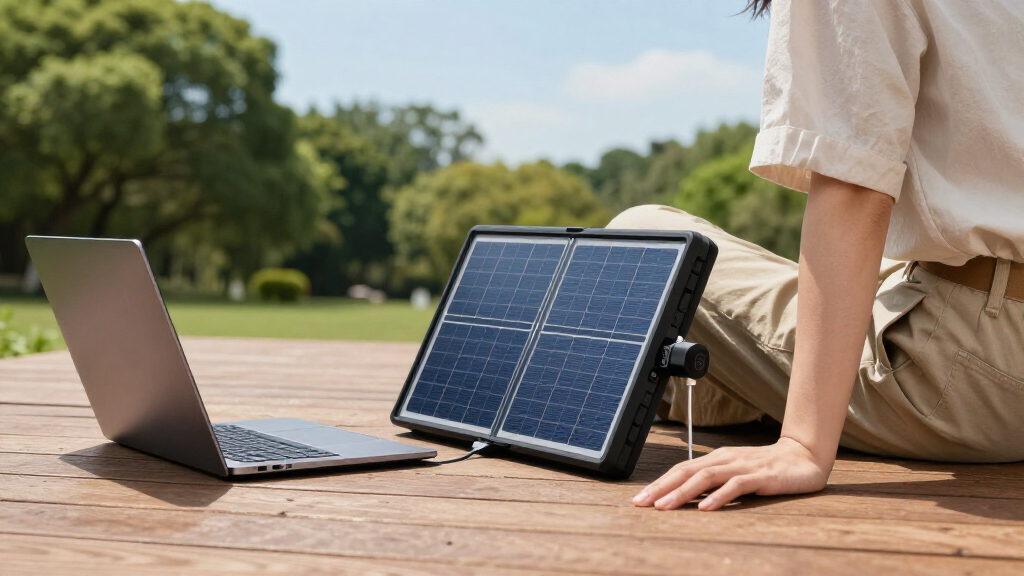
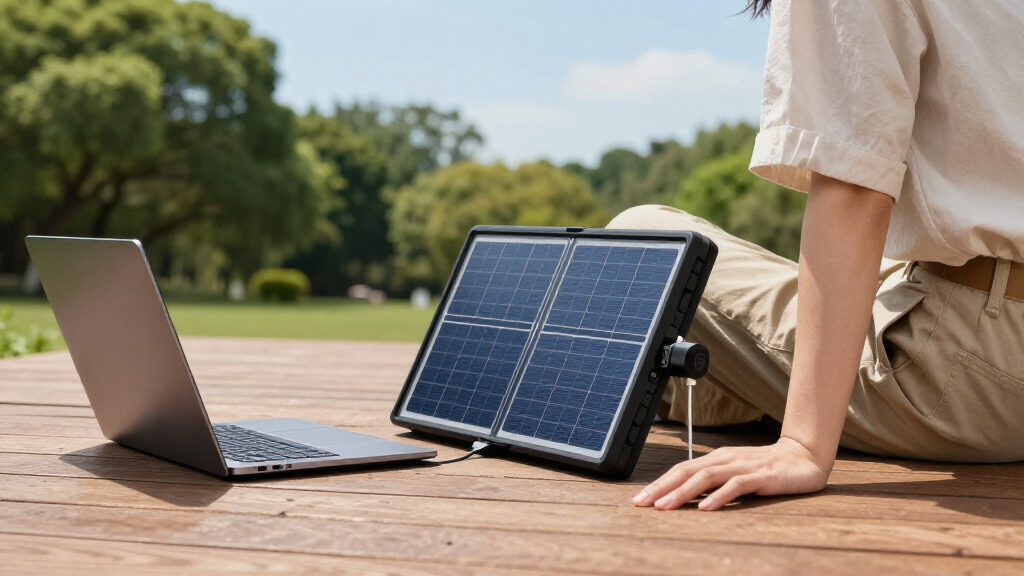
Portable Solar Power Bank with AC Outlet 65W, 24000mAh, Includes 30W Foldable Solar Panel
Most picks here make you buy the panel separately; this one ships with a 30W foldable panel, making it the only true out-of-the-box solar laptop setup in the group. The 65W AC outlet is sized almost perfectly for an ultrabook charger — no wasted overhead, no adapter gymnastics — and a built-in BMS guards against the usual charging faults. The 24000mAh battery holds roughly one full laptop charge plus phone top-ups, about half what the 146Wh stations store, so this reads as a day-hike and patio-work tool rather than an outage plan. Two annoyances stand out: the AC outlet must be manually switched on before it delivers power, and the panel’s junction box isn’t waterproof, so a surprise shower ends your harvest. Lighter and cheaper than the BLAVOR, but far more limited.
Pros:- 30W foldable solar panel included in the box
- 65W AC outlet matches typical ultrabook chargers
- Slim power bank plus flat-fold panel packs easily
- Built-in BMS for overcharge and short-circuit protection
Cons:- 24000mAh equals roughly one laptop charge
- Panel junction box is not waterproof
- AC outlet requires manual on/off switching
Best for: Day-trippers and outdoor freelancers with an ultrabook who want panel and battery in one purchase
Not ideal for: Multi-day off-grid users — one laptop charge of capacity won’t stretch across a long weekend
- Battery Capacity:24,000mAh
- AC Output:65W
- Solar Panel:30W foldable (included)
- DC Output:9V–12.6V / 10A max
- USB Output:5V/2.4A and 5V/3A, 9V/2A
- Power Bank Size:6.89 x 3.98 x 1.89 inches
- Panel Size:12.7 x 8.4 x 0.3 inches
- Protection:Built-in BMS
Our verdict“The smartest buy if you want a matched panel-and-battery kit for one ultrabook and accept its single-charge capacity.”
YELOMIN 10000mAh Solar Power Bank with Foldable Solar Panels, Wireless Charging, and Built-in Cables
Honesty first: with no AC outlet and 15W max wireless, this is a laptop charger only in the loosest sense — a USB-C laptop might sip a slow trickle through the built-in cable, but that’s emergency behavior, not a workflow. What the YELOMIN does well is pocketable resilience: four fold-out panels, integrated USB-C and Lightning cables, and a 10,000mAh cell wrapped in a shell with sealed ports and reinforced bumpers. For phones, earbuds, and a headlamp on a weekend trail, nothing else here is this self-contained — even the slim 65W kit looks fussy by comparison. But set against either 146Wh station, it’s a different category entirely. Buy it as a phone-first backup that can babysit a laptop in a pinch, never the reverse.
Pros:- Four foldable solar panels recharge the bank in sunlight
- Built-in USB-C and Lightning cables mean nothing to forget
- 15W wireless charging for cable-free phone top-ups
- Rugged shell with sealed ports and reinforced bumpers
Cons:- No AC outlet — laptop charging is slow USB-C trickle only
- 10,000mAh is the smallest capacity in this roundup
- Fold-out panels add bulk despite the compact pitch
Best for: Hikers and festival-goers who carry a phone, earbuds, and a USB-C laptop they only need to rescue occasionally
Not ideal for: Anyone whose laptop is the primary device to charge — the 65W solar kit or a 146Wh station serves that need far better
- Battery Capacity:10,000mAh
- Solar Panels:4 foldable panels
- Wireless Charging:15W
- Built-in Cables:USB-C and Lightning
- Ports:3
- Flashlight:3-mode with SOS
- Battery Type:Lithium Ion
- Durability:Sealed ports, reinforced bumpers
Our verdict“A tough, cable-free phone bank that can limp a laptop along in emergencies — pick it for portability, not for laptop-first charging.”
DARAN Portable Power Station 89.6Wh LiFePO4
This option stands out for genuine portability: at 2.54 pounds and roughly the size of a hardback book, it disappears into a daypack in a way the 23.8-pound Jackery Explorer 1000 v2 never will. The 100W AC output (200W peak) handles most ultrabooks and Chromebooks, and the 89.6Wh capacity translates to about one full laptop charge — enough for a day of café-hopping or a short camping trip, not a week off-grid. I also rate the LiFePO4 chemistry with 3500+ cycles, which outlasts the batteries in cheaper 146Wh stations in this roundup. The tradeoffs are real: power-hungry machines like a 16-inch MacBook Pro exceed its ceiling, you’ll need to buy a solar panel separately, and the first full charge/discharge cycle is required before it performs at spec. Compared with similar options, it’s the lightest route to true AC laptop charging.
Pros:- Lightest AC-capable option in the lineup at 2.54 pounds
- LiFePO4 battery rated for 3500+ cycles outlasts budget lithium-ion rivals
- Fast 0-80% recharge in 1.5 hours keeps downtime short
- Seven output ports, including two AC sockets, cover a full mobile kit
Cons:- 100W output ceiling rules out gaming laptops and large MacBook Pros
- 89.6Wh capacity yields roughly one laptop charge before it needs refilling
- Solar panel sold separately, adding cost for true off-grid use
Best for: Minimalists and day-trippers who need to top up a lightweight laptop or Chromebook and value pack weight over raw capacity
Not ideal for: Anyone running a high-wattage workstation laptop (over 100W) or needing multiple days of off-grid power — the Jackery suits that job far better
- Capacity:89.6Wh
- Battery Type:LiFePO4
- Output Power:100W (200W peak)
- Weight:2.54 lbs
- Dimensions:6.5 × 3.3 × 4 in
- Ports:2 AC, 2 USB-C, 2 USB-A, DC5521
- Charging Methods:AC wall, USB-C PD, car, solar (panel not included)
- Cycle Life:3500+ cycles
Our verdict“Buy this if you want the smallest, lightest way to charge a modest laptop away from an outlet and can live with a one-charge capacity.”
Jackery Explorer 1000 v2 Portable Power Station
For laptop charging, this is overkill in the best way. The 1070Wh capacity refills a typical laptop battery eight to ten times, and the 1500W pure sine wave AC output means even a 140W MacBook Pro charger runs with headroom to spare — something the 100W DARAN can’t claim. What earns it the top spot over the smaller power stations in this roundup is the combination of a one-hour full recharge, a LiFePO4 battery rated beyond ten years, and enough ports to run a whole family of devices at once. The honest drawbacks: at 23.8 pounds it’s a car-camping unit, not a backpack one; solar panels cost extra; and Jackery locks solar input to its own panels, limiting bargain shopping. The fastest charging mode also requires the companion app. If your goal is serious multi-day off-grid work rather than an emergency top-up, this pick makes the most sense.
Pros:- 1070Wh capacity charges a laptop eight to ten times per cycle
- 1500W output (3000W surge) handles any laptop charger plus appliances
- One-hour fast recharge and 10-year-plus LiFePO4 lifespan
- Three pure sine wave AC outlets plus dual USB-C for a full workstation
Cons:- 23.8-pound weight limits it to vehicle-based travel
- Solar charging works only with Jackery’s own panels, sold separately
- Fastest charge mode requires using the app
Best for: Remote workers, RV owners, and emergency-preparedness buyers who need to run a laptop for days and occasionally power small appliances too
Not ideal for: Hikers and carry-on travelers — 23.8 pounds is car-camping weight, and the DARAN or the power banks here cover light duty for far less money
- Capacity:1070Wh
- AC Output:1500W (3000W surge)
- Battery Type:LiFePO4, 10+ year lifespan
- Weight:23.8 lbs
- Wall Charging Time:1 hour (fast charge)
- AC Outlets:3 pure sine wave
- USB Ports:2 USB-C, 1 USB-A
- Extras:DC car port, app control
Our verdict“The right choice if you want one unit that powers a laptop-heavy off-grid setup for days without babysitting the battery.”
FEELLE Solar Power Bank 50000mAh with Hand Crank
Between the two big solar power banks in this roundup, I’d put this one in a go-bag and the SoaraiSe in a daypack. The difference is the hand crank: when the sun won’t cooperate and the battery is dead, manual generation — slow as it is — beats nothing, which is exactly what the SoaraiSe offers in that scenario. The shockproof, dustproof, and waterproof shell reinforces the emergency role, and the flashlight’s SOS and strobe modes are built for blackouts, not desk duty. For laptops, expectations need calibrating: there’s no AC outlet, so charging runs through USB, which suits USB-C ultrabooks at modest speeds but won’t drive a hungry workstation. Wireless charging hits 15W but weakens through thicker cases, and the four solar panels are a trickle source, not a fast refill. Against the FEELLE’s own marketing, treat solar and crank as last-resort layers, not the primary plan.
Pros:- Hand crank provides a last-resort charge when solar and outlets fail
- Rugged shockproof, dustproof, waterproof build survives rough handling
- 50000mAh capacity plus four built-in cables covers every device type
- 15W magnetic wireless charging and multi-mode flashlight add utility
Cons:- No AC outlet, so laptop charging is limited to modest USB-C speeds
- Hand crank and solar panels are slow trickle sources, not real refills
- Wireless charging struggles through thicker phone cases
Best for: Emergency-kit builders and campers who want a rugged, self-sufficient backup for phones, tablets, and a USB-C laptop in a pinch
Not ideal for: Buyers who need fast, reliable laptop charging off-grid — the lack of an AC outlet makes the Jackery or DARAN far better suited
- Capacity:50000mAh
- Solar Panels:4 fold-out panels
- Hand Crank:Yes
- Wireless Charging:15W max, magnetic
- Built-in Cables:USB-C, phone cable, Micro, USB-A
- Ports:USB-C in/out, USB-A out, Micro-USB in
- Durability:Shockproof, dustproof, waterproof
- Flashlight:Steady, SOS, strobe
Our verdict“The one to stash in an emergency kit if staying reachable through a blackout matters more than charging a laptop quickly.”
SoaraiSe Solar Power Bank 48000mAh Wireless Charger
This model is better suited to keeping a whole family’s gadgets alive than to serious laptop duty. Like the FEELLE, it skips the AC outlet entirely, so laptops charge only through USB — but its 3A USB-C port pushes faster wired speeds to phones and tablets than the FEELLE advertises, and four built-in cables plus wireless charging mean five devices can top up without anyone hunting for a cord. The four fold-out solar panels collect more sun than the single-panel designs common in cheaper power banks, though solar here remains a supplement: plan on wall-charging before a trip and letting the panels stretch runtime outdoors. Where it loses to its closest rival: no hand crank for true emergency generation, no stated rugged or waterproof rating, and the high capacity plus panels make it bulkier than a standard power bank. Compared with the DARAN, it trades AC flexibility for cable-free convenience at a lower price.
Pros:- Four built-in cables plus wireless charging handle five devices at once
- 3A USB-C port fast-charges phones and tablets quicker than typical rivals
- Four solar panels gather more sunlight than single-panel power banks
- 48000mAh capacity stretches across a long weekend for a group
Cons:- No AC outlet, so laptops charge only at USB speeds
- Bulkier and heavier than plain power banks due to panels and capacity
- No hand crank or stated waterproofing for true emergency use
Best for: Families and group travelers who juggle phones, tablets, earbuds, and an occasional USB-C laptop top-up on camping trips
Not ideal for: Solo laptop-first users — without an AC outlet or rugged rating, the DARAN charges laptops properly and the FEELLE survives rougher conditions
- Capacity:48000mAh
- Solar Panels:4 fold-out panels
- USB-C Port:Input/output, 3A fast charging
- USB-A Ports:2
- Built-in Cables:4 cables included
- Wireless Charging:Yes
- Primary Use:Camping and outdoor travel
Our verdict“Pick this if your real problem is keeping many small devices charged on group trips, with laptop charging as an occasional bonus.”
How We Picked
I evaluated every option through one lens: can it actually keep a laptop running, and for how long? That meant weighing four criteria in order. First, usable output — AC outlet wattage or USB-C Power Delivery rating — because a charger that can’t hit 65W won’t charge most laptops at full speed, and several banks in this lineup top out at phone-level output. Second, battery capacity in watt-hours, translated into real laptop charges (a typical ultrabook battery is 50-70Wh, so a 146Wh station yields roughly two charges after conversion losses). Third, solar realism: the panel’s wattage, whether it’s included or sold separately, and whether the unit can charge from the sun while simultaneously powering your laptop.
Fourth, I factored in portability and build — weight, form factor, and battery chemistry, since LiFePO4 cells survive several times more charge cycles than standard lithium-ion. The ranking reflects these priorities: full-size stations lead because they’re the only options that deliver genuine multi-day laptop power, mid-size power stations and panel-bundled banks rank next for balancing cost and capability, and the small solar power banks sit lower because their solar panels are emergency trickle sources rather than real laptop chargers. Where two products looked nearly identical on paper, the tiebreaker was value — what you actually get in the box per dollar.
| solar-powered laptop charger | Battery Type |
|---|---|
| Portable Power Station 146Wh 1 | Lithium Ion |
| BLAVOR Portable Power Station | LiFePO4 |
| Portable Power Station 146Wh 1 | Lithium Ion |
| Portable Solar Power Bank with | — |
| YELOMIN 10000mAh Solar Power B | Lithium Ion |
| DARAN Portable Power Station 8 | LiFePO4 |
| Jackery Explorer 1000 v2 Porta | LiFePO4, 10+ year lifespan |
| FEELLE Solar Power Bank 50000m | — |
| SoaraiSe Solar Power Bank 4800 | — |
Factors to Consider When Choosing Solar-powered Laptop Chargers
The product reviews above tell you what each option does. This section covers the knowledge you need before spending anything: the math behind laptop runtimes, why most built-in solar panels are marketing rather than engineering, and the mistakes that leave buyers with expensive paperweights. Read this before you decide which tier of charger fits your use case.
Match the Output Wattage to Your Laptop First
Capacity gets all the marketing attention, but output wattage is the spec that decides compatibility. A MacBook Air or most ultrabooks need 45-65W over USB-C Power Delivery; performance laptops like a MacBook Pro 16 or gaming machine can draw 96-140W and will either charge slowly or refuse to charge at all on a weaker source. An AC outlet sidesteps this because you use your laptop’s own wall adapter — which is why the 100W AC outlets on the 146Wh stations work for standard laptops but choke on anything hungrier. Check your laptop’s adapter rating before you shop, and buy at least 20% more output than that number. The common mistake here is buying a huge battery with weak output: a 50,000mAh bank capped at 15W will charge a MacBook Air slower than the battery drains under load. Output first, capacity second — get that order right and half the lineup eliminates itself.
Do the Watt-Hour Math Before Trusting Capacity Claims
Milliamp-hours are nearly useless for comparing laptop chargers because they’re measured at the cell’s internal voltage, not the voltage your laptop receives. Watt-hours are the only honest currency: divide the unit’s Wh rating by your laptop battery’s Wh rating, then multiply by about 0.8 to account for conversion losses. A 146Wh station gives a 60Wh laptop roughly two charges; the 89.6Wh DARAN manages barely over one; the 1,070Wh Jackery delivers around fourteen. Phone-style banks advertise numbers like 48,000-50,000mAh, which sounds massive but converts to roughly 178-185Wh — and much of that never reaches a laptop through low-wattage ports. Plan for your actual session length: one workday off-grid needs about 150-200Wh minimum, a weekend needs 400Wh-plus, and a week of remote work is firmly in power-station territory. Buyers who skip this math are the ones leaving reviews that say “only charged my laptop once.”
Treat Built-In Solar Panels as Emergency Backup, Not Fuel
Here’s the uncomfortable truth about small solar chargers: the panels sewn onto power banks produce 1-5W in good sun, meaning a full recharge takes three to five days of ideal exposure — not hours, days. They exist to top up a phone in an emergency, and products like the FEELLE even add a hand crank for the same reason. Real solar charging requires a separate foldable panel rated 30W or higher, ideally 60-100W for a power station. That’s what makes a bundled panel genuinely valuable — the 65W bank with its included 30W folder can meaningfully refill in a day of sun, while an identical bank sold without a panel cannot. For the big stations, check the maximum solar input rating: a 1,000Wh unit paired with a single 100W panel needs ten-plus hours of direct sun to refill, so plan on two panels or accept partial recovery. Position matters more than specs, too — a panel lying flat on the ground harvests a fraction of its rated output compared with one angled toward the sun.
LiFePO4 Chemistry Is Worth Paying For If You’ll Use It Weekly
Two battery chemistries appear across this lineup, and the difference compounds over years. Standard lithium-ion cells are typically rated for 500-800 charge cycles before capacity drops below 80%, which is fine for a charger you deploy a few weekends per year. LiFePO4 cells, found in the Jackery and DARAN units, run 3,000-4,000 cycles — a decade of weekly use — and they’re chemically more stable in hot cars and direct sun, which is exactly where solar gear lives. The tradeoff is weight and price: LiFePO4 packs are heavier per watt-hour and cost more upfront. If you’re buying an emergency charger that sits in a closet, cheap lithium-ion is the rational choice. If you’re a van-lifer, frequent camper, or remote worker who cycles the battery constantly, the per-cycle cost of LiFePO4 is dramatically lower even at a higher sticker price. Match the chemistry to your usage frequency, not your budget alone.
Portability Has Hard Cutoffs — Know Which Camp You’re In
Weight in this category doesn’t scale gradually; it jumps in steps that change how you travel. Under two pounds, you get the phone-style banks — jacket-pocketable, airline-friendly, but laptop-anemic. Around two to four pounds sit the 89-146Wh mini stations: one-hand carry, fine in a carry-on, and capable of one or two laptop charges. At 25 pounds and up you’re in 1,000Wh territory — car camping and RV gear that you will not carry far from the vehicle. Air travel draws a hard legal line at 100Wh for carry-on batteries (160Wh with airline approval), so the Jackery and BLAVOR stations are road-trip-only, while the DARAN’s 89.6Wh was clearly designed to slip under that limit. The mistake to avoid is buying mid-range: a 300-500Wh unit is too heavy to hike with yet too small for a real off-grid week. Decide whether your charger lives in a bag or in a vehicle, then buy at the top of that camp’s capacity rather than straddling the two.
Common Mistakes That Waste Money in This Category
Four errors account for most buyer regret with solar laptop chargers. First, buying mAh instead of Wh — covered above, but worth repeating because the biggest numbers on the box are the most misleading. Second, assuming the pictured solar panel is included; many listings show panels that cost extra, and a station without panels is just a battery. Third, ignoring pass-through charging: if the unit can’t charge itself from solar while simultaneously powering your laptop, a sunny afternoon forces you to choose between refilling the battery and working. Fourth, overpaying for phone features on a laptop purchase — wireless charging pads, built-in cables, and LED lanterns add cost and failure points while contributing nothing to laptop duty. The disciplined approach: set your output floor from your laptop’s adapter, set your Wh floor from your trip length, confirm the panel situation, and only then let extras break the tie. Every dollar spent outside those three criteria is a dollar that doesn’t extend your runtime.
Frequently Asked Questions
Can a solar power bank charge a laptop directly from sunlight?
Practically speaking, no — and this is the biggest misconception in the category. The fold-out panels built into banks like the YELOMIN, FEELLE, and SoaraiSe generate roughly 1-5W in direct sun, while a charging laptop draws 45-100W. The physics simply don’t close that gap, so those panels serve as emergency trickle sources for the internal battery, not live laptop power. The workable setups in this lineup all follow the same pattern: a battery sized for your laptop, refilled by a separate panel rated 30W or more — either bundled, as with the 65W power bank’s 30W folder, or added to a power station. Even then, you’re charging the battery during the day and running the laptop off stored power, not off the panel in real time. If a listing implies otherwise, treat it as marketing rather than physics.
How many watt-hours do I need to work a full day off-grid?
Work backward from your laptop’s battery, not from the product listing. A typical ultrabook carries a 50-70Wh battery and runs six to ten hours on it, so one full workday of off-grid use requires roughly 100-150Wh once you add conversion losses of 15-20%. That puts the 146Wh mini stations at the floor for a single day with no margin, and the 89.6Wh DARAN slightly below it — fine for a long afternoon, short of a full day. A comfortable weekend needs 300-400Wh, and anything beyond that pushes you into the 1,000Wh class, which is why the Jackery and BLAVOR top this roundup despite their weight. Add a 25-30% buffer on top of your math for cloudy solar days, cold weather, and battery aging. Buyers who size exactly to their estimate almost always end up rationing power on day two.
Are solar-powered laptop chargers allowed on airplanes?
It depends entirely on the battery’s watt-hour rating, and the line falls right through the middle of this lineup. Aviation rules limit carry-on lithium batteries to 100Wh without restriction, or up to 160Wh with airline approval, and they must go in the cabin, never in checked luggage. That clears the 89.6Wh DARAN, all the phone-style banks, and most 146Wh units (the latter needing airline approval since they exceed 100Wh). The 1,000Wh power stations — Jackery and BLAVOR — cannot fly at all; they’re strictly road, trail, and home-backup gear. If your work travel involves flights, that ceiling should drive your decision more than any other spec: a sub-100Wh LiFePO4 unit paired with a compact foldable panel is the strongest legal combination. Always verify the Wh rating printed on the unit itself, since gate agents check the label, not your receipt.
Is LiFePO4 worth the extra cost for a laptop charger?
For frequent use, yes — for occasional emergency backup, no. LiFePO4 cells are rated for roughly 3,000-4,000 charge cycles versus 500-800 for standard lithium-ion, so a unit you cycle three times a week lasts a decade instead of two years. They’re also far more heat-tolerant, which matters because solar gear spends its life in hot cars and direct sunlight where lithium-ion degrades fastest. The premium shows up as both a higher price and more weight per watt-hour, which is why the LiFePO4 options here — the Jackery station and the compact DARAN — target buyers with repeated, heavy use patterns. If your charger will live in a closet and see action a few times a year, a cheaper lithium-ion bank is the smarter spend, since calendar aging will retire it long before cycle count does. Match the chemistry to your usage frequency and the price gap usually resolves itself.
Should I buy a power station or a solar power bank for my laptop?
The deciding factor is how many consecutive hours of laptop work you need, not the setting. Choose a power bank (under 200Wh) if you need one emergency recharge, you travel by air, or you carry everything on your back — the 65W bank with the bundled 30W panel is the strongest expression of this tier. Choose a power station (1,000Wh-plus) if you need multiple workdays, run anything beyond the laptop itself, or your off-grid time is vehicle-based — camping from a car, RV travel, or home backup during outages, which is exactly what the Jackery and BLAVOR are built for. The trap is the middle: buyers who pick a small station expecting multi-day power, or a big station imagining portability. Be honest about your longest realistic session without wall power, then buy the tier that covers it with margin — the two categories solve different problems and aren’t substitutes for each other.
Conclusion
All nine chargers earn their spot for a different buyer, so the right pick comes down to your use pattern. For most people, the Jackery Explorer 1000 v2 is the best overall choice — its 1,070Wh LiFePO4 battery, 1,500W output, and fast charging cover everything from a MacBook Air to a dual-screen camp office for days at a time. The best value pick is the 65W solar power bank with the included 30W foldable panel, because it’s the only budget option that ships as a complete solar kit rather than a battery that demands accessories. Best for beginners is the 146Wh mini station with AC outlet: cheap, simple, and forgiving, with enough capacity to learn your real power needs before upgrading. The best premium option is the BLAVOR 1600W station, whose built-in panel and high output suit buyers who want maximum solar independence in one box. For frequent flyers, the 89.6Wh DARAN is the specific-needs winner — the only LiFePO4 option that clears airline limits. And if your laptop time is genuinely rare, the FEELLE or SoaraiSe banks will back up your phone and tide your laptop over in a pinch for the least money. Decide your longest stretch away from an outlet, and the ranking above makes the choice for you.