
TL;DR
SMT Energy’s 160 MW/320 MWh Houston IV battery began participating in the ERCOT market on July 13, six weeks after energization, according to controls provider FlexGen. FlexGen says lab testing, automated field checks and early coordination helped shorten commissioning; project earnings and the full test results were not disclosed.
SMT Energy’s 160 MW/320 MWh Houston IV battery began participating in the Electric Reliability Council of Texas (ERCOT) market on July 13, six weeks after energization, according to FlexGen, which supplied the site’s energy management software and led commissioning. The timeline was substantially shorter than FlexGen’s estimate of 25 weeks or more for the full commissioning process, a result the company attributes to advance lab testing, scripted field checks and coordination before construction was complete.

Get backup power and energy gear delivered free with Prime
- Fast, free delivery on millions of items
- Prime Video, Amazon Music and more included
- Member-only deals all year
The battery was energized on June 1. FlexGen says its commissioning measure runs from mechanical completion to the owner’s first day of market participation, covering cold, warm and hot commissioning with equipment suppliers and then grid qualification with ERCOT. The company’s reported six-week timeline is for this broader process, not just checks performed by field crews.
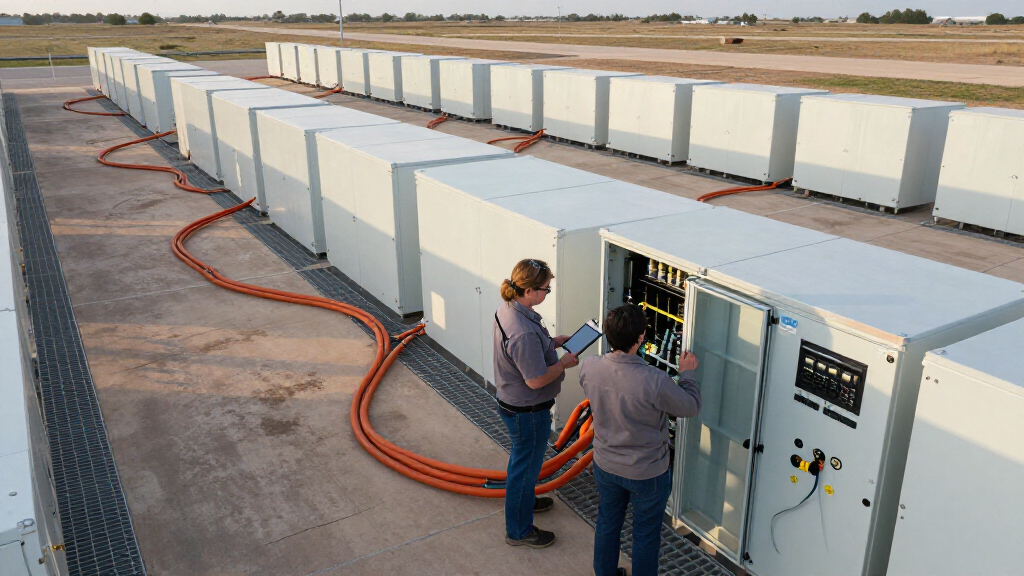
Houston IV uses 74 Trina Storage Elementa 2 units with lithium iron phosphate cells and 37 Sungrow SC5000-UD-MV-US-P3 power converters. Irby Construction Co., a Quanta Services subsidiary, served as engineering, procurement and construction contractor. FlexGen executive Jason Rislov said field commissioning typically takes about 12 weeks, while the 25-week-or-longer figure reflects industry averages and FlexGen’s own project history.
FlexGen prepared digital twins and mapped the system’s Modbus communications while equipment was in transit, then tested controls against an emulator at its Durham, North Carolina, lab. In the field, the company used automated scripts for point-to-point and telemetry checks. Rislov said ERCOT qualification, which can involve weeks of back-and-forth, took a few days for Houston IV. FlexGen also said its remote operations center continued commissioning support after field crews left each day.
What Six-Week Commissioning Could Change
The timeline speaks to a practical challenge for battery developers and grid operators: getting storage equipment from construction completion through technical checks and market approval quickly enough to be available when needed. Faster commissioning can bring a project into the market earlier, though the Houston IV schedule alone does not establish that other projects can match it or that the approach will produce the same result under different site and grid conditions.
Houston IV entered the market during a period of relatively low ERCOT battery revenues. Modo Energy’s benchmarks put average battery revenue at $1.67 per kilowatt per month in May, a record-low $1.11/kW per month in June, and $1.42/kW per month in July. Those market-wide figures provide timing context, not Houston IV’s earnings. Rislov said FlexGen is not SMT’s qualified scheduling entity and does not have visibility into the project’s revenue.
The case also bears on grid capacity and demand. Rislov identified getting systems online quickly and reliably as a key bottleneck. Commissioning speed may help address delays between construction and market participation, but it does not by itself resolve the wider constraints involved in expanding storage or meeting Texas demand growth.
Products Worth Considering

Ring Alarm 8-Piece Home Security System Kit

Levoit Core 600S-P Smart Air Purifier for Large Rooms

Levoit Core 400S-P Smart Air Purifier for Large Rooms
As an affiliate, we earn on qualifying purchases.
How FlexGen Prepared Before Site Work
FlexGen describes Houston IV as its fastest commissioning with SMT Energy and says it was its 14th or 15th project with the company. Rislov said FlexGen’s 25-week benchmark draws on the company’s historical projects, including earlier work with SMT. The comparison is FlexGen’s own industry and project estimate; the source does not provide a project-by-project dataset for independently comparing commissioning schedules.
The software provider said the work drew on its HybridOS energy management platform and experience across more than 25 GWh of projects and more than 70 equipment configurations. Rislov said FlexGen began working alongside Irby before mechanical completion, with SMT’s permission. He described that early start as something project owners do not always allow.
FlexGen said the process involved more testing rather than less. The company’s method moves some troubleshooting from the live site to a controlled lab environment and automates repeatable field checks. Rislov said the firm had achieved a similar approach on a project in the Midcontinent Independent System Operator market, but did not identify that owner.
““The biggest bottleneck is still just getting systems online fast and reliably.””
— Jason Rislov, FlexGen senior vice president of operations
Project Earnings and Test Data
FlexGen and SMT did not provide Houston IV’s revenue, operating performance or detailed commissioning records in the cited report. FlexGen said it is not the project’s qualified scheduling entity and has no visibility into its earnings. The reported ERCOT revenue figures are market-wide monthly averages and should not be read as Houston IV’s results.
The source also does not publish the full test plan, detailed pass/fail data or an independent comparison with other projects. FlexGen’s explanation of why the schedule was shorter, and its assessment that testing increased, are attributed to the company. It remains unclear whether the six-week schedule can be replicated across projects with different equipment, contractors, sites or grid-qualification requirements.
Further Evidence From Later Projects
No additional Houston IV commissioning milestone or project-specific earnings disclosure was announced in the report. The next evidence of whether the approach is repeatable will come from future projects and from any published operating or market-performance data for the battery.
FlexGen has also said its acquisition of Powin intellectual property, software and spare parts inventory broadened the equipment data feeding HybridOS. After naming former chief technology officer Hugh Scott as chief operating officer on September 17, the company said it intended to bring field lessons into software development earlier. The report does not specify a timeline or measurable targets for those changes.
Key Questions
When did Houston IV begin participating in the ERCOT market?
FlexGen says the 160 MW/320 MWh battery began market participation on July 13, 2026, six weeks after it was energized on June 1.
What equipment does the project use?
The project has 74 Trina Storage Elementa 2 units using lithium iron phosphate cells and 37 Sungrow SC5000-UD-MV-US-P3 power converters. Irby Construction Co. was the engineering, procurement and construction contractor.
How did FlexGen say it shortened commissioning?
FlexGen said it built digital twins and mapped communications before equipment arrived, tested controls in a lab emulator, and used automated scripts for field checks. It also credited SMT’s permission to start work before mechanical completion.
Does the six-week schedule show how much the battery earned?
No. FlexGen said it is not SMT’s qualified scheduling entity and cannot see the project’s earnings. The cited monthly revenue figures are averages for ERCOT batteries as a whole, not Houston IV.
Source: rss