
TL;DR

Get backup power and energy gear delivered free with Prime
- Fast, free delivery on millions of items
- Prime Video, Amazon Music and more included
- Member-only deals all year
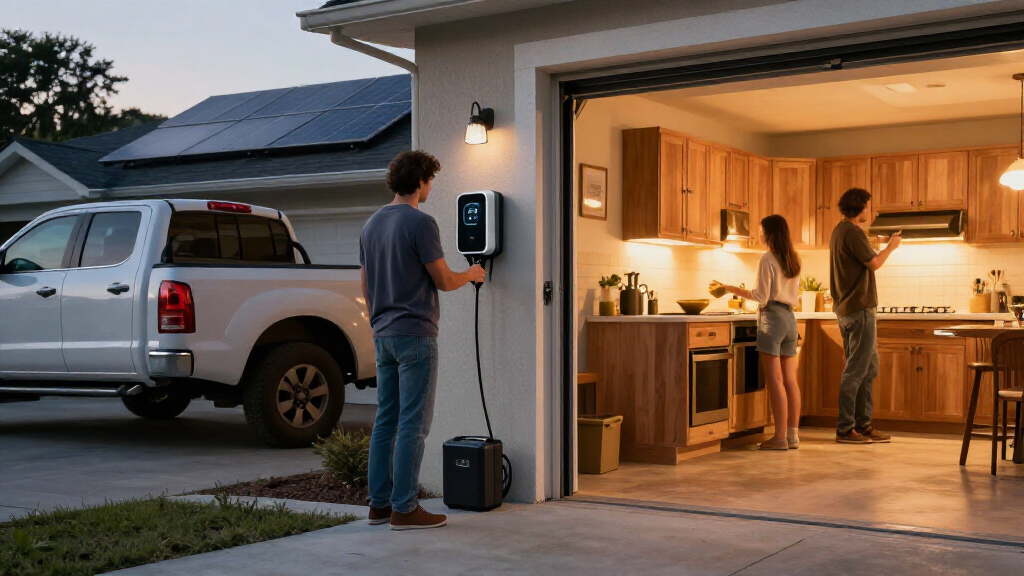
Ford says its upcoming Fathom electric pickup will use an onboard inverter for bidirectional AC power, allowing home backup with less expensive equipment than the company’s current system. Ford has not set the equipment’s final price, and access will depend in part on local utility rules and installation costs.
Ford says its upcoming Fathom electric pickup, which is expected to start below $30,000, will be able to supply power to a home using a lower-cost bidirectional system than the company’s current setup for the F-150 Lightning. The truck’s onboard inverter will convert battery power into household-ready AC, reducing the need for a costly external power-conversion unit.
Ford has not announced a final price for the home-power equipment compatible with the Fathom. It said the new AC-capable bidirectional charger will cost about half the $1,300 price of its Charge Station Pro, the bidirectional system developed for the F-150 Lightning. For outage backup, customers will also need a home backup power panel. Ford says the charger and panel together will cost 60% less than the $5,200 Charge Station Pro and home integration system combination. Those figures exclude installation.
The Fathom’s approach places an inverter in the vehicle, where it converts the battery’s direct-current electricity into alternating current suitable for household use. Most U.S. electric vehicles do not have that capability built in and instead rely on separate equipment to convert power. Canary Media reported that such systems currently cost from just under $7,000 to more than $10,000; Ford’s quoted comparison is with its own equipment, not a promise that every household’s total project cost will fall by the same amount.
Ford said the Fathom’s system can support home energy management while the grid is operating and, with a backup panel, provide power during an outage. The company developed the onboard technology with engineers from Auto Motive Power, which Ford acquired in 2023. Ford also said other vehicles based on its Universal EV Platform will have AC bidirectional capability, though the source did not identify models or release dates.
Lower Equipment Costs for Home Backup
Bidirectional charging can make an EV battery useful beyond driving, potentially letting owners draw on stored vehicle power at home. The expense of dedicated charging and home integration equipment has been one barrier to using an EV for backup. Ford’s stated price reductions could lower that barrier for Fathom buyers, particularly compared with its existing Lightning setup.
The savings are not a complete estimate of what a homeowner will pay. Installation is excluded, the final equipment price is unsettled, and customers need a compatible backup panel for outage protection. The technology’s practical reach also depends on whether local utilities allow the equipment to connect under clear, workable rules.
Products Worth Considering

Ring Battery Doorbell and Chime (3rd Gen), Satin Nickel

Ring Battery Doorbell (2nd Gen), Indoor Cam Plus, and Chime (3rd Gen) Bundle

Bose SoundLink Flex Bluetooth Speaker (2nd Gen), Portable Waterproof Speaker, Black
As an affiliate, we earn on qualifying purchases.
Ford’s AC Bidirectional Approach
Many vehicle-to-home systems use offboard equipment to convert a vehicle’s DC battery output into AC for a home. Ford’s Fathom instead integrates power conversion into the vehicle. Jiaqi Liang, Ford’s senior director of electrical hardware for Advanced Programs and formerly an Auto Motive Power executive, told Canary Media that developing the capability from the ground up on the Universal EV Platform avoided constraints associated with older vehicle designs.
Ford’s system uses communications technology based on SAE J3068, a standard certified by SAE International, to help the vehicle and home equipment communicate about safe power delivery. The source also identifies regulatory differences as a hurdle: California and Maryland have set utility regulations for AC bidirectional charging outside pilot projects, while rules elsewhere vary. Ford said it is working with utilities on shared interconnection standards.
Final Prices and Utility Access
Ford has not finalized the Fathom equipment price, and the source gives no installation estimate or total household cost. It is also not clear when the truck or compatible home-power equipment will go on sale, which markets will have access at launch, or what specific outage duration or household loads the system will support.
Utility rules remain a separate constraint. Ford said it has been engaging with regulators and utilities, but common standards have not yet been established nationwide. The company’s projected equipment savings do not by themselves confirm that every customer can connect a system or use it during an outage under local requirements.
Utility Standards and Product Details
Ford said it has been working since July with American Electric Power, BC Hydro, Consumers Energy, Exelon and Pacific Gas & Electric on common standards for integrating its AC vehicle-to-home system with utility interconnection rules. It also said it has engaged utilities and regulators in states including Michigan and Colorado. The source does not give a timetable for those discussions or a date for final rules.
The next details to watch are Ford’s final equipment pricing, installation requirements, Fathom availability and the utility conditions customers will face in their region. Ford has said the Universal EV Platform will support the capability in additional vehicles, but has not named those models or provided launch timing.
Key Questions
How will the Ford Fathom power a home?
The truck will have an onboard inverter that converts its battery’s direct-current power into alternating current for household use. A compatible charger and, for outage backup, a home backup power panel are also required.
How much will the Fathom home-backup system cost?
Ford has not set the final price. It says the AC-capable bidirectional charger will cost about half the $1,300 price of its Charge Station Pro, and the charger-plus-panel combination will cost 60% less than its $5,200 Lightning system comparison. Installation is not included.
Can the Fathom provide backup during a power outage?
Ford says the system can provide home backup when paired with a home backup power panel. The source does not specify how long it can power a home or which household loads it can support.
Will other Ford EVs have this capability?
Ford says other vehicles based on its Universal EV Platform will also have AC bidirectional charging. It has not named those vehicles or provided release dates.
Will the system work everywhere in the United States?
Not necessarily. Utility interconnection requirements vary, and Ford says it is working with utilities and regulators on common standards. Local rules may affect whether and how customers can connect the system.
Source: canarymedia.com