TL;DR
A solar-powered generator for outdoor cooking is a portable power station paired with solar panels, and it can run electric cookers when its inverter handles their wattage and its battery holds enough usable energy. Estimate appliance watts times cooking hours, allow extra capacity for losses, and treat panel ratings as best-case output. For a reliable trip, charge the station before you leave and plan meals around the battery you have.
Check continuous and surge wattage before plugging in an electric cooker.
A 1,500-watt appliance running for 20 minutes uses about 500 Wh before losses; leave extra battery capacity.
Panel ratings describe test conditions, so plan for clouds, shade, season, angle, and temperature.
Charge the station before travel and keep a lower-wattage or no-power meal as backup.
Keep cooking equipment stable, dry, ventilated, and away from tent fabric; use a licensed electrician for home wiring.

Get backup power and energy gear delivered free with Prime
- Fast, free delivery on millions of items
- Prime Video, Amazon Music and more included
- Member-only deals all year
Know what a solar-powered generator can actually run
A solar-powered generator for outdoor cooking can run an electric appliance when its inverter supplies enough watts and its battery stores enough energy for the job. The appliance’s running power determines whether it can operate; the battery capacity determines how long you can use it. Those are separate limits, and you need to check both. A small induction cooktop may draw around 1,000–2,000 watts while heating. A station with a 1,000-watt continuous AC output cannot run a 1,500-watt cooktop, even if its battery is large. Some appliances also draw a brief surge when they start, so check the station’s surge rating and the appliance’s specifications before packing. Imagine making pasta at a lakeside campsite. Your induction burner can bring a pot to a boil, but a power station that handles only 1,200 watts may shut off when the burner calls for 1,500. A lower heat setting might reduce the draw, but don’t assume it will: check the appliance manual or use a watt meter at home. The station’s AC outlet, continuous rating, surge rating, and solar-input limit all matter. Voltage and plug compatibility matter too; use only appliances and adapters supported by the manufacturer. For electrical or other home wiring changes, hire a licensed professional and follow local code and permit rules.Products Worth Considering

eufy C28 Robot Vacuum and Mop Combo with HydroJet Roller, 15,000 Pa Suction, and Self-Emptying Station

Roborock Q10 S5+ Robot Vacuum and Mop with Self-Emptying Station

Philips Hue Play HDMI Sync Box
As an affiliate, we earn on qualifying purchases.
Size the battery around the meal you plan to cook
Estimate a cooker’s energy use by multiplying its wattage by the time it runs in hours, then leave room for conversion losses and uncertainty. For example, a 1,500-watt appliance used for 20 minutes consumes about 500 Wh before inverter losses. A 500 Wh battery would not give you a dependable 20-minute cook; it has no useful margin for the conversion overhead or other loads. The calculation is straightforward, but the appliance may cycle on and off or use less power at a low setting. A rice cooker that spends part of its time keeping food warm may draw less over a full hour than its peak rating suggests. By contrast, boiling water with an electric kettle often demands high power for its entire short run. Check the product’s stated consumption or measure a typical cooking session when you can. Try this practical sizing sequence before you buy:- Write down each appliance’s watts and note its startup or surge needs.
- Estimate actual run time for each meal, not the time you’ll be at the campsite.
- Multiply watts by hours for each appliance and add the results in Wh.
- Leave a reserve for inverter losses, cold weather, and charging phones or lights.
- Compare the total with usable battery capacity, not just the advertised headline number.
Get more meals from each stored watt-hour
You can stretch a portable battery by choosing appliances and cooking methods that use less electricity or keep heat from escaping. A small induction cooktop, rice cooker, or electric pressure cooker can work well if its power draw and cooking time fit your station. High-powered appliances can drain even a large battery quickly, especially when you use several in a row. Consider a simple campsite dinner for two: an electric pressure cooker prepares beans while a small pot of rice cooks in an insulated container. That can use less stored energy than keeping a burner on while you simmer both dishes. Start with boiling water from a kettle only when it saves time overall; the kettle’s brief but strong draw still counts toward your energy budget. Small habits help. Put a lid on the pot to hold heat, chop ingredients before switching on the cooker, and use residual heat when the recipe allows. Match pan size to the burner so you don’t waste warmth around the edges. If your station has an app or display, watch the live watt reading; a number on the screen can reveal that a cooker’s “low” setting still pulls more than expected. There’s a pleasant organized chaos to cooking outdoors, but a little preparation protects your battery reserve. Pack one lower-wattage option or a no-power meal for the evening. Outdoor cooking is easier to plan when the menu adapts to the power supply instead of asking the battery to do everything.Treat solar charging as a weather-dependent refill
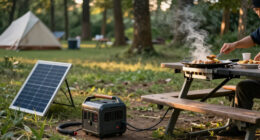
Solar panels recharge your station at a rate shaped by sunlight, shade, angle, temperature, and season, so their rated wattage is not a promise of constant output. A 200-watt panel is rated under test conditions; real campsite output may fall when clouds pass, branches shade a corner, or the sun sits low in winter. Plan around expected conditions and the station’s maximum solar-input limit. For example, a panel spread beside a sunny picnic table may produce useful charging through midday, then lose output as a stand of trees throws a long shadow across it. Repositioning a foldable panel can help, but you may need to check it as the sun moves. Keep the power station dry and ventilated, and place panels where they won’t block a path or invite someone to trip over their cable. Some newer stations accept solar and wall charging at the same time, support extra batteries, or show input and output in an app. These features make planning easier, but they don’t change the basic arithmetic: if cooking draws more power than the panels supply, the battery drains while you cook. Pass-through use also depends on the manufacturer’s guidance, so check the manual before relying on it. A hybrid approach often works best. Charge the station from a wall outlet before leaving, then use solar as a top-up. Stored energy is your cloudy-day reserve, while the panels help replenish it when the sky clears.Compare electric solar cooking with a fuel stove
A solar-charged power station gives you quiet electric cooking without burning fuel at the cooking spot, while a propane or gas camp stove offers a simpler way to produce heat when you don’t have a charged battery. The right choice depends on trip length, appliance style, weight, charging access, and how much you value electric cooking. Suppose you’re car camping for a weekend with a sunny site and already own a compact induction burner. A charged power station may handle planned meals and keep your campsite quiet. On a long, cloudy trip, a basic fuel stove may be easier to rely on, while the station runs lights and phones. Some campers bring both, accepting the extra gear for flexibility.| Factor | Solar power station | Fuel camp stove |
|---|---|---|
| Cooking sound | Quiet appliance operation | Burner hiss or flame noise |
| Energy supply | Stored battery energy and available sunlight | Fuel carried for the trip |
| Meal options | Electric cookers within the inverter rating | Pots and pans suited to the burner |
| Planning need | Estimate watts, Wh, and charging conditions | Estimate fuel use and pack safe storage |
| At the cooking spot | No fuel combustion from the station itself | Burns fuel; follow stove instructions |