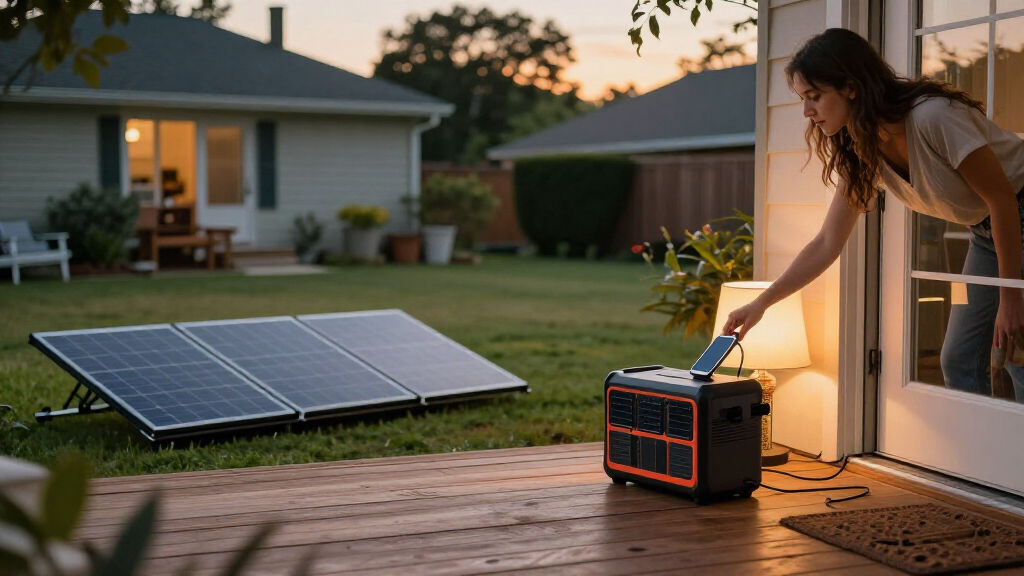
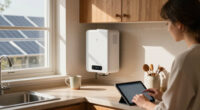
When comparing solar backup power stations, the key decision is whether you need a movable source of electricity for selected devices or a permanently installed system designed to support household circuits. A portable solar power station combines a battery, inverter, and charging inputs in one movable unit. A home solar battery backup system connects larger batteries to a home’s electrical setup, often alongside rooftop solar. The portable option is generally easier to buy and use, while the installed system can offer greater capacity, higher output, and more automatic outage coverage. Choose the portable station for essentials, outdoor use, or a limited budget; consider a home system if you want sustained backup for more of the house and can support the installation cost.

Get backup power and energy gear delivered free — and shop member deals
- Fast, free delivery on millions of items
- Access to Prime Big Deal Days deals on October 6–7
- Prime Video, Amazon Music and more included

GRECELL Portable Power Station 500W, 519Wh Solar Generator with 2 AC Outlets and PD 60W USB-C
- ✔ Capacity: 519Wh
- ✔ Continuous AC output: 500W pure sine wave
- ✔ AC outlets: 2

Jackery Explorer 300 Portable Power Station, 292Wh Backup LiFePO4 Battery
- ✔ Capacity: 292Wh
- ✔ Continuous output: 300W
- ✔ Peak surge: 600W

ZeroKor 300W Portable Power Station with 60W Foldable Solar Panel
- ✔ Maximum output: 300W
- ✔ AC outlets: 2
- ✔ Included solar panel: 60W foldable monocrystalline
At a Glance
| Criteria | Portable solar power station | Home solar battery backup system | Winner |
|---|---|---|---|
| Upfront cost | Usually lower; price rises with capacity, output, and included accessories. | Usually much higher once batteries, equipment, electrical work, and any solar work are included. | A |
| Usable capacity | Typically sized for selected devices; expansion varies by model. | Can be sized or expanded for a broader range of household needs, depending on the system. | B |
| Power output and circuits | Powers devices through its outlets, within its inverter rating. | Can support selected backed-up circuits or more of the home, subject to system design. | B |
| Solar recharging | Can accept compatible portable panels; charge speed depends on input limits and sunlight. | May recharge from rooftop solar automatically when the system supports it; actual recovery depends on sun, system configuration, and household use. | B |
| Installation and setup | Usually ready to use with basic setup; panel placement and cables still matter. | Requires professional planning and installation. | A |
| Portability and other uses | Movable for camping, work, or use in different parts of a property. | Fixed in place and designed for home use. | A |
| Outage convenience | Manual: connect devices and manage loads as needed. | Can switch backed-up circuits automatically if the system is configured for it. | B |
GRECELL Portable Power Station 500W, 519Wh Solar Generator with 2 AC Outlets and PD 60W USB-C
For backup planning, capacity is the GRECELL’s clearest advantage. Its 519Wh rating is substantially above the Jackery’s 292Wh, offering more stored energy for keeping small electronics going through a longer interruption. The 500W pure sine wave AC output also gives it more headroom than the two 300W models, although it remains unsuitable for many high-draw appliances. We would check both the running wattage and startup demand of anything connected before counting on it.The port selection is useful when several devices need charging at once: there are two AC outlets, USB-A, 60W USB-C PD, DC connections, a car port, and a wireless charging pad. That flexibility makes it easier to serve a mix of phones, a laptop, lights, or a compatible CPAP machine. It does not mean all ports can deliver their maximum output simultaneously, so we would avoid treating the port count as a guarantee of high total power.Compared with Jackery, GRECELL trades carrying ease and a specified long-cycle LiFePO4 battery for nearly twice the capacity and a higher AC ceiling. Compared with ZeroKor, it offers a stated 519Wh capacity and 200W maximum solar input, but the solar panel is not included. Full solar recharge is listed at six to nine hours with a 100W panel, which can leave a gap in a short outage. Its lithium battery also needs attention: the supplied guidance says to recharge it at least every three months. Choose it when extra stored energy matters more than the smallest footprint; skip it if you need panel-included portability or sustained appliance-level output.
Pros:
- 519Wh capacity exceeds the stated capacity of the Jackery and provides a longer potential run window for small loads.
- 500W pure sine wave AC output offers more headroom than the two 300W alternatives.
- 60W USB-C PD and a broad selection of ports accommodate a varied device mix.
- Supports solar, wall, and car charging, with solar input up to 200W.
Cons:
- Solar panel is not included, adding a separate equipment decision for solar use.
- A 500W ceiling still excludes many household appliances and high-startup loads.
- Listed solar recharge takes six to nine hours with a 100W panel, and battery maintenance calls for periodic recharging.
Best for: Households or travelers who want more stored energy for phones, laptops, lights, and compatible low-draw equipment during outages.
Not ideal for: Buyers who need to power high-wattage appliances, want a solar panel in the box, or prioritize the lightest station.
Bottom line: We rank GRECELL first because its 519Wh capacity and 500W pure sine wave output provide the most backup flexibility here, provided buyers accept a separate panel and modest appliance limits.
“We rank GRECELL first because its 519Wh capacity and 500W pure sine wave output provide the most backup flexibility here, provided buyers accept a separate panel and modest appliance limits.”
Jackery Explorer 300 Portable Power Station, 292Wh Backup LiFePO4 Battery
When a station needs to move between a vehicle, campsite, and home storage shelf, Jackery’s 7.1 lb listed weight is a practical advantage. Its 292Wh capacity is much smaller than GRECELL’s 519Wh, so we would choose it for a few essential devices rather than a longer backup list. The 300W continuous output similarly keeps expectations grounded: phones, routers, and many laptops are plausible loads, while a kettle or hair dryer is not.Jackery’s differentiator is its LiFePO4 battery rated for over 4,000 cycles to 70% capacity. That rating is useful for buyers who expect regular charge-and-use cycles, such as frequent campers or people who rotate a backup battery. It is a listed rating, not a promise of a particular lifespan in every use pattern. The ports include two AC outlets, a 100W USB-C PD port, two USB-A ports, and a 120W car port, giving it a useful spread for a compact station.Against the ZeroKor kit, Jackery is easier to carry and provides more specific battery-cycle information, but it arrives without a solar panel. Its listed solar recharge estimates are attractive with a 100W panel—about 80% in 2.8 hours—yet the panel must be acquired separately and conditions affect real charging. ZeroKor’s included 60W panel is simpler for a first solar setup, while GRECELL stores considerably more energy. Jackery makes the most sense when low weight and repeated use outrank capacity; buyers supporting multiple devices through a long outage should consider the larger GRECELL instead.
Pros:
- At 7.1 lbs, it is the lightest option in this comparison.
- LiFePO4 battery is rated for over 4,000 charge cycles to 70% capacity.
- 100W USB-C PD and multiple output types support a useful mix of electronics.
- Fast solar charging is listed when paired with a suitable 100W panel.
Cons:
- 292Wh capacity is well below GRECELL’s 519Wh.
- Solar panel is sold separately.
- 300W continuous output will not run many high-power appliances.
Best for: Campers, travelers, and households seeking a light station for phones, laptops, lights, and short-duration backup.
Not ideal for: People who need a bundled solar panel, more than 300W of continuous output, or the longest backup window in this group.
Bottom line: We recommend Jackery when portability and a high stated cycle rating matter more than capacity or an included solar panel.
“We recommend Jackery when portability and a high stated cycle rating matter more than capacity or an included solar panel.”
ZeroKor 300W Portable Power Station with 60W Foldable Solar Panel
ZeroKor earns its place by making the solar portion of the decision more immediate: a 60W foldable monocrystalline panel is included. That removes the need to choose a compatible panel before trying solar charging, a convenience Jackery and GRECELL do not provide in their listed packages. The station can also recharge from a wall outlet or car, and its built-in MPPT controller supports solar input. The panel’s modest rating, however, means sunlight may replenish energy slowly, especially when the station is also powering devices.Its listed 300W maximum output puts it in the same broad power class as Jackery, below GRECELL’s 500W. The description does not state battery capacity, so we cannot compare expected run time directly with either rival. Buyers should confirm capacity and device compatibility in the product details before treating it as outage coverage. Multiple AC, DC, and USB outputs help with small electronics, while the flashlight and SOS mode add a practical campsite feature.ZeroKor’s BMS lists protection against short circuit, over-current, over-voltage, overload, and overheating, with an automatic cooling fan. Those protections are useful, but they do not eliminate the need to respect the output limit or keep the panel junction box protected from water; it is not waterproof. The supplied guidance also calls for regular charging and discharging to avoid entering a protection state. Compared with Jackery, this bundle is more solar-ready out of the box; compared with GRECELL, it is less capable for higher-power loads and lacks a stated capacity in the provided specifications. Pick it for an entry-level panel bundle and modest electronics, not as the most predictable choice for extended home backup.
Pros:
- Includes a 60W foldable monocrystalline solar panel.
- Can recharge by solar, wall outlet, or 12V car port.
- Multiple USB, DC, and AC outputs support small electronics.
- BMS protection and an automatic cooling fan are specified.
Cons:
- 300W maximum output excludes high-draw appliances.
- Battery capacity is not stated in the supplied product details, making runtime harder to assess.
- Panel junction box is not waterproof, and regular charge/discharge is advised.
Best for: First-time solar station buyers who want an included foldable panel for camping or occasional small-device backup.
Not ideal for: Buyers needing documented capacity comparisons, longer backup duration, waterproof panel connections, or power beyond 300W.
Bottom line: We favor ZeroKor for buyers who want a panel bundled with a compact 300W-class station, while its unstated capacity and panel limitations make it a less certain outage choice.
“We favor ZeroKor for buyers who want a panel bundled with a compact 300W-class station, while its unstated capacity and panel limitations make it a less certain outage choice.”
As an Amazon Associate we earn from qualifying purchases.
Key Differences
The largest difference is scale. A portable station is a self-contained battery that can run compatible devices directly, so it works well for phones, laptops, lights, routers, and some smaller appliances. Its usefulness depends on both stored energy and the power it can deliver at once. A home battery system is planned around a household’s electrical needs and can support designated circuits, though the number of circuits and the appliances they can run depend on equipment ratings and installation design. Neither label alone guarantees that a system can run high-demand equipment such as electric heating or air conditioning.
Recharging and convenience also differ. Portable stations can take power from compatible solar panels, but the owner must set out and connect the panels, and charging slows when sunlight is weak or interrupted. A home system paired with rooftop solar may recharge without moving equipment outdoors, subject to its configuration and the available daylight. That can make it a better fit for repeated outages, but only if its capacity, charging capability, and household loads are planned realistically. A battery that is depleted faster than it can recharge will not provide continuous backup.
Cost follows the same divide. The portable station asks for less commitment and can serve several roles, but a small unit may cover only a short list of needs. The home system costs more and involves installation, yet can deliver a more integrated backup setup. The extra expense is most defensible for people who need household circuits covered during outages, expect to use the system often, or already have compatible rooftop solar. For occasional backup of essentials, the portable station is usually the more sensible first purchase.
Detailed Comparison
Upfront cost (Portable solar power station wins — major)
Winner: A; major gap. A portable station generally has a much lower purchase and setup cost than an installed home battery system. Prices still vary widely: a high-capacity station with panels can cost substantially more than a basic unit, and a home installation’s total depends on battery size, electrical work, and solar equipment. In practice, A lets buyers start with a defined set of essential devices. B asks for a larger investment, which makes sense when household coverage is the goal rather than occasional device charging.
Usable capacity (Home solar battery backup system wins — major)
Winner: B; major gap for whole-home needs. Portable stations range from compact units for electronics to larger models intended for longer or heavier use, but capacity is finite and expansion depends on the model. Home systems can be specified for greater stored energy and may support expansion, though capacity is not unlimited. The practical difference is how long and how broadly backup can last: A is often a good match for a prioritized list of loads, while B can be sized for a longer outage plan. Buyers should compare usable energy and expected appliance consumption, not just headline capacity.
Power output and circuits (Home solar battery backup system wins — major)
Winner: B for household coverage; moderate to major gap. A supplies power through its own outlets, and its inverter rating limits what it can run at once. It is straightforward for devices with ordinary plugs, but connecting it to house wiring requires equipment and arrangements designed for that purpose. A home battery system can feed selected circuits through installed electrical equipment and may cover more, depending on its design and output. That is more convenient for built-in household loads, but neither option should be assumed to run every appliance; high-demand devices need careful checking.
Solar recharging (Home solar battery backup system wins — moderate)
Winner: B for unattended household use; moderate gap. Both options can use solar when configured with compatible equipment. With A, the owner typically sets up portable panels, checks connections, and works around shade, weather, and the station’s solar input limit. A home battery paired with rooftop panels can recharge through the installed system, reducing hands-on work during an outage. Its performance still depends on sunlight, system design, and ongoing household consumption. If rooftop solar is unavailable, the portability of A’s panels may be useful, but recharging can take time and space.
Installation and setup (Portable solar power station wins — major)
Winner: A; major gap. Most portable stations need little setup beyond charging the unit and learning its controls; solar panels and extension cables add some planning. A home battery requires a suitable location, electrical integration, and professional installation. That work takes time and adds to the cost, but it also creates a system designed to serve designated household loads. Buyers who rent, move frequently, or want backup without electrical work will usually find A much easier to adopt.
Portability and other uses (Portable solar power station wins — major)
Winner: A; major gap. A can move between rooms or travel to a campsite, workshop, or temporary worksite, as long as its size and weight are manageable. The same purchase can cover home essentials during an outage and provide power elsewhere. B stays installed and earns its value through household backup rather than flexibility. That makes A more useful for people whose power needs follow them, while B is better suited to owners who want a fixed part of their home’s energy setup.
Outage convenience (Home solar battery backup system wins — moderate)
Winner: B; moderate gap. A requires the owner to connect devices, monitor remaining charge, and decide which loads take priority. A home system may switch backed-up circuits automatically when configured to do so, giving a smoother experience during an outage. Automatic operation does not mean unlimited power: only supported circuits receive backup, and the battery can still run down. People who can manage a smaller set of devices may see little benefit from paying for that convenience; households that need reliable service across designated circuits may value it.
Portable solar power station: Pros and Cons
Pros:
- Lower entry cost and simple setup for essential devices.
- Can move between home, travel, and work settings.
- Solar panels can be added without installing rooftop equipment.
Cons:
- Limited by its stored energy and inverter output.
- Usually requires manual load management and panel setup.
- Does not automatically supply household wiring without suitable equipment.
Home solar battery backup system: Pros and Cons
Pros:
- Can be sized for higher capacity and selected household circuits.
- May recharge through rooftop solar with less hands-on effort.
- Can provide automatic backup switching when configured for it.
Cons:
- Higher total cost, including installation and electrical work.
- Fixed in place and less useful for travel or remote work.
- Coverage depends on system design; it may not run every appliance or the whole home.
Who Should Choose What
Choose Portable solar power station if:
- You need backup for a short list of electronics, lights, communications gear, or other compatible devices.
- You want a lower-cost option that can also serve during camping, travel, or work away from home.
- You rent, move often, or prefer a system that does not require household electrical installation.
- You can manage loads manually and accept that solar recharging depends on panel setup and available sunlight.
Choose Home solar battery backup system if:
- You want backup for selected household circuits rather than plugging in devices one by one.
- You expect frequent or extended outages and can justify a larger installed system.
- You have rooftop solar or plan a compatible solar and battery installation.
- Automatic switching and a more integrated home setup matter more than portability.
Skip both if: Neither is a fit if your main requirement is uninterrupted power for every high-demand appliance during a long outage and you have not confirmed the system capacity, output, and installation design needed for those loads.
Value for Money
A portable station is usually the better value when the goal is to keep a defined set of devices running. Its lower entry cost and ability to serve outside the home help justify the purchase even if outages are rare. Paying more for a larger portable model is worthwhile only when its extra capacity or output matches appliances you actually plan to use; capacity that sits unused does not make it a better deal.
A home battery can justify its higher cost for households that need backed-up circuits, expect repeated outages, or can make practical use of an existing solar installation. Its value comes from coverage and integration, not from being a cheaper way to charge a phone. Before buying, compare installation quotes and check which circuits will be backed up, the system’s usable capacity and output, and how it recharges after an outage. If you only need a few devices powered for a limited period, the premium for an installed system is unlikely to pay off in backup convenience alone.
Final Verdict
For most people seeking backup for essential devices, choose the portable solar power station. It costs less to get started, requires little installation, and can also provide power away from home. Select a model by matching its usable capacity and output to the devices you intend to run, then check whether compatible panels can recharge it at a useful rate.
Choose a home solar battery backup system if your priority is household circuit coverage, repeated outage readiness, and a more automatic experience—and your budget and property can support installation. The biggest deciding factor is the scope of backup: portable power for chosen devices favors A; integrated support for household circuits favors B. Do not pay the home-system premium solely for solar charging if a portable station already meets your outage needs.
Frequently Asked Questions
Can a portable solar power station run a house?
It can power compatible devices through its outlets, but that is different from supplying household wiring. Its capacity and inverter output limit what it can run. Connecting any portable unit to house circuits requires equipment and an arrangement designed for that use; do not assume a standard station can feed a home’s electrical system.
Will either option keep working during several cloudy days?
Both depend on stored energy and the ability to recharge. Cloudy weather can reduce solar production, and a home battery’s rooftop panels are subject to the same basic limitation as portable panels. A larger battery can provide more stored energy, but actual runtime depends on the loads connected and how much power the panels produce.
Is a home battery worth the extra cost if I already have rooftop solar?
It may be, if you want stored solar power available during outages and the system is compatible with your panels and electrical setup. Existing panels alone do not guarantee backup during a grid outage; the equipment must be designed to operate safely in that condition. Compare the installed cost with the value of the circuits and outage duration you want covered.
Which option is better for renters?
A portable station is usually the more practical fit because it can be used without permanently modifying the property and moved when you leave. Check the unit’s weight, storage needs, and the rules for using solar panels where you live. A home battery installation generally suits property owners who can approve and arrange electrical work.
Fall Picks
fall essentials
As an affiliate, we earn on qualifying purchases.