To guarantee your home’s safety, you need to perform basic electrical load calculations by listing all appliances and noting their wattage or amperage ratings. Convert these to amps by dividing wattage by voltage, then add up all the loads on each circuit. Use this info to choose the right-sized circuit breakers, which should handle at least 125% of the continuous load. If you want to understand these steps in detail, there’s more to learn about safe and efficient home wiring.
Key Takeaways
- List all home appliances and note their wattage or amperage ratings for accurate load assessment.
- Convert appliance wattage to amps by dividing wattage by the system voltage (120V).
- Sum the total current of all devices on a circuit to ensure wiring and breaker capacity are adequate.
- Size circuit breakers at 125% of the continuous load to prevent overheating and ensure safety margins.
- Proper load calculations help prevent overloads, reduce fire risk, and ensure compliance with electrical safety standards.
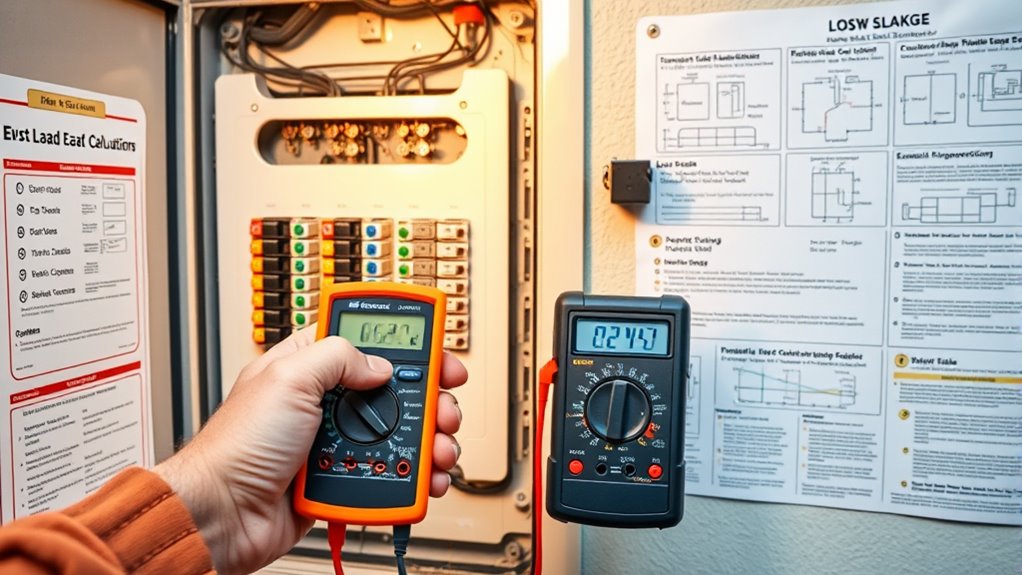
Understanding how to perform basic electrical load calculations is essential for designing safe and efficient electrical systems. When you’re planning your home’s electrical setup, knowing how to correctly size your circuit breakers and account for appliance power requirements helps prevent overloads and potential hazards. These calculations ensure your system can handle the total electrical load without tripping or risking damage, making your home safer and more reliable.
The first step in load calculation is to identify all the appliances and devices you plan to use. Make a list of each item, noting their wattage or amperage ratings. Appliance power requirements are usually listed on labels or in user manuals, and you need to convert this information into a common measurement—either watts or amps—to accurately estimate the total load. For example, a refrigerator might draw 6 amps, while a dishwasher could use 10 amps. Adding these values together gives you the total current your system will need to support.
Once you have your appliance power requirements, you need to determine the load for each circuit. This involves dividing the wattage of each device by the voltage of your electrical system (typically 120V in North America). This calculation gives you the current in amps for each appliance. For instance, if a device consumes 600 watts, dividing that by 120 volts results in a 5-amp load. Summing all the individual loads on a particular circuit tells you whether your wiring and breaker size are sufficient or if adjustments are necessary.
Circuit breaker sizing is critical in this process. You should select a breaker that can handle the combined load of all devices on that circuit, with some margin for safety and future expansion. Industry standards recommend sizing breakers at 125% of the calculated continuous load to prevent nuisance tripping. For example, if your total load on a circuit is 15 amps, you should use at least a 20-amp breaker. This extra capacity ensures your wiring doesn’t become overheated and that your circuit remains reliable during peak usage. Additionally, understanding home electrical safety principles is vital to prevent hazards related to improper load calculations and breaker sizing.
Frequently Asked Questions
How Often Should I Update My Electrical Load Calculations?
You should update your electrical load calculations whenever there are significant changes to your home’s electrical system, like adding appliances or new circuits. Keep an eye on electrical code updates, which may affect your calculations. Using modern load calculation tools makes this easier. Regularly reviewing and updating ensures your home remains safe and compliant, ideally every few years or after major renovations to maintain ideal electrical safety.
What Are Common Signs of an Overloaded Circuit?
Ever wonder if your home’s electrical system is at risk? Warning signs of a circuit overload include frequent tripped breakers, warm outlets, flickering lights, and a burning smell. When your circuits struggle to handle the demand, these signs appear, risking damage or fire. Pay attention to these warning signs and avoid pushing your system past its limit to keep your home safe and prevent costly repairs.
Can I Perform Load Calculations Without Professional Help?
You can perform a DIY assessment of your electrical load, but it’s best to seek professional consultation for accuracy and safety. Start by listing all appliances and their wattage, then add up the total to see if it exceeds your circuit capacity. While simple calculations are manageable, a professional can ensure everything’s correctly rated and prevent potential hazards. When in doubt, consulting an electrician is the safest choice.
How Do I Account for Future Electrical Appliance Additions?
Thinking ahead is like planting a tree for future shade. To account for appliance additions, you should include estimated future loads based on appliance lifespan and usage patterns. Always follow electrical code compliance to guarantee safety. Keep a buffer in your calculations, so you’re prepared for new devices without overloading circuits. Regularly review your electrical system to accommodate changes, making sure your home stays safe and efficient.
What Safety Precautions Are Essential During Load Calculation Procedures?
You should prioritize circuit safety by turning off power before working on electrical systems, and use insulated tools to prevent shocks. Verify measurement accuracy by double-checking your readings and using properly calibrated instruments. Always follow electrical codes and standards, and avoid overloading circuits. Wearing protective gear like gloves and safety glasses adds extra protection. These precautions help prevent accidents and ensure your load calculations are precise and safe.
Conclusion
So, after all that effort, you might think your home is perfectly safe. But don’t get too comfortable—ignoring proper load calculations could turn your cozy haven into a disaster. It’s ironic, really—calculating loads could save your home, yet many overlook it until it’s too late. Don’t wait for sparks or outages to remind you. Take the time now; your safety depends on it. Because nothing says “home sweet home” like avoiding avoidable hazards.