The best overall home backup power inverter in this roundup is the ECO-WORTHY 10 kW Home Backup Power Kit, a strong fit for buyers seeking a larger integrated system with two 51.2V batteries. The ECO-WORTHY PowerMega 48V system stands out for its 10kW hybrid inverter and substantial battery capacity, while the EF ECOFLOW DELTA Pro Ultra X offers a power-station format for buyers who value a packaged solution. The main tradeoff is between a simpler 12V inverter for selected appliances and a more involved battery-and-inverter system that can support broader household loads. Capacity, battery compatibility, installation needs, and waveform type all affect what you can actually run. Read on for the full comparison and guidance on choosing a setup that matches your backup plan.

Get backup power and energy gear delivered free with Prime
- Fast, free delivery on millions of items
- Prime Video, Amazon Music and more included
- Member-only deals all year
Key Takeaways
- Integrated 48V kits lead for broad household backup: the ECO-WORTHY 10 kW kit and PowerMega system pair high-output inverters with substantial battery capacity, unlike standalone inverter models.
- Inverter wattage alone does not determine runtime: the 12V LANDERPOW, ALLWEI, and Jlouneo units need a suitable external battery, so usable energy depends on the battery bank.
- The ECOFLOW DELTA Pro Ultra X takes a different route: its 12,288Wh power-station format packages storage and power electronics, reducing the need to assemble a separate inverter-and-battery setup.
- Waveform type separates the EGSCATEE from the pure sine wave picks: its modified sine wave design may limit compatibility with some sensitive electronics and appliances.
- System voltage changes the project as much as output does: a 48V inverter or kit calls for compatible batteries and wiring, while a 12V inverter may suit smaller, simpler backup loads.
| LANDERPOW 3000W Pure Sine Wave Power Inverter, 12V DC to 120V AC |  | Best 12V High-Output Inverter | Input voltage: 12V DC | Output voltage: 120V AC | Continuous output: 3000W | VIEW LATEST PRICE | See Our Full Breakdown |
| ALLWEI 2000W Pure Sine Wave Power Inverter (12V DC to 120V AC) |  | Best for Straightforward 2000W Backup | Input voltage: 12V DC | Output voltage: 110V/120V AC | Continuous power: 2000W | VIEW LATEST PRICE | See Our Full Breakdown |
| ECO-WORTHY PowerMega 48V 314Ah LiFePO4 Battery and 10kW Hybrid Inverter System |  | Best Complete 240V Home Backup System | Battery chemistry: LiFePO4 | Battery voltage and capacity: 51.2V, 314Ah | Usable energy: 16.1kWh | VIEW LATEST PRICE | See Our Full Breakdown |
| Jlouneo 2000W Pure Sine Wave Power Inverter, 12V DC to 110/120V AC Converter with Remote Control |  | Best 2000W Inverter for Convenient Monitoring | Input voltage: 12V DC | Output voltage: 110/120V AC | Continuous power: 2000W | VIEW LATEST PRICE | See Our Full Breakdown |
| EF ECOFLOW DELTA Pro Ultra X 12,288Wh Power Station with AC Cable |  | Best Expandable Premium Home Backup | Battery capacity: 12,288Wh | Output: 12,000W | Expandable capacity: 12–180kWh | VIEW LATEST PRICE | See Our Full Breakdown |
| ECO-WORTHY 48V Home Backup Power Kit with 5120Wh LiFePO4 Battery and 5000W Inverter |  | Best Modular Starter Kit | Battery chemistry: LiFePO4 | Battery voltage and capacity: 51.2V, 100Ah | Energy capacity: 5,120Wh | VIEW LATEST PRICE | See Our Full Breakdown |
| ECO-WORTHY 10 kW Home Backup Power Kit with Two 51.2V 100Ah LiFePO4 Batteries |  | Best for Whole-Home Output | Battery configuration: Two 51.2V, 100Ah LiFePO4 batteries | Total energy capacity: 10,240Wh | Inverter output: 10,000W; 20,000W peak | VIEW LATEST PRICE | See Our Full Breakdown |
| ECO-WORTHY 48V 5000W Solar Inverter with Built-in MPPT Controller |  | Best for Custom 48V Builds | Input voltage: 48V | Continuous output: 5,000W | Peak output: 10,000W | VIEW LATEST PRICE | See Our Full Breakdown |
| Jlouneo 3000W Pure Sine Wave Power Inverter, 12V DC to 110V/120V AC Converter with Remote Control and LCD Display |  | Best for 12V Battery Backup | Continuous and peak power: 3,000W continuous; 6,000W peak | Input and output voltage: 12V DC to 110/120V AC | Waveform and frequency: Pure sine wave; 60Hz | VIEW LATEST PRICE | See Our Full Breakdown |
| EGSCATEE 5500W 12V DC to 120V AC Modified Sine Wave Power Inverter |  | Best for Basic High-Wattage 12V Loads | Continuous and peak output: 5,500W continuous; 11,000W peak | Input and output voltage: 12V DC to 120V AC | Waveform and frequency: Modified sine wave; 60Hz | VIEW LATEST PRICE | See Our Full Breakdown |
| home backup power inverter | Waveform |
|---|---|
| LANDERPOW 3000W Pure Sine Wave | Pure sine wave |
| ALLWEI 2000W Pure Sine Wave Po | Pure sine wave |
| ECO-WORTHY PowerMega 48V 314Ah | Pure sine wave |
| Jlouneo 2000W Pure Sine Wave P | Pure sine wave |
| EF ECOFLOW DELTA Pro Ultra X 1 | — |
| ECO-WORTHY 48V Home Backup Pow | — |
| ECO-WORTHY 10 kW Home Backup P | — |
| ECO-WORTHY 48V 5000W Solar Inv | Pure sine wave |
| Jlouneo 3000W Pure Sine Wave P | — |
| EGSCATEE 5500W 12V DC to 120V | — |
More Details on Our Top Picks
LANDERPOW 3000W Pure Sine Wave Power Inverter, 12V DC to 120V AC
The LANDERPOW 3000W suits buyers who already have a substantial 12V battery bank and want more continuous AC capacity than the 2000W ALLWEI or Jlouneo models provide. Its pure sine wave output is a sensible match for sensitive electronics and motor-driven loads, while three outlets, a hardwired terminal, and USB-C charging let it serve several types of equipment. The wired remote reports battery level, output, and errors from up to 15 feet away, useful when the inverter is installed near a battery but controls need to be reachable elsewhere. The tradeoff is that 3000W from a 12V system can demand very high battery current and substantial cabling, so this is not a shortcut to whole-home backup. It also lacks the integrated battery and 240V capability of the ECO-WORTHY PowerMega system.
Pros:- 3000W continuous output exceeds the 2000W ALLWEI and Jlouneo inverter ratings.
- Pure sine wave output is suitable for sensitive electronics and many motor-driven appliances.
- Three AC outlets, a hardwired terminal, USB, and 30W USB-C cover varied connections.
- The wired remote displays battery level, output, and error information.
Cons:- Requires a 12V battery system; it is not a standalone battery backup.
- High output at 12V can require a large battery bank and carefully sized wiring.
- The 15-foot remote is wired rather than wireless.
Best for: RV owners or off-grid households with a properly sized 12V battery bank who need more continuous inverter output and several connection options.
Not ideal for: Buyers seeking a complete home backup system, 240V output, or a plug-in setup without a compatible 12V battery and suitable high-current wiring.
- Input voltage:12V DC
- Output voltage:120V AC
- Continuous output:3000W
- Peak output:6000W
- Waveform:Pure sine wave
- AC connections:3 outlets and 1 hardwired terminal
- USB-C output:30W PD
- Remote:15-foot wired remote with LED display
Our verdict“Choose the LANDERPOW if your 12V battery system can support its high current draw and you need more inverter capacity than a 2000W model offers.”
ALLWEI 2000W Pure Sine Wave Power Inverter (12V DC to 120V AC)
The ALLWEI 2000W is a straightforward choice for buyers who want a 12V inverter without stepping up to the LANDERPOW’s higher 3000W output or the ECO-WORTHY PowerMega’s battery-and-inverter system. It provides pure sine wave power for electronics and motor-driven appliances, with a 4000W peak rating for brief startup demands. Its LCD and 10-foot wired remote make basic monitoring easier when the unit is mounted away from the living area, and the aluminum alloy housing and listed safety protections suit a fixed RV or battery installation. The compromise is capacity: 2000W continuous output leaves less room for simultaneous loads than the LANDERPOW. It also has only two AC outlets and no listed USB charging ports, so buyers wanting more direct device connections may prefer the Jlouneo 2000W.
Pros:- Pure sine wave output supports sensitive electronics and motor-driven appliances.
- LCD display and 10-foot wired remote aid monitoring from a separate location.
- ETL listing and multiple protection features support safer installation.
- Aluminum alloy housing and automatic cooling fans help manage heat.
Cons:- 2000W continuous output is lower than the LANDERPOW’s 3000W rating.
- Two AC outlets and no listed USB ports offer fewer direct connections than the Jlouneo.
- Requires a compatible 12V battery and is not a standalone backup unit.
Best for: RV owners and households with a 12V battery bank who need moderate AC backup for a few appliances and want a display plus remote operation.
Not ideal for: People planning to run several high-draw appliances at once, needing 240V, or wanting a complete battery-and-inverter home backup system.
- Input voltage:12V DC
- Output voltage:110V/120V AC
- Continuous power:2000W
- Peak power:4000W
- Waveform:Pure sine wave
- AC outlets:2
- Display and remote:LCD and 10-foot wired remote
- Safety certification:ETL listed (UL 458)
Our verdict“Pick the ALLWEI for moderate 12V backup loads when remote monitoring matters more than extra outlets or higher continuous output.”
ECO-WORTHY PowerMega 48V 314Ah LiFePO4 Battery and 10kW Hybrid Inverter System
Unlike the LANDERPOW and ALLWEI, which convert power from an existing 12V battery, the ECO-WORTHY PowerMega combines a 48V battery with a 10kW hybrid inverter. Its 16.1kWh usable energy and 120V single-phase or 240V split-phase output make it a more home-oriented option for backing up larger loads and compatible 240V equipment. LiFePO4 chemistry, active-balancing battery management, built-in protection, and Wi-Fi and Bluetooth monitoring add useful system-level features. This is a different commitment from buying a compact inverter: the battery ships by freight, the system needs installation planning, and the single-battery package does not include parallel connection cables. It also weighs against the more expandable DELTA Pro Ultra X if you want a system designed to grow far beyond its included battery capacity.
Pros:- Includes a 16.1kWh usable LiFePO4 battery and 10kW hybrid inverter.
- Supports both 120V single-phase and 240V split-phase output.
- Wi-Fi, Bluetooth, LCD, and multiple communication protocols provide monitoring options.
- Active-balancing BMS, built-in breaker, and fire suppression add system protections.
Cons:- The single-battery package does not include parallel connection cables.
- Freight delivery and multiple packages require more receiving and installation planning than a standalone inverter.
- The inverter exterior version depends on inventory.
Best for: Homeowners or off-grid users who want an included battery and inverter, substantial stored energy, and 120V plus 240V output.
Not ideal for: Buyers seeking a portable, simple 12V inverter, or anyone who needs an easily expandable multi-battery setup with connection cables included.
- Battery chemistry:LiFePO4
- Battery voltage and capacity:51.2V, 314Ah
- Usable energy:16.1kWh
- Inverter output:10,000W
- AC output:120V single-phase or 240V split-phase
- Waveform:Pure sine wave
- Monitoring:Built-in Wi-Fi and Bluetooth; LCD display
- Warranty:10 years
Our verdict“Choose the PowerMega when you want an integrated high-capacity home system with 240V output rather than a standalone 12V inverter.”
Jlouneo 2000W Pure Sine Wave Power Inverter, 12V DC to 110/120V AC Converter with Remote Control
The Jlouneo 2000W separates itself from the similar-output ALLWEI with a more flexible set of direct connections: three AC outlets, a hardwire terminal, USB-A, and 30W USB-C. Its dual LCD displays—one on the unit and another on the remote—make it easier to check voltage, load, and fan status without walking back to the inverter. Included 2AWG copper cables and compatibility with 12V AGM, GEL, and LiFePO4 batteries also help clarify what the package is designed to connect to. The ceiling remains 2000W continuous, however, so it cannot match the LANDERPOW’s 3000W rating for heavier combined loads. Like both of those models, it depends on a 12V battery and is not an integrated home storage system comparable to the ECO-WORTHY PowerMega.
Pros:- Three AC outlets, hardwire terminal, USB-A, and 30W USB-C provide varied connection options.
- Dual LCDs show operating information at both the inverter and remote.
- Pure sine wave output and stated compatibility with AGM, GEL, and LiFePO4 12V batteries.
- Included 2AWG pure copper cables support the battery connection.
Cons:- 2000W continuous output is below the LANDERPOW’s 3000W capacity.
- 12V-only input rules out direct use with 24V or 48V battery systems.
- A 4000W peak rating is short-term and does not support that load continuously.
Best for: RV and off-grid users with a 12V battery who want multiple output options and remote readouts for routine load monitoring.
Not ideal for: Households needing 240V service, an included battery, or enough inverter capacity to run loads beyond a 2000W continuous limit.
- Input voltage:12V DC
- Output voltage:110/120V AC
- Continuous power:2000W
- Peak power:4000W
- Waveform:Pure sine wave
- Conversion efficiency:At least 91%
- Outputs:3 AC outlets, hardwire terminal, USB-A, and USB-C
- Display:Dual LCD on unit and remote
Our verdict“Choose the Jlouneo over the ALLWEI if you value extra outlets, USB-C, and dual remote displays more than higher continuous power.”
EF ECOFLOW DELTA Pro Ultra X 12,288Wh Power Station with AC Cable
The EF ECOFLOW DELTA Pro Ultra X is the most home-focused option here: its 12,288Wh battery capacity, 12,000W output, and stated expansion range of 12–180kWh put it well beyond the small 12V inverter-and-battery setups represented by the LANDERPOW and ALLWEI. It can switch among solar, battery, and off-peak grid power, with an outage response under 20 milliseconds aimed at keeping connected equipment running through a disruption. LiFePO4 cells and dual battery management systems support the system’s residential role. The tradeoff is physical scale: at 350 pounds, this is not a portable backup box, despite the expandable design. Buyers also need to plan for separate shipments of the inverter and extra battery. Compared with the ECO-WORTHY PowerMega, it offers a much larger stated expansion range, but takes up more space and requires a more substantial installation plan.
Pros:- 12,000W output and 12,288Wh capacity target substantial residential backup loads.
- Expandable capacity is specified from 12kWh to 180kWh.
- Under-20-millisecond outage response is designed to limit interruptions.
- LiFePO4 batteries and dual battery management systems support system monitoring and protection.
Cons:- The 350-pound weight makes relocation difficult and calls for careful installation planning.
- The inverter and extra battery ship separately.
- The listed package has three power outlets, so household connection needs may require additional planning.
Best for: Homeowners seeking high-output backup with substantial stored energy and room to expand capacity as household needs grow.
Not ideal for: People needing a lightweight, easy-to-move inverter, a compact RV setup, or a system that arrives as a single package.
- Battery capacity:12,288Wh
- Output:12,000W
- Expandable capacity:12–180kWh
- Expandable output:12–36kW
- Battery chemistry:LiFePO4
- Outage response:Under 20ms
- Power outlets:3
- Weight:350lb
Our verdict“Choose the DELTA Pro Ultra X if you need high-output residential backup with extensive capacity expansion and can accommodate a heavy, separately shipped system.”
ECO-WORTHY 48V Home Backup Power Kit with 5120Wh LiFePO4 Battery and 5000W Inverter
This kit is my pick for buyers who want a matched 48V inverter-and-battery starting point without committing to a larger system. Its 5,000W pure sine wave inverter, 5,120Wh LiFePO4 battery, and built-in 100A MPPT controller combine core backup and solar-charging components in one package. Bluetooth and Wi-Fi monitoring also make battery status easier to check than with a bare inverter such as the ECO-WORTHY 48V 5000W Solar Inverter, which requires a separate battery purchase.
The tradeoff is scale: one inverter supplies 120V only, so buyers needing 120/240V service must plan for multiple compatible inverters. Its two outlets may also call for additional distribution, and the battery and inverter ship separately. Compared with the larger ECO-WORTHY 10 kW kit, this option is a less costly-in-components way to start small, but it stores half as much energy and delivers half the inverter output.
Pros:- Combines a 5,120Wh LiFePO4 battery and 5,000W pure sine wave inverter.
- Built-in 100A MPPT controller and battery charger reduce the number of separate core components.
- Bluetooth and Wi-Fi app monitoring provide battery-status access.
- Supports expansion with compatible parallel inverters and batteries.
Cons:- One inverter provides 120V output; 120/240V requires multiple inverters.
- Battery and inverter ship separately.
- Two outlets may require added distribution for multiple home circuits or appliances.
Best for: Homeowners building a 48V solar-backup system in stages who want one battery, an inverter, and monitoring in a coordinated starter package.
Not ideal for: Households that need 120/240V from a single inverter or want a ready-to-connect system with all components arriving together.
- Battery chemistry:LiFePO4
- Battery voltage and capacity:51.2V, 100Ah
- Energy capacity:5,120Wh
- Inverter output:5,000W continuous; 10,000W peak
- Waveform and output voltage:Pure sine wave; 120V
- Solar controller:100A MPPT; PV input 120–500V DC
- Monitoring and communication:Bluetooth, Wi-Fi, ECO-WORTHY app, CAN, and RS-485
- Expansion:Up to 6 inverters and 32 batteries in parallel
Our verdict“Choose this kit if you want a monitored 48V backup system you can expand, and skip it if you need 120/240V from one inverter.”
ECO-WORTHY 10 kW Home Backup Power Kit with Two 51.2V 100Ah LiFePO4 Batteries
This is the strongest fit in this batch for buyers who need high inverter output and 120/240V flexibility from a bundled system. The 10,000W pure sine wave inverter can supply either 120V single-phase or 120/240V split-phase power, while two 51.2V, 100Ah LiFePO4 batteries provide 10,240Wh of storage. That makes it more capable for mixed household loads than the smaller ECO-WORTHY 48V Home Backup Power Kit, which has one 5,000W inverter and 5,120Wh of storage.
Dual MPPT controllers and a 200A charger suit a larger solar-and-battery setup, and app monitoring helps track the included batteries. The tradeoff is a 265.5-pound system that ships in separate pieces; this is not a light, plug-in backup appliance. It also demands careful planning for installation and compatible expansion parts, unlike the stand-alone Jlouneo 3000W, which is simpler but limited to 12V battery systems.
Pros:- Includes a 10,000W pure sine wave inverter and two LiFePO4 batteries totaling 10,240Wh.
- Supports 120V single-phase or 120/240V split-phase output.
- Dual MPPT controllers and a 200A battery charger support a higher-capacity solar setup.
- Bluetooth and Wi-Fi app monitoring, with parallel expansion available.
Cons:- The 265.5-pound system is heavy and calls for planned installation.
- The inverter and batteries ship separately.
- Expansion depends on compatible additional inverters or batteries.
Best for: Homeowners seeking a substantial battery-backed system with 120/240V capability for multiple household circuits and larger loads.
Not ideal for: Renters, buyers with limited installation space, or anyone wanting a lightweight, simple backup unit that can be moved easily.
- Battery configuration:Two 51.2V, 100Ah LiFePO4 batteries
- Total energy capacity:10,240Wh
- Inverter output:10,000W; 20,000W peak
- Output options:120V single-phase or 120/240V split-phase
- Inverter features:Pure sine wave, dual MPPT controllers, 200A battery charger
- Monitoring and battery communication:Bluetooth, Wi-Fi, ECO-WORTHY app, CAN, and RS485
- Dimensions:22.09 × 19.02 × 5.63 in
- Weight:265.5 lb
- Expansion:Up to 6 inverters and 32 batteries in parallel
Our verdict“Pick this kit for higher-output home backup with split-phase flexibility, provided you have space and a plan for installation.”
ECO-WORTHY 48V 5000W Solar Inverter with Built-in MPPT Controller
I’d choose this inverter when the goal is to build around batteries and solar panels selected separately, rather than buy a bundled backup kit. It supplies 5,000W continuous power, reaches 10,000W peak, and includes an MPPT controller, so a DIY system has fewer core components to source. Its 120/240V output also offers a capability the smaller ECO-WORTHY 48V Home Backup Power Kit’s single inverter does not provide.
That flexibility comes with real setup work: batteries and panels are not included, and the single outlet means a home installation needs suitable distribution for multiple loads. At 21.25 by 17.71 by 8.66 inches, it also needs dedicated space. Compared with the 10 kW ECO-WORTHY kit, this is a more configurable inverter-only route, but it cannot match that kit’s bundled 10,240Wh storage or 10,000W inverter output.
Pros:- Provides 5,000W continuous and 10,000W peak output.
- Built-in MPPT controller simplifies integration with a solar array.
- Pure sine wave output suits sensitive electronics.
- 120/240V output supports more flexible system planning.
Cons:- Batteries and solar panels must be purchased separately.
- One outlet requires added distribution for multiple loads.
- Its physical footprint may be difficult to accommodate in a compact installation.
Best for: DIY-minded homeowners or cabin owners who already have, or want to select, a compatible 48V battery bank and solar array.
Not ideal for: Buyers seeking a complete backup kit, included battery storage, or multiple ready-to-use AC outlets.
- Input voltage:48V
- Continuous output:5,000W
- Peak output:10,000W
- Output voltage:120/240V
- Waveform:Pure sine wave
- Solar charge controller:Built-in MPPT
- Display:LCD
- Dimensions:21.25 × 17.71 × 8.66 in
Our verdict“Choose this inverter for a customizable 48V solar-backup build, not for an all-in-one battery system.”
Jlouneo 3000W Pure Sine Wave Power Inverter, 12V DC to 110V/120V AC Converter with Remote Control and LCD Display
The Jlouneo suits buyers who already have a 12V battery bank and need a straightforward way to run AC loads during an outage. Its 3,000W continuous pure sine wave output is a more suitable match for sensitive electronics than the EGSCATEE 5500W inverter’s modified sine wave output, even though the EGSCATEE lists higher continuous wattage. Three AC outlets, USB, USB-C, and a hardwire terminal give this model more connection options than the one-outlet ECO-WORTHY 48V inverter.
The included dual LCD displays and remote make it easier to check system status without standing beside the unit, and the supplied 1AWG copper cables help with a direct battery connection. But 12V is a limitation: delivering high power at that voltage places heavy demands on batteries and cabling, and this inverter cannot connect directly to the 48V ECO-WORTHY kits. It is an inverter, not a battery-backed kit, so the buyer must supply suitable storage.
Pros:- 3,000W continuous and 6,000W peak pure sine wave output.
- Dual LCD displays and remote control show system status away from the inverter.
- Three AC outlets, USB, USB-C, and a hardwire terminal offer varied connection choices.
- Includes 1AWG pure copper battery cables.
Cons:- Works with 12V DC batteries only, unlike the 48V ECO-WORTHY systems.
- Battery is not included, and the unit needs a direct battery connection.
- High output on a 12V system requires appropriately sized batteries and cabling.
Best for: RV owners or homeowners with a compatible 12V AGM, GEL, or LiFePO4 battery who need pure sine wave power and remote status monitoring.
Not ideal for: Buyers building a 48V home system, seeking included battery storage, or expecting a standard plug-in input instead of a direct battery connection.
- Continuous and peak power:3,000W continuous; 6,000W peak
- Input and output voltage:12V DC to 110/120V AC
- Waveform and frequency:Pure sine wave; 60Hz
- Battery compatibility:AGM, GEL, and LiFePO4
- Efficiency:≥ 91%
- Connections:3 AC outlets, USB, 30W USB-C, and hardwire terminal
- Display:Dual LCD displays on inverter and remote
- Included cable:1AWG pure copper
Our verdict“Choose this model for pure sine wave backup from an existing 12V battery bank, but look elsewhere for a 48V or bundled system.”
EGSCATEE 5500W 12V DC to 120V AC Modified Sine Wave Power Inverter
This inverter is aimed at buyers who prioritize listed wattage and connection variety over a pure sine wave. It claims 5,500W continuous output from a 12V battery, with four AC outlets, a hardwire terminal, USB, USB-C, and an LCD remote. That gives it more outlet options than the Jlouneo 3000W, but the Jlouneo’s pure sine wave output is a better fit for sensitive electronics and equipment whose operation depends on cleaner AC power.
The EGSCATEE’s modified sine wave output is the key compromise, not a minor spec difference: buyers should check appliance compatibility rather than assume every device will run as intended. A 12V system also needs batteries, cables, and connections sized for substantial current, and the inverter itself does not include storage. Its protection features add safeguards, but they do not remove those system-matching demands. I’d reserve this pick for compatible loads and established 12V setups, not as a universal household backup source.
Pros:- Lists 5,500W continuous and 11,000W peak output.
- Includes four AC outlets, a hardwire terminal, USB, and 30W USB-C.
- LCD remote and multiple electrical protection features are included.
- Compatible with supported 12V LiFePO4, AGM, GEL, and lead-acid batteries.
Cons:- Modified sine wave output is less suited to sensitive or waveform-sensitive appliances than the Jlouneo’s pure sine wave output.
- Battery storage is not included.
- High output from a 12V battery requires properly sized batteries, cables, and connections.
Best for: Owners of compatible 12V battery systems who need several AC connections for backup or vehicle use and have checked that their appliances tolerate modified sine wave power.
Not ideal for: Households powering sensitive electronics or appliances that require pure sine wave output, and buyers without a suitably sized 12V battery and cable setup.
- Continuous and peak output:5,500W continuous; 11,000W peak
- Input and output voltage:12V DC to 120V AC
- Waveform and frequency:Modified sine wave; 60Hz
- AC outlets:4
- Other connections:Hardwire terminal, 5V/3.1A USB, and 30W USB-C PD
- Compatible batteries:12V LiFePO4, AGM, GEL, and lead-acid
- Protection features:Over-voltage, under-voltage, overload, overheating, and short-circuit protection
- Dimensions and weight:7.87 × 4 × 2.28 in; 16 lb
Our verdict“Consider it for compatible loads on a well-sized 12V system, but choose a pure sine wave inverter for broader household appliance use.”
How We Picked
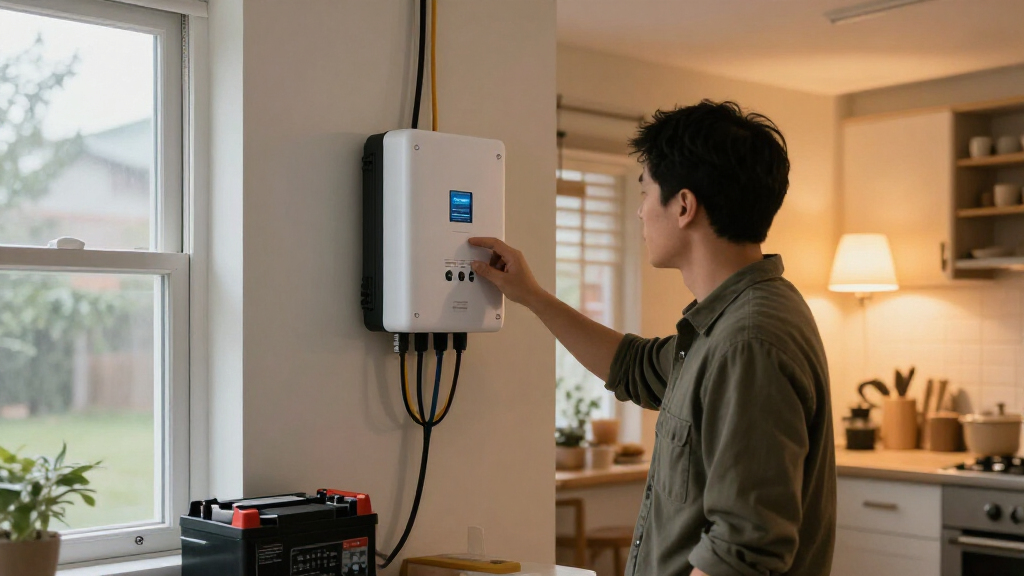
I ranked these home backup power inverters by how well each option fits a real household backup plan, not by headline wattage alone. I weighed inverter output, included battery capacity, system voltage, waveform, and whether the product is a standalone inverter, hybrid unit, kit, or packaged power station. I also considered how much extra equipment a buyer may need and whether the setup appears suited to a few selected circuits or broader household use.
The ranking favors products that combine useful output with a clear path to stored energy and practical household use. That puts integrated battery systems and the packaged power station ahead of inverter-only models for buyers seeking ready-to-plan backup, while compact 12V units still earn a place for simpler, targeted loads. I ranked the modified sine wave option lower because waveform compatibility can narrow appliance choices. Any installation involving household circuits, high current, or hardwiring calls for careful planning and qualified help.
Factors to Consider When Choosing Home Backup Power Inverters
Choosing an inverter starts with the backup job, not the biggest number on the label. I would first decide which appliances need power, how long they must run, and whether I want to assemble a battery system or use a packaged solution. These broader checks can prevent overspending on output while leaving too little stored energy for an outage.
Separate Running Watts From Startup Surges
List the appliances you want to run at the same time and note both their operating draw and any startup surge. Motors in refrigerators, pumps, and some tools can briefly demand much more power than their normal running figure. An inverter whose continuous rating barely matches the combined load may shut down when a motor starts, even if the average demand looks modest. Avoid adding every appliance’s maximum rating if you will not use them together; instead, build a realistic simultaneous-load plan. A larger inverter can provide headroom, but it does not add battery runtime. Check the inverter’s continuous and surge specifications against appliance documentation before choosing.
Size Battery Capacity Around Outage Duration
Inverter wattage tells you how much power can be delivered at once; battery capacity is what determines how long it can be delivered. Estimate energy use in watt-hours by multiplying each load’s watts by the hours you expect to run it, then allow for conversion losses and reserve capacity. A high-output inverter connected to a small battery can run out of stored energy quickly, while a larger battery paired with a modest inverter may not start demanding appliances. Buyers comparing a standalone 12V inverter with a battery-included kit should count the cost, space, and compatibility of the battery bank as part of the system. Plans for overnight refrigeration or several days of essential loads need a different capacity target from short outages.
Match System Voltage to Battery Size and Wiring
12V systems can be straightforward for modest loads, but high power at low voltage means very high DC current. That calls for suitable battery capacity, short and adequately sized cables, and secure connections; undersized wiring can overheat and reduce performance. A 48V system carries less current for the same power, which can make it a better fit for larger household-scale equipment, but it requires compatible batteries and components. Do not assume a 12V inverter can connect to a 48V battery bank, or that batteries from different systems can be mixed freely. Verify the inverter’s required input voltage and the battery manufacturer’s compatibility guidance before buying.
Choose Waveform and Output for Your Appliances
Pure sine wave inverters are generally the safer choice for varied household electronics, especially devices with motors, power supplies, or sensitive controls. Modified sine wave models can be less suitable for some appliances, with possible noise, heat, reduced performance, or incompatibility. That difference matters more than a high wattage figure if the intended load does not work well with the waveform. Check appliance manuals and inverter output details rather than assuming every 120V device will behave the same way. Buyers who only need to power a small set of known loads may accept more limitations, while mixed household use favors broader compatibility.
Decide Between a Standalone Inverter, Kit, and Power Station
A standalone inverter offers flexibility if you already own a compatible battery bank, but it leaves battery selection, wiring, and system integration to you. A kit can simplify matching the inverter and batteries, though buyers still need to confirm installation requirements and what components are included. A power station packages key parts into one format and can reduce assembly work, but buyers should check its expansion options and whether its output and capacity match their loads. Compare the complete setup rather than the inverter alone: batteries, cables, charging equipment, protection devices, and any transfer equipment may affect the real project. Paying for an integrated system makes more sense when convenience and coordinated components matter more than building around existing gear.
Plan Charging, Transfer, and Safe Installation
A backup system needs a way to restore its battery, whether from utility power, solar panels, a generator, or a combination supported by the equipment. Confirm the charging input limits and whether the inverter includes a solar charge controller before planning an array. Powering selected appliances with extension cords is different from supplying household circuits; connecting an inverter to home wiring requires suitable transfer equipment to prevent dangerous backfeed. High-current battery connections also need correctly rated protection and wiring, with clear ventilation and placement requirements followed. If the plan involves a panel connection or permanent installation, bring in a qualified electrician and check applicable local rules before purchase.
Frequently Asked Questions
Can a 2,000W or 3,000W 12V inverter run my whole house?
Usually, a 12V inverter in that output range is better suited to selected appliances than whole-house backup. The available power depends on the battery bank, cabling, and the loads running at the same time, and 12V systems draw substantial current at high output. Choose a short list of essentials and check their running and startup demands before deciding. A larger household load may call for a higher-voltage system, a transfer setup, and professional installation. Do not connect an inverter directly to home wiring without appropriate transfer equipment.
How do I compare an inverter’s wattage with a battery’s watt-hours?
Watts describe the rate at which an inverter can supply power, while watt-hours describe stored energy available over time. A 2,000W inverter does not automatically provide 2,000W for any particular duration; runtime depends on battery capacity, actual load, conversion losses, and reserve limits. Estimate each appliance’s energy use by multiplying its wattage by expected operating hours, then total the loads you need during an outage. Compare that estimate with usable battery energy, not just the inverter’s output rating. This prevents choosing a high-output system that lacks enough stored energy for the planned runtime.
Is a pure sine wave inverter worth choosing for ordinary household appliances?
Pure sine wave output is the more flexible choice when the appliance mix is unknown or includes electronics, motors, or devices with sensitive controls. Modified sine wave output may work with some simpler loads, but compatibility can vary and some equipment may run less smoothly or generate extra heat or noise. Check the appliance manual for power requirements before relying on a modified sine wave model. In this roundup, the EGSCATEE’s modified sine wave design makes it a more limited match than the pure sine wave alternatives. Buyers with mixed household loads will generally have fewer compatibility questions with pure sine wave output.
Should I choose a packaged power station or build a battery system around an inverter?
A packaged power station can reduce assembly work because storage and power electronics come together in one product, which suits buyers who value a simpler setup. A separate inverter and battery system gives more control over capacity and component choices, especially if you already own compatible batteries or plan to expand. Compare usable energy, continuous and surge output, charging options, and expansion limits rather than judging by format alone. Also check what is included and what additional wiring or equipment the installation needs. For household circuits or permanent wiring, either route may require professional planning.
What do I need to check before connecting an inverter to household wiring?
First confirm that the inverter is suitable for the intended connection and that the home has compatible transfer equipment; never connect an inverter to a wall outlet to feed household circuits. Backfeed can endanger utility workers and damage equipment. Have a qualified electrician review circuit loads, grounding, protection, cable sizing, and any local code requirements. Check the inverter and battery manuals for installation limits, ventilation, and connection procedures. If you only need to power a few portable appliances, using approved cords may avoid the complexity of a permanent circuit connection.
Conclusion
Best overall: I recommend the ECO-WORTHY 10 kW Home Backup Power Kit for buyers seeking a larger integrated 48V system with two batteries. Best value for a targeted setup: the ALLWEI 2000W pure sine wave inverter is a sensible direction for buyers who already have a compatible battery and need moderate output, while recognizing that the battery is a separate part of the plan. Best premium: the EF ECOFLOW DELTA Pro Ultra X suits buyers who prefer a packaged 12,288Wh power station over assembling separate components. Best for beginners: I would start with the power-station format if ease of setup is the priority, after checking its output and expansion fit. Best for larger hybrid-system needs: the ECO-WORTHY PowerMega 48V system pairs 10kW inverter output with substantial battery capacity. Choose a 12V inverter for selected loads and existing battery setups, and skip the modified sine wave EGSCATEE unless your specific appliances are confirmed compatible.